ELK Studios game rules · South Island guide
Nitropolis TV: Nitro Reels, feature order and settings
 Best casinos available in New ZealandUpdated 7 November 2026

Nitropolis TV uses ELK-described Nitro Reels alongside symbol changes, two-way evaluation and separate bonus states. A useful review follows each board modifier in order and checks how the active operator help defines the interaction, rather than importing values from unrelated Nitropolis editions or another market.
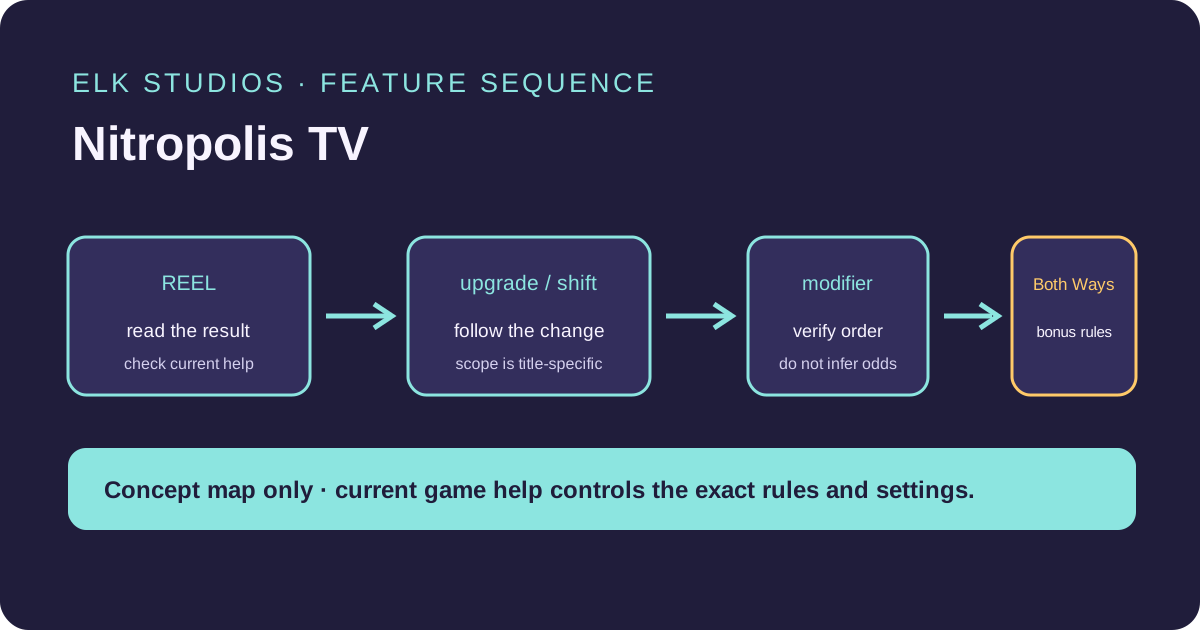
The short answer
Nitropolis TV is an ELK Studios slot whose public description revolves around Nitro Reels, symbol modifiers and two bonus routes. ELK names Match Up, Both Ways, Nitro Upgrade and Nitro Shift, and says that Nitro Reels persist through its free-spin bonus. The Super Bonus adds a different stated condition involving both-way evaluation and a Wild-filled Nitro Reel in each free spin. The central reading task is to distinguish those states and trace when each modifier changes a result.
This page uses the supplier’s public feature outline, not an operator help panel. No current game help or paytable was supplied, so no active RTP, alternative RTP settings, volatility label, hit frequency, stake range, payout cap, mode price or operator release status is asserted. Reviews for UK or other markets publish configurations that may not match a New Zealand-facing operator. ELK’s catalogue listing is not evidence that an NZ account can play the game.
Start with Nitropolis TV, not the franchise label
The official Nitropolis TV page describes a specific title in ELK’s Nitropolis world, and the ELK games catalogue lists it as its own product. That proves supplier documentation. It does not make its rules interchangeable with Nitropolis, Nitropolis 2, Nitropolis 5 or another sequel. A returning character, familiar icon or shared “Nitro” term cannot establish that an earlier game’s grid, payout system or feature trigger still applies.
Confirm the full title and provider from the in-game help. Keep the game’s product identity separate from the story setting. A TV-studio theme may provide context for characters and visuals, but only the help panel defines whether a symbol is a Wild, a modifier, a bonus trigger or decoration. If a review calls the title the “next Nitropolis” and then borrows an earlier installment’s rules, treat the resulting statements as unverified until the client confirms them.
For a useful evidence trail, record the operator, date, title spelling and any build label. Save the help’s exact term for each feature. Then compare that client information with ELK’s product summary. If the labels differ, explain the difference rather than silently replacing operator wording. The current client is required for settings and detailed rule order; the supplier page is a high-level product source.
What the Nitro Reels add to the screen
ELK presents Nitro Reels as a feature area that can be activated, upgraded and moved. The public page names Nitro Upgrade, which can activate or improve reels, and Nitro Shift, which changes their positions. This creates a board-management layer: a reviewer must say which reel changed, whether its contents changed as well, and how a later result uses the updated arrangement.
Do not equate “activated” with “filled with Wilds.” The supplier’s description separates ordinary Nitro Reel activity from the Super Bonus condition that starts free spins with a Nitro Reel filled with Wild symbols. That distinction should remain visible in any summary. An activated reel may have an effect defined by help, but it is not automatically identical to the bonus’s Wild-filled starting condition.
The current client should answer where Nitro Reels sit relative to the main play area, how their contents are determined and what the upgrade changes. Check whether activation can occur with no immediate win, whether a reel’s position persists after it swaps, and whether the help treats a reel as a collection of symbols or a separate modifier. The product description does not answer all of those questions.
During an authorised demo or operator inspection, record the screen before and after one visible Nitro event. Note the difference between a reel being present, active, upgraded and moved. Then check the help or history for the associated evaluation. This method is more reliable than narrating a fast animation from memory. A visual effect can reveal the state transition but cannot establish its probability.
Nitro Upgrade and Nitro Shift are different actions
ELK’s public outline uses two different verbs. An upgrade can activate Nitro Reels or change them so that they contain more symbols; a shift makes reels swap places. A concise review should not collapse both into “the reels get stronger”. One changes a reel’s active contents or status, while the other changes its place in the layout.
To verify Nitro Upgrade, find the exact event that causes activation and what “more symbols” means in the live build. Check whether the reel gains new positions, receives a new symbol arrangement or gains another property stated in help. To verify Nitro Shift, establish which reels can move, whether both positions change and whether the game re-evaluates the board immediately afterward. If help describes only the visual effect, avoid inventing a board algorithm.
The order between upgrade, shift and an ordinary symbol result may influence how a reader interprets a screen. Does a win resolve before the feature modifier appears? Does an upgraded reel participate in the same evaluation or a later one? Does a shift preserve a previous state? Those questions belong in the operator’s game help or round history. Without that evidence, report the supplier-level relation and label the detailed order unresolved.
This distinction is also useful when comparing game versions. A third-party review may use “Nitro Reels” as an umbrella phrase for several actions. When a page is intended to answer a rules query, an umbrella label is not enough. Name each effect, state what ELK’s public summary says, and say which part still requires the active rules screen.
Match Up and symbol upgrades
ELK describes Match Up as replacing a random number of low-value symbol types with one high-value symbol or Wild symbols. The important functional idea is symbol substitution: the board’s symbol mix can change, which may affect later evaluations. The public description does not provide the selection weights, exact eligibility list, placement algorithm or timing relative to the pay check.
Check the help for whether the replaced symbols are selected from those already present on the board or from a defined pool. Confirm whether the high-value symbol is chosen once for all replacements, whether Wilds can be selected instead and whether upgraded symbols occupy the same positions. The phrase “random number” does not mean that each count is equally likely. Do not infer a probability distribution from the range of outcomes you happen to see.
Then establish when the game checks for a win. If the replacement occurs before the new result is evaluated, the transformation can create a different set of matching symbols; if it occurs after settlement, its role may be different. A reviewer should not assume that each upgraded symbol creates value. It changes the board; the paytable determines whether the resulting symbols qualify.
Avoid presenting Match Up as a fixed upgrade or an improvement that always favours the player. The product summary names the possible replacement categories, not the financial effect of a particular event. It may alter low-value symbols to high-value symbols or Wilds, but the outcome still depends on the complete board and game rules. Use neutral wording that describes the rule rather than promising a better result.
Both Ways and direction of evaluation
ELK says Both Ways evaluates wins from left to right and from right to left. That is a directional rule. It does not by itself say how many symbol paths exist, which symbols qualify, how simultaneous results are combined or whether the feature is active in every mode. The current help should supply those details.
When inspecting the game, find the rules entry for direction and look at how it relates to the main board. Identify which columns or symbol sequences are included and whether a single result can be counted in both directions. Check whether the same symbol participates in separate evaluations or whether the game de-duplicates a combination. Do not infer this from a single screen where the same symbols appear to align both ways.
The feature’s relationship to the Super Bonus is explicit in ELK’s summary: both-way evaluation is activated there. That does not prove it is always active in the base game. Keep the mode boundary attached to the statement. If the current game help identifies multiple modes, record the exact mode name and whether Both Ways is conditional or permanent in that state.
Directional rules are easy to explain with a simple arrow diagram, but a diagram should be labelled as a conceptual explanation rather than a live board or payout example. Avoid adding made-up symbol sequences that imply a verified payout. A text explanation can state the evaluation direction while leaving exact line, way or paytable details for the active help.
Symbol replacement, wins and event order
Nitropolis TV’s modifiers can affect the same visible board in different ways: a symbol type can change, a reel can be repositioned, a Wild can fill a feature area and a result may be evaluated in two directions. A reader needs to know not merely that these features exist, but when each one acts relative to the pay check. The public feature list is not a complete event scheduler.
Use the operator help to map the sequence. Start with the ordinary symbol outcome. Identify any modifier that acts before evaluation. Find whether the game then settles a win, removes symbols, drops new content or performs another check. Next, record any Nitro Reel change and any second evaluation. The round history may show whether each part is a distinct calculation or one combined settlement.
When a rule is undocumented, avoid writing a deterministic walkthrough. You can say that the supplier names a particular modifier and that its detailed timing is not established by the public summary. That still answers part of the reader’s question and shows exactly what information is missing. It is better than presenting an animation as proof of an official sequence.
Do not call a transformation “a payout” unless the help says the transformation settles money directly. Most feature names describe a rule or state change. A payout is an evaluated result that the client credits according to the game’s terms. This vocabulary helps separate a busy screen from a recorded win.
Bonus route and persistence
ELK’s public page describes a free-spin bonus in which Nitro Reels remain persistent, with additional bonus symbols associated with an additional spin. It separately describes a Super Bonus triggered by a combination involving a Super Bonus symbol; Both Ways is active there and every free spin starts with a Nitro Reel filled with Wilds. These are distinct routes and should not be compressed into one generic “free spins” paragraph.
The current help should confirm the exact trigger, starting state, number and extension rules for each route. This assignment requires numerical game claims to come from current help; no operator panel was supplied, so no trigger counts or spin totals are repeated here. Check whether the supplier uses the same feature name and whether a particular operator offers the described configuration.
Persistence should be described narrowly. ELK says Nitro Reels persist during the free-spin bonus. That statement does not establish whether all reel contents persist, whether a shift or upgrade remains, whether the state carries from one feature to another, or what happens when the round ends. Record each persistent property separately as the live help defines it.
For the Super Bonus, note the role of the Wild-filled reel and Both Ways but do not assume that a special starting state guarantees a winning combination. The feature’s terms may create an altered board without determining the outcome. A “Super” label is a product name, not a measure of expected return or a promise of a larger payout.
RTP and configuration values
There is no current operator game-help screen in the supplied research, so the active RTP, available RTP variants, volatility, hit frequency, stake limits, maximum payout and mode pricing remain unverified. Third-party results contain varying figures and descriptions. Because they target other jurisdictions or do not identify the exact current operator build, this page does not treat them as NZ configuration evidence.
RTP describes a theoretical long-run return for a specified version. It does not predict a session or set a minimum amount that will be returned. If an operator lists an RTP selection, the article should identify the exact active figure and any alternatives only where the help distinguishes them. A number on a review page is not enough to identify which version the operator serves.
Volatility is not a promise of a particular rhythm. The label should come from current help if the game publishes one. A feature-heavy display, persistent Nitro Reels or a dramatic Super Bonus animation cannot prove volatility. A writer’s short play observation is also not a statistical measurement and must not be framed as one.
For limits, preserve the currency and unit shown in help. A wager limit, a maximum payout and a paid feature-mode cost answer different questions. Do not convert one into another, combine a ceiling with a headline return, or recommend an optional mode from those values. If help does not show a figure, keep it explicitly unknown.
Demo and operator availability
The supplier page may expose a Play control, but its presence alone does not prove that a public demo can be used from a particular country. A New Zealand visitor’s account access depends on the operator and its eligibility requirements. This article does not name an operator that has been checked and does not claim that Nitropolis TV is available in New Zealand.
If a demo is offered, use it only to understand the interface and broad feature flow. Confirm whether its help panel is available and whether the displayed title and rules match the current product. A demo can answer where the Nitro Reels sit and how the client labels a feature; it cannot establish that a cash build uses the same RTP or that an account qualifies.
No demo or game was opened while preparing this guide. That boundary means the page contains no firsthand claim about play, loading, payout speed, mobile controls or the timing of a feature. A later editor with legitimate access should log the operator, date, version, locale and evidence before adding an observation.
Do not use a short demo run to estimate feature frequency, volatility or RTP. The experience teaches what buttons do and what labels mean. It does not provide a reliable sample for long-run mathematical behaviour. Distinguish interface learning from statistical proof in any future update.
Mobile reading and control checks
No specific app or handset was tested for Nitropolis TV. The game’s multi-area layout can make controls, main symbols and Nitro Reels compete for screen space, so an actual mobile review should check each region instead of judging only whether the game launches. Test help readability before discussing an operator’s mobile experience.
Look for a clear way to open the paytable, a legible stake selector, a visible balance, an accessible history panel and an exit control. When a modifier changes the board, make sure the help or animation labels remain understandable at the available screen size. If a tooltip disappears behind another panel or the relevant reel is partly offscreen, do not infer its state.
Check whether the page scrolls vertically while the game remains embedded and whether orientation changes obscure a control. Never suggest that zooming a browser is a fix if it makes the spin or exit button hard to reach. If the rules cannot be read comfortably, pause and use a supported device or another legitimate help source before playing.
Mobile support is not the same as mobile accessibility. A game can load on a small screen while leaving labels too small, relying on colour alone or making a feature counter hard to distinguish. A reviewer should report a tested device and version before making claims. This guide makes no such test claim.
A current-build verification checklist
Start with title identity, provider, operator, date and any version label. Read the ordinary win system and paytable first. Record whether the help calls the base system lines, ways, clusters or another method. Then document the Nitro Reel area, the definitions of Upgrade and Shift, and the specific effect of Match Up and Both Ways.
For each modifier, record its trigger, affected area, change to symbols or positions, timing relative to evaluation and reset conditions. For the bonus states, capture the entry conditions, starting board, persistent properties, extension rules and settlement. Keep the standard bonus and Super Bonus in separate rows so their differences are not lost.
Only after mechanics are clear, record RTP, any alternatives, volatility, hit frequency, stake range, payout ceiling and optional mode prices as the live help displays them. Save the unit, currency, mode and date. If the current operator’s panel uses a different label from the public supplier page, quote the client wording and explain the mapping without silently changing the product claim.
Finally, use the round history to compare the help’s stated order with what the interface records. If there is a discrepancy, stop and capture the issue as a question for the operator or supplier. Do not invent the missing transition. This produces a page that can be updated later without creating a separate URL for RTP, demo or bonus rules.
Mistakes to avoid when comparing the series
The franchise name can encourage a reviewer to transfer rules from another Nitropolis title. Avoid that. A sequel can preserve characters while replacing the board system, symbols, payout evaluation or feature trigger. This page covers Nitropolis TV alone. It does not attempt to review the wider series or repeat a separate guide for an earlier game.
Another error is conflating Nitro Reels with every kind of Wild. A feature reel may contain ordinary symbols, change state or be filled with Wilds in a defined bonus condition. These are different states. Use the current help’s terms so the article does not imply that every active Nitro Reel is a Wild reel.
Some reviews label a game by paylines or “ways” while the official source uses different language. Treat that as a configuration question. Do not adopt a competitor’s win-system label unless the current paytable confirms it. The same caution applies to release dates, return values, volatility labels and maximum win claims.
Finally, “both ways” should not be presented as double payout. It describes the direction of evaluation in ELK’s public outline. Whether a particular board pays in one or both directions, how combinations interact and how a result is valued are separate help-panel questions.
Responsible boundaries around a feature sequence
If you choose to play through a lawful operator, set a loss limit and time limit before opening the game. Treat optional feature costs as part of the same budget. Do not raise your stake because Nitro Reels moved, a symbol changed, or a bonus seems close. A changing board is not evidence that a favourable outcome is due.
The animation sequence can encourage continued attention, so schedule breaks away from the screen. Avoid using rapid controls or autoplay to play beyond the time you planned. If you feel compelled to chase a result or spend more than you intended, close the session and seek independent support. Do not rely on a feature meter or a recent result to make a financial decision.
The New Zealand safer gambling guide lists support and break options. This title guide explains supplier-described rules and the limits of available evidence; it does not recommend gambling, guarantee an outcome or establish local access. It can be useful to decide that an unclear configuration is not one you want to use.
Frequently asked questions
What are Nitro Reels?
They are a feature area named in ELK’s public description. The supplier says they can activate, change contents or shift position. The current operator help should define how each state affects an evaluation.
What is Match Up?
ELK describes it as replacing a random number of low-value symbol types with a high-value symbol or Wilds. Exact selection weights and timing are not provided by the short product summary.
How does Both Ways work?
The supplier says it evaluates wins in both left-to-right and right-to-left directions. The active rules should confirm its mode boundary and how overlapping results are settled.
What distinguishes the Super Bonus?
ELK says Both Ways is active and free spins start with a Nitro Reel filled with Wild symbols. Exact triggers and counts must be checked in current game help.
Is Nitropolis TV available in New Zealand?
This guide has not verified an operator listing or account eligibility. ELK’s catalogue is supplier documentation, not proof of local access.
What is its RTP or volatility?
No current operator panel was supplied, so this page reports neither figure. Third-party numbers for other markets are not substituted.
Can I play a demo?
Availability depends on a specific operator and account. No demo was tested here; a supplier Play control does not prove NZ access.
Sources and verification boundary
Supplier primary sources rechecked 6 October 2026: ELK Studios’ Nitropolis TV page for Nitro Reels, modifiers and bonus distinctions, and ELK’s official games catalogue. The competitor pages listed here were opened in the earlier review pass; search listings were spot-checked again 6 October 2026: FruitySlots, OLBG, Hideous Slots, Slot Gods, Bigwinboard, and Clash of Slots. Their displayed figures and descriptions differ; they are not treated as current operator settings.
The New Zealand advertising context in the article was checked against the DIA advertiser guidance on 6 October 2026. This is not a legal determination about any particular site or route.
No operator game-help screen, demo, account or distribution list was supplied. Active release status, exact rules, RTP variants, volatility, hit frequency, wager limits, cap, mode prices, mobile behaviour, NZ availability and search demand remain unverified. No game or CPA destination was opened. The requested affiliate buttons are omitted while the existing New Zealand advertising notice remains in place.
