ELK Studios game rules · South Island guide
Tinkerbot: Botboxes, grid changes and settings to verify
 Best casinos available in New ZealandUpdated 7 November 2026
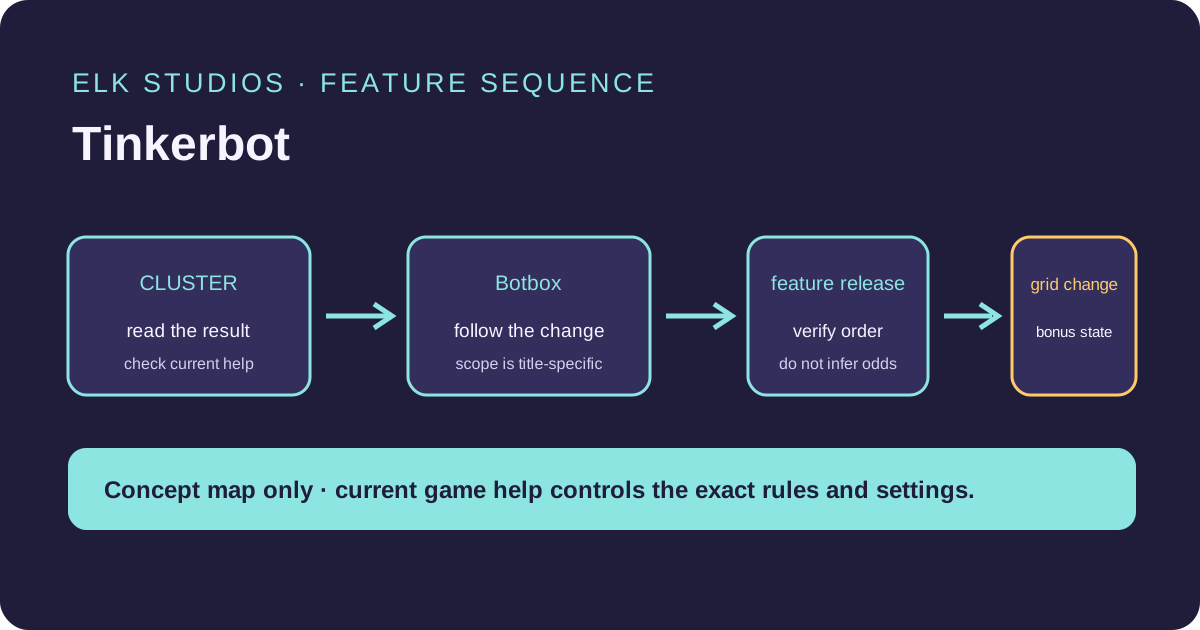
Tinkerbot is an ELK Studios cluster slot organised around Botboxes that can release board-changing effects. ELK names absorb, transform, Wild and grid-expansion features, and describes persistent state in its bonus modes. To understand a version accurately, follow each box from creation to effect and verify the active rules and settings in the operator’s help.
The short answer
Tinkerbot is a cluster slot in which a winning cluster can create Botboxes, and accumulated boxes can release features that change symbols, add Wild effects or expand the grid. ELK’s public product page names absorb, transform, Wilds, hot Wilds, multiplier Wilds and grid expansion. It also distinguishes an ordinary bonus from a Super Bonus and describes certain state as persistent within those bonus sequences. The essential review task is to follow the box count, the effect it releases, the resulting board and the next evaluation as separate stages.
No live operator help or paytable was provided. This article therefore does not publish an active RTP or variants, volatility, hit frequency, wager limits, maximum payout, feature-entry cost or exact bonus counts. The supplier’s feature outline does not prove which configuration an operator serves, whether an account in New Zealand can access it, or whether a public demo is available. No numerical game setting is copied from review sites for other markets.
Confirm Tinkerbot’s identity and build
The official Tinkerbot page identifies the supplier’s product and describes its main feature families. The ELK games catalogue places it among the supplier’s documented titles. That establishes product documentation, not a specific operator’s current release, account eligibility or New Zealand distribution.
If a legitimate client is available, confirm the exact title and provider inside its information panel. Note the operator, locale, currency, check date and any version or rules label. A product tile, search result or review page can help locate the game, but it cannot confirm the live client’s settings. A third-party table may reflect a different national version, an older release or a particular demo build.
Read the game help before drawing conclusions from an animation. The help is where the active configuration should define a winning cluster, the interaction between boxes and features, what persists and how a result settles. If the current help is inaccessible, do not substitute the most repeated figure in search results. State that the setting remains unverified.
How cluster wins start the Botbox chain
ELK says each winning cluster generates a Botbox. This ties the feature system to the result evaluation: the game first recognises a qualifying cluster, then a box becomes part of the state. The public page does not provide the complete cluster rule or every possible interaction, so the current paytable must define matching, adjacency, Wild treatment and whether a single symbol can contribute to more than one qualifying group.
Start the review by reading the base-game win rule separately from the Botbox rule. A cluster result can have a payout under the paytable while a Botbox tracks a feature state. Do not call the box a cash prize. It may enable a later action, and the active help should say when that action occurs and what happens to the box after release.
Check whether a Botbox appears for every qualifying cluster, how several clusters are counted in one sequence, and whether boxes persist across symbol drops or a complete round. ELK describes a feature release after boxes accumulate, but the operator rules are needed for exact counting and timing. Avoid stating a specific threshold from a third-party page; the assignment restricts numerical mechanics to current game help.
A clear event log can show what happened without claiming a probability. Record the board, qualifying cluster, newly created box, current box state, any release, the effect applied and the final result. If the round history omits a stage, mark it unknown. A glowing box or a change in its colour is not enough to establish whether it is available, spent or locked.
Botboxes: one container, different outcomes
The supplier describes Botboxes as releasing features such as absorb, transform, Wilds, hot Wilds, multiplier Wilds and grid expansion. This means a box is a route into an effect family rather than a single fixed payout. The orange instant Botbox is separately described as always releasing a feature. That statement should be kept at supplier-summary level until the operator’s help confirms its exact trigger and behaviour.
In a live rules panel, identify which box types are named and whether their colour or icon carries a mechanical meaning. Check what qualifies a box for release, whether a box can hold more than one effect, and whether the release is random or selected under a stated condition. Do not infer that every box gives the same feature or that an “instant” label means an immediate cash result.
For each effect, record its input and output. Does the feature act on one symbol type, a set of matching positions or the entire grid? Does it change a symbol, remove it, add a Wild, alter a multiplier or modify the board dimensions? Is the effect evaluated before another cluster check? Keeping those fields separate makes a complex game easier to explain and prevents a feature list from reading like a promise.
The game’s visual style may make a box appear as a physical object that is opened, but theme language should not replace rule language. A “scrapyard” container may release a modifier; the actual help determines the result. An editorial illustration can map that path, but should not mimic the game screen or invent a specific box outcome.
Absorb: combine eligible symbols carefully
ELK describes Absorb as selecting one paying symbol and collecting all identical symbols, creating a Multisymbol. The useful idea is a collection and conversion step: a selected symbol type is gathered and represented in another state. The public overview does not give the complete selection pool, whether every matching symbol is eligible, how the resulting Multisymbol is valued, or when the feature settles.
The help panel should define “paying symbol”, the eligible area and the outcome of collection. Check whether special symbols are excluded, whether symbols blocked by another effect are included and whether a Wild can be absorbed. Determine whether the Multisymbol occupies one position or represents a collected amount across more than one position. These are not safe guesses from the animation.
Then check timing. Does absorption happen before the normal cluster evaluation, as a response to a box release, or after a win has already been paid? If it creates a new state, does the board receive another check? A visual sequence can show a symbol disappearing and another appearing, but the order determines how that event belongs in the rules narrative.
Do not describe Absorb as a guaranteed upgrade in value. ELK says it gathers identical symbols and creates a Multisymbol; it does not promise that the resulting state always exceeds what the original symbols would otherwise return. The paytable and current operator rules decide the valuation. Explain the transformation neutrally and leave any undisclosed calculation open.
Transform: identify what changes and what does not
ELK describes Transform as selecting one paying symbol and changing all identical symbols into another type. This is a board-wide symbol conversion, but the supplier summary does not specify the eligible symbol pool, the selected destination, the treatment of Wilds or whether the conversion is applied to every visible matching symbol.
Use help to distinguish “selection” from “conversion”. The game may select an existing paying symbol as the source and another as the destination. Check whether the destination is fixed, randomly selected or tied to a mode. Establish whether the transformed symbols remain in the same positions and whether the board is evaluated again after the change.
If the effect happens within a sequence that already contains a cluster, confirm whether the original result is settled before transformation. If the conversion creates new matching groups, the help should explain whether they qualify and how the result is recorded. Do not say that the feature “turns low symbols into valuable symbols” unless the active rules say which types it can create.
The safest explanation is to describe only the supplier-supported relationship and name the unanswered parts. Readers still benefit from knowing that a symbol conversion can alter the distribution across the grid. They also need to know that the change is not itself proof of a win or an improved return.
Wild, hot Wild and multiplier Wild
ELK’s public list includes Wilds, hot Wilds and multiplier Wilds as possible Boxbot effects. Those names indicate distinct feature types, but the overview does not specify substitution rules, activation conditions, multiplier scope or whether “hot” means a particular animation, state or payout property. Use the operator paytable to establish each role before grouping them under a general Wild label.
For an ordinary Wild, check which symbols it can substitute for and whether it can form a win by itself. For a hot Wild, find the precise difference from the standard Wild. For a multiplier Wild, confirm the value basis, whether it affects a single combination or a sequence and when it resets. A displayed multiplier may be a rule modifier rather than a cash balance.
Watch for interactions with Absorb and Transform. Can a Wild be collected or transformed? Does a multiplier Wild remain attached to a position after a grid expansion? Can several modifiers apply to the same result? The official overview lists the feature family but does not provide a complete interaction matrix. Keep a question mark rather than inventing priority rules.
If the client displays multiple Wild effects in one round, use the history to determine what was evaluated and when. Do not add multipliers manually unless the game’s help explicitly describes the calculation order. An animation can be sequential while the final amount is settled by a different internal formula.
Grid expansion and changing space
ELK names grid expansion as a feature that can be released from Botboxes. A changing board affects more than its appearance: the reader needs to know whether new positions enter play, what symbols can occupy them, whether prior symbols remain and how the base win rule applies to the expanded area. The public product summary does not establish those details.
Read the help for the starting layout and the exact condition that changes it. Check whether expansion is temporary or persistent, whether it can occur more than once in a sequence and what causes the grid to return to its earlier size. If the game says a larger area persists in a bonus, record that as a bonus-specific rule rather than a universal feature.
An expanded grid can create more possible symbol arrangements, but that does not by itself prove more frequent wins, a better return or a predictable result. The math model determines how symbol distribution and payout values behave across positions. Avoid statements such as “more grid means more chances” unless supported by the exact rules and a tested probability analysis.
When describing a board change, distinguish the area displayed from the positions that count for an evaluation. A visual border can expand even if some cells are inactive, or a feature can add positions only for a specific event. The paytable should identify active positions and whether all visible symbols participate in the same result.
Bonus and Super Bonus state
ELK’s public page distinguishes a bonus from a Super Bonus. It describes unused Botboxes, current multipliers and grid size as persistent between free drops in the bonus, and says the Super Bonus uses a maximum grid and boosted multiplier state. The assigned rule requires exact game numbers to come from current help, so this article does not repeat trigger counts or free-drop totals from ELK’s summary or third-party pages.
The main verification task is to identify what exactly persists. “Unused Botboxes” suggests that an unreleased box may remain available during a feature sequence, while a multiplier and grid size are also described as persistent. The current help should state when this state starts, which events consume a box and what is retained at the end of a drop. Do not imply persistence between separate paid rounds unless the operator rules say so.
Keep the Super Bonus separate from the ordinary bonus. The product overview says the Super state begins with a more developed grid and a boosted multiplier value, but its exact entry, starting configuration and reset rules require current help. A “Super” label does not establish a typical payout or a better expected return.
In a review, define the bonus as a rule state, not a guaranteed financial outcome. Additional drops provide more feature evaluations under the bonus conditions; they do not ensure a positive result. If the rules allow an extension, verify how it is awarded and whether a cap applies. No exact count, extension limit or trigger probability is provided here.
X-iter and paid entry modes
ELK lists X-iter as a set of modes that can begin the game in a selected state. That is a separate feature choice from naturally reaching a bonus. An optional paid entry changes the amount at risk and may alter the starting board, but it is not a guarantee of a win. The supplier page does not prove which modes are enabled by a particular operator or what they cost for an account.
If a live client offers X-iter, inspect every mode’s name, price and starting conditions. Determine whether the charge is expressed against the selected stake and whether the displayed mode includes a bonus or only increases a feature opportunity. Read any jurisdiction-specific restrictions. Do not use “bonus buy” as a catch-all if the operator’s help distinguishes several types of entry.
This guide does not recommend selecting a paid mode or compare its price with an expected return. Without verified current help and configuration, a price comparison would be speculative. If the terms are not transparent, do not proceed. A player should understand the total amount at risk before confirming any optional feature.
For editorial accuracy, record the client version and date alongside the menu text. A review from another country may describe a mode that is absent or priced differently elsewhere. This is another case where a supplier feature list is a research lead, not a current operator contract.
RTP, volatility, stake and payout limits
No current game-help panel was supplied for Tinkerbot. The active RTP and any alternatives, volatility label, hit frequency, wager range, maximum payout, feature-mode price and exact release status remain unknown. Online reviews publish a variety of values, but they are tied to particular markets, dates or test interfaces; they are not used as a current New Zealand configuration here.
RTP is a theoretical return for a specified configuration measured over a very large number of plays. It is not a prediction for one session. If an operator help panel offers different RTP settings, document which one the account actually uses and keep the alternatives distinct. An unlabelled percentage from a third-party page cannot answer that question.
Volatility is a broad description of how outcomes are distributed, not a timetable for features or losses. A title with a busy Botbox system may look active, but that does not verify its volatility. Use an operator or supplier help label if available; do not claim that a short demo “felt high” or “felt medium” unless it was actually tested and clearly described as subjective.
Keep a maximum payout ceiling separate from a typical result and from RTP. A stake limit is an allowed boundary, not a recommendation. A mode-entry cost is a separate wager. When current help becomes available, note the mode, currency, unit, exact displayed term and date. If it does not list a value, retain the uncertainty rather than filling it from a competitor.
Demo and New Zealand availability
The supplier page’s Play control does not establish that a free demo is open to the public or that it can be used from New Zealand. Nor does an ELK catalogue entry establish that an operator lists the title for a particular account. This review has not checked an operator lobby, sign-up terms, geographic eligibility or a game client.
If a demo is genuinely available, check who hosts it and whether its help, language, currency and build match the product you are trying to understand. It can teach the relationship between Botboxes, feature releases and grid changes. It cannot establish that a real-money build uses the same RTP, that a mode is permitted, or that the account is eligible.
No game or demo was launched for this page. It therefore makes no firsthand claim about how often a box appears, how a feature feels, whether controls work on mobile or how quickly a result settles. If a later revision adds observed details, record the platform, date and precise client state without publishing personal information.
Mobile interface checks
No specific mobile device or operator application was tested. Tinkerbot’s changing grid and multiple feature states make it useful to check whether the interface remains legible as the play area changes. A client that loads is not automatically easy to use: the help can be difficult to read, the board can become visually crowded and feature counters may be hard to distinguish.
Before playing, locate the help, paytable, history, balance, wager selector and exit control. Check that help text scrolls fully and that its close button is reachable. Compare a normal grid with an expanded state to see whether all active positions remain visible. Do not state that all cells are active simply because they are shown on screen.
Check whether screen rotation or browser resizing changes the board, moves controls or clips an expanded edge. If you need to zoom in to read the rules, make sure you can still reach the exit and settings without placing a wager by accident. If the feature descriptions are unreadable, pause rather than relying on assumptions.
Mobile usability, accessibility and mobile availability are separate claims. An accessible game would need evidence about the relevant controls, contrast, labels and assistive-technology behaviour; none was tested here. A future editor should name the device, operating system, browser or app and operator build before reporting specific results.
A checklist for reviewing an operator version
Begin with the exact title, provider, operator, locale, date and version label. Read the base cluster definition and paytable. Check how a winning cluster creates a Botbox and how accumulated boxes become available. Then identify the instant-box condition and whether box type affects the feature released. Record only the terms the active help actually uses.
For each feature, note its trigger, affected symbols, board area, order of operations and effect on the next evaluation. Separate Absorb from Transform. Separate the standard Wild from a hot Wild and multiplier Wild. For grid expansion, record which positions become active, how the layout changes and when it resets. If the operator help omits an interaction, leave it open.
For each bonus, capture the entry condition, state carried in, state that persists, box consumption, additional-drop rule and end condition. Keep the ordinary bonus and Super Bonus in their own notes. Record optional X-iter modes only if the live client shows them, including the exact cost and starting state. Do not compare a paid entry with a free trigger as if the terms were identical.
Then document the numeric settings the assignment asks for, using current help only: RTP and variants, volatility, hit frequency if defined, wager bounds, payout ceiling and mode price. Preserve the unit, currency and mode. Compare a round history with the rules text before writing a specific example. If the panel cannot be accessed, say that the settings remain unverified.
Finally, verify operator availability and demo status separately. A game guide can explain the supplier’s public rules while still declining to say that a person in New Zealand can access it. That is a more accurate answer than treating supplier distribution as local availability.
Common mistakes in a Botbox game
The first mistake is treating a Botbox as immediate money. ELK describes boxes as releasing feature effects. A box can represent a feature state, while a payout is a separate game evaluation. The distinction should appear in any clear explanation.
The second is assuming that every box releases the same result. The public description names several effect types and separately calls out an orange instant box. The active rules determine which types exist in a given build and when each one acts. A colour or icon should not be assigned a meaning that the help does not confirm.
The third is assuming that Absorb and Transform both improve symbols. They change the board in different ways, and their value depends on the paytable. A newly created Multisymbol or a transformed group is not automatically a larger payout. Likewise, a Wild or multiplier should not be described as cash before settlement.
Another error is carrying a persistent bonus state into ordinary rounds. A property retained between drops during a feature does not necessarily survive after the feature ends or between paid plays. Record the exact persistence boundary. Do not assume the expanded grid remains forever.
Lastly, do not treat a feature-buy screen or a third-party review as proof of local eligibility. The operator, mode, date and account matter. If a menu is absent or hidden, no claim should be made about its price or availability.
Set a budget before a complex feature sequence
Feature variety can hold attention, but an elaborate chain does not make play safer or more profitable. Decide a total spend and time limit before starting. Include a paid X-iter option in the same limit as ordinary play and do not increase the budget after a box appears or a bonus seems close.
Take breaks away from the client and avoid chasing a feature or a loss. A progress display or an unused box is not a forecast of the next result. Do not use money needed for household costs and do not borrow to continue. If you feel unable to stop, leave the game and seek support.
The New Zealand safer gambling guide links to independent support and practical ways to take a break. This article is an information reference, not a recommendation to play. Knowing what a feature may do can help you decide whether its complexity suits you; it does not remove gambling risk.
Frequently asked questions
What is a Botbox?
ELK describes a Botbox as a feature container generated by a winning cluster. Accumulated boxes can release effects such as Absorb, Transform, Wild variants or grid expansion. Exact triggers and timing need current game help.
What does Absorb do?
ELK says it selects a paying symbol, collects matching symbols and creates a Multisymbol. The live rules should explain eligibility, placement, timing and valuation.
How is Transform different?
The supplier describes Transform as changing matching instances of a selected paying symbol into another type. The destination, eligible symbols and subsequent evaluation must be verified in the operator help.
Does the grid stay expanded?
The product page names grid expansion and describes grid state as persistent during its bonus drops. It does not prove that an expanded layout remains after the feature ends; check current help.
What RTP and volatility does Tinkerbot use?
No current operator help was supplied, so this article does not state either value or any RTP alternative.
Can a New Zealand account play Tinkerbot?
This page did not verify a local operator listing or account eligibility. The supplier catalogue is not proof of access.
Is there a free demo?
That depends on the operator or host and the account’s access. No demo was launched for this review.
Sources and verification boundary
Supplier primary sources rechecked 6 October 2026: ELK Studios’ Tinkerbot page for its public Botbox, Absorb, Transform, Wild, grid and bonus outline, and ELK’s games catalogue. The competitor pages listed here were opened in the earlier review pass; search listings were spot-checked again 6 October 2026: Online-Slot, OLBG, About Slots, FruitySlots, and Gambling.com UK. Their review-specific figures and subjective impressions are not used as current NZ settings.
The New Zealand advertising context in the article was checked against the DIA advertiser guidance on 6 October 2026. This is not a legal determination about any particular site or route.
No operator help, current build, demo, local distribution evidence or mobile test was supplied. Release status, RTP variants, volatility, hit frequency, limits, maximum payout, feature-mode price and New Zealand eligibility remain unverified. No game or CPA route was opened. The requested affiliate buttons are omitted while the existing New Zealand advertising notice remains in the shared site template.