ELK Studios game rules · South Island guide
Tropicool 4: Cool Reel, character effects and settings
 Best casinos available in New ZealandUpdated 7 November 2026

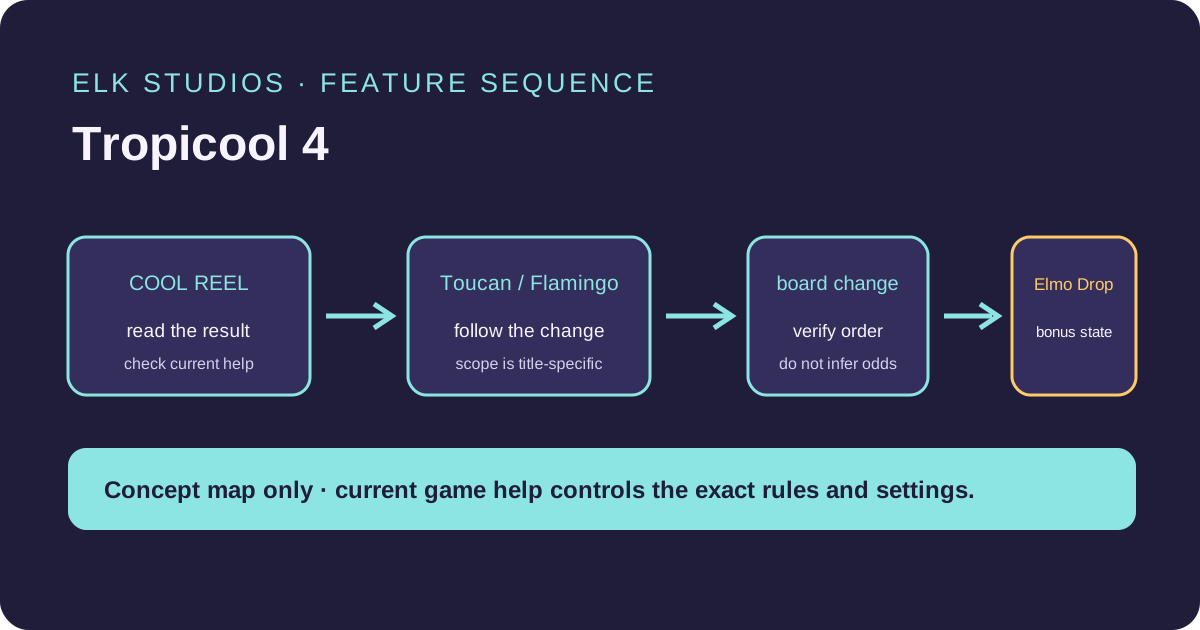
Tropicool 4 centres its supplier-described feature flow on a Cool Reel and three named character effects: Toucan, Flamingo and Elmo. The page also names row and grid modifiers and a bonus state with a persistent global multiplier. These details belong to Tropicool 4 specifically and must not be borrowed from Tropicool 5.
The short answer
Tropicool 4 is an ELK Studios slot organised around a Cool Reel and character-linked effects. ELK says winning combinations can explode and leave room for features to drop from the Cool Reel; Toucan is tied to a walking multiplier and redrops, Flamingo to an expanding Wild and redrops, and Elmo to removing payout symbols from multiple rows. The product page also names row swaps, grid flips, a global multiplier and separate bonus states. A careful review follows the order of those changes instead of treating every character as the same kind of Wild.
No operator game-help panel was supplied. Accordingly, this guide does not state an active RTP, alternative return settings, volatility, hit frequency, wager bounds, win cap, mode cost or exact release status. It also does not establish a New Zealand operator listing or demo. Those facts must come from the current client, not from another edition or a third-party review page.
Keep Tropicool 4 separate from other editions
ELK documents Tropicool 4 on its official product page and lists it in the games catalogue. The title shares a series name with other releases, including Tropicool 5, but a franchise connection does not make their mechanics interchangeable. This article is only about Tropicool 4; the Cool Reel, character roles and persistence described here must not be copied into another game guide without checking that title’s own source.
Confirm the full name in the client help and identify the provider. A lobby image may use familiar characters or colours, but help is the place to check the exact title and rule set. Keep the supplier source, active operator build, operator availability and independent review as separate evidence layers. A page from another market can make a useful research lead but cannot prove the rules served to a New Zealand account.
Record the operator, date, version label and locale when available. Check whether the current help uses the same names as ELK’s overview. If the client calls a feature differently or describes a different mode, document that difference before writing. Do not infer a release date from a review’s publication date, a Play control or a supplier catalogue entry.
The Cool Reel and the order of a result
ELK describes the Cool Reel as a feature area from which effects can fall after winning combinations explode. This gives the game an order-sensitive structure: an initial result may create space, and an effect can arrive into that space, changing the next state. The public summary does not define all timing details, so readers need the active paytable to determine whether the new effect is evaluated immediately or later.
When examining the current game help, first identify the main play area and the Cool Reel. Find out whether the feature reel has fixed positions, whether every symbol on it is eligible to fall and how an effect is selected. Then check how a winning combination is removed and when a new position becomes available. The animation can show a sequence, but the rules determine whether each step counts as a new evaluation.
Do not call every effect falling from the Cool Reel a payout. A modifier may change a symbol, place a Wild, increase a counter or remove part of the board. The game still needs to evaluate the resulting state according to its paytable. A visible feature icon can represent a state change rather than credited money.
For a clear walkthrough, describe a round in phases: starting board, qualifying win, symbol removal, feature arrival, character action and final evaluation. If the operator help does not explain a phase, label it unverified. Avoid giving a made-up round example with exact values; the assignment requires numeric game facts to come from current help, which is unavailable here.
Toucan Multiplier and the global counter
ELK describes Toucan as a walking multiplier that increases a global multiplier as it moves and awards redrops. That description links movement, a shared counter and another evaluation opportunity. It does not specify the exact movement path, whether every step has the same effect, what conditions produce a redrop or how the global counter is applied to a settled result.
The word “global” needs particular care. The active help should state which eligible wins are affected, when the multiplier resets and whether its state remains during a bonus. A counter shown at the top of the screen could apply to a specific sequence, a feature or another scope; do not assume it modifies every payout in every mode. A public feature summary names the relationship but not the full calculation.
When reading a round history, track the Toucan’s position and the multiplier before and after its action. Confirm whether the redrop occurs before settlement or after a win has already been credited. If the history lists a multiplier and a total, use the game’s own calculation rather than reverse-engineering the arithmetic from a single animation. A rounded display may not reveal the exact order or precision.
Toucan’s presence should not be framed as a guarantee of an increasing return. It is a modifier that changes a state under the rules. A movement sequence may occur without a qualifying payout, and a higher counter does not mean an equivalent cash balance. Explain what the symbol does while keeping risk and uncertainty visible.
Flamingo Wild: growth and redrops
The supplier describes Flamingo as a walking Wild that grows in height and awards redrops for each step. This is distinct from Toucan: Toucan’s public role is a moving multiplier, while Flamingo substitutes as a Wild and changes its height. A guide that refers to both simply as “walking characters” misses the feature roles a reader needs to understand.
The game help should say how Flamingo enters the board, which symbols it substitutes for, whether it grows before or after a win check and what happens when it reaches an edge or another feature state. The product description does not provide the full substitution list, movement algorithm or limits. Do not assume that it can substitute for bonus symbols or that every growth step creates a winning combination.
Redrops give the board another evaluation opportunity, but they do not promise a new win. Check what stays in place during the redrop and whether any symbol changes carry over. A feature may be visually persistent while its payout eligibility follows a separate rule. The active help should distinguish a locked symbol, a walking symbol and a Wild that merely occupies a new position.
When recording an example, note the original location, movement, changed height and resulting board. Then consult the round history for the actual settlement. Do not infer an average feature length or hit rate from a short observation, and do not describe the Flamingo as “expanding the win” unless the help defines that effect.
Elmo Drop and removing payout symbols
ELK says the Elmo Drop feature removes payout symbols from multiple rows. This is a board-clearing effect, not the same as the Flamingo’s substitution role or the Toucan’s multiplier. The supplier overview does not say which rows are selected, whether all payout symbols in those rows disappear, or how Wilds and feature symbols are treated.
Look for the exact “payout symbol” definition in the current help. Check whether the feature removes only ordinary symbols or whether it affects special symbols as well. Determine if a prior win is settled before removal, whether the removal can create more room for a new result and whether a subsequent drop happens automatically. These are separate conditions and should not be condensed into “Elmo clears the reels for bigger wins”.
Also verify whether Elmo’s action is linked to a symbol, a counter or a mode. The public summary names the effect but not its trigger details. The event can be explained at the supplier level without inventing how often it occurs. A review should say which part of the feature is confirmed and which part is only visible after loading an operator’s current client.
The term “drop” can refer to a game sequence, a symbol movement or a named feature. Preserve the game’s official label and describe the mechanical result in plain language. If the client uses “redrop” elsewhere, do not assume it means the same thing as Elmo Drop without a rule entry connecting them.
Row swaps, grid flips and big symbols
ELK’s Tropicool 4 feature list also names row swaps, grid flips and big symbols. These are different kinds of board change from the three character effects. A row swap changes arrangement; a grid flip changes orientation or presentation according to the title’s rules; a big symbol may occupy more space or represent a special payout symbol. The public feature list does not provide the exact trigger or geometry for each.
Use help to verify what “flip” means mechanically. It might describe an orientation change, but the word alone does not establish whether symbols move, the pay direction changes or the layout is merely presented differently. The same caution applies to a swap: identify which rows can exchange places, when the exchange happens and whether evaluation follows immediately.
For big symbols, check how the game treats the covered positions, whether they count as one symbol or multiple, whether they can participate in more than one combination and how their payout value is displayed. These are common slot questions, not facts to assume from a general gaming convention. The current game’s paytable decides.
The purpose of listing these features is to help a reader know what to inspect, not to imply that all modifiers can trigger together. A combination of row swap, grid flip and character feature may be possible or not; the supplier’s summary does not settle that interaction. Record only combinations explicitly shown in the help or observed in a named client, and do not present a hypothetical mix as a guaranteed sequence.
Bonus game and persistence
ELK describes a bonus game in which a global multiplier persists, and in which the Cool Reel can award additional free drops. That makes persistence and extension the core verification questions. The supplier overview does not establish whether all character states carry over, how the multiplier is applied, what triggers the feature, or when the bonus ends.
Read the bonus entry in the current help and record what initiates it, what is carried into the feature and what resets. Separate the global multiplier’s persistence from Toucan’s movement rule. A value can persist while the character itself does not, or the help may define a different relationship. Do not assume that every character modifier remains active just because one counter is retained.
The Super Bonus should be treated as a distinct state where the help says its terms differ. Do not copy the exact trigger count, drop count or mode conditions from a review page. Those are numeric claims, and no current game help was supplied. A feature summary can point the reader to the relevant help entry but cannot replace it.
If the Cool Reel can award an additional drop, verify how that extension is represented and whether there is a cap or end condition. The fact that a feature can extend play does not indicate how long it will last or what it will return. Be precise about whether the source says “can” rather than “will”.
RTP, volatility and operator settings
There is no current operator help screen for Tropicool 4 in this research. The active RTP and any alternatives, volatility label, hit frequency, stake range, maximum payout, bonus terms and optional-mode cost are therefore unreported. Third-party databases and review sites publish numbers for specific markets, and those may not represent the configuration a New Zealand reader would encounter.
RTP is a theoretical property of a specified configuration over a very large amount of play. It is not a promise about the next session or a threshold the player will receive back. If the operator help lists more than one value, identify which version is active and keep the alternatives separate. A supplier or aggregator headline cannot prove the casino’s current selection.
Volatility describes broad outcome distribution. A game with walking characters, multipliers and redrops may look active, but activity is not a volatility measurement. Use the help’s label if it provides one. A reviewer’s subjective statement should be attributed as an impression and should never be substituted for a statistical or supplier classification.
A maximum win is a ceiling, not an expected result. A minimum or maximum stake is a control boundary, not a recommendation. A paid feature mode has an explicit cost and changes the amount at risk. Keep these fields separate and use the mode, currency and date shown by the client. When a field is unavailable, make that gap visible instead of choosing a value from another market.
Demo, release status and New Zealand access
ELK’s product page confirms a supplier-described title, but it does not prove current distribution to a particular operator or eligibility for a New Zealand account. It also does not establish that a demo is freely available to the public. The operator’s live catalogue and terms would be needed to make an access claim; none was supplied or checked.
If a legitimate demo is offered, read its help panel and check the title, version and settings. A demo is useful for learning where the Cool Reel sits and how character labels appear. It is not proof that a cash game uses the same return, currency or feature menu. Nor does a successful launch prove that the operator is approved or that a New Zealand account is eligible.
No title client or demo was launched for this guide. Therefore it makes no claim about how the game loads, whether a feature can be selected, or how a round feels. If later research verifies operator access, document the account region, operator terms and date without exposing personal account information.
The same evidence discipline applies to release status. A title’s presence in a current supplier catalogue establishes that ELK documents it. It does not establish an exact launch date or whether the title remains enabled in a particular operator lobby. Avoid translating a third-party article’s date into a verified release status.
Mobile usability checks
No phone or casino app was tested. The feature areas and moving characters may make it important to distinguish a small board state from a counter, so a mobile review should check more than whether the page renders. Confirm that the main game area, Cool Reel, help controls and balance information are all visible and operable.
Open the help and paytable before play. Check that the article-like rules text scrolls without hiding the exit path and that rows, symbols and multiplier labels remain legible. If an overlay covers part of the game, identify whether a close button remains reachable. Do not claim that a specific mobile browser supports the game without recording the actual device and operator build.
Test whether changes in orientation rearrange controls or crop a character effect. The client might resize while preserving the rules, but it could also reposition menus. Do not change a wager while trying to inspect a clipped help panel. If any critical condition cannot be read, stop and seek another supported view.
Mobile loading and accessibility are different questions. A game can load but still rely on colour alone or make a feature state hard to track. A proper report should mention the device, software version and observed limitation. This source-only guide does not claim such testing.
How to verify a current version
Start with the title and provider, then record the operator, country/account context, date and any build indicator. Read the base symbol and win rules before the features. Identify the Cool Reel and what can fall from it. For Toucan, capture movement, multiplier scope and redrop conditions; for Flamingo, capture Wild substitution, growth and end condition; for Elmo, capture which symbols and rows are affected.
Next, check the row swap, grid flip and big-symbol entries. Write down the trigger, exact transformation, timing and settlement. Use the round history to confirm which event occurred before the payout was credited. If help omits a relationship, mark it unresolved; never fill it using Tropicool 5 or another game’s mechanic.
Read the ordinary and Super Bonus entries independently. Record entry conditions, retained state, possible extensions and end condition. Then note every numeric setting only from the current help: RTP and variants, volatility if stated, wager limits, payout ceiling and any optional mode price. Preserve the displayed unit and the mode. A value without a version and date is weak evidence.
Finally, review access terms and any demo separately from game rules. A listing can be localised or hidden from an account for reasons that are not visible from a supplier catalogue. Do not claim NZ availability, public demo access, or permission to advertise from a supplier page alone.
Common mistakes when reading Tropicool 4
The most important mistake is transferring Tropicool 5’s rules into Tropicool 4. Shared series branding does not mean a shared feature set. Keep this page on the assigned game and refer to a separate title guide only when that guide exists and the reader needs another product’s rules. Do not silently merge the editions in a table.
Another mistake is calling all characters “Wilds”. ELK describes Toucan as a multiplier, Flamingo as a Wild and Elmo as a symbol-removal feature. Their roles are different. The article should preserve those categories unless an operator help panel uses a different description.
A third error is overstating redrops. A redrop gives another state or evaluation opportunity according to game rules; it does not guarantee that a new win occurs. Likewise, a persistent multiplier changes a calculation only if an eligible result exists and the help applies it there.
Finally, do not copy a database’s headline grid, win ceiling or return percentage without checking the source. The same page can be outdated, region-specific or inconsistent with the supplier description. Use those results to identify questions, then answer from the exact game help. If the help is unavailable, say so.
Play with pre-set limits
Before any lawful session, decide the total amount and time you can afford. Include any optional feature price within the same spending cap. Do not increase the limit after a loss or because a Toucan counter appears larger, a Wild has grown or a bonus seems near. None of those board states makes the next result predictable.
Set breaks outside the game and leave the screen when the session ends. Feature animations can create a sense of continuous progress, but they do not change the financial risk. Avoid borrowing, using bill money or chasing losses. If you feel unable to stop, close the session and seek independent help rather than raising your stake.
The site’s New Zealand safer gambling guide provides support information. This page explains how to read a supplier feature outline and what current help should verify. It does not recommend play, establish local access, promise any return or claim firsthand testing.
Frequently asked questions
What is the Cool Reel?
ELK describes it as a feature area from which effects can fall after winning combinations leave space. The current operator help should explain its symbols, trigger and timing.
How do Toucan and Flamingo differ?
ELK describes Toucan as a walking multiplier associated with a global counter and redrops. Flamingo is a walking Wild that grows in height and is also associated with redrops. Exact rules require the active help.
What does Elmo Drop do?
The supplier says it removes payout symbols from multiple rows. It does not provide all details about which rows or other symbols are affected; check the game help.
Is Tropicool 4 the same as Tropicool 5?
No. They are distinct titles. This guide covers Tropicool 4 alone and does not transfer mechanics from the later edition.
What is the active RTP?
No operator game-help panel was supplied, so the active value and any alternatives are not reported here.
Can New Zealand players access it?
No operator listing or account eligibility was checked. The ELK product page confirms supplier documentation, not local access.
Is there a free demo?
That depends on a specific operator and account. No demo was tested for this guide.
Sources and verification boundary
Supplier primary sources rechecked 6 October 2026: ELK Studios’ Tropicool 4 page for the Cool Reel, Toucan, Flamingo, Elmo and bonus concepts, and ELK’s official games catalogue. The competitor pages listed here were opened in the earlier review pass; search listings were spot-checked again 6 October 2026: FruitySlots, SlotCatalog, Gamesville, Bigwinboard’s Tropicool 4 review, and ELK’s separate Tropicool 5 product page. Review-site settings are not treated as current NZ help; Tropicool 5 is consulted only to preserve the edition boundary.
The New Zealand advertising context in the article was checked against the DIA advertiser guidance on 6 October 2026. This is not a legal determination about any particular site or route.
No current operator build, paytable, demo, release notice, account eligibility or local distribution evidence was supplied. RTP variants, volatility, hit frequency, wager limits, max payout, feature price and exact mobile behaviour remain unverified. No game or CPA destination was opened. The requested affiliate buttons are omitted while the existing NZ advertising notice remains in place.
