Nolimit City game guide · South Island guide
Ding Dong Death rules: Death Meter, Wilds and bonus spins
 Best casinos available in New ZealandUpdated 7 November 2026

Ding Dong Death is a Nolimit City video slot built around avalanches, a five-level Death Meter, transforming symbols and persistent multiplier state. This guide explains how the main features connect, what the official product page publishes, and which figures still need to be checked against the operator’s active game help.
The short answer
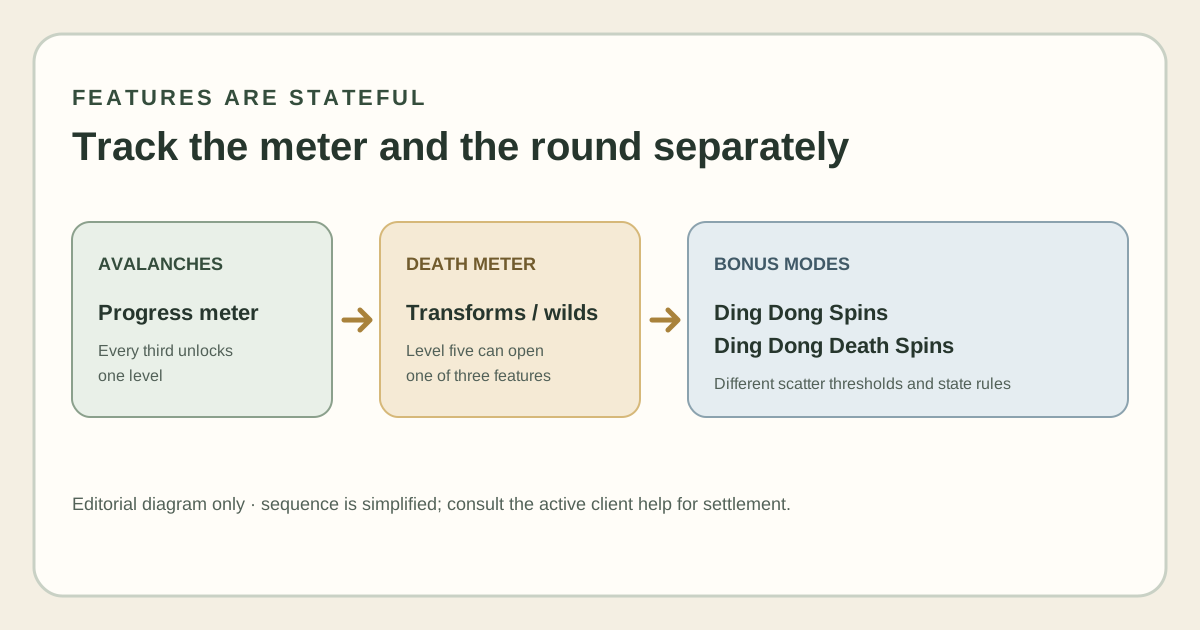
Ding Dong Death is a six-reel, three-row Nolimit City slot released to partners on 22 September 2026, according to the studio’s product page. Its central loop uses avalanches to advance a five-level Death Meter. Every third avalanche unlocks a level and transforms a designated character symbol into Wilds for the rest of the round. The meter also connects the base game with Ding Dong Spins and Ding Dong Death Spins, where some state persists between spins. The current public Nolimit City product page lists a 96.08% RTP, 14,280x maximum payout and additional feature prices; those are supplier-published catalogue details, not proof that a particular casino uses the same configuration. Check the exact game help before relying on any setting.
Product identity, release and scope
This guide is about Ding Dong Death from Nolimit City, a video slot with the supplier’s graveyard-clubhouse theme and returning characters from earlier studio releases. The theme may help identify the title, but mechanics must be tied to the exact product page and version. Do not transfer a feature from The Crypt, Mental or another Nolimit City game merely because the same character or xMechanic appears in both.
The official product page gives an early-access date of 15 September 2026 and a general release date of 22 September 2026. This establishes the studio’s published release schedule; it does not confirm that every operator launched the game on the same day or that a New Zealand account can access it. Operator catalogues can be enabled by market, platform and configuration.
The public supplier page shows a six-reel, three-row layout. It also lists one RTP figure, a maximum payout, a minimum and maximum stake in euros, a hit-frequency field, and feature buy information. These figures describe the supplier’s public product data as checked on 6 October 2026. They are not a replacement for an active casino’s rules panel, which may show a different currency, range or configuration. This page does not create separate guides for demo mode, RTP, feature buys or bonus spins; those topics are explained only as parts of this title’s one rules page.
The official announcement calls the game “Extremely Volatile”, while the catalogue’s volatility field does not display a comparable numeric scale in the text reviewed. The qualitative label is therefore attributed to the launch announcement and is not converted into a score such as 9/10. Volatility describes variation in outcome pattern; it does not tell a player when a feature will appear.
How avalanches feed the Death Meter
An avalanche occurs when a win removes participating symbols and new symbols fall into the open spaces, allowing another result within the same sequence. Nolimit City’s product description presents avalanches as the events that progress the Death Meter. Every third avalanche unlocks a meter level. At that point, all instances of a designated character-symbol type are converted into Wilds for the rest of the round.
The words “for the rest of the round” are important. The transformation is stateful within the active round; it should not be assumed to carry across every later paid spin. The meter itself is described as active in both the main game and bonus modes. The exact reset point and persistence conditions differ by mode, so read the rules for the current round type rather than assuming that the same reset behaviour applies everywhere.
At level five, the meter can trigger one of three features: Mental Patient, xSplit Wild or xNudge Wild. Once one of those features triggers, level five is locked again. The meter can progress through levels again according to the rules, which is why a diagram of the sequence is more useful than treating level five as a one-time terminal state.
The global win multiplier is another piece of state. The official product page says the first level-five unlock sets it to x2; each later level-five unlock increases it by one. That value is separate from a Wild’s own multiplier. Keep the two labels distinct when reading a large on-screen total: one can be global to the round while another applies only to a particular symbol or winning combination.
The three level-five features
Mental Patient
The Mental Patient feature randomly selects a low-paying symbol and transforms all instances of that symbol into Mental Patient symbols. It is a symbol transformation, not a new bet selection. A reader following a screen should identify the chosen low-paying symbol, count the transformed positions and then look at the resulting combinations under the game’s normal pay rules.
The public description does not provide a separate payout table for every symbol transformation. A transformation can affect which combinations form, but it does not by itself say how much a round returns. The active help and the displayed line or ways rules decide settlement. A player should not add the former symbol’s pay value to the new symbol’s value unless the client explicitly instructs that both apply.
xSplit Wild
An xSplit symbol splits symbols to its left, doubling them and increasing the number of ways to win, then turns into a Wild. The product page says xSplit symbols to the right of a Scatter convert that Scatter into a Super Scatter. This creates two distinct positions to follow: which symbols are being split, and whether a Scatter is affected by the feature.
The special case for an xNudge Wild is that its multiplier doubles if it is split. That interaction means a symbol may carry both a location-based feature and a multiplier state. Do not assume every split symbol becomes a Wild immediately; the official description gives a sequence in which the split occurs and the xSplit symbol then turns Wild. For an interrupted animation, the final round record is more useful than a single frame.
xNudge Wild
An xNudge Wild drops towards the bottom of its reel. Each symbol it passes increases its multiplier by one. Once it reaches the bottom, it expands to cover the reel. As it expands upwards, only split symbols increase its multiplier. If several xNudge multipliers participate consecutively, the supplier says they are added together; its example of x3 and x1 produces x4.
The multiplier applies only to wins that involve the xNudge Wild. This qualification prevents a common reading error: a Wild visible on the reels does not necessarily boost every payout in the round. First confirm which winning combination uses that Wild; then apply the feature’s multiplier under the rules shown by the client.
Knock Knock and the avalanche sequence
Knock Knock can trigger in the main game when at least three identical symbols line up horizontally and there is no winning combination. The triggering symbols are removed and create Mental Patient symbols in the middle positions of the alignment. If a replaced middle position has a multiplier, the product page says that multiplier transfers to the Mental Patient symbol. Other symbols then explode except Scatter, Wild and Mental Patient symbols, producing another collapse.
This is different from a normal winning avalanche. Knock Knock begins from a specified alignment that is not itself a winning combination; it then changes the board and can create a new cascade. The symbol condition, replacement positions and exclusions matter. A short animation may show several changes at once, so replay the sequence or consult the current help rather than assuming all symbols vanish.
The feature can preserve or move multiplier information. That does not make a multiplier an independent win. A symbol must still participate in a combination that the pay rules recognise. If the multiplier is transferred to a new symbol, track the final position and its role in the next avalanche. The amount shown may then depend on any global multiplier that is active too.
Ding Dong Spins and Ding Dong Death Spins
The product page describes two bonus-spin modes. Landing three, four or five Scatter symbols awards seven, nine or eleven Ding Dong Spins respectively. The Death Meter and global win multiplier do not reset during those spins, and a Scatter adds one spin. Persistence is the feature’s distinctive state rule: the sequence continues with prior meter progress and global multiplier according to the stated mode conditions.
Landing six Scatter symbols awards thirteen Ding Dong Death Spins. The page says all Ding Dong Spins features are active in this mode. Each unlocked Death Meter level adds one to the global win multiplier; level five adds one in this mode, rather than using the main-game first-unlock x2 rule. An xNudge Wild multiplier that participates in a win adds to the global multiplier.
The two names are similar, but their trigger thresholds and state rules differ. The ordinary spins start from three to five scatters and include a scatter retrigger; Death Spins require six and use their own multiplier adjustment. When comparing a game-history record, identify the exact bonus name before applying a state rule. Do not assume that a sixth Scatter simply grants one more ordinary spin.
The official page does not show all spin values in the visible public text reviewed here, nor the complete probability of triggering either feature. A “13 spins” grant is the starting count for that mode, not a guarantee that the round will have a particular return. Additional scatter rules may change the count as the feature proceeds.
Nolimit Boosters and xTra Spin
The supplier lists a Bonus Booster costing two times the base bet and describes it as making Ding Dong Spins or Ding Dong Death Spins three times more likely. “Three times more likely” is a relative statement, not a percentage point probability. The product page does not publish the starting trigger probability in the same field, so a reader cannot calculate an absolute chance from that phrase alone.
Other listed boosters guarantee a meter state or Wild condition at a stated price: Death Meter 3 is 50 times the base bet, Death Meter 4 is 100 times, and Death Meter 5 is 200 times. The public product page currently lists the xNudge Booster at 300 times the base bet and says it guarantees an xNudge Wild on reel three or four. These are high-cost optional features. A “guaranteed” feature condition is not a guaranteed profitable result; the resulting symbols still have to produce a settled win under the game rules.
There is a source discrepancy worth preserving. Nolimit City’s launch post lists the xNudge Booster at 80 times the base bet, whereas the current product page lists 300 times. This guide uses the current product page for the public supplier figure and flags the conflict. The active operator client is the source to use for the feature price that actually applies to a particular account. Do not average the two figures or select whichever is lower.
xTra Spin may be offered at the end of a round. It keeps the prior Death Meter levels and global multiplier rather than resetting that state. Its cost is calculated from the meter and multiplier, and the supplier says the offer appears only when that cost is no greater than the total win. The player still needs to decide whether to pay for the extra spin. A displayed opportunity should not be mistaken for a free continuation or a recommended choice.
Supplier-published settings and how to read them
The official product page, checked 6 October 2026, lists a 96.08% RTP, a 14,280x maximum payout, and a six-reel, three-row layout. It also shows a minimum and maximum bet of €0.20 and €100.00 in its public listing. Those numbers are supplier catalogue fields. They should not be represented as the stake limits or RTP for every operator, currency, market or optional mode.
The same page does not display a set of alternate RTP percentages in the text reviewed. That means this guide can report the one published figure observed, not claim that no variants exist. A client may have a configuration-specific return value or may display a different currency and stake range. Compare the title, version, jurisdiction and help-panel date before treating two figures as conflicting.
RTP is a theoretical return over a very large number of game rounds under a defined mathematical configuration. It is not the percentage a person should expect back in a short session. Maximum payout is a cap, not a target. The official product page states that a round ends at the cap and awards 14,280 times the base bet if the total win exceeds it. Neither figure predicts how often a bonus will occur or whether a particular stake is suitable.
The current product listing includes a 20.02% hit-frequency field and a one-in-five-million maximum-win probability field. Such figures are technical indicators with a scope that should be confirmed in the operator help. They are not guarantees for a personal session. This guide does not calculate likelihoods from a short sample or turn those values into a strategy.
How to inspect the active game help
Before a session, verify these items in the operator’s version:
- The game title and supplier are Ding Dong Death by Nolimit City.
- The stake currency and range, especially if the supplier page shows a different currency from the wallet.
- Which RTP or math setting is listed, if any, and the mode it applies to.
- How the three-to-five Scatter spin awards differ from the six-Scatter Death Spins.
- The Death Meter reset and persistence rule for the current mode.
- The price of each Booster and whether the selected feature is enabled.
- The xTra Spin price before accepting, and what state it retains.
- The maximum payout and what happens when it is reached.
If the operator and supplier show different feature prices, save the help text or transaction context and use the client’s terms for that operator. The supplier page remains useful for product identity and broad mechanics, but the operator’s displayed rules govern the wager presented in that client.
Mobile play, demo and New Zealand availability
The supplier’s game page and feature descriptions do not confirm that every operator provides the same mobile client, demo mode or real-money access. A responsive website may still embed a separate game frame with its own controls. Check that the stake, selected bet, feature-buy price and round state remain visible on the device you are using. If a small screen truncates an amount or warning, stop rather than confirming by memory.
The public product page includes game information and media; that does not establish an unrestricted demo for every jurisdiction. Nor does an international provider catalogue show that a specific New Zealand casino account has access. This guide makes no New Zealand availability claim and includes no operator recommendation.
New Zealand’s rules for online casino advertising and access are changing. Consult the current Department of Internal Affairs information independently. This article is a supplier-mechanics reference only, not legal advice or an invitation to open an account.
Common misunderstandings
Every third avalanche unlocks a level; it does not directly promise a cash win. The meter can transform symbols and may open another feature.
The global multiplier and a symbol multiplier are different. Check which one applies to the winning combination and mode.
A Scatter count has mode-specific meaning. Three to five scatters and six scatters trigger different bonus-spin rules in the public description.
xNudge only boosts wins involving it. A Wild’s presence on the grid does not imply that all combinations use it.
A Booster guarantee is not a guaranteed return. It guarantees a stated feature condition at a price, not a profitable result.
The official product’s RTP is not necessarily the operator’s active setting. Check the client’s exact version and help text.
Questions readers commonly ask
When does the Death Meter advance?
Nolimit City says every third avalanche unlocks a Death Meter level. The meter is described as active in the main game and bonus modes, with different multiplier behaviour in Death Spins.
What does Knock Knock do?
It can start in the main game when three or more identical symbols line up horizontally without a win. Those symbols are removed, Mental Patient symbols are created in middle positions, and other eligible symbols collapse again.
How many spins do the Scatter modes award?
The supplier lists seven, nine or eleven Ding Dong Spins for three, four or five scatters; six scatters awards thirteen Ding Dong Death Spins. Check the live rules for the active build.
What is the current xNudge Booster price?
The current official product page lists 300 times the base bet, while the launch post lists 80 times. This conflict is why the active operator’s help must be checked before relying on a price.
Is 96.08% the RTP at every casino?
No such universal claim is made. The figure is shown on the supplier’s public product page. The exact operator configuration and any variants need to be checked in its game help.
Sources and verification boundary
- Nolimit City: Ding Dong Death product page — current public product fields and feature descriptions; checked 6 October 2026.
- Nolimit City: Ding Dong Death launch post — release information and feature announcement; checked 6 October 2026. The xNudge Booster cost differs from the current product page.
- DIA: Online gambling for advertisers — New Zealand advertising context; checked 6 October 2026.
Public supplier values are not verified operator settings. The active game help, NZ availability, demo eligibility and a complete list of RTP variants were not directly inspected. The 80x/300x xNudge Booster conflict remains explicit rather than being silently resolved for an operator.
