Wazdan game rules · South Island guide
Easter Coins by Wazdan: rules, features and RTP evidence
 Best casinos available in New ZealandUpdated 7 November 2026

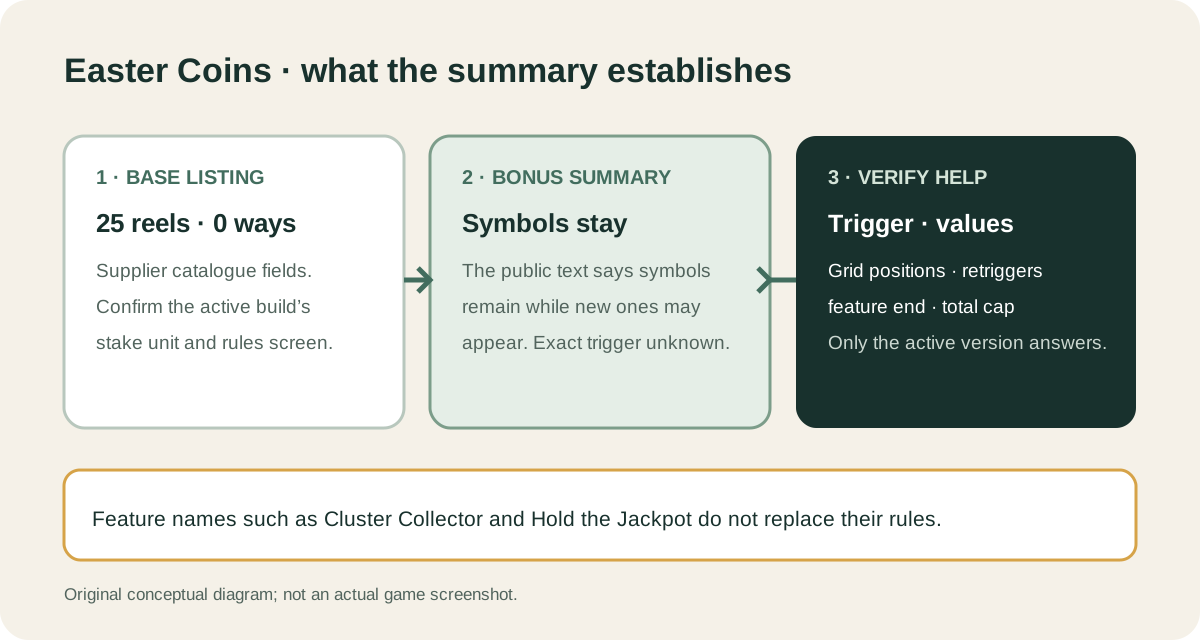
Wazdan’s official page lists Easter Coins as a 25-reel, zero-ways game, with RTP 96.17%, High volatility, a maximum win of 2,000x and a 20 March 2026 release date. Its summary describes a bonus where symbols remain on the reels while new ones may appear and lists Cluster Collector, Hold the Jackpot, Cash Infinity and Sticky to Infinity. The catalogue does not provide the complete trigger, paytable or operator-selected settings.
The short answer
Easter Coins is a Wazdan game whose product page, checked on 8 October 2026, lists 25 reels and zero ways to win, an RTP field of 96.17%, High volatility, a maximum win of 2,000x and a release date of 20 March 2026. The supplier describes a bonus round in which symbols remain on the reels while new ones may appear, with the potential reward building as the grid fills. Its feature list includes Cluster Collector, Hold the Jackpot, Cash Infinity, Sticky to Infinity, Chance Level, Buy Feature, Volatility Levels, Ultra Fast Mode, Gamble Feature and Energy Saving Mode.
The public summary does not explain the bonus trigger, what qualifies as a symbol that remains, which positions can fill, the end condition or how an award is settled. The 25/0 field also needs the actual rules to explain how ordinary results are evaluated. Those are not minor details: they define the game’s core sequence. A complete consumer review should answer them from the exact help screen rather than infer them from “Coins” or the seasonal theme.
All numeric values here belong to Wazdan’s published product page. They are not independently confirmed settings for a casino build. This review does not claim that a named operator offers Easter Coins in New Zealand or that the page’s RTP is active everywhere. The purpose is to separate the supplier evidence from the details that still require the game’s own help.
Confirm the exact product
The full title is Easter Coins. Wazdan’s page associates it with its Coins series and an Easter theme. Do not shorten it to “Coins” in a way that could point to another title. The series includes products with distinct formats and feature descriptions; a shared series label does not mean the same paytable, bonus trigger or maximum win.
Record the title shown in the casino lobby and compare it with the game’s Help or Rules title. Note the provider and version number if visible. If a page gives the provider as Wazdan but the launched game’s help does not show a product identifier, state that limitation. A catalogue card can identify what Wazdan publishes without confirming which exact game build has loaded.
The source page gives a supplier release date of 20 March 2026. That field does not tell a reader when a particular casino integrated the game. Release status and operator availability are separate facts. A game may be listed in a supplier portfolio while absent from a specific operator’s lobby or unavailable to an account because of local rules or product settings.
The product page also lists all platforms, currencies and multiple languages at supplier level. Do not treat those broad fields as proof that this specific title is offered in a New Zealand casino, has an NZD denomination, or presents a particular translation in a live account. The exact operator and build have not been verified.
What a 25-reel, zero-ways listing tells us
Wazdan describes Easter Coins with 25 reels and zero ways to win. Keep that exact field in context. It indicates that the supplier does not list a conventional fixed-line or ways count in the usual field, but it does not explain how a base-game result is produced. The product page’s marketing summary focuses on the bonus and does not include a full paytable.
Avoid converting “25 reels” into a familiar grid description unless the active help confirms the number of rows and how the reels are arranged. A visual board with 25 positions could be laid out in several ways. A zero-ways entry does not establish cluster wins, scatter-only payouts, symbol collection, or any other evaluation method by itself. Those terms each describe different rules.
The help should identify ordinary symbols, special symbols, any position limits, award conditions and the stake basis. If symbols pay by count rather than a line, the rules should state that. If a feature uses a different grid from the base game, record both states. If the help does not disclose the base evaluation in a public view, say the public evidence does not answer it.
When reviewing a round, do not infer a winning pattern by looking at a collection of coin icons. The relevant game rule determines whether a symbol is a trigger, a value, a collector or simply part of an animation. A screenshot can document the visual state; the paytable and round history determine how it settled.
The supplier-described bonus
Wazdan’s page says that the game centres on a bonus round where symbols remain on the reels and new symbols continue to appear. It adds that each new symbol can increase the potential reward as the grid fills with coins and prizes. That is the central mechanic described publicly, but the text is a summary rather than a full sequence of rules.
Several questions remain open. What triggers the round? Which symbols remain fixed? Do they carry values or multipliers? How many spins or attempts are available? Does a new symbol reset a counter? Can a position contain more than one value? How does the feature end? Is the final award based on a total, a combination, a prize table or a cap? The product page does not answer these points.
The wording “can increase” is conditional. It does not promise that every new symbol raises the award, that a particular number of symbols will land or that a feature will begin within a given number of spins. Do not turn the supplier’s summary into a prediction. The help screen should state how the award changes and what the possible symbols mean.
A useful explanation follows the feature in order: trigger, starting board, retained symbols, new arrivals, any counter or reset, end condition and settlement. If only some of those steps appear in the current help, report the steps that are documented and identify the rest as unconfirmed. A complete state description is more helpful than a string of feature names.
Hold the Jackpot, Cash Infinity and Sticky to Infinity
The official page lists Hold the Jackpot, Cash Infinity and Sticky to Infinity. The bonus paragraph describes symbols remaining while new ones appear. Those details suggest that persistence is important to this product, but the public text does not specify which symbols belong to which named feature or whether all three operate in the same round.
Do not assume Sticky to Infinity means a symbol remains for the rest of the game or carries between sessions. It is a branded feature label, and only the exact game help can define its period. Similarly, Cash Infinity does not disclose from the name whether an amount stays on a position, combines with another symbol or settles after the bonus. Avoid importing a rule from 9 Coins, Ox Coin or another title with a similar mechanic.
For each named mechanic, note the trigger, the element that persists, the duration and the settlement event. If the help says “until the bonus ends”, preserve that boundary. If it says a symbol remains for a number of attempts, record whether the first attempt is included. If the terminology is not explained, mark it as missing rather than assuming the most common version of the feature.
A jackpot-sounding title also does not establish a progressive prize. The page publishes a maximum-win field of 2,000x but does not state that a shared network pool exists. Use “bonus award” or “maximum-win field” unless an operator’s terms or game help explicitly define a progressive jackpot and explain its funding.
Cluster Collector: name the evidence gap
Cluster Collector is included in the features list, but the public summary does not explain its operation. The label may suggest collecting groups or values, yet that inference is not a rule. The active help should show what can be collected, which symbols qualify, whether positions or clusters matter, when a collection is credited and whether the mechanic is limited to a bonus state.
A reviewer should search the game help for the exact name and any diagram that shows the collector. Does the feature gather values from a defined area? Does a special symbol activate it? Does the collection contribute to Hold the Jackpot or a separate prize? Is there a counter, threshold or multiplier? If none of those explanations is public, the honest statement is that Wazdan lists the feature but its exact effect was not confirmed.
The distinction between a collector and a paying symbol matters. An icon might represent a trigger, a container, a value or the event that transfers values to a total. Each role has different consequences. A screenshot without rule text can show what happened visually, but it cannot prove how the game calculated an award.
Avoid adding a numeric collector example. No count, value range, probability or award formula is supplied in the public product summary. The active paytable is required before a review can explain a precise outcome. Readers should be able to tell which claims come from the supplier’s page and which remain unanswered.
RTP and the supplier’s published values
Wazdan lists RTP 96.17%, volatility High and maximum win 2,000x. Attribute each value to the Easter Coins product page and its check date. The page does not state that 96.17% is the only possible configuration or identify an operator’s selected RTP variant. A casino’s game help is needed for an operator-specific statement.
RTP is a theoretical long-run measure under specified assumptions. It does not mean that a particular user will receive 96.17% back in a session. It does not determine the order of results, the time until a feature appears or the size of an individual win. A single percentage on a supplier page cannot support a claim about a short play period.
“High” is a category, not a distribution table. The page does not define the category’s range or supply the probability of each outcome. Do not tell readers that High volatility means a certain frequency of wins or a particular drought. It is a supplier label for the title and should be presented as such.
The maximum win of 2,000x needs its multiplier base and overall scope. Does “x” refer to the total wager, a coin value or another defined stake? Is the ceiling the aggregate of a bonus and base award? The page does not say. Until the active rules provide that basis, write “maximum win listed as 2,000x” rather than presenting a computed NZD amount or treating it as a prize guarantee.
If the game help gives a different value, preserve both evidence records: the supplier listing and the exact build’s information. Include date and version. Never average two RTP values or select the larger one. If the operator setting is not disclosed, say that it could not be confirmed.
Optional modes and settings
The supplier page also lists Energy Saving Mode, Chance Level, Volatility Levels, Buy Feature, Ultra Fast Mode and Gamble Feature. Some are interface or presentation labels; others may affect stake or round selection. Their presence on the catalogue page does not tell us which controls appear in a live build, how much they cost or whether local configuration removes them.
Energy Saving Mode should be described only as a listed feature until help explains what it changes. Do not claim that it changes game probabilities or reduces energy use on a user’s device based only on its name. The operator’s rules should say whether it affects animations, background activity or any other part of the product.
If Chance Level or Volatility Levels appear, record each selectable option, exact stake and stated effect. A change in trigger chance is not a guaranteed win. A mode label may refer to a different math configuration, but the active RTP and cap must be checked rather than inferred from a selection name.
Buy Feature and Gamble Feature require particular care. Find whether a purchase is available, what it costs, which event it starts and how its result is settled. For a Gamble option, check the risk, the available choice and whether declining leaves the original amount unchanged. No recommendation to use either option follows from their presence on the supplier list.
Ultra Fast Mode concerns pace only if that is what the actual help says. Make sure faster presentation does not hide the current stake or settlement history. Do not claim an option is enabled in an operator build without seeing that build.
Release, demo and New Zealand availability
Wazdan lists 20 March 2026 as Easter Coins’ release date. That is useful for identifying a supplier chronology, but it is not evidence of a casino’s launch, a permitted demo, or availability in a particular country. Those require different sources.
A demo should be called available only if there is a permitted public version that can actually be accessed under the relevant terms. A supplier catalogue image or a product description is not a demo. No demo was verified for this review. Do not ask a reader to use an unlicensed mirror or bypass the operator’s access rules to inspect it.
Likewise, “all currencies” or “all platforms” on a supplier page describes a broad product capability. It is not a confirmation that Easter Coins is available through a New Zealand operator, uses NZD in a given account, or has a specific mobile build. The operator’s current lobby, terms and regulatory status would be needed for those statements.
The New Zealand regulatory transition is separate from the supplier’s release date. Check current government information if a page makes an operator or availability statement. This article makes no such claim and does not connect Wazdan’s catalogue to a particular casino.
What to inspect on a real help screen
Use a structured check before publishing an exact rules statement:
- Match “Easter Coins” and Wazdan on the game screen.
- Record a build or version identifier and check date.
- Read how the 25-reel, zero-ways format evaluates symbols.
- Identify ordinary and feature symbols in the paytable.
- Find the Hold the Jackpot trigger.
- Record which symbols remain and what new symbols do.
- Find any counter, reset, respin or end condition.
- Check Cluster Collector’s role and the feature it affects.
- Check Cash Infinity and Sticky to Infinity separately.
- Record the RTP, volatility and maximum-win wording shown for that build.
- Check whether optional modes are present and their stated prices.
- Keep the supplier-page facts separate from operator-selected settings.
This list is for reading help, not for initiating play. If an operator locks the rules behind an account or requires a wager to view them, do not place a bet merely to complete a content check. Record that the information could not be confirmed from public sources. A missing source is a limitation, not a prompt to invent a rule.
Reading a result and preserving a record
If a reader needs to understand a completed round, preserve the game’s round ID, accepted stake, visible feature state and final game-history entry. Note whether the record says the round settled, was cancelled or remains pending. Keep the account balance screenshot separate from the game animation; a value shown during a bonus may not yet be a settled credit.
The help version is important because the product name alone does not show which paytable or feature description applied. A factual support request should identify the title, version, round ID and specific difference between the on-screen summary and the final statement. Ask which rule explains that result. Do not assume a bonus was triggered merely because a symbol looked similar to the catalogue artwork.
Do not use a single observed round to claim a feature’s probability, average return or expected wait. A recorded result can establish what appeared in that round, not what should appear next time. A public catalogue page and a personal screenshot are not enough to calculate a game’s math model.
If money stress or gambling harm is involved, an operator’s help process is not a substitute for independent assistance. The New Zealand Gambling Helpline lists support and debt-related services. A review should give factual information and avoid promising that a feature, limit or game setting will solve a personal difficulty.
Common mistakes when reviewing Easter Coins
Treating the series label as a ruleset. Easter Coins shares the Coins name with other products, but the actual trigger and math must come from this title’s help.
Calling the 25/0 format a 25-line slot. The supplier says 25 reels and zero ways to win. Do not silently rewrite that as paylines or invent an evaluation method.
Describing the bonus as a guaranteed build-up. The page says new symbols may appear and can increase potential reward. It does not say that every round starts, fills the grid or reaches a particular amount.
Calling the maximum win a fixed cash prize. The source gives 2,000x but not the multiplier base in the summary. Preserve the field and verify the exact unit.
Treating seasonal artwork as availability evidence. The Easter theme and March release date identify the product but do not prove a seasonal promotion, operator integration or New Zealand access.
Assuming feature labels are active settings. A catalogue may list options that an operator build does not expose. Check the launched version and local terms.
Inventing a Cluster Collector rule. The name alone does not define which symbols qualify or when values settle. The game help must explain those details.
FAQ
What does 25 reels / 0 ways mean?
It is the supplier’s published format field. The product page does not explain the full symbol-evaluation method, so read the exact game help before calling it a cluster, ways-to-win or line-pay game.
Does the bonus trigger when coin symbols appear?
The public summary does not state the trigger. It describes a bonus where symbols remain while new symbols may appear. The starting condition must be taken from the active help.
Is 96.17% the RTP used by every casino?
No. It is the figure listed on Wazdan’s page. An operator’s selected setting was not verified and should be checked in that version’s help.
Is the 2,000x maximum a guaranteed prize?
No. It is a maximum-win field published by Wazdan, not a promised award. The help must define the multiplier unit and conditions.
Can I assume Easter Coins is available in New Zealand?
No. A supplier release entry does not prove an operator carries the game or that a particular account is eligible. No New Zealand operator was confirmed.
Editorial conclusion
The public evidence for Easter Coins is useful but bounded. Wazdan supplies a title, 25-reel/zero-ways field, headline RTP, High volatility, a 2,000x maximum and a bonus summary about retained symbols. The title-specific trigger, paytable, feature state changes and selected operator settings still require the active help.
Keep the feature sequence and numbers attributed to their source, and do not borrow rules from another Coins game. The date of a supplier listing is not an operator launch date, and a seasonal theme is not proof of regional access. Where help is unavailable, name the gap instead of filling it with an assumption.
Sources and verification boundary
- Wazdan: Easter Coins — checked 8 October 2026; supplier page lists 25 reels / 0 ways, RTP 96.17%, High volatility, maximum win 2,000x, release date 20 March 2026, and a short feature summary.
- Wazdan official Games catalogue — checked 8 October 2026 for catalogue context.
- New Zealand Department of Internal Affairs: Online gambling for advertisers — checked 8 October 2026 for current regulatory and advertising scope.
- Gambling Helpline NZ resources — checked 8 October 2026 for support context.
- No active operator help, paytable, demo, mobile build or New Zealand availability was verified. Supplier values are not asserted as live operator settings. No CPA route was opened or changed.
