Wazdan game rules · South Island guide
Magic Fruit$: Oranges by Wazdan: rules, features and RTP
 Best casinos available in New ZealandUpdated 7 November 2026

Wazdan’s official page lists Magic Fruit$: Oranges as a nine-reel, zero-line game with RTP 96.14%, Low-Medium volatility, a maximum win of 100x and a 26 March 2026 release date. It describes a Cash Out label that may remain for up to five spins, Cash Infinity persisting until the Hold the Jackpot feature ends, and other named features. These are supplier-level statements; the active casino configuration and New Zealand availability are not confirmed.
The short answer
Magic Fruit$: Oranges is a Wazdan title with a supplier page that lists nine reels and zero lines, RTP of 96.14%, Low-Medium volatility, a maximum win of 100x and a release date of 26 March 2026. The page names Cash Out, Chance Level, Hold the Jackpot, Cash Infinity, Volatility Levels, Buy Feature, Ultra Fast Mode and Gamble Feature.
The most distinctive short description is Cash Out: Wazdan says a label may appear on a random reel and remain there for up to five spins; after that, a symbol landing on it pays the prize for that symbol. The public page does not give every timing edge case, the symbol-to-prize table or the active operator’s exact implementation. It also says that a Cash Infinity symbol sticks to a reel until the Hold the Jackpot bonus ends. That is a useful persistence boundary, but the trigger and settlement sequence still need the game’s help.
The numbers are catalogue fields, not proof of a particular account’s settings. This review uses them as facts about the Wazdan page checked on 8 October 2026. It does not claim the game is offered by a New Zealand operator, that the active version uses 96.14%, or that a demo is available. For the similarly named Magic Fruit$: Cherries guide, use its own rules rather than importing Oranges’ mechanics.
Match the title and version
The exact supplier title is Magic Fruit$: Oranges. The dollar sign is part of the displayed name. Keep it in the title and source record so the page is not confused with Magic Fruit$: Cherries, a general Magic Fruit slot, or an operator’s shortened lobby label. If a casino uses a different label, the game’s help panel should identify the underlying title and provider.
Record the title, provider, version or build number where shown, and the date you opened the help. A product page can establish that Wazdan lists a title. It cannot identify the precise code version connected to a casino account. A later release could alter feature text, translations or settings while preserving the same public game name.
The source page’s release date is 26 March 2026. That is the date Wazdan publishes for the title. It is not a casino launch date, and it does not prove that a particular operator has added the game. The page also describes availability across currencies and platforms at supplier level; those broad statements are not a New Zealand account check.
A useful review begins by asking whether the named title matches the help actually displayed. If the lobby says “Oranges” and the help says “Magic Fruit$: Oranges”, record both labels. If the provider or version is missing, do not fill it from a different game. A precise identity prevents rules from one fruit-themed product being attributed to another.
Nine reels and zero lines: read the format carefully
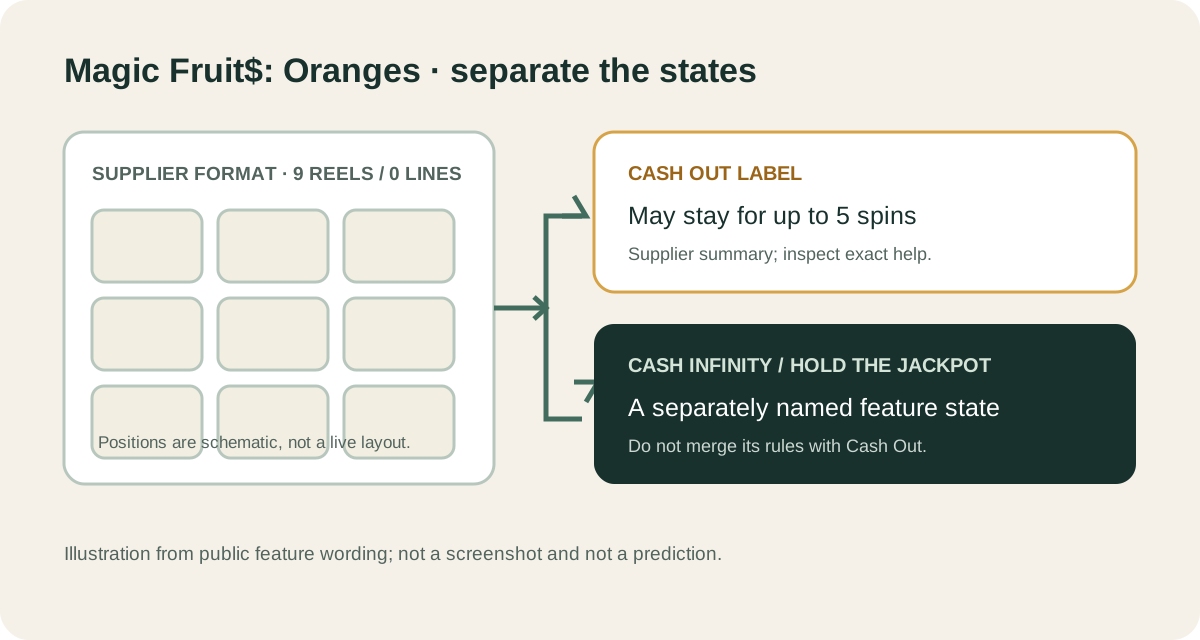
The Wazdan Game Info panel lists “9 / 0” for reels and lines. That is an unusual enough field that it should be kept in the supplier’s wording until the game help explains the layout. Zero lines does not mean the game has no way to award a prize. It means the page is not describing a conventional fixed-line count in the usual way.
The product page does not publish a full paytable diagram or explain exactly how symbols are evaluated in the base game. Avoid inventing a cluster-pay rule, ways-to-win count, scatter rule or special sequence. A nine-reel label is a catalogue fact; it is not a complete mathematical description of a slot. The active help should explain what a winning event looks like and whether the same evaluation is used in all modes.
When reading the actual help, identify the visible arrangement, the positions counted as reels and the symbols that can pay. Note whether symbols are evaluated in groups, by a special position, by collection or by another title-specific condition. The exact language matters. If an interface uses a grid-like display, that alone does not prove that adjoining symbols form a cluster win.
Check how the stake is presented. Does the game show a total bet, a per-spin amount or a unit multiplied by a selected level? What currency or coin value is in use? A zero-line layout can still have a clear stake and paytable; the missing information is not a reason to guess. Record what the active help states and leave everything else unconfirmed.
Cash Out: the temporary marker
Wazdan describes a Cash Out label that may appear on a random reel and remain for up to five spins. Its text says that after the period, a symbol landing on the labelled reel pays the prize associated with that symbol. That description suggests a timed state: a marker appears, remains visible across some spins, then resolves when the condition is met or its stated duration ends.
The phrase “up to five spins” is precise enough to report as supplier wording, but it does not answer whether the appearance spin is included in the count, what happens if a feature round interrupts the countdown, or whether a fresh marker can appear while one is already active. The help screen should define the count and settlement event. It should also show the eligible symbols and whether the awarded prize is fixed, a multiplier or another value.
If a marker appears on one of the nine reels, note its position and any displayed counter. Do not call the feature a cash-out button or imply that a player can choose when to withdraw the value. The supplier text describes a symbol label; it does not describe a discretionary account withdrawal. “Cash Out” is a feature name, and the game help determines its exact meaning.
The resulting symbol’s value also needs a unit. If the paytable expresses prizes as a multiple of the bet, record that. If it shows a coin amount, establish whether the amount is per line, per spin or part of a feature total. The catalogue summary does not include the paytable, so this article does not provide an invented example.
Hold the Jackpot and the stopping point
Hold the Jackpot is a named feature on the supplier page. The Cash Infinity paragraph says that a Cash Infinity symbol sticks to a reel until the Hold the Jackpot bonus ends. This gives one documented relationship: the retention period is linked to the end of that bonus. It does not state the trigger, how many positions are held, how the feature resolves or whether a retained symbol pays independently.
The active help should answer four separate questions. First, what symbols or combination start Hold the Jackpot? Second, what remains fixed between attempts? Third, what changes after a new symbol arrives or a spin produces no new symbol? Fourth, what event ends the round and settles any values? Do not assume the answer is the same as a Wazdan Coins title or another Magic Fruit product.
A feature name can make an outcome sound like a jackpot when the actual rules may describe a bonus round or capped prize. The public page does not establish whether this feature is progressive, network-funded, fixed or simply a name. Do not add those labels without exact documentation. If the help shows a prize meter, check its terms rather than reading the graphic as a cash balance.
A careful explanation distinguishes the feature’s start, continuation and end. If an operator’s build has an incomplete or translated description, say what is missing. Avoid suggesting that a round will persist indefinitely or that a particular symbol must arrive. The supplier’s summary is a broad overview, not a guarantee about the next spin or a full state diagram.
Cash Infinity: one title, one persistence rule
The page names Cash Infinity and describes a symbol that sticks to the reel until Hold the Jackpot ends. Keep this rule inside Magic Fruit$: Oranges. A shared brand name does not mean the same symbol, trigger and duration apply to every Wazdan game. The product page for Cherries, for example, should be checked separately even if it uses the same feature-family label.
“Sticks to the reel” describes a visible persistence concept. It does not by itself say whether the symbol occupies the same row, whether another symbol can replace it, whether the feature carries into additional rounds, or how its value is calculated. Look for a diagram or help text about the relevant feature state. If the screen shows an attached amount, see when it becomes part of the final result.
Also check whether the bonus ends immediately when a counter reaches zero or after a final evaluation. A symbol remaining visible at the end of the animation could be part of the display, not an unsettled credit. The round history and paytable establish settlement. Keep the intermediate image and final history record distinct when explaining a disputed round.
Do not treat the phrase “increasing chances” on a supplier page as a measured probability claim. The summary offers no frequency or statistical table. Describe the sticky state and its stated duration, then direct the reader to the active help for triggers and final values. That is enough to explain what is known without making a prediction.
Chance Level and stake changes
Chance Level appears in the feature list. Wazdan’s feature-family text describes a bet increase intended to improve the chance of reaching a bonus. The Oranges listing does not give the available levels, price, exact trigger or odds. A higher trigger probability is not the same as a guaranteed bonus, and it does not prove that expected value increases.
If the actual game shows a Chance Level control, record the full stake before confirming it. Check whether the interface displays a base bet and a separate feature charge or only a combined amount. Confirm whether the change applies to the next round or remains selected. The help should say which event becomes more likely and whether other payouts, RTP or a feature cap change.
An option may be unavailable in one operator build or region even if the supplier lists it generally. Do not write that a New Zealand user can buy a feature or adjust Chance Level without verifying the current operator and exact game. A supplier page that says “all platforms” is not evidence for a named site’s configuration.
If the option’s price or effect is unclear, do not ask the reader to test it with a wager. Use help text, a permitted demo if one exists, or a direct written explanation from the operator. A missing answer should remain a limitation. A review is not improved by converting marketing wording into a numeric claim.
RTP, Low-Medium volatility and the 100x field
The product page lists RTP 96.14%, volatility Low-Medium and maximum win 100x. Each value belongs to the supplier page checked on 8 October 2026. The page does not reveal which RTP configuration a particular operator selected or whether all available game builds use this value. The active in-game help is the primary source for the version a user actually sees.
RTP is a theoretical measure over a large number of rounds under stated assumptions. It cannot predict an individual result or tell a reader how much one session will return. Do not convert 96.14% into a promised percentage of a personal stake. If a casino help panel displays a different setting, report that value separately and identify the source, game mode and version.
Low-Medium is a category, not a schedule. It does not state how often a symbol will appear or when a feature should arrive. The source page supplies no scale definition or measured distribution for this title. Avoid claims that the label means frequent wins or a particular losing streak.
The maximum-win field of 100x needs a unit. The active rules should state whether the multiplier is applied to the total bet, a coin value or another stake basis, and whether the figure is an overall cap across base and bonus results. Do not assume that a 100x field means every feature is capped in the same way or that the cap is reached by one symbol. Keep the catalogue value as “maximum win listed by Wazdan” until an exact help screen confirms its scope.
Gamble Feature, Buy Feature and pace settings
Wazdan lists Gamble Feature, Buy Feature, Ultra Fast Mode and Volatility Levels for Magic Fruit$: Oranges. The feature list does not describe their cost, availability or effect in the active operator build. For the Gamble Feature, find out whether it is a post-win option, what choice the screen presents, how the risk is displayed and whether declining leaves the original award unchanged. Do not claim a cashout guarantee or recommend using the option.
For Buy Feature, if present, inspect the displayed charge and the feature it starts. Determine whether the amount counts as the full stake for the round and whether the purchased route uses the same rules as a naturally triggered feature. The current public page does not state purchase prices or feature probabilities. No reader should be asked to activate a purchase to clarify an editorial question.
Volatility Levels can refer to selectable configurations. If the active version shows more than one, record each option as a separate set of rules and settings. A catalogue value of Low-Medium should not be confused with a selection menu or interpreted as proof that no other settings exist.
Ultra Fast Mode concerns pace, but the product page does not specify how the control works. A faster animation is not a change in the outcome rules unless the help explicitly says it changes settings. Ensure the screen gives enough time to read the total stake and result. The supplier listing does not establish that this mode is enabled for every operator or device.
Compare Oranges with Cherries without merging them
Magic Fruit$: Oranges and Magic Fruit$: Cherries share a branded family, but their supplier pages contain different title-specific fields. Oranges is listed with nine reels and zero lines, a 96.14% RTP field, Low-Medium volatility and a 100x maximum-win field. The previous Cherries page has a 16-reel format and different catalogue values. Do not copy one title’s table, feature duration or award cap into the other.
The comparison can be useful if each row is attributed. Match the full name, source URL and check date, then compare only fields that both pages actually publish. A missing value is not evidence that the feature is absent; it means the source does not answer it. A feature label shared by both pages still needs a game-specific help check.
Keep the internal link as a navigation aid, not an argument that the titles have identical mechanics. If a reader wants to know how Cash Out works in Oranges, the Cash Out description on the Oranges page is relevant. A separate rule from Cherries would not settle the same question. Cross-links should help readers keep variants apart.
An operator may expose one title and not another. A provider catalogue comparison cannot establish a shared availability list. Each account and region requires separate evidence from the operator. This guide makes no New Zealand availability claim for either product.
Mobile and interface review
A mobile check should focus on whether the nine-reel information, help and current stake are readable without accidental selection. Inspect the screen in portrait and landscape if permitted, but do not place a bet to reach a particular state. Does the paytable fit the viewport? Can the user zoom or scroll? Does a Cash Out marker stay visually distinguishable from an ordinary symbol? Can the rules panel be closed without starting a new round?
Test text and layout, not outcomes. If an animation obscures the five-spin Cash Out duration or the feature’s counter, note that the supplier page’s simple description is not enough to explain the mobile display. If a help icon is hidden behind a button, do not infer its content from another version. A responsive page should make the same essential rules accessible as a desktop layout.
Check whether the screen differentiates a token balance, stake amount and feature value. If the interface displays all three with similar coin symbols, identify the unit in the help. A temporary value in a reel should not be confused with an account credit. The operator’s history is needed to see what was actually settled.
No active casino account or mobile operator build was available during this review. The product page’s general platform claims do not replace a device-specific test. The diagrams in this page are original explanatory assets, not screenshots or proof of a mobile interface.
A practical evidence checklist
Before describing this game as configured at a casino, collect the following:
- Exact title and provider on the launched screen
- Version or build identifier and date checked
- Current game-help link and paytable
- Board diagram showing the nine-reel, zero-line terminology
- The stated condition for a winning base-game result
- Hot Slot symbol role and two-line condition
- Cash Out appearance, counter and resolution rule
- Hold the Jackpot trigger and ending event
- Cash Infinity persistence and value settlement
- Chance Level price, trigger effect and any RTP change
- Active RTP and its currency or stake assumptions
- Definition and unit for the 100x maximum
- Availability evidence from the named operator, not only Wazdan
If a value cannot be found, write “not confirmed in the sources reviewed.” Do not fill the gap using a similar game, a third-party review or a generic feature article. For an operator-specific conclusion, cite the operator’s current help and date. For a supplier-level statement, cite the Wazdan page.
FAQ
Is the game a nine-line slot?
The supplier page lists nine reels and zero lines. That is not the same as saying it has nine paylines. The exact way the base game evaluates symbols should be confirmed in its help.
Does Cash Out let a player withdraw money?
The supplier description refers to a Cash Out label on a reel that can remain for up to five spins. It does not describe a withdrawal control. The active help determines the exact symbol and settlement rule.
Is 96.14% the live RTP everywhere?
No. It is the RTP value listed by Wazdan on the page checked. A casino’s active setting was not verified.
Does Low-Medium volatility mean more frequent wins?
The label does not define a schedule or guarantee. It should not be used to predict an individual round or session.
Is Magic Fruit$: Oranges available in New Zealand?
The supplier page is not proof of an operator offer or account eligibility. No named New Zealand casino was verified for this title.
Editorial conclusion
Magic Fruit$: Oranges has a distinctive supplier summary: a nine-reel, zero-line listing, Cash Out marker with a stated maximum five-spin period, and Cash Infinity persistence linked to the end of Hold the Jackpot. The listing also supplies headline RTP, volatility and cap fields. Those details give readers a focused checklist, while the game help is still needed for the exact base-game evaluation, feature triggers and selected settings.
Keep this title separate from Cherries, attribute every catalogue value and describe unknowns plainly. A release date does not prove casino availability, and a feature label does not promise a result. The best next step is to read the exact help screen before treating a supplier value as an operator setting.
Sources and verification boundary
- Wazdan: Magic Fruit$: Oranges — checked 8 October 2026; supplier page lists 9 reels / 0 lines, RTP 96.14%, Low-Medium volatility, maximum win 100x, release date 26 March 2026 and feature summaries.
- Wazdan: Magic Fruit$: Cherries — checked 8 October 2026 only to keep the neighbouring title distinct; Cherries is not a source for Oranges rules.
- Wazdan official Games catalogue — checked 8 October 2026 for supplier catalogue context.
- New Zealand Department of Internal Affairs: Online gambling for advertisers — checked 8 October 2026 for advertising scope.
- No active operator game help, paytable, demo, mobile build or New Zealand availability was verified. No CPA route was opened or changed.
