Provider catalogue guide · South Island guide
Big Time Gaming games guide: formats and catalogue
 Best casinos available in New ZealandUpdated 7 November 2026

Big Time Gaming publishes its own slots and a catalogue of named mechanics, including Megaways. This guide explains how to use the studio’s catalogue, distinguish BTG-developed titles from licensed mechanics and verify a particular operator build.
The short answer
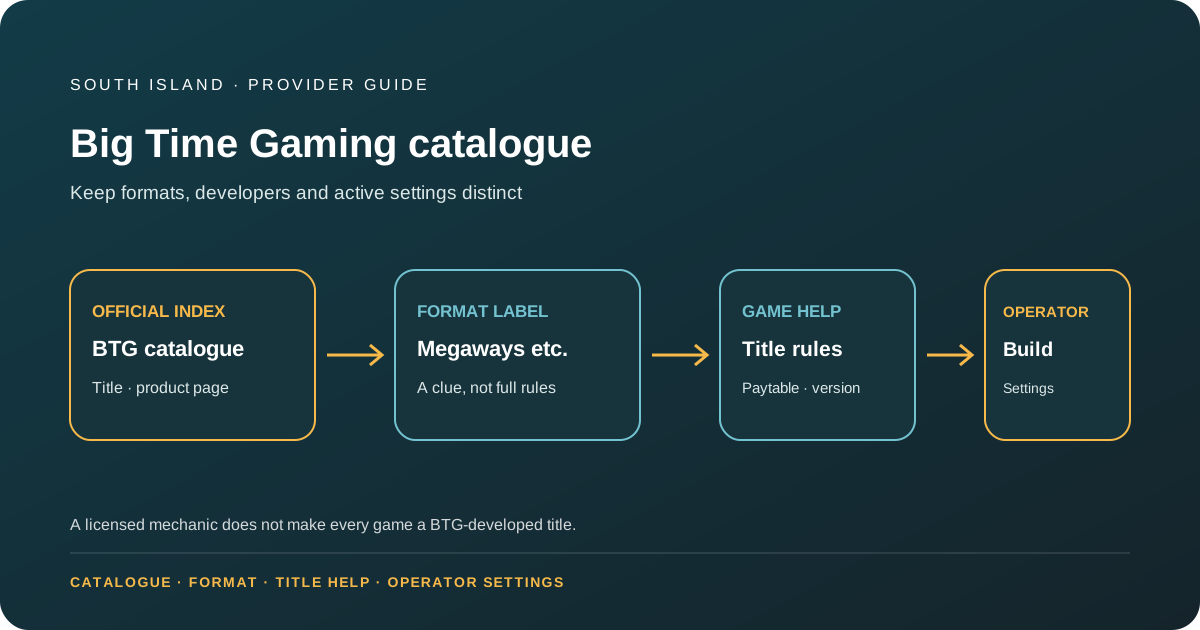
Big Time Gaming (BTG) is a slot studio whose own catalogue can be browsed through its official game pages. It is associated with Megaways, a variable-reel format it created, and lists other named formats such as MegaClusters, Megapays, Megapots, Megaquads, Megadozer, Power Play, Win Exchange, Tapcards and Hold and Spin. These labels help a reader navigate design ideas; they do not establish a particular title’s return percentage, stake range, payout table or New Zealand availability.
Start with the exact game name on the studio catalogue, then open that title’s help in the operator build you are considering. Keep three questions separate: who developed the game, whether it uses a mechanic licensed from BTG, and which version an operator has enabled. A game can carry Megaways under licence without being a BTG-developed game. A supplier catalogue also cannot confirm that a particular casino carries a title or accepts customers in New Zealand.
What this provider page covers
This is the provider hub for Big Time Gaming. It explains how to move through the studio’s own catalogue, what the format labels mean at a high level and how to verify information that varies by title or operator. It does not attempt to list every slot on the internet bearing a Megaways label, compare casinos, or reproduce complete reviews of individual games.
That distinction matters because provider pages often collapse different entities into one list. A supplier may create some titles, develop a mechanic, license the mechanic to other studios and later become part of a wider group. Those activities are related but not interchangeable. For a catalogue search, the developer credit on the specific game and its official supplier page are better evidence than a general provider directory or a search snippet.
The site’s game guide index is the catalogue of materials this publication has actually prepared. It includes provider hubs and selected title guides. If a BTG title is not listed there as an individual guide, this page does not imply that a full review or verified help transcription exists elsewhere on the site.
Find the official catalogue entry
Use the Big Time Gaming games catalogue as the starting point. Its interface presents titles and category filters; the available groups include named formats and feature labels. The catalogue is dynamic. Search results, category membership and visible title counts can change, so any count should be recorded with a date and should never be presented as a permanent size of the studio’s library.
When opening a result, compare the displayed title, studio branding and any game-specific page. Do not rely on a thumbnail alone: artwork may be reused in promotional material, localised title variants or an older game page. If a title appears in an operator lobby but is absent from the supplier catalogue, record that as an unresolved identification question rather than assigning it to BTG by resemblance.
The catalogue may use tags to make browsing easier, but a tag is not the full rule set. A “Megaways” label tells you to look for a variable-reel ways system. It does not tell you how many symbols appear on each reel in the active version, what triggers a feature or what the paytable says. Those details belong in the individual game’s information screen.
A practical way to read catalogue filters
Treat a catalogue filter as an index, not a recommendation. First decide what you want to understand: a title, an underlying mechanic, a branded collaboration or a broad game family. Then use the filter to locate relevant product pages and follow through to the exact title page. This keeps a category search from becoming an assumption that every item plays the same way.
If the catalogue interface offers several filters, note whether they are exclusive or overlapping. A game can plausibly appear under both a format and a feature category. The count in each category should not be added to estimate the total number of unique titles because the same title may appear in more than one group. Search results can also include licensed collaborations and older catalogue entries, so confirm that each item has its own product page before recording it as active.
For a research note, save the exact URL and the date you checked it. Capture only the title, the category wording shown and the supplier’s own description. Avoid copying large parts of the page into a new article. Summarise the difference between formats in your own words, and link the reader to the source when the supplier page provides a more detailed explanation.
Megaways: variable ways, not a fixed payline count
Megaways is BTG’s best-known format. The official explanation describes a six-reel design where the number of visible symbols can vary from reel to reel. When reel heights change, the number of adjacent symbol paths can change as well. That is why a game’s ways count may differ from one spin to another instead of behaving like a fixed set of paylines.
An official Evolution page for BTG describes the mechanic as allowing up to 117,649 ways in the relevant six-reel configuration. That is a maximum format example from the published explanation, not a promise that every Megaways game uses the same reel set, maximum or symbol rules. A title can use a different layout, additional reels, cascading wins or a feature that changes the board. Verify the game’s own help before stating a specific number for a specific slot.
“Ways to win” also describes possible adjacent symbol combinations, not the probability that a spin wins or the value of a win. A large maximum count does not make a result more likely to pay a particular amount. To understand a title, read the paytable, the rules for left-to-right or other permitted connections, and how Wild or feature symbols interact with the variable reel heights.
Who developed a licensed Megaways game?
Megaways can appear in games developed by studios other than BTG. A licence to use a format does not transfer authorship of the whole game. The third-party developer may choose its own theme, artwork, maths model, features and game rules while using the licensed mechanic under the agreed terms.
When checking a specific title, inspect the developer credit in the game information panel and the official product pages. If the game says “Megaways” but names another provider as developer, describe it as that provider’s game using the licensed format. Do not add it to BTG’s owned catalogue merely because the mechanic originated with BTG. A reader looking for a BTG game and a reader looking for any game with Megaways are asking different questions.
This separation is useful when comparing support and rules. The title’s developer is the source for title-specific mechanics and help. BTG is a source for its format explanation and licensing information. The operator is the source for the version it offers, its local availability, account terms and settings. Those evidence roles are not replaced by a shared corporate parent or a common catalogue tag.
MegaClusters: connected symbol groups
MegaClusters is a separate named format in BTG’s catalogue. At a broad level, a cluster-pay game evaluates connected groups of matching symbols rather than fixed paylines or a variable set of ways. The exact qualifying size, adjacency pattern, cascade behaviour and symbols that can substitute must be read from the individual game’s help.
It is easy to misread a cluster board when the animation is fast. A symbol group might connect diagonally in one game but only orthogonally in another; a game may also have special rules for feature symbols or changing board sizes. Do not infer those details from the word “cluster.” Use the paytable or rules panel, and if the screen uses a visual highlight, compare that highlight with the written conditions.
MegaClusters can be useful as a catalogue filter for players who prefer to understand group-based wins. It does not tell you whether a particular title has a low or high volatility label, how often a cluster appears or what a round costs. Those are separate settings and performance characteristics.
Megapays and Megapots
Megapays and Megapots are also named in the current supplier catalogue. A category label is a useful clue about how BTG groups a product or feature family, but the label alone should not be turned into a guaranteed payout description. Read the actual product page to learn what is unique to the title and the active help for the exact awarding rules.
When a game uses a symbol-collection or pot-style feature, record the condition that adds value, the condition that triggers a collection and what ends the feature. Separate displayed values from a payout that has actually been settled. A meter filling up, a pot changing colour or a counter reaching a threshold may be part of the visual state; it does not tell a reader the final amount without the game’s rule text.
If a feature uses a multiplier, check whether it applies to a symbol win, the full round, a bonus-only result or a particular collection. The same word can refer to different scopes in different titles. Make a note with the title name and the state in which the multiplier applies so that it is not accidentally copied into a neighbouring game guide.
Megaquads and multiple-board layouts
Megaquads is another catalogue term associated with combining more than one grid or board. Multiple boards can create a more complex reading task: the player may need to distinguish whether one board is a separate game state, a simultaneous set of reels, a bonus-only surface or a way of multiplying the result from another area.
Before explaining a multi-grid title, identify each board by its on-screen label and describe what makes it active. Check whether a symbol on one grid can affect another grid, whether the boards share a bet and whether results are evaluated separately or together. A product video can illustrate a sample, but the help screen should answer how wins are actually counted.
Do not assume that a name like “quad” means four identical wagers or that a four-board game offers four independent chances at the same return. The visible design and the paid stake can be related in different ways. When the operator help does not make the relationship clear, state the uncertainty and ask the operator for clarification before treating the display as a settlement rule.
MegaDozer, Power Play and other formats
The current catalogue also uses names such as MegaDozer, Power Play, Win Exchange, Tapcards and Hold and Spin. These labels indicate that BTG organises its titles around several game ideas rather than one universal reel recipe. The names are a guide to navigation; for each title, the product page and game help must explain the actual rules.
For a feature with a “dozer” theme, look for what symbols are removed or moved, whether a chain can continue and which event concludes the sequence. For a Power Play category, check whether the term refers to a selectable mode, a random event or a feature that changes a payout. For Hold and Spin, identify which symbols remain locked, what can add new symbols and what ends the round. Do not assume a familiar industry label has a universal rule.
Win Exchange needs particular care in wording. If a title allows a player to exchange one form of feature value for another, the trade-off and cost need to come from the game’s own help. Do not describe an exchange as a free improvement without noting any stake or feature condition. Tapcards can suggest a different interaction style, but a touch action on a screen is not necessarily a choice over the random outcome.
Branded collaborations and catalogue ownership
BTG’s official and group pages include branded collaborations. A recognisable film, board-game or television property can help a reader identify a title, but the branding does not tell you which studio built its software. Credit should follow the exact game page and in-game information panel.
For a provider catalogue, treat the game’s developer line as the ownership clue and any format line as a mechanic clue. The two can point to different companies. A group portfolio page may include several studios and titles, while BTG’s own catalogue is narrower in scope. Do not use the broader group catalogue as if it were a complete BTG product list.
This page therefore links back to the site’s game index rather than creating a second general “Evolution Group casino” page. If an individual game guide is added later, that guide can explain its own rules. The present provider hub remains focused on finding BTG’s own catalogue entries and reading their format labels correctly.
Where to verify the actual game settings
The supplier catalogue is the correct place to confirm the official title spelling and find a product description. It is not a substitute for the active operator’s game help. Before relying on a particular setting, open the exact build and record the version, date and setting displayed in its information panel.
Use a verification table for every title you research:
| Field | What to record | Best evidence |
|---|---|---|
| Identity | Full title and developer credit | Loading screen and official product page |
| Win method | Lines, ways, clusters or another method | Active help and paytable |
| Return setting | Displayed RTP or configuration | Active help for the exact operator build |
| Volatility | Exact label and any mode-specific variation | Active help, not a studio-wide assumption |
| Stakes | Minimum and maximum in the displayed currency | Operator game screen |
| Maximum payout | Wording, multiplier basis and any cap condition | Active help and operator rules |
| Feature purchase | Availability, price and entry state | Current feature menu and help |
Leave an entry blank when the source does not show it. A complete table with “not stated in the source checked” is more useful than a filled table assembled from different countries, currencies and versions.
RTP: read it as a configuration, not a session promise
RTP is a theoretical return measure associated with a game configuration over a very large number of rounds. It does not forecast what one player will receive in a short session, and it does not establish the return setting installed at every casino. A title may have more than one selectable supplier build, while an operator may publish only the setting it has chosen.
If a game’s help shows an RTP figure, capture the figure together with the title, build and source date. If it offers several versions, name them as possible versions rather than implying the highest is universal. A review page written for a different country may show a figure that is absent from the New Zealand operator build. Third-party pages can be useful signals for questions to ask, but they are not proof of the live configuration.
The same care applies to volatility. A label such as medium, high or extreme is not a promise about win frequency, nor does it tell a person how long a balance will last. If a game offers several modes, see whether the help says that the volatility or feature set changes. Do not use a single label to cover all modes unless the title-specific source does so.
Demo, mobile and device questions
A demo, when provided, can help a reader learn the controls and recognise the feature sequence. It cannot verify account eligibility, the cashier, the actual stake currency, the operator’s game version or any current withdrawal terms. A demo may also use a different configuration or be unavailable by location. Do not claim it is accessible in New Zealand without checking the actual operator and applicable rules.
On mobile, the practical questions are about legibility and navigation. Can the player open the paytable without losing a round? Does the information panel fit in portrait orientation? Can a table be scrolled without moving the entire page? Are buttons labelled clearly for keyboard or touch users? These observations need a dated test on the device in question; a supplier’s general “mobile ready” statement is not proof of every casino’s client performance.
This guide has not opened an operator’s game, created an account or tested a phone. Its purpose is to show how to find evidence. A reader should use the in-game help before placing a stake and should not use a VPN or other workaround to get around a region block.
New Zealand availability and responsible use
The fact that a supplier lists a game does not mean it is available through an operator for a person in New Zealand. Availability depends on the operator, its permissions, the customer’s location and the configuration enabled in that market. Confirm the legal operator and current local conditions independently; a supplier logo or international catalogue does not answer those questions.
New Zealand’s online casino framework is changing. The Department of Internal Affairs says advertising restrictions apply to operators and to third parties that publish or arrange online-casino advertisements. The Online Casino Gambling Regulations 2026 define an affiliate arrangement around a referral and a benefit contingent on a later outcome, and regulation 40(c) prohibits advertisements involving such an arrangement. Because this site has been assigned an outcome-based CPA route and no compliance approval was supplied, this page contains no casino referral button. That is a publication blocker for the affiliate placement, not a claim about a particular operator’s authorisation.
For general support and self-check tools, use the site’s New Zealand safer gambling information. Treat gambling as paid entertainment only, decide in advance what you can afford to lose, and step away if the activity stops being enjoyable. Do not chase losses or borrow money to continue.
A step-by-step catalogue research workflow
- Search the official catalogue for the exact title and save the URL and date.
- Read the developer credit and distinguish the game’s creator from a format licensor.
- Record category labels exactly as the catalogue shows them, without treating them as full rules.
- Open the game page and note only claims that appear on that page.
- Use the active operator’s help for payout, RTP, volatility, stakes and feature prices.
- Keep the displayed currency and version beside every numeric value.
- Check whether a demo is publicly available and whether its geography is stated.
- Confirm the operator’s New Zealand eligibility independently of the supplier catalogue.
- Label any missing source as unverified and avoid filling gaps with a similar game’s rules.
This workflow gives the reader an auditable trail. It is also a useful way to update an older guide: a title name may remain stable while a category, game client or operator setting changes. Revisit the official page, keep a note of any changed field and update the publication date only when the article’s evidence is actually refreshed.
How this catalogue guide differs from an individual review
A catalogue hub answers “what does this studio list, and how do I navigate its own formats?” An individual game review answers “how does this title work, what settings are published and what should I verify in the version I can access?” Combining both tasks often creates a long provider page that repeats the same rules for each game and blurs the source of each fact.
When a selected BTG title receives its own page on this site, that page should own the title-specific query and describe its board, feature sequence, help, RTP variants and version caveats. This hub should then link to that material. Until a specific guide exists, the appropriate destination is the broader game index or BTG’s own product page. No unbuilt article should be linked as if it were already available.
The page also avoids ranking studios or casinos. A catalogue is not a recommendation list. A title’s presence, a memorable mechanic or a high maximum-payout figure does not establish that the game suits someone’s budget, preferences or risk tolerance. Readers can use the format descriptions to decide what rules they want to understand, then stop if the live terms are unclear.
Common interpretation mistakes
The first mistake is treating a licensed mechanic as a developer credit. Check both lines. The second is copying a maximum ways number from a different Megaways game. A format’s headline ceiling does not become every title’s active count. The third is using one RTP shown by an overseas casino as a universal supplier value. Read the operator’s own information for its build.
Another common mistake is using “bonus buy”, “feature buy” and a named studio mode as synonyms. The screen may distinguish between an increased chance, a guaranteed entry, a feature with a changed configuration and a separate extra game. The names and costs are title-specific. Record the exact words instead of translating them into a more familiar label.
Finally, do not infer local access from a game being in a dynamic catalogue. The supplier can serve operators across multiple markets, and operators can choose different titles or versions. A directory should not make a New Zealand availability claim without an operator-specific source and a dated check.
Questions readers commonly ask
Is Big Time Gaming the same company as Evolution?
BTG is a studio within the wider Evolution group portfolio. The BTG guide here is limited to BTG’s own supplier catalogue and formats. A broader group page would answer a different question and is not the purpose of this URL.
Does every Megaways game come from BTG?
No. BTG created and licenses the Megaways format, but other studios can develop titles that use it. Check the exact title’s developer credit before assigning it to BTG.
Does a catalogue listing confirm that I can play a game in New Zealand?
No. It confirms that the supplier publicly lists the title. It does not prove that a New Zealand-facing operator offers it or that an individual account is eligible.
Where do I find the RTP and stake range?
Open the active operator version’s help or paytable. Record the value with its displayed currency and title version. Do not substitute a number from a third-party review for a missing operator setting.
Why is there no casino button in this guide?
New Zealand rules prohibit certain online casino advertisements, including advertisements involving defined outcome-based affiliate arrangements. The assigned CPA route is not included while the site lacks a compliance determination for that placement.
Sources and verification boundary
Official pages checked 6 October 2026: Big Time Gaming games catalogue; Big Time Gaming official homepage; Evolution’s BTG brand page; DIA guidance for online-gambling advertisers; Online Casino Gambling Regulations 2026, regulations 3 and 40.
Competitive pages opened 6 October 2026: CasinoHawks provider page, Casino Context provider page, Bonus.com provider guide, and PlayCasino provider review. Their descriptions were used to identify common catalogue claims and source gaps, not as evidence for operator settings. Some search results failed to load and are not treated as reviewed.
This article reports no search-volume measurement. There is no New Zealand operator build or game-help file supplied for the titles referenced by the format overview. Therefore it publishes no title-specific RTP, volatility, stake or paytable figures. Local build, rendered word count, browser layout and performance measurement remain pending because the archived dependency toolchain could not complete a production build; no page is described as deployed.
