Live baccarat rules · South Island guide
Live baccarat rules: drawing, bets and table payouts
 Best casinos available in New ZealandUpdated 7 November 2026

Live baccarat is a streamed version of a card-comparison game. In standard punto banco, the Player hand draws on a starting total of 0–5 and stands on 6–7; the Banker follows a fixed chart that can depend on the Player’s third card. Bettors choose Banker, Player or Tie before the deal, but commission, tie settlement and side-bet payouts vary by table.
The short answer
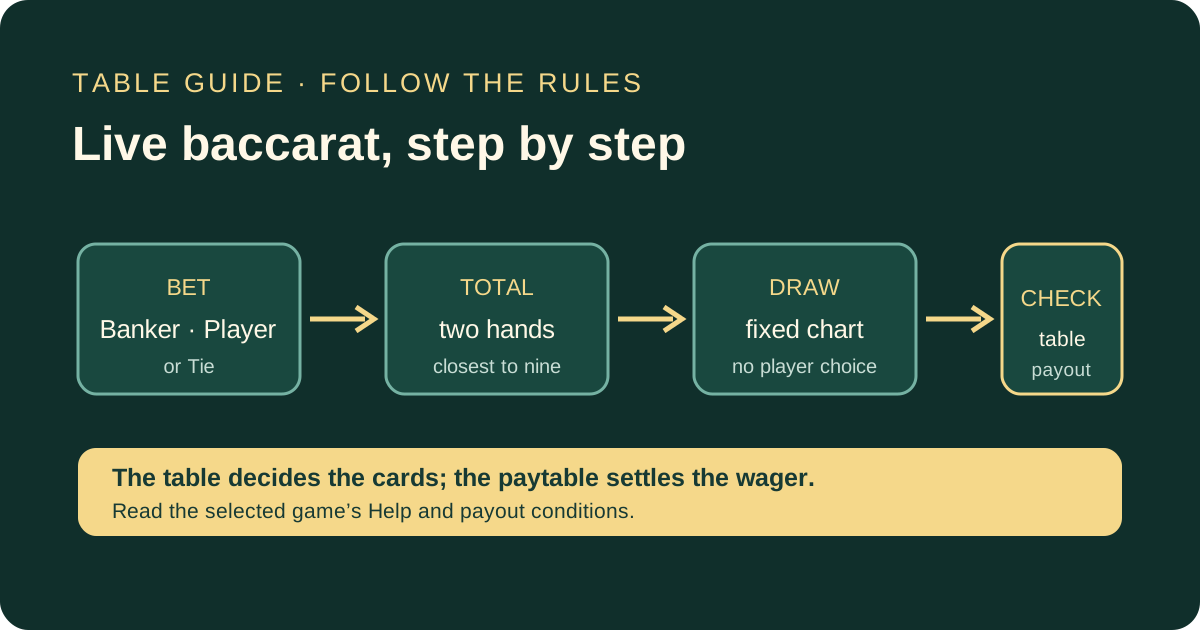
Live baccarat is a streamed card game in which the Player hand and Banker hand are compared, and the hand whose final total is closest to nine wins. In the common punto banco format, neither the bettor nor the dealer chooses whether to draw. The table applies a fixed third-card chart after the opening deal. Before a round, a player normally chooses Banker, Player or Tie; any pair or bonus bets are separate options whose presence and payout must be checked on that table.
The words “Player” and “Banker” name the two hands. They do not mean that the person betting on Player controls cards, or that the house must always win when Banker is selected. A tie is a third possible result. When totals match, the main bets are often returned while a Tie wager wins, but that settlement and its odds belong to the selected table’s rules. Banker commission is also not universal. A conventional table may deduct commission on a winning Banker bet, while a no-commission version can change the settlement for a particular Banker total instead.
This guide explains the standard punto banco sequence and the checks that matter at a live table. It does not claim that every baccarat variant shares one rulebook, that a named product is available to New Zealand accounts, or that recent road patterns predict the next hand.
What “live baccarat” describes
“Live” refers to the streamed presentation: a real dealer handles cards at a physical table, while an online interface displays the betting areas, timer, hand values and result. The stream changes how the round is presented, not the basic meaning of a card total. A virtual betting screen may let several people back the same Player or Banker hand, but their shared bet does not give them a decision about drawing. The rules still determine whether either hand receives another card.
The phrase “baccarat” covers more than one game tradition. Punto banco is the fixed-rule format most online readers mean when they search for live baccarat rules. Other forms, including games where participants can make decisions for a hand, do not necessarily use the same draw procedure. A branded live product can also add side bets, a fee, a bonus animation, a faster dealing pace, a squeeze interface or a multiplier feature. Those add-ons should be treated as table-specific layers around a named ruleset, not as proof that all baccarat games work alike.
Evolution’s live baccarat catalogue, checked on 6 October 2026, lists several distinct products, including standard Baccarat, Speed Baccarat, No Commission Baccarat, Peek Baccarat and other branded variants. Its catalogue separately describes the special settlement of No Commission Baccarat and fees or side features in other products. That is useful evidence that the label “live baccarat” alone does not settle every detail. Read the product’s help and paytable after opening the actual table, and compare the exact displayed game name with the table you meant to select.
A streamed dealer can make the process feel more social, but it does not make card outcomes controllable by chat, a prediction panel or another player’s wager. Betting closes at a displayed point, after which the dealt cards determine the result. The screen can show a shoe, discard area and previous hands, but those visible objects do not turn the fixed drawing sequence into a skill decision for the bettor.
Card values and hand totals
Baccarat totals use a compact scoring system. An Ace counts as one point; cards from two through nine count at face value; and ten, Jack, Queen and King count as zero. Suits usually do not change the main hand total. Add the points in a hand, then keep only the units digit. If the sum is greater than nine, drop the tens digit: a total of fifteen is a baccarat seven, not a fifteen that risks busting.
For example, a hand containing a seven and an eight totals fifteen, so its baccarat value is five. A hand containing a King and a nine totals nine because the King is worth zero. A hand with a six, a four and an Ace totals eleven, so its value is one. The cards do not accumulate toward twenty-one as in blackjack; there is no bust threshold. A hand can receive a third card and still be assessed by the final units digit.
This arithmetic is the first useful check when a table displays a hand result. If an interface shows a hand total and the visible cards appear not to match it, recalculate the cards using baccarat values rather than ordinary addition alone. Confirm whether the interface is showing each side’s total before or after a third card. In a squeeze presentation, the dealer may reveal cards slowly, but the order of reveal does not alter their point values.
The opening two-card total can be called the initial total. That number matters because it can immediately finish a round as a natural, or determine whether Player draws. If Player takes a third card, the value of that card also matters for the Banker chart. The final comparison happens only after the automatic drawing sequence has ended. A high initial total can therefore stop the draw before the interface reveals any additional cards.
How the standard round proceeds
A standard punto banco round follows a short sequence. First, the table opens a betting window. The participant selects one or more permitted bet areas, checks the amount and confirms before the betting timer closes. Second, two cards are dealt to Player and two to Banker under the selected table’s procedure. Third, the initial totals are calculated and checked for a natural. Fourth, if no natural ends the round, the Player and Banker drawing rules are applied. Finally, the finished totals are compared and the table settles each selected wager under its paytable.
A new reader can follow a result without learning every Banker row by asking four questions: what was each opening total, did either side have a natural, did Player draw, and what final totals appeared? That sequence identifies the point at which the decision chart applies. If Player stood, the Banker rule is simpler. If Player drew, the Banker may respond to the value of that card as well as its own initial total.
The dealer performs the draw procedure; a bettor does not tap Hit or Stand. Some interfaces show a highlight or a rule label, and some hide part of a card until the reveal animation is complete. Treat the result history as a record of the finished hand, not as a menu of choices. A road chart may display previous Banker, Player and Tie outcomes, but it does not replace the third-card rule or change the way a new hand is settled.
The sequence also separates an outcome from a payout. The winning hand is determined by the final totals. The amount returned to a winning wager depends on the bet type and payout schedule. A player can correctly predict Banker and still need to know whether the table deducts commission, uses a special payout for a winning six, or includes another condition. The final balance is not determined by the card total alone.
Naturals, draws and stands
A natural is an opening two-card total of eight or nine. Under the common punto banco rule, if either hand begins with a natural, neither hand draws another card and the round is decided from the two opening totals. If both sides have a natural with the same total, the hand is a Tie. A natural nine beats a natural eight. The term describes how the opening hand is made, not a separate betting area.
If neither side has a natural, the Player rule is fixed: an initial total from zero through five draws one card, while six or seven stands. A starting total of eight or nine would already have stopped the round. This Player step comes before the more conditional Banker decision. The chart uses the Player’s third-card value only if that card exists; when Player stands, there is no third-card value to consult.
For Banker, the first two-card total controls the basic action. Totals zero, one or two draw. A total of seven stands. Totals three through six use more specific conditions. If Player stood on six or seven, the common table of play has Banker draw on zero through five and stand on six or seven. If Player drew, Banker totals three, four, five and six respond to ranges of the Player’s third-card value.
This is why a short mnemonic can be useful for remembering a chart but cannot substitute for the table’s help panel. The opening value and the third-card value must be tracked separately. A Banker six is not enough information by itself if Player drew; the value of Player’s third card determines whether the Banker draws. A Banker seven, by contrast, stands under the common chart even when Player drew. If a variant changes a rule, its own interface instructions should take precedence.
Banker’s third-card chart
When Player has drawn, use the Banker’s two-card total as a row and the Player’s third card as the condition. In the standard punto banco chart below, “draw” means the Banker receives one third card; “stand” means the two-card Banker total is final. This is a rules reference, not an instruction to predict which card will appear.
| Banker’s first two cards | Banker draws when Player’s third card is | Banker stands when Player’s third card is |
|---|---|---|
| 0, 1 or 2 | Any value from 0 to 9 | — |
| 3 | 0–7 or 9 | 8 |
| 4 | 2–7 | 0–1 or 8–9 |
| 5 | 4–7 | 0–3 or 8–9 |
| 6 | 6–7 | 0–5 or 8–9 |
| 7 | Never | Any value from 0 to 9 |
The chart’s labels refer to baccarat card values, not card ranks. A third card worth zero could be a ten or a face card. A third card worth one could be an Ace. A table may display a summary of this chart in its Help area, and that table’s exact wording should be checked if its branding or game mode suggests a special rule.
Consider a hand where Player’s first two cards total four. Player draws because the starting value falls between zero and five. Suppose the third card has a baccarat value of seven. Banker begins with five. Under the chart, Banker draws when its two-card total is five and Player’s third card is four through seven, so Banker takes one card. Compare the final totals only after that automatic step.
Now change just one detail: Player’s third card is two while Banker’s initial total remains five. Banker stands, because the total-five row calls for a draw on Player values four through seven. This small comparison shows why saying “Banker draws on five” is incomplete. The statement depends on whether Player drew, and, if so, on that card’s value. A total-five Banker facing a Player who stood follows a different part of the rule procedure.
Banker, Player and Tie bets
The three main betting areas predict the result of the two hands. A Banker wager wins when Banker’s final total is higher, a Player wager wins when Player’s is higher, and a Tie wager wins when both final totals match. These labels describe the outcome, not who controls the deal. Both main hands are part of the same round; choosing a side does not influence how many cards the dealer deals.
A usual table pays an even-money return for a winning Player wager and may charge commission on a winning Banker wager because its payout arrangement differs. Some tables describe the commission as a percentage withheld from winnings; others show a net payout ratio in the paytable. Do not transfer a commission figure from another casino or a supplier overview to the table currently open. Check whether the fee applies to every Banker result or only under specified conditions, how it is rounded, and where the deduction appears in the settlement panel.
A Tie wager commonly carries a larger stated payout than a Player or Banker wager, but a larger multiplier is not the same as a better expected outcome. The event is settled under its own probability and payout schedule, and the paytable should specify what happens to Player and Banker bets when the hands tie. Many standard tables return those main wagers, often described as a push. A variant can set a different payout or tie condition, so verify before placing money.
When comparing ratios, distinguish net winnings from total return. If a winning wager is described as paying one-to-one, a NZ$10 stake may earn NZ$10 in winnings and return the original stake, subject to the table’s settlement wording. A commission deduction can reduce the net amount. If the display says “0.95:1,” confirm whether it describes profit relative to stake or the total amount returned. Interfaces sometimes use “pays,” “wins” and “returns” differently.
The table’s minimum and maximum bet are practical controls, not advice to use them. Check the displayed currency, the amount selected for each bet spot, and whether more than one bet is active. A bet slip or on-screen total can combine Banker, Player, Tie and side-bet amounts. Before betting closes, make sure the total committed stake matches the intended figure rather than assuming the amount beside one chip represents the full round.
Tie settlement, commission and no-commission variants
“No commission” describes a payout design, not a promise that the Banker wager is identical to a standard table in every other respect. Evolution’s public Live Baccarat page describes its No Commission Baccarat as having no five per cent commission on Banker wins, with a specific exception: when Banker scores six, that wager is paid at half the original stake. The same official page describes an optional Super 6 side bet. This is a concrete example of why the exact product and its current paytable matter.
A common commission-free variation replaces the recurring commission with a special settlement for one Banker outcome. Other variants may use different exceptions or additional side bets. If a table is labelled “commission-free,” read the rules for every Banker total and any stated six condition. Do not infer that no commission means every winning Banker wager pays an unmodified one-to-one amount. A changed payout condition is still a changed rule with mathematical consequences.
Tie handling also deserves its own check. Look for whether the Tie bet pays on any equal final total, whether a particular natural tie has a different settlement, and whether Banker or Player stakes push, lose or are returned on a Tie. A tie side bet can be visually prominent, but it remains independent of the main hand comparison. Side-bet wording can reference a pair, a natural or a specific winning margin; read the condition rather than relying on the side-bet name.
Some tables include a Banker-pair or Player-pair wager based on the first two cards. A pair bet does not mean the hand wins overall; a hand can form a pair and still lose the comparison. The settlement depends on the side-bet paytable. Evolution’s catalogue page describes its default pair bets and notes that further optional side bets may be enabled in settings. Another operator may offer a different selection, pay different odds or omit those options entirely.
A useful comparison note records four fields: main-bet payout, Banker commission or exception, Tie treatment and available side bets. It prevents a category-level label from hiding a table-level difference. If any field is absent from the information displayed before betting, use the table’s Help and Paytable controls before wagering, or choose not to play until the rule is clear.
Side bets and branded additions
Pair bets are the most familiar side wagers, but live baccarat products may include bonus bets, pair variants, insurance-style features or branded multipliers. Their names are not a standard vocabulary across studios. A “bonus” wager in one game can resolve on a winning margin; a similarly named wager elsewhere may depend on a natural or an exact card combination. Read the stated condition, eligible hand and payout together.
Evolution’s official catalogue distinguishes the core Baccarat experience from variants with added functionality. It describes a 20% fee for Lightning Baccarat and a 20% fee for Golden Wealth Baccarat in its product explanations. It also describes Peek Baccarat as adding a fee on Banker or Player bets and a mid-round option to increase a bet after a peek. Those mechanics should not be carried over to standard Baccarat. The operator’s game help should identify whether a fee is included in the displayed amount and how it affects any return.
An extra feature can change the wager’s cost without changing the basic Player/Banker/Tie comparison. If the table adds a fee when you place a bet, determine whether the fee is charged on all areas or only on selected ones, whether side bets are treated differently and whether the displayed stake includes it. The wording “fee” can refer to a surcharge rather than a commission taken from a win. Keep those two ideas distinct when reading the rules.
A bonus multiplier or insurance feature can also introduce a second condition that is independent of the main outcome. A main Banker wager can lose while an optional side bet wins, or the reverse. The history or result screen should show the settlement by bet area. Do not count a feature animation as a payout until the game displays the result and amount for the wager that triggered it.
For a first session, it is reasonable to use only the three main bet areas and ignore optional bets until their exact rules are understood. That is a comprehension choice, not a strategy claim. It reduces the number of conditions a reader needs to track while learning the draw sequence, and it makes the round history easier to reconcile with the chosen wager.
Live presentation, squeeze and interface controls
A live baccarat interface may reveal cards face-up, use a squeeze reveal, let a player peel back a digital overlay, or present multiple tables in one window. These are presentation and navigation choices. They do not alter card values unless the named table’s rules explicitly add a game feature. A squeeze can slow the reveal for atmosphere while the third-card chart continues to govern the result.
Before entering a table, identify which panel shows the current betting window, which shows the hand totals, where the paytable opens, and how the game labels the last result. Check whether a tap on the board selects a bet area or changes a display. On a small screen, controls can sit close together; confirming the selected chip and active bet areas avoids confusing a control action with a wager placement.
Some suppliers offer a multi-table view that puts several live baccarat games on one screen. It can make it easier to watch more than one dealer, but the rules and limits still belong to each selected table. The wager placed on one table should not be assumed to carry to another unless the interface clearly shows that. Verify the game title, currency and active bet slip when changing tables.
The round timer is a practical limit. Bets accepted in one round are usually locked before the cards are fully dealt. If the interface shows a countdown, make the decision before the last moment and leave time to check the amount. A delayed stream, reconnect or device notification can obscure the state. The game history or account record can help distinguish a wager accepted in the prior round from one that was not accepted.
A dealer’s hand movement, chat message or animation is not a rules source. For a disputed settlement, keep the round ID and the table name, then compare the result with the paytable that applied at that moment. Rules can be updated, and a saved screenshot from an older session may no longer represent the current version. If a transaction remains unclear, use the operator’s official support channel rather than guessing from an animation.
What road charts can and cannot tell you
Baccarat tables often show bead roads, big roads or derived pattern charts. These are compact records of past results. They may make it easier to see whether recent hands ended in Banker, Player or Tie, but they do not change the dealing rules. They also do not disclose the next cards. A chart that displays streaks is a history visualisation, not a forecast with a guaranteed edge.
A road chart can be useful for record-keeping or for understanding what the interface has recorded. It may have a defined method for deciding which cell receives a result, and derived roads can display patterns based on earlier marks rather than raw cards. If you choose to use one, read the legend so you know whether it records main outcomes, pairs or another event. Do not treat a coloured mark as a recommendation.
The previous hand does not affect the mandatory third-card chart for the next hand. That chart uses current cards: the opening totals and, where relevant, Player’s third-card value. A run of Banker outcomes does not cause the Banker to stand or draw differently. A sequence of ties does not make the next tie “due.” The main bet settles on the cards dealt in the new round.
For a more reliable personal record, note the table name, date, selected bet, displayed rules and final settlement instead of trying to decode a pattern as a prediction. This can help if you need to ask support about a result or compare two product variants. It should not become a reason to increase a stake after a losing run or to keep playing until a pattern changes.
Checking a live baccarat table before playing
Use a short pre-play checklist and stop if a key field is missing. Confirm the table’s exact name and whether it is standard, speed, commission-free or another branded variant. Read the available rules for card values, natural treatment and draw rules. Open the paytable and record Banker, Player and Tie returns, commission or special exceptions, plus any side-bet condition you may select. Check the displayed currency and limits, then make sure the total stake shown matches your intended amount.
If the game has optional fees or enhanced bets, work out what is deducted before the round resolves. Do not assume a feature is free because it appears beside a standard betting area. If you are comparing two tables, compare like with like: use the same main wager, the same stated bet amount and the payout information for each table. A faster round or more elaborate video does not establish a better payout schedule.
For the first few rounds, observing without placing a wager can help you understand where the interface displays cards, totals and result history. If the supplier offers a freeplay mode, access may depend on location and product settings; availability should be confirmed directly on the source or operator page, and this guide has not launched a demo. A freeplay screen can illustrate controls, but it cannot confirm which real-money rules an operator has loaded.
When an operator publishes an information panel, use the version that appears inside the selected table. A generic help page or static review may describe a different market, game build or payout option. If a number on a review site disagrees with the current paytable, the paytable is the useful source for the active session. If the conflict is unresolved, do not place a bet on the assumption that the more favourable description is correct.
Set a session budget and time limit before opening a live table. Treat each wager as entertainment spending that can be lost, and do not use money needed for essentials or attempt to recover previous losses by raising stakes. A fixed-rule draw chart makes dealing easier to follow; it does not remove the chance element or guarantee a result.
Frequently asked questions
Can I choose whether Player or Banker draws?
In standard punto banco, no. The table applies fixed rules after the opening cards. Player draws on an initial total from zero to five and stands on six or seven. Banker’s action follows its own chart, which can depend on Player’s third-card value. Other baccarat traditions or branded products can differ, so the named table’s rules remain decisive.
What is a natural in baccarat?
A natural is an opening two-card total of eight or nine in the common punto banco format. It normally ends the drawing sequence immediately. If both hands have the same natural total, the outcome is a Tie; a nine beats an eight. Check the selected variant’s help panel for any special condition.
Does a Tie make Banker and Player bets lose?
On many standard tables, main Banker and Player bets are returned on a Tie, while a Tie wager can win. This is often described as a push. Do not assume every variant settles it identically; the table paytable must state the result and payout.
Is Banker always paid at even money?
No. Some tables deduct commission on a winning Banker wager, while commission-free variants may use a special payout for a particular Banker result. Read the Banker line in the selected game’s paytable instead of carrying over a payout from another table.
What happens if Player stands on six or seven?
Under the common punto banco chart, Banker draws on an initial total of zero through five and stands on six or seven when Player has stood. If Player draws, Banker totals three through six use the value of Player’s third card, so the applicable chart is different.
Are the Player and Banker bets controlled by the person at the table?
No. “Player” and “Banker” identify the two hands being compared. The online participant predicts which side will finish closest to nine; the dealer or software applies the fixed drawing rules.
Do road charts predict the next hand?
No. Road charts record prior outcomes or derived patterns. They do not change how cards are dealt, and a past streak does not compel a particular result in a new hand. Use them as a display of history only.
Is commission-free baccarat the same game with a better payout?
Not necessarily. A no-commission product can replace a recurring commission with a special settlement, such as a reduced payout on a designated Banker total. Compare both the commission and every exception in the selected table’s help.
Sources and verification boundary
Checked 6 October 2026. The official supplier catalogue establishes the existence of multiple live baccarat products and describes several table-specific fees and features; its public overview is not a complete substitute for the current table’s in-game Help and Paytable. The exact operator build, local account access, limits and settlement were not supplied or tested. NZ search demand was not measured. This page is informational and contains no casino referral button.
- Evolution: Live Baccarat and Sic Bo catalogue
- Evolution: Insurance Baccarat product explanation
- PokerStars: Live Baccarat rules
- BetMGM: Live Baccarat help
- Singapore Gambling Regulatory Authority: baccarat game rules
- Competitive comparison checked 6 October 2026: Live Baccarat.io rules, LaroScope third-card guide, Baccarat Terminal rules. These are secondary editorial sources, not controlling payout documentation for a named New Zealand table.
