Live blackjack rules · South Island guide
Live blackjack rules: decisions, table rules and payouts
 Best casinos available in New ZealandUpdated 7 November 2026

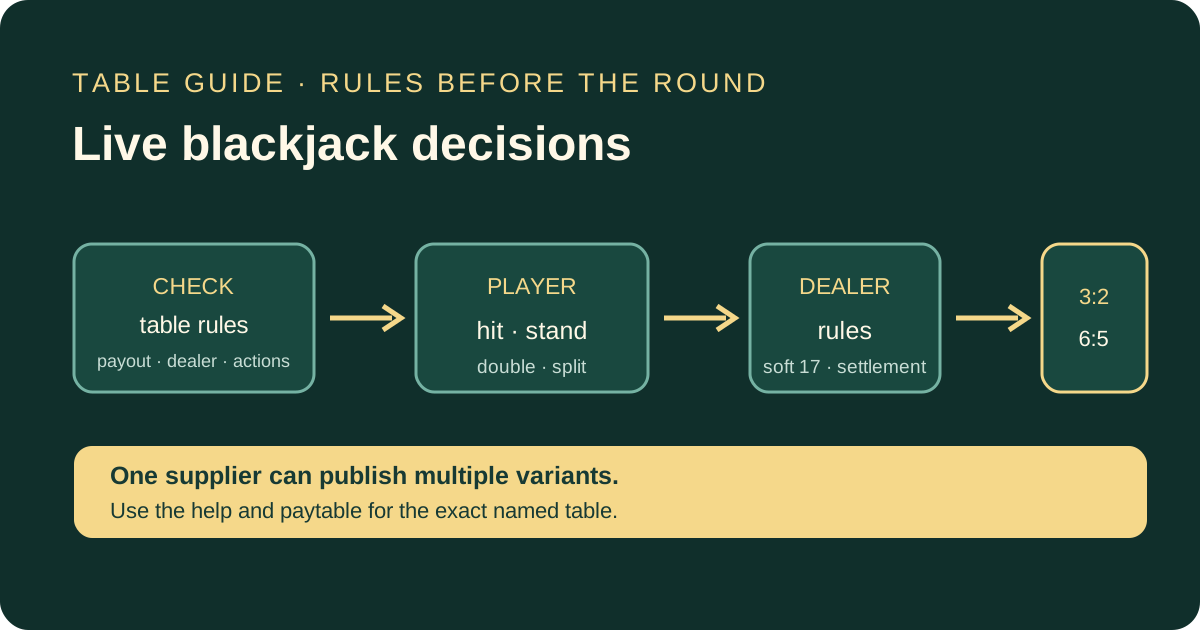
Live blackjack uses a streamed dealer and a digital betting interface, but there is no single universal ruleset. Hit, stand, double and split describe common choices; dealer drawing rules, natural-blackjack payout, insurance, split limits and side bets depend on the specific table. Compare the rule panel and paytable before betting. A 3:2 natural payout returns NZ$15 net on a NZ$10 winning stake, while 6:5 returns NZ$12 net; neither ratio tells you the table’s full house edge by itself.
The short answer
Live blackjack is a card game played through a live stream and an on-screen table. The aim is to finish with a hand closer to 21 than the dealer without going over, but the details are table-specific. Before a wager, check how the dealer treats a soft 17, when a player may double or split, whether split aces receive one card or can be played further, what insurance covers, and how a natural blackjack is paid. The table’s own help and paytable are the authority for that session.
The most visible payout comparison is a natural blackjack paid at 3:2 or 6:5. If a NZ$10 hand qualifies for the stated natural payout, 3:2 means NZ$15 in net winnings; 6:5 means NZ$12. In both cases the original NZ$10 stake is usually returned as well, subject to the game’s settlement wording. That NZ$3 difference applies to this example, not to every hand. A payout label alone does not establish the game’s total expected return.
This guide explains the common decisions, what they change, and how to compare two live tables without treating one provider’s product page as a universal rulebook. It does not provide a betting system, claim a winning strategy, or confirm that a particular live casino is offered to New Zealand accounts. Evolution’s catalogue itself separates classic blackjack from variants with different features, which is a useful reminder to open the rule panel for the named table rather than carrying rules over from a different game.
What “live blackjack” tells you—and what it does not
In a conventional live-dealer table, cards are dealt in a studio or casino setting and shown by a camera. The player uses a digital layout to place a main bet and then selects an action when prompted. The visual stream can make the dealing sequence easier to follow, but it does not define the payout or decision rules. A game title, table limit, seat count, side-bet menu, shoe size, and settlement rules may differ between products even when the felt layout looks familiar.
Evolution describes its classic live blackjack tables as a regular seven-seat format and separately describes Infinite Blackjack as an unlimited-seat variant. It also lists other products with distinct mechanics. These are supplier-level product descriptions, not a promise about which version an operator has enabled, what currency it uses, or the rule sheet attached to a particular lobby tile. A brand may show several tables from one supplier, and an operator may list more than one table with the same broad name but different limits or settings.
The phrase “live blackjack” is therefore a category label, not a complete specification. It does not, by itself, tell you whether the dealer hits or stands on soft 17; whether a dealer checks for blackjack before player actions; whether doubling is allowed on any two-card hand; whether a split can be repeated; whether an ace can be split again; or whether a natural pays 3:2, 6:5, or another stated amount. Those fields need to be read from the game that will actually accept the wager.
An especially important distinction is between a conventional live table and a named variant. A product may share card values but add a fixed dealer card, a bonus multiplier, a fee, free doubles, a different number of seats, or a side-bet feature. Those changes can affect decisions or the way a wager settles. The general explanations below help decode the labels; they do not replace rules for a named variant such as a bonus-based or “free bet” blackjack product.
Hand values and the objective
Number cards normally count at their printed value, picture cards count as ten, and an ace can count as one or eleven depending on which value helps the hand without busting. A hand with an ace counted as eleven is commonly called soft; if the ace must count as one to keep the total at or below 21, the hand is hard. For example, ace plus six can be a soft 17, while ten plus seven is a hard 17. If a later card would take the soft hand above 21, the ace can be treated as one instead.
A natural blackjack usually means an ace and a ten-value card as the original two cards. It is not always equivalent to making 21 with three or more cards. The paytable usually lists the natural payout separately from an ordinary winning hand, so a player should not assume that any total of 21 receives the same premium. If the dealer also has a natural, the hand may push rather than pay as a player win; confirm the particular rules’ order of comparison and settlement.
Blackjack is usually a player-versus-dealer comparison. Other people at the table may make different decisions, but their cards do not normally change the basic win condition for a seated hand. A shared initial deal in an unlimited-seat product or a “bet behind” option may change how the interface presents the hand. Read the product-specific explanation so you know whether you are playing your own hand, backing another seat, or participating in a distinct variant.
The objective is not simply to “get close to 21.” A player who exceeds 21 busts and ordinarily loses the main wager without waiting for the dealer’s final total. A player who stands keeps the current total for comparison. If the dealer busts, surviving player hands typically win; if neither busts, the higher total generally wins and equal totals generally push. These are common conventions, and the official game help should confirm whether the table uses them or includes exceptions.
How a round usually proceeds
First, the table opens a betting window. The player selects a seat or a permitted behind-bet position, chooses a stake, and places the main wager before the countdown ends. Optional side bets, when present, are separate wagers with their own conditions and paytables. The interface may let a player repeat a previous set of selections; check the full total before using that control because one stored layout can contain several positions.
After betting closes, initial cards are dealt and the interface shows the player’s hand plus whatever dealer card or cards the product displays. Some tables offer a natural-blackjack check at a particular point; other variants use a different sequence. The player is then prompted for an eligible action. The available buttons can depend on the hand, the dealer’s upcard, prior actions, and whether the hand was split. A disabled button may reflect a rule, not a software fault.
Once player decisions finish, the dealer follows the table’s fixed drawing rule. The dealer does not usually make discretionary strategy choices in the way a player does. When all hands are resolved, the interface displays wins, losses, pushes, and any side-bet settlement. A card stream can be difficult to follow on a small screen, so review the hand history or round summary if a displayed result is unclear. The balance update should correspond to the stakes and paytable, rather than a celebratory animation alone.
In a multi-seat game, the order of decisions and the stream’s pace can matter for understanding the prompt. “Initial decision” or early-decision features let some players choose before the usual turn order reaches them, while other tables require a player to wait. That convenience does not establish a different mathematical rule. If the interface gives a short response timer, make sure the selected action is intentional; do not leave the browser unattended with a live hand open.
Hit and stand
“Hit” asks for another card. It may improve the total or cause the hand to bust. A hit normally remains available until the player stands, busts, or reaches a hand state where the table no longer permits another draw. The game interface should show the current total, though an ace can make that total soft or hard depending on the cards received. The button is an action, not a promise that the next card will help.
“Stand” ends the player’s drawing for that hand and locks its current total for dealer comparison. Standing does not automatically win, even on a strong-looking total. The dealer still has to complete the table’s required play, and a dealer natural or higher total may defeat the hand depending on the rules. Conversely, a player total below 21 can win if the dealer busts. A decision should be understood as fixing the player hand, not as receiving a guaranteed outcome.
The same pair of cards may present a different decision depending on whether the total is soft or hard, whether the dealer shows an ace, and what the rules allow. This guide does not give a universal hit/stand chart because a chart depends on the table’s number of decks, dealer soft-17 rule, doubling and surrender options, and other details. A chart copied from another product can silently assume a different game. If a player studies strategy, it should match the complete rule set displayed by the selected table.
Double down
Doubling down usually means adding an amount equal to the original main wager in exchange for receiving a limited additional card and then standing. Some games offer the choice on any initial two-card hand; others restrict it to certain totals or states. It may be unavailable after a split, or available only for particular split hands. The action’s exact timing matters because it changes the total amount at risk and limits further choices.
Before selecting double, read the amount shown in the control. If the original stake is NZ$5 and the table lets the player double for an equal amount, the hand’s main exposure becomes NZ$10. This arithmetic is only an example of what “double” means; the actual accepted amount, any cap, and the payout currency come from the current table. A double is not the same as increasing the original bet after seeing the dealer’s final total.
Some variants use free-doubling mechanics or add a fee to certain actions. That can make the interface look like a standard double while changing who funds the extra wager or how much is settled. The name of a feature does not answer the accounting question. Confirm whether an extra amount is deducted, whether a bonus element is involved, whether a win pays the main hand and the added wager, and what happens to the extra amount on a push or loss.
Split
Splitting turns an eligible two-card pair into separate hands, usually by placing a second main wager matching the first. Each resulting hand is then played under the table’s split rules. A player may need to decide whether to hit or stand on one hand before continuing to the other. Because the split normally increases total exposure, the amount shown for both hands should be checked before confirming the action.
“Pair” can be defined by equal ranks or equal values in the table help. Two ten-value cards may or may not qualify as a pair when their ranks differ; the table’s rule wording controls. Rules can also restrict resplitting, specify whether split aces receive only one card, or forbid doubling after a split. Some products treat a two-card 21 after a split differently from a natural blackjack. Those distinctions affect both what buttons appear and whether the hand receives a special payout.
When the split button is offered, the interface should make clear whether the second stake will be added immediately. A split does not improve the odds of the cards that have not yet been dealt; it creates more than one hand and exposes more money to settlement. A player can end with one winning hand and one losing hand, two pushes, or any other combination allowed by the rules. Review each resulting hand independently and avoid thinking of the split as a guaranteed rescue for an unfavourable pair.
Dealer rules and soft 17
The dealer generally follows a mandatory rule rather than choosing a strategy. A table may say “dealer stands on soft 17” or “dealer hits soft 17.” A soft 17 contains an ace counted as eleven and totals 17; the distinction matters because drawing can improve the dealer’s hand or cause it to bust. A hard 17 has no ace counted as eleven without exceeding 21. The exact table wording should say whether the dealer hits or stands on each required total.
Dealer rules can also specify how many cards are dealt face up, whether there is a hole card, and when a check for a dealer natural takes place. In some dealing styles, the dealer’s second card is hidden initially; in others, the sequence is different. Insurance and player action timing are related to the dealer’s visible card and any check. Do not infer this sequence from a physical casino or a different live table, particularly when the interface uses a variant-specific deal.
A dealer standing rule is not a recommendation about the player’s hand. It is a deterministic instruction for completing the dealer’s total after players have acted. The table might also describe what happens on a dealer 22 or another exceptional result; that is a special product condition, not a standard assumption. The dealer’s game help should be read in full if the table includes a named modifier or side game.
Insurance
Insurance is usually offered when the dealer’s visible card is an ace. It is a separate side wager on whether the dealer has a natural blackjack, rather than a way to protect every possible loss. The offer normally appears before the player completes ordinary hand decisions because the dealer’s hidden card may settle the insurance proposition first. The cost, maximum insurance amount, payout ratio and settlement order are all table-specific.
Some rule sheets describe insurance as a fraction of the original bet and give a separate return if the dealer has blackjack. For example, a table might cap the insurance stake at half the main wager, but that should be treated as an example only until the current rule panel confirms it. The player should check whether the insurance amount is deducted as a new wager, what is returned when it wins, and what happens to the main hand in the same round. “Insurance” in the button label does not mean the original bet is always preserved.
Insurance decisions are often framed as protection, but mathematically they are a separate proposition with a separate payoff. The fact that a player has a strong main hand does not change the dealer’s hidden card composition in a way visible from the interface, and taking insurance does not change the main hand’s rules. This article does not recommend taking or declining it universally. A decision rule would depend on the game’s card composition, the dealing procedure and the specific payout.
Do not confuse insurance with an even-money offer on a player natural. A table may present a player who has blackjack with an option that effectively resolves the hand in a particular way when the dealer shows an ace. The exact language matters: compare the main hand’s natural payout, dealer-blackjack check and offered side wager. If the interface uses “even money,” “insurance” or another term, the rules should explain whether it is a separate stake or an early settlement choice.
Natural blackjack: 3:2 versus 6:5
The ratio describes net winnings per unit of qualifying natural-blackjack stake. For a NZ$10 main bet, 3:2 is three halves of the stake, or NZ$15 net; 6:5 is six fifths, or NZ$12 net. If the original stake is also returned, the total credited amount in a winning example would be NZ$25 under 3:2 and NZ$22 under 6:5. The table’s paytable should state whether it displays net profit or total return, so use its accounting definition when reconciling a result.
The NZ$3 difference in that example applies only when the hand qualifies for the natural-blackjack payout and the table pays those stated ratios. It is not a claim that every 3:2 table is better under every other rule, nor a complete house-edge calculation. A dealer soft-17 rule, number of decks, split restrictions, double rules, blackjack tie settlement and side bets can all matter to the full game. To compare two tables fairly, hold the other published conditions in view rather than reading one payout figure in isolation.
Check what qualifies as a natural. An ace and a ten-value card as the first two cards is the common meaning, while a hand that reaches 21 after hitting or splitting may be paid as an ordinary win. A variant can change this distinction, so the table help must specify it. Also check whether a natural pushes against the dealer’s natural or whether the product has a special side wager that changes the result.
Some review pages state a single blackjack payout as though it applies to every table from a provider. That is not enough evidence for a particular current session. An operator may host multiple suppliers, variants or rule configurations. Use the named table’s paytable, record the natural payout, and then read the remaining rules that affect the game’s return. If the paytable does not expose a clear ratio before betting, do not guess from another site’s screenshot.
Side bets, bet behind and table variants
Side bets are optional wagers with conditions separate from the main hand. Examples can include pair combinations, card combinations involving the dealer’s upcard, or a bet on a particular dealer outcome. Each has its own paytable and may carry a different probability and expected cost from the main game. The main blackjack rules do not tell a player whether a side bet is favourable; the side-bet panel is needed to know the qualifying cards and payout.
Evolution lists optional products such as Perfect Pairs and 21+3 on many classic tables, while some named products have other side-bet menus. This supplier catalogue helps identify that variation exists. It does not establish that every table contains those bets, that their payout schedule is identical, or that an operator makes the game available in New Zealand. When comparing tables, treat each side bet as a separate product and check its own help.
“Bet behind” lets a person wager on a seated player’s hand where a table offers it. That may help someone join a full table, but it does not give the behind-bettor control over the seated player’s hit, stand, double or split choice. Confirm whether the bet follows one hand or multiple selected seats and what happens if the seated player misses a prompt. A related feature, an unlimited-seat format, may deal a shared initial hand and then let participants make separate decisions; do not assume every infinite-seat product works the same way.
Named variants may also change the dealing sequence, decision timing, fees, seat count, dealer card or settlement. A variant description can help identify these differences, but the help panel is still necessary to know their exact consequences. The remaining sections focus on a pre-bet comparison routine rather than transferring a rule from one product to another.
A table-by-table verification checklist
Before you compare tables, note the exact game name and provider as displayed inside the game. Then open the help and payout screens rather than relying only on the lobby tile. Record the natural payout, dealer soft-17 action, whether a dealer blackjack check occurs, eligible double hands, split and resplit limits, split-ace treatment, and insurance terms. If surrender or a special dealer-22 rule appears, include that as a distinct field.
Next, compare the table’s financial controls: currency, minimum and maximum for the main bet, side-bet range, permitted seat or behind-bet options, and what happens to an added wager on a split or double. A display may show values in a currency different from the player’s usual account balance. Exchange fees or account conversion are operator-specific and cannot be inferred from the game supplier’s rules. A round with several side bets or split hands can put more at risk than the main stake alone.
Finally, check timing and interface behaviour. Note how long betting remains open, whether a repeat-bet button preserves side bets, what the decision timer does if a player does not act, and whether a hand history is available. A fast round is not necessarily a better round. If the stream pauses or the connection drops, the operator’s account and game rules explain how the hand is resolved; do not reconnect repeatedly without understanding whether an existing wager is still active.
A compact table note can be written as: “Name / payout / dealer soft 17 / double / split / insurance / currency / limits / side bets.” If one field is missing, treat it as unknown rather than filling it from another provider’s general rules. This method is useful even when comparing two tables from one supplier because product pages and table help can cover different layers of detail.
How to interpret an unclear result
If a hand result looks wrong, start with the round summary and the active rules panel. Identify the original bet, any insurance stake, each split hand, added doubles, side bets and the final settlement. Check whether the hand was a natural or a later total of 21, whether a push returned a stake, and whether a side bet was settled independently. A familiar animation is not an accounting record.
Save the game name, table identifier, round reference and a screenshot of the rules if the platform provides one. Avoid publishing personal or account details in a public complaint. Contact the operator through its stated support route with the hand ID and a neutral description of the difference between the displayed rule and the account history. The supplier’s general product page may clarify the feature category, but the operator’s current rule panel and record are needed for the particular round.
If the issue is a missing payout ratio or a button that is not explained, stop before placing another wager. The goal of this guide is to make the decision and payout labels readable, not to resolve a dispute in the abstract. A rule that cannot be verified before the bet is a reason to pause and seek the platform’s explanation rather than assume the more favourable interpretation.
New Zealand context and responsible limits
This is a rules reference for reading a table, not a statement that an online operator or particular blackjack product is available to a New Zealand player. The Department of Internal Affairs publishes New Zealand casino table-game rules for authorised land-based casinos and notes that not all casinos offer every listed game. Those rules should not be silently substituted for an online supplier’s table help. The Department’s current online-gambling guidance also addresses advertising and the transitional licensing regime; this page contains no operator promotion or affiliate button.
Set a maximum entertainment spend and a time limit before opening a table. Include main bets, doubles, splits, insurance and side bets in the same budget. A choice that adds a second wager can increase the amount at risk even if the interface presents it as a single action. Do not use credit or money set aside for rent, bills, food, transport or savings, and do not increase a limit to recover a previous loss.
Take a break if decisions begin to feel rushed or if stopping becomes difficult. A live stream can continue presenting hands quickly, and the dealer’s conversation or other players’ choices do not require you to remain at the table. Close the game when the planned limit is reached. The site’s New Zealand safer gambling guide lists independent support and ways to step away.
Frequently asked questions
What does hit mean in live blackjack?
Hit asks the dealer to add a card to the active player hand. The new card can improve the total or take it above 21, which is usually a bust. The available action and consequences should be confirmed in the active table’s help.
What does stand mean?
Stand ends further drawing for that hand and leaves its current total for comparison after the dealer completes the required play. It does not guarantee a win; the dealer can still finish higher or a tie can push, depending on the rules.
What is the difference between 3:2 and 6:5 blackjack?
They are payout ratios for a qualifying natural blackjack. On a NZ$10 stake, 3:2 means NZ$15 net winnings and 6:5 means NZ$12 net winnings. Check whether the paytable reports net profit or total return and confirm that the hand qualifies as a natural.
Does insurance protect the main bet?
Insurance is generally a separate wager about whether the dealer has blackjack, not an automatic guarantee that the main hand is preserved. Read its amount, payout, and settlement order in the selected table help before choosing it.
Can I split any two cards with the same value?
Not necessarily. Tables can define eligible pairs by rank or value and can limit resplitting, split aces, or later doubling. The split button and table rules determine what this particular game permits.
Does every live blackjack table make the dealer stand on soft 17?
No universal rule should be assumed. The help panel should state whether the dealer hits or stands on soft 17 and explain the dealer’s other drawing requirements.
Can I apply a strategy chart from another blackjack game?
A chart may assume a different deck count, dealer rule, natural payout or action restriction. Use a chart only when its assumptions match the table’s complete published rules. This guide does not offer an all-tables strategy chart.
Does a live dealer make a table’s rules easier to predict?
The stream shows the cards and dealing sequence, but it does not replace the written rules or make future cards predictable. The paytable and help panel remain the sources for the table’s actions and settlements.
Sources and verification boundary
Primary pages checked 15 June 2026: Evolution’s Live Blackjack catalogue for its published distinction between classic tables, Infinite Blackjack and named variants; New Zealand DIA Rules of Casino Table Games for the current land-based New Zealand blackjack rule document; and DIA guidance for online-gambling advertisers for the current advertising transition. PokerStars’ live blackjack rules were reviewed as a competitor example, not used as a universal rule source.
The NZ$10 examples are arithmetic applied to the payout ratios written in the example; they are not claims about a currently available table. Evolution’s catalogue page is a supplier overview, not the help sheet for every table. No selected operator, current table help, rules PDF for an identified table, geographic access, stake limit, dealer rule or payout was supplied for this review. No game was launched, no wager was placed, no CPA route was opened and no New Zealand online access is claimed. Check the exact table help before any future public update.
