Live craps rules · South Island guide
Live craps rules: come-out rolls, points and pass line
 Best casinos available in New ZealandUpdated 7 November 2026

Live craps is easiest to follow as two linked phases: a come-out roll either resolves a Pass Line wager or establishes a point; later rolls settle that point when it repeats or a seven appears. This guide explains Pass and Don’t Pass, true-odds bets, practical settlement examples and the table-specific details to confirm before a wager.
The short answer
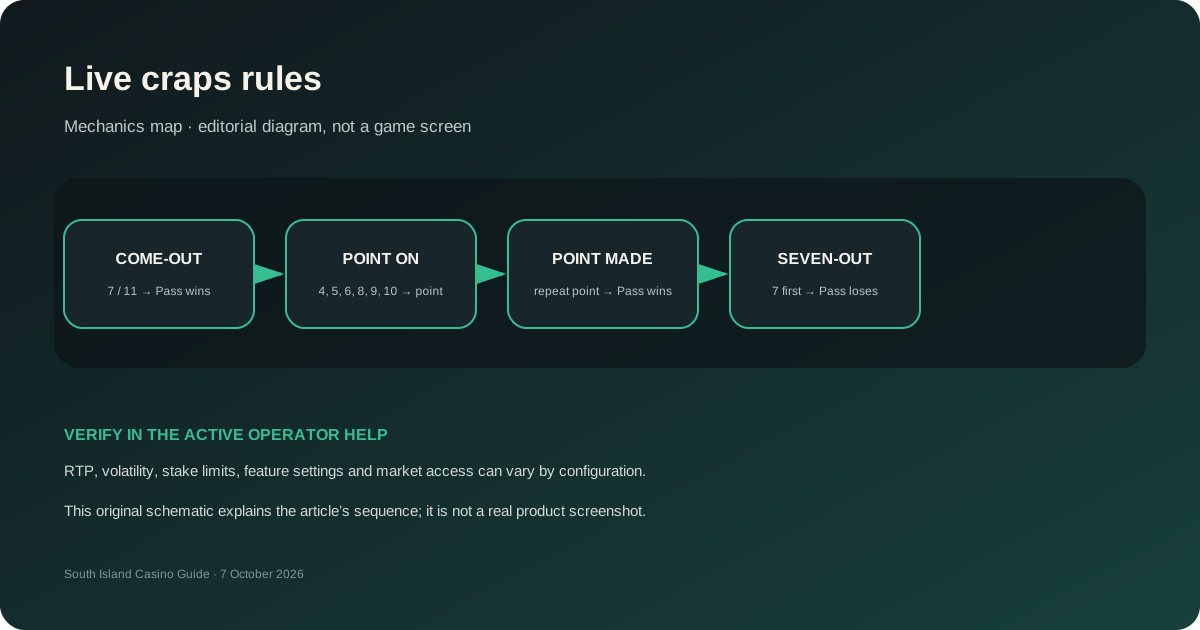
Live craps uses two dice and separates a round into the come-out phase and the point phase. On a standard Pass Line wager, a come-out total of 7 or 11 wins at even money; 2, 3 or 12 loses; and 4, 5, 6, 8, 9 or 10 establishes the point. Once a point is on, the Pass wager stays unresolved until that same point repeats, which wins, or a 7 appears first, which loses. Other totals leave that line wager in place.
The simplest way to read a live craps screen is to find the point marker, then ask whether the next result settles your bet or simply leaves it active. The Don’t Pass line takes the opposite side of the point race, but it has its own come-out outcomes and a common 12 push. An odds bet is an optional second wager attached to a line bet after a point is set; it pays according to the point-specific true odds and is subject to the table’s maximum.
The guide below explains the standard structure rather than claiming every live-casino product uses identical controls, caps or rules. The Evolution public page describes the two-stage round and its tutorial, but the exact table help should be checked for the markets actually offered. The Department of Internal Affairs’ current advertiser guidance also means this page does not include an operator or affiliate button while that issue awaits qualified review.
Read the table state before reading the dice
The key visual aid is commonly a puck or point marker with an “on” and “off” state. “Off” means the come-out phase: a new point has not yet been established for that shooter. “On” means a point is active. A number can therefore mean different things at different moments. A 7 on the come-out is a natural that wins a standard Pass Line bet; a 7 after a point is set is a seven-out that loses that Pass bet. Reading only the number without the marker is a frequent source of confusion.
At a streamed table, the interface normally separates the dice result, the point status, bet areas, countdown timer, dealer commentary and settlement notifications. Use the state indicator as the primary guide, then check the result history as a secondary reference. A history road can help you review what just happened, but it does not change the current rule or tell you what the next roll will be. A string of repeated points does not make a future 7 or point more predictable in a fair dice process.
Before a round begins, confirm which part of the interface accepts the bet and when betting closes. A chip can appear on screen while a wager is still pending or can be rejected if the window closes; only the accepted-wager record should be treated as proof that a bet is live. In a disputed settlement, note the game name, round identifier if shown, accepted stake, displayed state and final result rather than relying on a cropped screenshot of the dice alone.
The two phases do not represent separate games. The same shooter can continue through multiple point cycles. When the point is made or the shooter sevens out, the point state resets and the next come-out begins according to the table’s procedure. Some online presentations automate the next round quickly; the speed of that transition does not change how the previous bet settled.
The come-out roll: the first decision point
For a standard Pass Line wager, the come-out roll resolves immediately on three totals: 7 or 11 wins even money, and 2, 3 or 12 loses. Any of the other six possible totals—4, 5, 6, 8, 9 or 10—does not settle the Pass Line wager. Instead it becomes the point. The dealer or interface marks that number and the game moves into the point phase.
“Even money” means a winning stake earns profit equal to the original stake, while the stake is also returned. It is important to distinguish the profit from the total returned amount: a $10 winning line wager ordinarily produces $10 profit plus the $10 stake, for a $20 total credit, before any unusual table rule. Interfaces sometimes label returns in different ways, so check whether a quoted figure means profit only or stake plus profit.
Consider a hypothetical $10 Pass Line wager. A come-out total of 8 establishes 8 as the point; the $10 remains at risk. A total of 3 on that first roll loses the line wager immediately. If the first roll is 11, the line wins immediately. This example describes the standard rule only, not a minimum stake, a specific product’s allowed currency or an operator’s current availability.
The Don’t Pass bet is not simply “Pass with a minus sign.” On the come-out, 2 or 3 wins, 7 or 11 loses, and 12 commonly pushes: the wager is returned without profit or loss. A bar on the layout may indicate the push number. Some table rule sets can treat that bar differently, including a different number, so look at the exact help text rather than assuming that every screen uses the same Don’t Pass exception.
If the Don’t Pass come-out result is 4, 5, 6, 8, 9 or 10, that total becomes the point and the wager stays active. The Don’t Pass side wins if a 7 arrives before that point repeats. It loses if the point repeats first. This is why observing the point marker is essential even when betting the opposite side.
Point phase: repeat the point or roll a seven
Once a point has been established, the Pass Line wager becomes a race between two outcomes: repeat the point and win, or roll a 7 first and lose. If the point is 6, then a later 6 settles the line as a win and a 7 settles it as a loss. A 2, 3, 4, 5, 8, 9, 10, 11 or 12 does not settle that Pass wager; the point remains active and the next relevant roll continues the same race.
The Don’t Pass line follows the reverse race after its own point is established. It wins if the shooter rolls a 7 before repeating the point and loses if the point appears first. This “before” relationship matters: a 7 is not a universal losing number for every bet on the table. A player may hold one wager that wins on 7 and another that loses on 7, because bets can cover different conditions or different point numbers.
For example, suppose the come-out establishes 9. A Pass Line bet stays open through a 4, an 11 and a 5. If 9 is rolled next, the pass wager wins. If a 7 arrives before 9, it loses. The same sequence from a Don’t Pass perspective gives the opposite result: an intervening 7 wins; a 9 loses. If neither the point nor 7 appears, both line bets can remain unresolved across several throws.
The point may remain active while players place other eligible wagers, depending on table rules and interface timing. That does not mean every chip participates in the point race. One-roll bets, place bets, hardways and odds positions each have their own conditions and may be “working” or “off” at particular moments. This guide focuses on the line and odds wagers; it does not treat unrelated proposition bets as interchangeable with them.
When the point resolves, the table normally pays winning bets and removes losing bets according to their own rules, then moves to a new come-out state. A line-bet win does not automatically mean every unrelated bet wins, and a seven-out does not necessarily settle every other wager the same way. Read each active position separately before interpreting the account balance.
Pass Line and Don’t Pass at a glance
| Stage | Pass Line | Don’t Pass |
|---|---|---|
| Come-out 7 or 11 | Wins even money | Loses |
| Come-out 2 or 3 | Loses | Wins even money |
| Come-out 12 | Loses | Commonly pushes; verify the table’s bar rule |
| Come-out 4, 5, 6, 8, 9 or 10 | Establishes the point | Establishes the Don’t Pass point |
| After point: point repeats first | Wins | Loses |
| After point: 7 arrives first | Loses | Wins |
| Other total after point | Bet remains unresolved | Bet remains unresolved |
This summary is intended for orientation, not a replacement for the named table’s complete rulebook. The table may have separate rules for removing a line bet, placing a wager after the come-out, or handling a point that is already on when a player joins. Do not infer one of those procedural rules from the basic settlement chart.
The table also distinguishes a wager’s original stake from an optional odds wager. A Pass Line bet can win at even money while the odds portion, if one was accepted, returns a different profit based on the point. The two amounts should be read separately on the settlement panel. A combined payout can obscure that distinction if an interface shows only one total.
Odds bets: what “true odds” means
After a point is established, a player may be allowed to take odds behind a Pass Line bet. The odds wager is conditional on the same point race: it wins when the Pass Line bet wins and loses when the Pass Line bet loses. In a standard layout, the profit on the odds component is paid at true odds for the point: 2:1 on 4 or 10, 3:2 on 5 or 9, and 6:5 on 6 or 8. The original odds stake is also returned on a win.
Those ratios follow from the number of two-dice combinations that make each total. Four and ten can each be formed in three ordered ways out of 36; six and eight can each be formed in five ways; five and nine can each be formed in four ways. A seven has six combinations. Once a point has been rolled, the odds wager compares that point’s combinations against the six ways to make 7. For a point of 4, there are three point combinations against six sevens, so the 7 has twice as many ways to appear before a repeat; a successful 4 therefore pays 2:1. For a 6, five combinations face six sevens, giving 6:5.
The odds portion is often called a “true odds” bet because its payout ratio matches that point-versus-seven comparison. That phrase does not tell you how large an odds bet is allowed, whether the software accepts fractional amounts, how rounding works or whether the operator offers it at all. The flat line bet and the odds amount are still separate wagers, and the table’s maximum-odds multiplier can vary.
An example makes the accounting clearer. Imagine a $10 Pass Line wager, a point of 6 and an accepted $20 odds bet. If the 6 repeats before a 7, the line wager ordinarily earns $10 profit. The odds part pays 6:5, or $24 profit on $20, in addition to returning its $20 stake. The line stake is returned as well. The total credit would be $64 under those standard terms: $10 line profit, $24 odds profit, and $30 in returned stakes. A different point, cap, rounding rule or displayed definition can change the displayed total; confirm it in help.
Lay odds and the reverse calculation
When a Don’t Pass point is established, the optional odds wager is generally a lay bet: the player risks a larger amount to win a smaller amount at the inverse true odds. Common standard profit ratios are 1:2 on a point of 4 or 10, 2:3 on 5 or 9, and 5:6 on 6 or 8. The first number here refers to profit and the second to the risk. Risking $20 at 1:2, if accepted and successful, produces $10 profit plus the return of the $20 stake.
These ratios reflect the same dice combinations seen from the other side of the point race. For a Don’t Pass point of 4, the shooter must roll a 7 before repeating 4. Since a 7 has six combinations and 4 has three, the lay side has twice as many ways to win as lose within that pair of relevant outcomes; the profit must therefore be smaller than the risk. For a point of 6, six combinations make 7 and five make 6, so a successful lay odds stake risks six units to win five, commonly written 5:6 profit-to-risk.
The screen can use “lay” or “odds” for this position, but wording varies. Confirm which amount is the amount at risk and which is potential profit. A listed ratio of 5:6 may be misread if the interface displays it in a format that puts the stake first. Read the example in the table help and compare it with a small hypothetical amount before staking.
Odds wagers can materially increase the amount exposed during a point phase. A low theoretical house advantage on a combined line-and-odds position does not make a larger stake safe, remove variance or guarantee that a session lasts longer. The line wager remains exposed to its normal result, while the odds portion can add a substantial additional loss when a 7 appears before the point.
Why the point’s probability is not the same as a prediction
The combinations of two fair six-sided dice are not equally likely by total. There is one way to make 2, two ways to make 3, three ways to make 4, four ways to make 5, five ways to make 6, six ways to make 7, then the counts mirror back down to one way for 12. That count is a mathematical description of possible combinations, not a forecast of when an outcome will occur in a particular stream.
After a point is established, only the point and 7 settle a basic line wager. The other totals can be ignored for that wager even though they may resolve a different market. A roll of 8 during a point-6 phase may be meaningful for a place bet or another position, but it does not resolve Pass Line. This is one reason the felt can look busy while a specific line bet remains unchanged.
A “hot table,” recent streak, dealer rhythm or player chat does not change the number of combinations available on a fair roll. Independent rolls can produce streaks without contradicting their mathematical structure. The chance of a result over many rolls is not the same as a guarantee that it will appear within a short session. Any interface statistics should be treated as historical records unless the rules explicitly say they alter a game feature.
The house advantage is specific to a wager and its exact rules. A simple Pass Line has different mathematics from an Any Craps proposition bet or a field bet. Odds are a separate add-on and do not erase the risk of the base wager. Avoid comparing “best” bets based on one table’s commission, cap or rule to a differently configured game without matching the assumptions.
Settlement examples without a particular operator’s cap
Example one: Pass wins on the come-out. A player places a line stake before the new round. A 7 appears while the point marker is off. The standard Pass Line wager settles as a win at even money. There is no point phase for that round, and a separate bet would need to be judged by its own market conditions.
Example two: Pass point is made. A come-out 5 establishes 5. A later 8 does not settle the line. A later 5 wins the Pass Line wager. If the player also accepted odds, the odds part is paid at its 3:2 profit ratio, subject to the stake and the table’s accepted amount.
Example three: seven-out. A come-out 10 establishes 10. The shooter rolls 6 and 4, neither of which settles the line. A 7 follows before another 10. The Pass Line wager loses; a Don’t Pass bet with that same point would win, and its lay-odds part would be calculated separately.
Example four: Don’t Pass push. On a come-out roll, 12 appears. Under a common bar-12 rule, the Don’t Pass wager is returned without profit. A player should verify that the named table uses 12 as the bar number; a different rule would change the result.
These examples deliberately omit currencies, local minimums, maximum odds, fees, and balance screenshots. Those are operator-level or table-level details. A supplier’s public description of a live product does not disclose every currently configured limit for every market.
What to check in a live interface
Before wagering, locate the rules or “?” control and read the sections for Pass Line, Don’t Pass, Odds, point establishment, table limits and settlement. Confirm whether odds must be placed after a point is set, whether the software offers a preset maximum, and what happens if a stake is changed or withdrawn before the next throw. Do not assume that an online control behaves exactly like a physical dealer’s procedure.
Then confirm the displayed currency and denomination. If the interface uses NZD, understand whether the chip amount is a per-bet stake or a multiplier of a base unit. Check that the odds amount is independent of the flat bet and that the screen clearly associates it with the correct point. If the screen is cluttered, do not place several different bet types until you can tell which chips belong to which condition.
Check the betting countdown and accepted-bet state. A live round moves on a schedule. A click near close may not be accepted, and an animation can be delayed. After the roll, review the settlement record rather than inferring acceptance from a momentary chip icon. For a technical dispute, keep the round ID, accepted wager detail and final outcome together.
Evolution says its live craps product has an interactive tutorial and an Easy Mode that limits the visible choices to simpler bets. Those can help a new reader learn the interface, but they do not prove any particular operator’s New Zealand eligibility, limit, payout cap or availability. A tutorial is a rules aid, not an account or legal-status check.
Common mistakes and a simple pre-bet checklist
The most common error is treating 7 as either always good or always bad. It is a Pass Line winner on a standard come-out and a Pass Line loser after a point is set. The second is assuming that 2, 3 and 12 have the same meaning on Pass and Don’t Pass. The third is treating a point number’s appearance as an automatic win without asking whether it was the come-out or a repeat during the point phase.
Another mistake is confusing returned stake with profit. “Pays 2:1” usually describes profit, while account interfaces may show the profit, the total return or a combined payout differently. Read the table’s example calculation. Likewise, don’t assume the maximum odds amount is the same for all points or providers. A 3x, 5x or 10x cap changes exposure; it is not a promised return.
Before placing a basic line wager, a player can pause and answer five plain questions: Is the puck on or off? Which exact wager am I placing? What outcome wins it? What outcome loses or pushes it? If I add odds, what is the maximum stake and how is its payout shown? If any answer is unclear, wait and read the rule text rather than using a guess.
Set a session limit before opening the table and treat each accepted wager as money at risk. Do not increase the stake to recover a loss, and do not use the mathematical “true odds” label as reassurance that the wager is safe. A result can be mathematically fair in ratio and still be volatile over short play. New Zealanders can find independent support and break options in our safer gambling guide.
Questions players ask
What does a come-out roll do?
It starts the shooter’s point cycle while the point marker is off. A standard Pass Line wager wins on 7 or 11, loses on 2, 3 or 12, and uses 4, 5, 6, 8, 9 or 10 to establish the point. The table’s own help controls any variation.
What happens after a point is set?
The Pass Line wager wins if that same point is rolled before 7. It loses if 7 arrives first. Other totals leave the line bet unresolved. A Don’t Pass wager uses the reverse order after its point is set.
Does a 7 always lose a craps bet?
No. It wins the standard Pass Line on a come-out roll and loses it after a point is established. A 7 can win the Don’t Pass side after its point is set. Each wager has its own condition.
What is an odds bet?
It is an optional wager added behind a Pass or Don’t Pass line bet after a point is established. A Pass odds bet pays 2:1 on 4/10, 3:2 on 5/9 and 6:5 on 6/8; Don’t Pass lay odds use the inverse profit-to-risk ratios. The accepted limit varies.
Are odds bets risk-free?
No. “True odds” describes the payout ratio for a conditional event. The odds stake can still lose when the relevant 7 or point comes first, and the stake can increase the amount exposed in a round.
Can I remove an odds bet after placing it?
Some table rules allow odds to be removed or reduced, but the product’s help must confirm when that control is available. Do not assume a rule from a land-based casino applies to every live interface.
Is every live craps product the same?
No. The two-phase structure is standard, but the available bet spots, odds caps, controls and some settlement details can differ. Read the named table’s help panel and accepted wager record.
Sources and date checked
Sources checked on 7 October 2026. Evolution Live Craps & Dice describes the Come Out and Point stages, two dice, live tutorial and Easy Mode; its public marketing page does not supply the full payout table. Evolution Live Craps product page was opened, but its video did not load in the text research view. The standard pass-line and odds examples above are cross-checked against Live! Casino & Hotel’s craps rules, Bally Bet’s craps rules, and the Live! Casino Pittsburgh gaming guide PDF; those are examples from other jurisdictions and do not establish rules for a New Zealand operator. DIA advertiser guidance checked on the same date. Separate New Zealand search-volume data was not supplied.
