ELK Studios game guide · South Island guide
Jeff & Scully: ELK Studios rules, features and RTP checks
 Best casinos available in New ZealandUpdated 7 November 2026

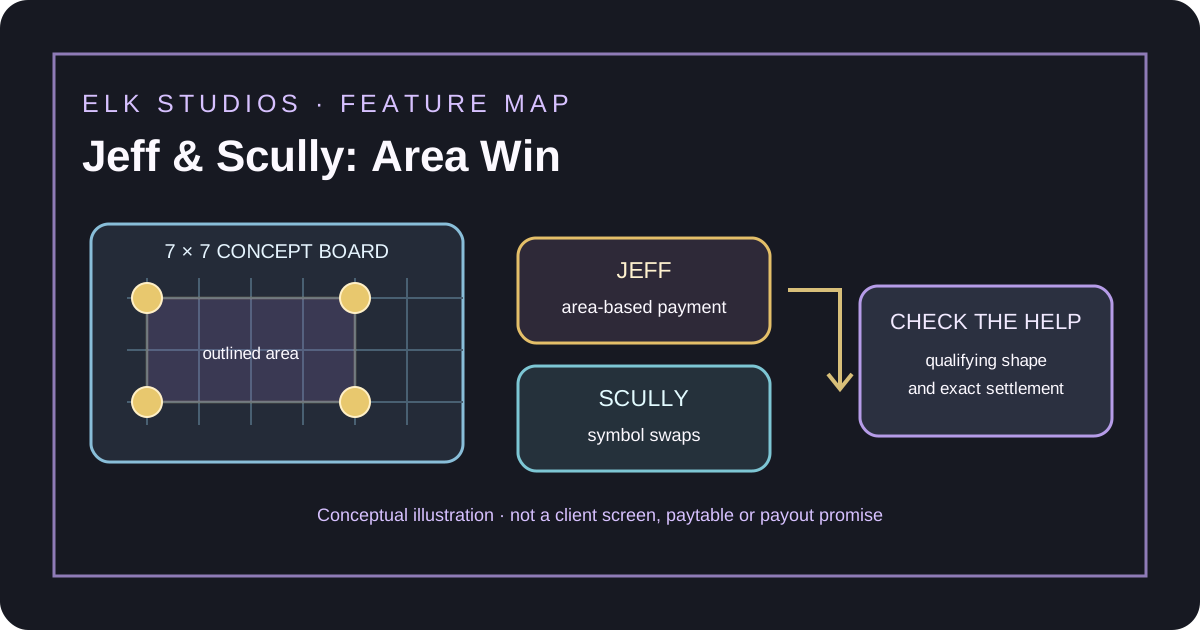
Jeff & Scully is an ELK Studios 7×7 slot built around Area Wins: four matching symbols at the corners of a rectangle can form a win, and the supplier says a larger area produces a larger win. Jeff can pay an area win for each symbol inside the area; Scully swaps symbols to create additional areas. The supplier lists sticky multipliers, instant-pay coins, Bonus and Super Bonus games, and a 10,000× maximum-win potential. It does not publish an exact operator RTP or volatility on the public game page.
The short answer
Jeff & Scully is a 7-reel, 7-row ELK Studios slot whose defining feature is the Area Win. The supplier says that four matching symbols at the corners of a rectangular area trigger a win, with a larger area producing a larger win. Multipliers inside the area can affect both the symbol win and instant-pay symbols in that area. A Jeff area win pays an area win for each symbol within the area; a Scully area win swaps symbols to create additional areas. The page also describes sticky redrops, Wilds, instant-pay coins, a Bonus Game, a Super Bonus and a maximum-win potential of 10,000 times the bet.
Those are supplier-level feature statements, not a complete operator paytable. The public page does not state the active RTP version, volatility label, exact chance of a feature, stake limits, or every settlement edge case. Those need the help panel of the exact client an operator serves. Nothing on the supplier page proves that a named casino offers the game to New Zealand accounts, or that a free-play version is available there.
Quick facts and the evidence boundary
| Question | What ELK’s page says | What the live game help must settle |
|---|---|---|
| Exact title | Jeff & Scully, ELK Studios | Confirm title and supplier in the loaded client |
| Layout | 7 reels by 7 rows | Whether the displayed board changes during any feature |
| Main win idea | Four matching symbols at the corners of a rectangle; larger area, larger win | Qualifying symbol patterns, minimum area, overlapping areas and exact evaluation order |
| Characters | Jeff pays an area win for each symbol in the area; Scully swaps symbols to create more areas | Which wins activate a character, swap limits, tie-breaking and settlement sequence |
| Bonus | Three Bonus symbols collected from winning areas trigger Bonus; four trigger Super Bonus | The symbol collection and retrigger rules for the exact build |
| Maximum-win potential | 10,000× bet | Whether a particular operator displays the same cap and the cap’s full rule wording |
| RTP and volatility | Not stated on the public product page reviewed | Exact configured RTP, volatility description and any jurisdiction-specific disclosure |
The difference between a confirmed supplier description and an unanswered operator setting is useful. It prevents a feature page from being mistaken for a verified math sheet. Where a table says “not stated,” that is not evidence that a value is unavailable inside the game; it means the public material inspected here did not establish it. The player should open the help icon in the active game and read the displayed values rather than treating a third-party database as the current configuration.
Find the exact game before applying any rules
The name matters because slot series often reuse visual motifs while changing their feature model. This article concerns Jeff & Scully, the title whose public ELK page describes a 7×7 board and Area Win. It is not a general guide to every ELK game with characters, coins, multipliers, respins or area-based wins. A sequel, similarly named game, or operator-specific branded version needs its own help sheet.
Before applying a rule, check the title at the top of the client, supplier attribution, game identifier if shown, and the information or rules icon. A lobby tile can use short copy or a thumbnail that is insufficient to establish the exact build. The information panel is more useful because it normally links the game’s own paytable, special-symbol descriptions and settings. If an operator’s lobby and game panel disagree, use the current in-game instructions for gameplay and ask the operator for clarification before relying on a disputed value.
The official supplier page describes the game as “Live Now!” when reviewed on 7 October 2026. That is a statement about the supplier’s product page, not a directory of casino integrations. A title can be released by a supplier but absent from a particular operator’s catalogue, disabled in a market, or unavailable to an account for reasons the public product page does not show. Do not infer access from a search result, a promotional image or a game list copied from another country.
Area Wins: think in rectangles, not familiar paylines
An Area Win starts with a geometric relationship across the grid. ELK describes four matching symbols at the corners of a rectangular area as the condition that triggers a win. This is not the usual instruction to count a run from left to right on a fixed payline. The corners give the shape its boundary, and the interior of that rectangle matters to how the feature is explained. The supplier says that a bigger area produces a bigger win.
Imagine a square board with symbols at the four corners of a rectangle: one at the top-left, one at the top-right, one at the bottom-left and one at the bottom-right. If the four corner symbols match under the game’s rules, they define a candidate area. A wider or taller rectangle covers more grid positions than a smaller one. That illustration explains the word “area”; it is not a promise that any four matching corner symbols always qualify in every state. The precise symbol set, minimum dimensions, exclusions and evaluation details belong to the actual game help.
There are several questions a reader should keep separate:
- Which symbols can create an Area Win? The supplier’s short feature description says “matching symbols” but is not a full symbol-by-symbol paytable. Read the game’s payout table for eligible regular symbols and any special treatment of Wilds.
- How large is a winning area? The product page gives the directional rule that a larger area has a larger win. It does not publish an operator-specific payout formula or every area-size value in the text reviewed.
- Can one spin produce more than one candidate area? If the screen appears to show overlapping rectangles, consult the help for how the client counts, prioritises or combines candidates. A screenshot alone may not show the evaluation order.
- What happens to symbols inside an area? The “Jeff” feature description refers to every symbol inside an area, while multiplier symbols in an area affect specified values. The live instructions explain exactly which cells count and when the award is settled.
- When is the result final? An animated swap, coin reveal or multiplier change can be part of the feature sequence. The balance and round history, rather than a visual effect alone, show the settled result.
The main practical advantage of this geometry-first model is that a player can read the board without inventing a conventional line count. Mark the four corners first, identify whether they are the same eligible symbol, then read the area and any feature effect. Avoid counting every cluster, diagonal, horizontal run or nearby match as a win unless the game help says it participates. Area Win is the named evaluation concept; it is not shorthand for every possible arrangement on a 7×7 board.
Area size and payout: what the headline does not calculate
“Bigger area, bigger win” is a useful direction, but not an amount. To calculate a specific award, the active paytable must show how each symbol pays, how area size affects its award, how an applicable multiplier is applied, and whether separate regions can pay in one resolution. The public game page reviewed does not provide a complete numerical payout table in its descriptive text. This guide therefore does not invent a table, percentage, line count or worked cash value.
If you want to understand a displayed example, record the facts in a fixed order. First note the bet for that round and whether the rules express pays as bet multipliers or coin values. Next record the symbol and the size or shape of the qualifying area. Then list any multiplier symbols and instant-pay coins inside that area. Finally, read the client’s settlement panel to see whether it presents one combined award, several component awards, or a feature total. Keeping those fields separate is especially useful when a win has both a symbol component and an instant-pay component.
A hypothetical diagram is best used to check interpretation, not to forecast a result. For example, two matching corner sets may look like one small rectangle and one overlapping larger rectangle. The eye may prefer the larger outline, but only the game’s evaluation rule says whether both count, one is selected, or another condition controls. If the client highlights a shape, compare the highlight to its help text. Do not derive a fixed “area pays X” formula from a single observed animation.
There is also a difference between an area’s size and a multiplier’s scope. Area size concerns which grid positions are included by the winning rectangle. Multiplier scope concerns which values the multiplier acts on. ELK’s description says multiplier symbols within the area multiply both the symbol win and instant-pay symbols within that area. That is a scope statement; it does not disclose every multiplication order, cap, combination rule or reset condition. The active game help is the reference for those details.
Jeff and Scully: two different feature branches
The character names are not decorative labels for the same effect. ELK describes a Jeff area win as paying an area win for each symbol within the area. It describes a Scully area win as swapping symbols to create additional Area Wins. The first description concerns a payout effect across the area; the second describes a symbol-change effect that can lead to more qualifying areas. Readers should keep those branches distinct when tracing a feature sequence.
The public description does not enumerate every trigger restriction. It does not say in the short text whether every Jeff or Scully symbol is eligible at the same time, how many swaps can happen, whether a swap can create a chain, or precisely how a new area is checked after the change. Those are exactly the kinds of details that should not be filled in from a third-party review or a general slot convention. Read the title-specific help and, if an example is available, follow the step-by-step feature animation while checking each rule label.
A disciplined way to follow the sequence is:
- Identify the original qualifying Area Win from the symbols the game highlights.
- Note which character effect, if any, the game says has activated.
- For Jeff, distinguish the area-based award from any multiplier or coin component also present.
- For Scully, note which symbols change and whether the game highlights a newly qualifying area afterward.
- Wait for the round’s final result and compare it with the win-history or round summary.
This sequence helps explain why a character animation should not be read as a separate guaranteed win. Scully’s symbol swaps are described as creating additional areas; the word “additional” does not tell us that every swap must create a winning arrangement. Jeff’s feature uses an area-win payout rule, but the public summary alone does not state the amount for each symbol or how it combines with all other components. Exact awards remain client-specific and rule-specific.
Multipliers and instant-pay coins inside an area
The supplier says that multiplier symbols within an Area Win multiply both the symbol win and instant-pay symbols within the same area. The word “within” is important. A multiplier elsewhere on the 7×7 board should not be assumed to affect a rectangle merely because it appears in the same spin. The visual boundary of the highlighted area is a practical clue; the in-game help determines the actual rule.
For clear accounting, treat a round as having at least three conceptual layers:
- Base symbol award: the amount associated with the qualifying symbol arrangement and the area under the game’s rules.
- Instant-pay values: coin symbols or other instant-pay symbols that the help says are collected or paid in a specific state.
- Multiplier effect: the multiplier symbols that the rules say apply to eligible values inside the winning area.
These layers are a reading aid, not a claim that the client necessarily displays a three-line calculation. A client may combine the outcome into one total. The key is not to multiply the full screen by every visible number. Confirm whether a coin falls within the winning boundary, whether it is an instant-pay symbol in that build, whether more than one multiplier is eligible, and whether the displayed multiplier acts before or after another feature. The page’s short description does not answer every ordering question.
Sticky redrops introduce a second distinction: “sticky” refers to a symbol or value remaining in the game state during a specified sequence, not to permanence across sessions. The official product page mentions sticky redrops and says multipliers and instant-pay coins remain sticky through the Bonus Game. That does not establish that state carries into a later paid spin after the bonus ends. Read the feature’s entry, continuation and reset statements separately. A persistent value inside one feature can still reset when that feature is completed.
Bonus Game and Super Bonus: the trigger is a collected count
The official page says three Bonus symbols collected from winning areas trigger the Bonus Game. It says four Bonus symbols trigger the Super Bonus Game. During the Bonus Game, multipliers and instant-pay coins remain sticky. During the Super Bonus, the sticky multipliers and instant-pay symbols increase in value for every new free drop. These are the supplier’s published differentiators between the two bonus tiers.
“Collected from winning areas” is narrower than “visible somewhere on the board.” The rule description ties the trigger to collection from eligible wins. A symbol that merely appears on-screen may not count toward the feature meter or trigger if it is outside a qualifying area or otherwise excluded by the help. The game panel should show the collected count and explain what qualifies. Do not assume a counter is a generic “symbols seen” total.
To compare the two tiers without overstating them, use the following questions:
| Check | Bonus Game | Super Bonus Game |
|---|---|---|
| Stated entry | Three Bonus symbols collected from winning areas | Four Bonus symbols trigger the tier |
| Persistent values | Multipliers and instant-pay coins remain sticky during the bonus | Sticky multipliers and instant-pay symbols increase in value with every new free drop |
| What remains unknown from the short public copy | Starting drop count, retrigger terms, maximum values and all restrictions | Exact increase sequence, cap, reset behavior and any entry-mode differences |
The table deliberately does not list a “guaranteed payout.” A bonus entry creates a feature round under its rules; it does not promise that every drop pays or that a particular result will occur. The public game page’s description of a Super Bonus provides a mechanical distinction, not a prediction of value. Anyone who needs the detailed trigger or settlement wording should use the help for the selected version, including the rules displayed before any optional paid mode.
RTP and volatility: verify the active configuration
The phrase “verified RTP settings” calls for version-specific evidence. RTP is a theoretical long-run return percentage for a particular mathematical configuration; it is not a forecast for an individual session. Volatility is a broad description of how outcomes are distributed over time; it is not a promise about a specific run. A maximum-win figure describes a ceiling or potential, not the chance of reaching it.
ELK’s Jeff & Scully page reviewed here lists a 10,000× maximum-win potential and describes the mechanics, but the text does not publish a precise RTP percentage or a volatility label. A third-party database may display an RTP or volatility value. That value can be useful as a lead for a question, but it is not proof that the same version is active in a specific casino. Different markets and operator configurations can expose different return settings, and data sites can be outdated or refer to a different client.
To verify the exact setup, open the game help and look for the RTP or theoretical return field, the volatility wording, and a version or paytable identifier if provided. Record the operator, the exact title, date checked, displayed currency or bet unit, and the rules panel used. If the help does not show a value, do not infer one from the supplier’s maximum win or from another review. Ask the operator where the game discloses the configured return. If a number is presented only in marketing copy, distinguish it from the current client’s paytable.
The 10,000× figure is not a typical win, a session target, a cash-out expectation or proof of a particular RTP. It is a maximum-win potential stated by the supplier. Before repeating it, check whether the live help gives the same multiplier and how the cap interacts with a round containing multiple features. The product page’s label does not tell us the odds of reaching the cap, and no probability should be invented from the cap alone.
X-iter and paid entry modes
ELK’s product page names X-iter and describes five modes, with examples ranging from a 3× bet mode with more than three times the chance to trigger the Bonus to a 500× bet Super Bonus mode with progressive sticky multipliers and instant-pay symbols. Those are product-page descriptions of optional modes. They are not necessary to understand a normal paid round, and they should never be collapsed into the base-game rules.
Before choosing any paid entry or mode, read the actual offer panel. Confirm what the multiplier applies to, whether the cost is a separate charge or replaces a normal stake, which feature state begins, whether the stated chance is relative to a baseline or an absolute probability, and what payout cap applies. “More than three times the chance” is a relative claim as described by the supplier; without a baseline probability, it does not provide an exact chance. A 500× cost also has a different risk profile from a base spin and should be understood in the displayed currency before confirmation.
Some X-iter features can be named similarly across games while varying in mode count or terms. Do not transfer a purchase cost or bonus rule from a different ELK title. If a button opens a mode selector, use the help adjacent to that selector, check whether the game shows a separate confirmation, and decline to proceed if the amount or feature state is unclear. An optional paid mode cannot be treated as a demo or as a neutral way to test the rules.
Mobile, help and a method for reading one round
ELK recommends a 1600×900 desktop resolution and a 16:9 aspect ratio if scaling is needed. That is a supplier recommendation for the game display, not a promise that every phone or browser will show every panel in the same way. On a smaller screen, controls can be rearranged and help text may require scrolling. Use the client’s full-screen or orientation controls only if the operator provides them, and check that the game is not cropped before interpreting a symbol or balance.
For a first inspection, keep a note of the sequence rather than trying to remember a fast animation:
- Record the exact title, operator and date shown in the client.
- Open the help before playing; find the Area Win, symbol, character, multiplier, coin and bonus sections.
- Check the currency, unit, minimum and maximum bet, and any line or area values the client actually displays.
- On a result, identify the highlighted rectangle before looking at the character effect.
- Separate multiplier values from instant-pay coins and read the in-area rule.
- If Jeff or Scully activates, follow the feature’s own steps and note each new area or swap.
- Compare the final credit with the round history and help wording.
- Reopen the help after an update if the title, paytable or game identifier changes.
That process is useful on mobile because a narrow view makes it easier to mistake nearby symbols for part of a highlighted shape. Rotating the device does not change the game math; it can only change how much of the board is visible. If the animation runs before a player can understand the feature, use any available history or rules view instead of inferring the result from memory.
The supplier offers a “PLAY” link on its page, but that page does not establish that a New Zealand visitor can play a demo. A supplier staging client, promotional preview, or play button does not prove a production casino deployment. Demo access should be treated as a separate fact to verify with the specific operator, including whether the client is available without a real-money account and whether the rules and settings match the money-play version. Do not assume that because one version is demonstrable, its exact RTP or feature configuration is the version used elsewhere.
Frequently asked questions
How does an Area Win work?
ELK describes four matching symbols at the corners of a rectangle as triggering an Area Win, with a larger area producing a larger win. The exact qualifying symbols, overlap treatment and payout values should be read in the active client’s help.
What is the difference between Jeff and Scully?
The supplier says a Jeff area win pays an area win for each symbol in the area. A Scully area win swaps symbols to create additional areas. The public summary does not state every trigger or chaining restriction.
What is the RTP of Jeff & Scully?
The public ELK game page reviewed on 7 October 2026 does not give an exact RTP percentage. Check the active game’s help for the operator’s configured version; do not use the 10,000× maximum-win potential as a substitute.
Is Jeff & Scully available in New Zealand?
The supplier’s product page does not confirm that a particular operator offers the game to New Zealand accounts. Check current operator information and local eligibility. This guide does not claim access or demo availability.
What triggers the Bonus Game and Super Bonus?
ELK says three Bonus symbols collected from winning areas trigger the Bonus Game and four trigger the Super Bonus Game. The help for the selected build should clarify exact collection and continuation conditions.
Does the 10,000× figure mean a 10,000× win is likely?
No. It is a maximum-win potential, not a probability, expected result or session forecast. The supplier’s public description does not give the likelihood of reaching the cap.
Can I use X-iter to test the game?
X-iter is an optional paid mode, not a free demo. Read its displayed cost and terms before any choice. The supplier’s description of a mode does not establish local access or the settings in a particular client.
What should I do if a displayed win seems wrong?
Keep the game title, date, round identifier, help version and any available history record, then ask the operator how that exact build settles the feature. A visible animation alone may not contain the full payout calculation.
Is the game mobile friendly?
The supplier recommends a 1600×900 desktop resolution and 16:9 ratio when scaling is required. That does not certify a particular phone or browser. Check the active operator client for readable controls, full board visibility and accessible rules.
Sources and scope
- ELK Studios: Jeff & Scully — title, 7×7 layout, Area Win, character effects, multiplier and instant-pay interaction, bonus thresholds, X-iter examples, maximum-win potential and desktop ratio. Reviewed 7 October 2026.
- ELK Studios official game catalogue — supplier catalogue context. Reviewed 7 October 2026.
- New Zealand Department of Internal Affairs: online gambling advertising — current advertising guidance. Reviewed 7 October 2026.
- ELK Studios: X-iter — supplier description of optional paid modes. Reviewed 7 October 2026.
- AboutSlots: Jeff & Scully, SlotCatalog: Jeff & Scully, Bonustiime: Jeff & Scully, and Stop and Step: Jeff & Scully — secondary coverage compared 7 October 2026. Numeric RTP and volatility labels can vary by market or version and were not treated as proof of a New Zealand operator configuration.
This is one editorial guide to Jeff & Scully, not a claim of personal play, independent game testing, operator integration, licensed access or current demo availability. Supplier descriptions do not disclose every operator setting. No wager, win, payout, RTP version or volatility label is guaranteed here. The five topic boundaries in Batch 23 remain separate; this page does not create a standalone bonus, RTP or demo page.
