ELK Studios game rules · South Island guide
The Grand Galore review: rules, features and settings to verify
 Best casinos available in New ZealandUpdated 7 November 2026

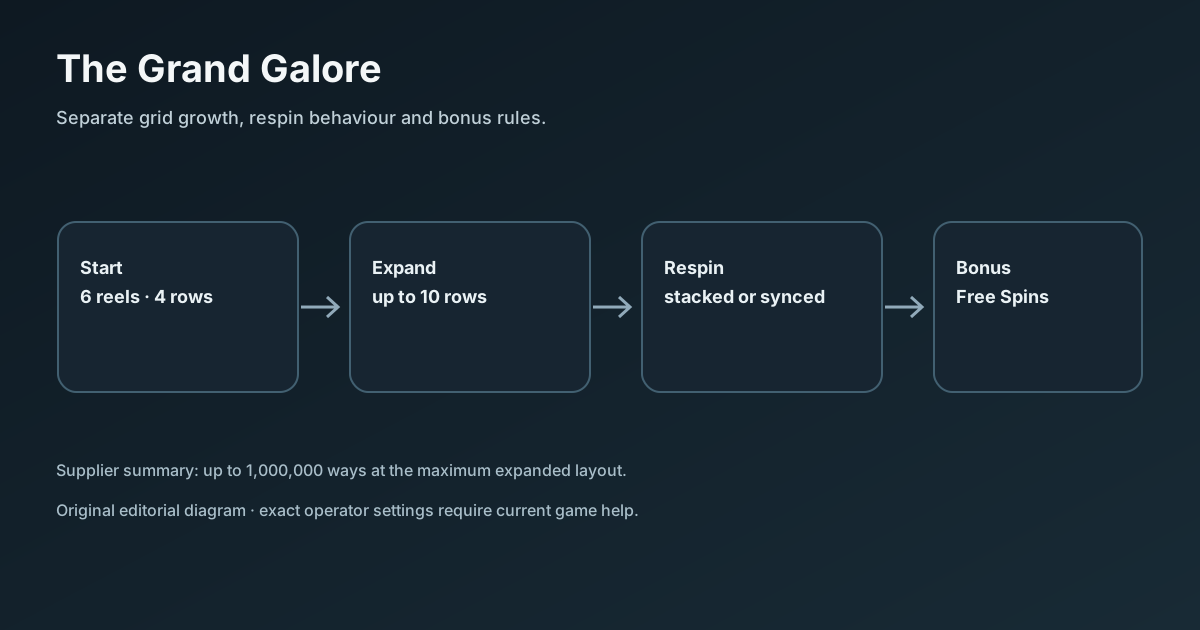
The Grand Galore begins with six reels and four rows. A winning reel can grow through an expanding reel respin; stacked symbols and randomly synced neighbouring reels create separate respin behaviours. ELK says the grid can reach ten rows and up to one million ways, while three or more bonus symbols start Free Spins with up to 25 spins and a Grand Synced Respin every fifth win. The public summary does not verify an operator’s active RTP, volatility or maximum-win setting.
The short answer
The Grand Galore is an ELK Studios slot built around reels that can expand after wins. Its supplier page describes a starting layout of six reels and four rows, expanding reels that can reach ten rows, stacked respins, randomly synced neighbouring reels and a Free Spins feature. ELK states that the expanded layout can reach one million ways to win. Those mechanics explain the game’s structure, but they do not tell you the return, volatility, stake range or maximum win selected by a particular casino.
The useful way to read this title is as a chain of separate events. First, a winning combination can cause the reel or reels contributing to that win to expand by a row. The winning positions and the newly added positions then respin. A stacked respin keeps symbols on the same reel aligned to the same symbol. A synced respin makes between two and five neighbouring reels land on the same symbol. In the bonus, ELK says every fifth win creates a Grand Synced Respin, and the feature can be retriggered.
The names sound similar, but the effects are not interchangeable. Reel expansion changes the size of the play area; a stacked respin describes a same-symbol landing on a reel; a synced respin coordinates neighbouring reels. A reader comparing versions should confirm the title and current in-game rules, then inspect the paytable for the active RTP and cap. ELK’s Game Data Sheet link returned 403 when checked on 7 October 2026, so exact numerical settings remain unverified here.
What the supplier confirms
ELK’s public The Grand Galore page is the primary source for the named mechanics in this guide. It confirms a six-reel, four-row starting layout, an expansion ceiling of ten rows, and a stated maximum of one million ways to win. It describes three or more bonus symbols as the trigger for Free Spins, awards up to 25 spins, says every fifth win generates a Grand Synced Respin, and notes that the feature can retrigger.
The page also defines three relevant respin terms. In a Stacked Respin, respinning symbols stacked on a reel always land on the same symbol. In an Expanding Reel Respin, each reel contributing to a win expands upwards by one row, and both winning-symbol positions and the added positions respin. In a Synced Respin, two to five neighbouring reels randomly synchronise and land on the same symbol. Those definitions make it possible to distinguish a genuine mechanic from a visual effect that merely looks like a larger reel or repeat spin.
The public page is not the same as a casino’s active build. It does not establish that a given New Zealand account can load the title, which RTP configuration is active, what stake limits apply, or whether the operator has a specific cap or feature setting. ELK links a Product Sheet and Game Data Sheet, but those files returned a 403 access response during this research. A secondary review cannot fill that evidence gap for a particular casino.
How to read the expanding reels
The opening layout is six reels by four rows. ELK’s public description says a winning reel grows upwards by one row when it contributes to a win, with the added positions and the winning positions respinning. This is not simply a static six-by-four grid in which the number of possible combinations never changes. As eligible wins occur, the visible grid can grow, giving more symbol positions an opportunity to participate in later outcomes.
The sequence matters. A win is evaluated under the game’s rules; the reels that contribute to that win expand; then the specified positions respin. The added row is not an independent bet and the respin is not a new player-selected stake unless the active rules explicitly say otherwise. It is part of the original game sequence. A screenshot can show an enlarged board, but only the rules panel tells you why a row was added and which positions were involved.
ELK gives ten rows as the expansion ceiling. Reaching the maximum number of rows is a layout condition, not a promise of a win. A larger grid creates more symbol positions and the supplier describes up to one million ways to win, but a ways count is not a payout amount or a probability that an award will occur. It says how many adjacent-symbol routes can be evaluated under the game’s arrangement; the paytable determines the values and game mathematics determine the chances.
When reviewing a sequence, separate the initial layout from the expanded one. Record whether the game shows six reels and four starting rows; whether a winning reel expands by one row; which positions respin; and whether a later animation is described as stacked or synced. If the live help uses a different term or a screenshot appears to show another rule, use the current help for the version on screen rather than assuming that every casino has the same configuration.
Ways to win are not the same as paylines
The phrase “one million ways” is often easy to misread. A payline game evaluates a fixed route across reels. A ways-to-win arrangement evaluates matching symbol paths according to the game’s specified reel and adjacency rules. The number can grow when the grid grows. It does not mean there are one million distinct prizes, that a player has one million chances per spin, or that the maximum payout equals one million times the stake.
For this title, ELK’s page ties the one-million figure to the expanded reels at the game’s maximum height. It does not publish the exact contribution of each intermediate row count in the accessible summary. A review that prints a starting ways count or a complete ladder of combinations may be using a product sheet, a particular configuration or a secondary source. Unless the same detail appears in the game help you can access, treat it as an additional claim to verify.
To read the paytable, look for the minimum symbol match, direction of wins, whether the game uses ways or lines, the value of each symbol combination, and whether awards are expressed per line, per way or as a multiple of the total stake. Then check how overlapping routes are counted. Do not multiply a symbol value by the visible ways count yourself unless the paytable explicitly defines that calculation. The game usually performs the full award calculation, and an animation may show intermediate amounts before the final total.
When a game grows, check whether the interface keeps the original stake constant through the respins. The supplier’s public page describes the respin mechanics but does not state a stake-selection screen or currency. Read the on-screen bet total and the history entry for a completed spin. If a casino labels the feature as part of one round, the history may show one round result with multiple internal respins rather than separate player wagers.
Stacked respins: one reel, repeated symbol identity
A Stacked Respin is defined by how stacked symbols on a reel behave: symbols that respin on top of one another land as the same symbol. That coordinated landing can make the reel appear uniform, but the public description does not say that every stacked symbol is a Wild or that a winning combination is guaranteed. Symbol identity and winning status are separate properties. The paytable and the symbol legend determine whether a particular symbol substitutes or pays.
When the interface shows a vertical group of matching symbols, ask three questions. Did the rules call this a Stacked Respin? Which reel or reel set is involved? Does the symbol have an independent payout or substitution rule? The visual can be a feature result without being a cash award by itself. If the symbols create a qualifying combination, the game then evaluates that combination under the normal award rules and any feature-specific conditions.
Stacked and expanded are also different dimensions. Expansion adds a row to a contributing reel. Stacking describes how respinning symbols on top of one another resolve. A reel can expand and then show a stacked result, but one label does not prove that the other event occurred. For an accurate review, describe the order shown in the game history or rules rather than compressing all of the animation into “reels grow and sync.”
The help panel is the right place to confirm whether the stacked behaviour applies in the base game, the bonus, or both. ELK’s summary describes the mechanic as Meta Data but does not specify every state in which it may appear. If the panel does not identify a condition, do not claim a trigger frequency or say that a particular symbol will appear after a set number of spins. Repeated animations in a short session cannot establish a mathematical probability.
Synced respins and the Grand Synced Respin
ELK describes a Synced Respin as two to five neighbouring reels randomly synchronising so that all synchronised reels land on the same symbol. The requirement that they are neighbouring reels is part of the description. This should not be confused with two distant reels independently landing on the same symbol, or with a player choosing which reels to synchronise. “Randomly” also means a player should not infer a predictable sequence from previous outcomes.
In the Free Spins feature, the supplier identifies a Grand Synced Respin on every fifth win. It says that all respinning symbols on up to five reels will synchronise. The event counter is described in terms of wins, not merely the number of spins. A spin with no win therefore cannot safely be counted as one of the fifth-win events. The exact counter and any special conditions should be checked in the active game help, because the public page’s short summary may not contain every edge case.
An animation can make a synced result look more powerful than its actual award. The fact that reels share symbol identities says how they land, not whether those symbols form a winning match or what the amount will be. Evaluate the final arrangement through the paytable and review the posted total. If the display shows a multiplier, symbol value or feature label, check whether it applies to the current combination, the next respin or the whole bonus; do not infer timing from a generic screenshot.
For a careful feature description, name the event and its condition separately: the bonus win counter reaches the stated fifth win; a Grand Synced Respin occurs; eligible respinning symbols on as many as five reels synchronise; then the game evaluates any resulting combinations. This wording describes the supplier’s stated sequence without promising that a particular spin will qualify or produce a large award.
Free Spins and retriggers
ELK says three or more bonus symbols trigger the Free Spins feature and award up to 25 spins. “Up to” matters: the summary does not say that every trigger awards the maximum. Check the visible award screen and rules panel for how the number is determined. If several bonus symbols appear, note whether the interface specifies a count, a range or a random award. Do not claim that the bonus grants a fixed number unless the active version says so.
The supplier also says the bonus can be retriggered. A retrigger means the feature can be entered or extended again under its rules, but the public page does not provide the exact retrigger condition. Do not assume that a familiar scatter count from another slot applies here. The current game help should state what symbols, positions or event qualify. If that condition is absent from the operator’s help, leave the exact trigger unstated.
The fifth-win Grand Synced Respin is a bonus-specific described feature. Keep it separate from the ordinary Synced Respin definition. One description concerns a random alignment of two to five neighbouring reels; the other concerns a special event every fifth bonus win, with all respinning symbols on up to five reels synchronising. Combining them into a single sentence can hide the different condition and scope.
When the Free Spins feature starts, review whether the stake remains the base stake and whether the operator history shows the feature as part of the original round. Do not treat a Free Spin as cash or a separate deposit. The accounting definition is whatever the game and operator rules state. The visible animation can contain several wins, respins and an accumulated total; the final history is the evidence for what was credited.
RTP, volatility and maximum win: what remains unverified
RTP is a theoretical long-run percentage for a particular game configuration and calculation model. It is not a forecast for the next spin or a guarantee that a short session will return a stated share of the stake. More importantly for this review, ELK’s accessible The Grand Galore summary does not display an RTP figure. Its Game Data Sheet was linked from the official page but returned 403 when opened on 7 October 2026. This guide therefore does not publish a numeric RTP as verified or universal.
Competitor pages often show a rounded RTP of 96%, but that does not identify the active setting at a particular operator. They also disagree on volatility and maximum win: the sample includes claims of medium volatility, high or high 8/10, and different maximum-win amounts. Those figures may relate to different data sheets, markets or editorial methods. None of those pages establishes the setting selected for a New Zealand account. The responsible answer is to inspect the paytable or information panel in the actual game and record the title, operator, date and value shown.
Volatility is a description of outcome distribution, not a promise that wins arrive on a schedule. A feature with repeated respins may create a long animation, but animation length is not hit frequency. A large ways count does not prove low volatility. A maximum-win figure, if the game publishes one, must be understood with its unit: a multiple of stake, a currency amount, or a limit for one round. The accessible supplier summary does not provide those fields, so they remain unverified here.
If a casino offers multiple RTP versions, the game help or information panel should identify the active one. Record the exact text and distinguish theoretical RTP from any community statistic or sampled historical return. If the screen lists more than one value without identifying which is loaded, ask the operator to state the selected configuration. Do not use a figure from another ELK slot, another operator, or a reviewer’s demo as a substitute.
What other reviews get right—and where they diverge
The competitor sample checked on 7 October 2026 included AskGamblers, Lucky Mobile Slots, AboutSlots, Gambling.com and Casinos.com. Their useful contribution is a quick overview of the six-reel starting layout, expansion concept and Free Spins. Some also explain the visual impression of synced and stacked reels.
The weakness is that numerical summaries do not agree. AboutSlots describes high volatility and a 10,000x maximum; Gambling.com displays medium volatility on its summary but later calls the game highly volatile; another page provides a different currency cap. These are not enough to identify which build or operator settings are in scope. The official page is more reliable for the named mechanics, while the live operator help is needed for the numerical configuration.
Review text also sometimes turns an observed or advertised feature into a prediction, using phrases like “frequent big wins” or implying that the maximum is easy to reach. A theoretical maximum says what is permitted, not how likely it is. A hit-frequency figure, even if present in a data sheet, needs its definition: any positive award, a bonus trigger or a particular threshold. Without the underlying methodology, two reviews may be measuring different events.
The useful reading strategy is to extract mechanics from the supplier and treat each third-party number as a lead. Then verify the active paytable, RTP, cap and stake at the operator. If the operator help is unavailable, state that the field is not confirmed; do not select the most attractive value or average conflicting numbers.
A practical settings checklist
Before relying on any review, check the version on screen and note the exact game title. Open the information, rules or paytable control before starting a session. Confirm the currency, total stake, symbol values, win direction, number of reels and rows, and the terms used for every respin. Verify how the game counts wins during Free Spins and whether the feature screen explains the fifth-win event. If the game displays more than one RTP or cap, ask which configuration is loaded.
If you are comparing two casino pages, compare the actual help text rather than marketing cards. A lobby can show an old thumbnail or generic supplier summary. A demo may use a different configuration or be unavailable in your jurisdiction. The presence of a Play button on ELK’s catalogue does not prove that a casino has the game, that a New Zealand account can open it, or that the same settings are selected there.
For a quick audit, save a screenshot of the rules panel with date and operator context, but remove private account details before using it outside the casino support channel. Record the title, version if shown, RTP, volatility, cap, minimum and maximum stake, and whether any option costs extra. If a field is missing, write “not shown.” That small discipline makes a later comparison more accurate than repeating a generic value from a review.
Questions readers ask
How many reels does The Grand Galore start with?
ELK’s public summary describes six reels and four rows at the start, with winning reels able to expand upwards. The same supplier page gives ten rows as the maximum height. Use the active game’s help if its displayed version differs, and do not assume that every round reaches the larger layout.
Does one million ways mean one million guaranteed win chances?
No. ELK ties the one-million figure to the expanded layout, but a ways count is a description of possible symbol routes evaluated by the game. It does not mean that every route wins, that one million prizes are available or that a payout is guaranteed. The paytable and the result determine whether a qualifying combination occurs.
What is a Grand Synced Respin?
ELK says that in Free Spins, every fifth win generates a Grand Synced Respin, where all respinning symbols on up to five reels synchronise. This is separate from the supplier’s general Synced Respin description, which concerns two to five neighbouring reels. Check the in-game help for the active version’s exact counter and conditions.
Is the RTP 96%?
Several competitor pages reported 96%, but the accessible official summary did not show a numeric RTP and the linked Game Data Sheet returned 403 during this check. A third-party figure does not confirm the operator’s current setting. Read the exact paytable or information panel for the version you can access; if it is missing, ask the operator.
Is The Grand Galore high volatility?
The competitor sample uses different labels, from medium to high or high 8/10. ELK’s accessible public summary did not show a volatility rating. Without the current title-specific data sheet or active game help, this guide cannot verify the classification. Do not use the expansion animation or number of respins to infer it.
Can Free Spins retrigger?
ELK’s public description says the bonus game can be retriggered. It does not give the full trigger condition in the summary available here. Check the in-game rule panel for which symbols and count cause a retrigger in the active version, and do not assume that rules from another slot apply.
Does the title have a verified maximum win?
The public page checked here did not state a maximum-win value. Reviewers publish differing numbers, so none is used as verified. If the operator’s help shows a cap, note whether it is a multiplier of one bet, the total round stake or a currency amount, and whether any special rule applies when it is reached.
Mobile view, demo access and New Zealand availability
ELK recommends a desktop resolution of 1600×900 and a 16:9 ratio if scaling is needed. That is a presentation recommendation, not a guarantee of support on every phone or browser. On a smaller screen, confirm that the paytable, full expanded grid, spin controls and history remain reachable. A large layout can require vertical scrolling or a landscape view; the device itself does not change the game’s rules.
The supplier page includes a Play link, but an official showcase or demo control does not prove access through a particular operator. Demo access can depend on jurisdiction, operator, account state and product availability. Do not register or deposit on the basis of a third-party review. Check the operator’s own help and current eligibility terms, and make no assumption that the title is offered in New Zealand.
The ELK Studios catalogue guide explains how to distinguish supplier descriptions from operator-selected settings. For New Zealand support information and a way to pause, see our safer gambling guide. The game can be evaluated from its published rules without a partner link, a deposit or a claim that playing is worthwhile.
Sources and verification boundaries
- ELK Studios: The Grand Galore — official mechanics page checked 7 October 2026.
- ELK’s linked Product Sheet and Game Data Sheet — the Game Data Sheet request returned 403 on 7 October 2026; numerical settings are not treated as verified.
- AskGamblers review, Lucky Mobile Slots review, AboutSlots review, Gambling.com review and Casinos.com review — sample reviewed 7 October 2026 for coverage and conflicting secondary settings.
- DIA information for online casino customers — checked 7 October 2026; no conclusion is made here about an individual operator’s eligibility.
This guide does not claim a personal play test, operator configuration, New Zealand access, a bonus offer or a likely return. Recheck the active game help before relying on a numerical field.
