ELK Studios game rules · South Island guide
Oxygen 2: rules, multiplier features and settings to verify
 Best casinos available in New ZealandUpdated 7 November 2026

Oxygen 2 is ELK Studios’ Coral Creek sequel built around Oxygen Bubbles, position-based Octopus and Jellyfish effects, transforming Wilds and distinct bonus states. The supplier confirms these broad mechanics, while the active RTP, volatility, wager limits and availability must be checked in the operator’s current help.
The short answer
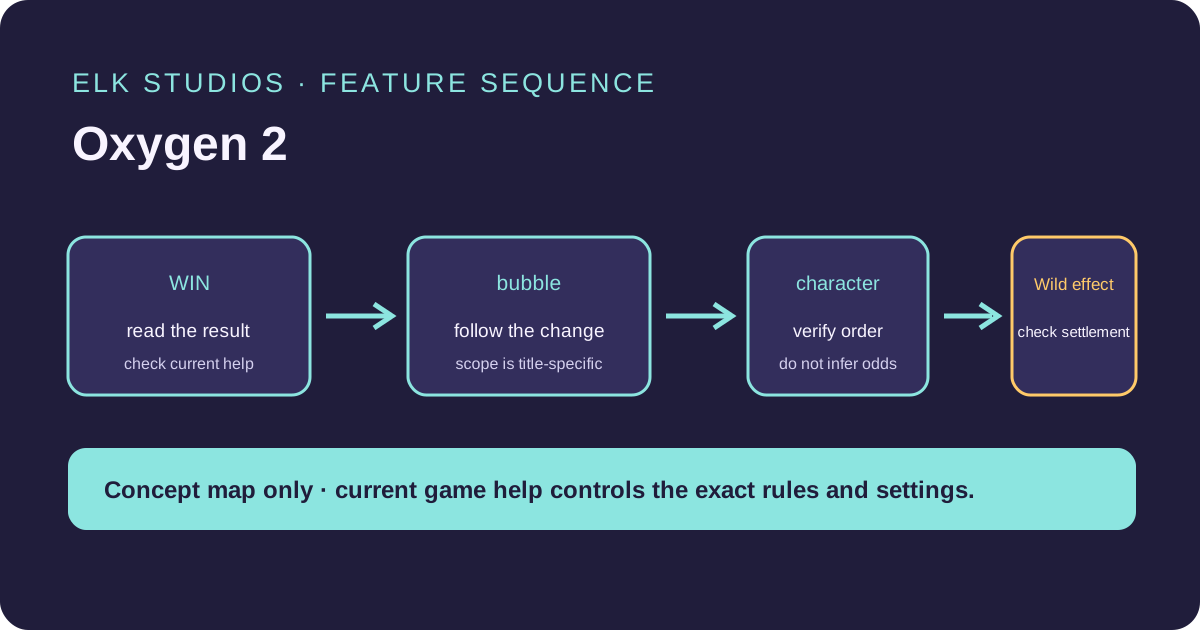
Oxygen 2 is a feature-led ELK Studios slot in which winning symbols can activate or build Oxygen Bubbles, while character and Wild effects interact with positions on the board. ELK’s public page names an Octopus, a Jellyfish, a Blaster Wild, an Exploding Wild and a Super Exploding Wild, then describes separate bonus and super-bonus routes. The best way to understand the game is to trace how a symbol win changes the board and which modifiers remain active for later evaluations.
That overview identifies feature relationships, but it is not a current operator rules sheet. No live help or paytable was supplied, so this page does not state an RTP percentage or variants, volatility, hit frequency, stake bounds, win ceiling, mode cost or operator release status. Numeric values on third-party review pages can reflect a different jurisdiction or game configuration. This guide also does not claim that Oxygen 2 or a demo is accessible to New Zealand accounts.
Confirm the title and evidence layer
The ELK Oxygen 2 product page presents the game under its own name and connects it to the Coral Creek setting. The supplier catalogue is useful for confirming that ELK documents the title. Neither page establishes that a particular operator offers it to New Zealand players or tells you which return setting that operator has selected.
For a reliable review, separate supplier documentation from the current game help, operator availability information and independent commentary. The supplier page describes broad mechanics. Game help should define the active version’s rules and settings. An operator page may tell you whether it is listed or available to an account. A review can offer a clear explanation of a feature, but a table of values is not proof that the same values apply in a different country or build.
Record the operator and date when a client is available. Look for the full title in its help panel, not just a thumbnail in a lobby. Check whether the title includes a build label or a rules revision. If the help menu is inaccessible before play, do not infer terms from a review. The correct editorial statement is that the configuration has not been verified.
Read the board as a system of positions
Oxygen 2’s public description emphasises position-specific effects. A winning symbol can activate an Oxygen Bubble at a location or interact with an existing bubble there. The Octopus is also linked to a win occurring at its position, while the Jellyfish visits symbol positions and affects bubble multipliers. This makes “where” an event occurs at least as important as “what” symbol appears.
When reviewing a round, identify the winning positions first. Then note which bubble was created or changed, where the Octopus stood, whether it moved, and what the Jellyfish touched. Only after mapping those states should you describe the final payout. This keeps the explanation grounded in the board rather than assuming that an animation indicates every position received the same effect.
The current help should define the cluster rule and the role of Wilds before any position effect is explained. It should also say when the game checks a win, when symbols are removed or transformed, and whether a newly activated modifier applies immediately or to a later evaluation. A sequence animation may combine those steps visually. The rules panel or round history is the right source for their order.
Oxygen Bubbles and multiplier scope
ELK says winning symbols explode and activate an Oxygen Bubble, or activate an existing bubble’s multiplier. That description establishes a connection between wins and bubble states. It does not by itself explain the bubble’s lifetime, how its value changes, the unit to which that value applies, or whether the same position can be used by multiple effects in a single sequence.
In the help panel, look for the distinction between creating a bubble and increasing one that already exists. Check whether an affected bubble attaches to a cell, a symbol, a feature state or another unit. Then verify when its multiplier is used and when it resets. The visual number may be a modifier, not a cash amount. A counter or glowing space is not a settled win until the paytable says how it contributes.
If a bubble persists through a bonus state, note the exact boundary. “Persistent” might mean that the feature remains for a sequence, a bonus, or another condition defined in help. Do not broaden one persistence claim to the whole game. If the public supplier summary does not name the boundary, record that it is an open question for the operator build.
The interaction also needs careful language around causation. A symbol being part of a win may activate a bubble, but that does not show the chance of a win or its expected amount. Avoid wording such as “each win boosts your payout” unless the rules say the bubble affects that particular settlement. The supplier overview gives the feature concept; the operator help decides the exact calculation.
Octopus: position, movement and surrounding effects
The supplier says a win on a position with an Octopus adds random surrounding multipliers to the win. This is a positional modifier with two parts: the qualifying win must meet the stated location relationship, and the effect is associated with nearby positions. “Surrounding” is a spatial term in the feature description, not an exact set of cells unless the game help defines that set.
Check the help for how the Octopus arrives at a position and whether it remains there across later drops. ELK’s public description says the Octopus moves to a new random position during each free drop. That broad statement concerns the bonus sequence; it does not establish movement in the base game or all operator implementations. Keep the context attached to the claim and verify the live wording before describing its boundaries.
During a legitimate demo or client inspection, note the board before and after an Octopus effect. Which neighbouring cells changed? Were the multipliers assigned to bubbles, symbols or the win itself? Did an existing value combine with a newly assigned value? The help should clarify how multiple effects interact. An animation can illustrate placement, but it may not explain settlement order.
Do not treat an Octopus icon or nearby multiplier display as a promise of a result. It can change how an eligible win is evaluated, but the eligible win condition and calculation remain important. If the game shows the modifier before a result has been assessed, it is still a game state rather than guaranteed money.
Jellyfish: a second kind of bubble interaction
ELK describes the Jellyfish as stopping at random symbol positions and increasing Oxygen Bubble multipliers, with a possible effect on the Jellyfish multiplier itself. This creates a different role from the Octopus: the supplier describes an effect that travels across positions and interacts with bubbles, while the Octopus is tied to a win occurring in its position and the surrounding area.
That difference is useful when reading the board. Look at what the Jellyfish marks, which bubbles are affected and what the interface says about its own multiplier. Do not assume “random positions” means all positions are equally likely, or that a visible marker was randomly selected in a mathematically uniform way. The product summary does not disclose the selection model or the detailed probability distribution.
The help should identify whether the Jellyfish acts during a normal round, a bonus, or a particular mode and whether its state is carried forward. ELK specifically connects its appearance to the Super Bonus description, but the current operator help is needed for the exact starting condition and order. If the help uses different terminology, preserve the operator wording and note how it corresponds to the supplier’s feature label.
When describing a multiplier interaction, distinguish its displayed value from its contribution to an eventual payout. A modifier can be present without an eligible win; the rules must define which settlement it changes. Do not multiply the amount manually from a screenshot unless the game documents the exact arithmetic and rounding. An article can explain the concept without inventing a worked result.
Blaster Wild and symbol transformation
ELK describes the Blaster Wild as selecting a random payout symbol and replacing symbols in an X or plus-shaped area from its position with that selected symbol. The useful point is that the feature affects a pattern of cells and uses a selected symbol type. It is not merely a Wild substitute in the ordinary sense. Its replacement effect may alter the board before another check, but the precise sequence belongs to game help.
Read whether the Blaster Wild itself participates in a winning combination, whether the shape is chosen from alternatives, and what happens at the board edge. The official short description names two shape types but does not settle how cells are selected when part of a shape would fall outside the play area. Nor does it establish whether an affected symbol is replaced once or can be involved in additional cascades. Do not guess from one animation.
The help should explain what qualifies as a “payout symbol” and whether feature symbols or other Wilds can be replaced. If transformations create a new set of matching symbols, determine when the game evaluates that set. This matters for an accurate flowchart: symbol selection, cell replacement, win check and settlement are separate actions even when the game presents them quickly.
This feature is a good example of why a review should explain function rather than just repeat a marketing phrase. The reader needs to know which area changes, what kind of symbol appears there and which rule governs the new state. If exact selection logic is not published, identify the gap rather than claiming that the feature improves a particular chance.
Exploding Wild and the Super Exploding Wild
The supplier describes an Exploding Wild removing payout symbols in cone-shaped areas, with the direction selected from two alternatives. It separately describes a Super Exploding Wild as also activating any unactivated Oxygen Bubbles behind the removed symbols. The “also” is meaningful: the Super version has a stated bubble interaction that should not automatically be attributed to the ordinary version.
Check the active paytable for the area covered by each cone, how the direction is selected, and what “behind” means in the game’s spatial layout. Determine whether symbols are removed before the next evaluation and whether the event can create a new cluster, reveal a feature, or simply clear part of the board. These outcomes are not interchangeable, and the public overview does not provide a complete settlement algorithm.
If the feature activates a bubble, check whether the bubble’s effect is applied immediately or only when a later eligible win occurs. A feature can activate a modifier without producing an immediate payout. That distinction helps prevent a reader from interpreting the visual effect as an amount already credited.
Keep the two Wild names separate in any review table. For each, record the trigger, affected area, treatment of payout symbols, treatment of bubbles and settlement point. If an operator’s help uses a combined entry, structure the explanation so that the extra behaviour remains visible. A single short line that says “Wilds explode and multiply wins” would hide material differences.
Bonus game and Super Bonus
ELK distinguishes a free-drop bonus from a Super Bonus. Its public page describes a trigger involving bonus symbols for the former and another condition that includes a Super Bonus symbol for the latter. It also says existing multipliers carry into the ordinary bonus, while the Super Bonus activates a Jellyfish feature throughout its free drops. This is enough to identify separate feature routes, not to publish all numeric trigger or round counts.
The current help should confirm what a qualifying bonus symbol is, where it must land, how entry is awarded and whether any additional symbol can extend the feature. It should also define what “persistent” means for an existing multiplier: where it is stored, which values carry forward and when they reset. Do not assume that the ordinary bonus and Super Bonus share the same entry conditions or state persistence.
Separate the bonus mechanics from the X-iter menu. ELK names X-iter modes as optional ways to begin different states, but the supplier page does not establish which ones a particular operator offers or their current prices. If a paid entry mode appears, read its cost and terms in the live help before using it. This guide does not repeat feature prices from third-party pages.
A bonus is a game state, not a promise that the outcome will exceed the stake. A persistent bubble or a Jellyfish animation can modify eligible results; it does not make a result certain. When writing a walkthrough, describe the state transitions and allow the final settlement to remain unknown unless the rules actually calculate it.
RTP, volatility and other settings
No operator help screen was provided for this review, so there is no verified active RTP, RTP variant, volatility label, hit frequency, stake range, win cap or paid-mode price to report. A supplier catalogue confirms the game’s existence and named mechanics, but configuration values may be selected by an operator or vary by market. Reviews can also use a dated demo or specific regional lobby.
RTP is a theoretical statistic about a defined configuration across a very large number of plays. It is not a session forecast. If an operator lists more than one return setting, record which is active and whether the displayed figure applies to the mode being described. Do not write “the RTP” as if a number found on one review page automatically applies to every version.
Volatility describes the shape of possible outcomes at a broad level, not a schedule for losses or feature appearances. A game-help volatility label should be reproduced with its source and exact wording. An author’s subjective impression from a short demo can be described as an impression only if the demo was actually played; no such test is claimed here.
If a maximum payout or stake range is listed in the help, record the relevant mode and unit. A cap is an upper bound and does not imply a typical return. A feature-mode cost is a separate amount at risk. None of these should be blended into a recommendation. Where a number is absent or inaccessible, say that it remains unverified rather than selecting the most common online claim.
Demo availability and what a demo can teach
The supplier product page includes a Play link, but that does not tell you whether an open demo is available through a New Zealand-accessible operator. A free-play version may help a reader recognise bubbles, characters and the timing of transformations. It cannot establish account eligibility, current operator settings or a real-money result distribution.
If a demo is offered, check who hosts it, what version is running and whether its information panel includes the same rules and settings as the operator’s cash game. If not, record the mismatch. A third-party demo can have a different currency, locale or client wrapper. Do not state that a demonstration session was tested unless it was actually opened and observed.
Use a demo to answer interface questions: where help is located, how an Octopus or Jellyfish is indicated, how to identify an activated bubble, and where a round history appears. Do not collect a handful of results and call them a test of RTP or volatility. A limited sample is not a reliable estimate of a mathematical setting.
This article has not launched a game or demo. It therefore makes no claim about mobile performance, current access, exact timing or the ease of reading the interface. Supplier descriptions and a live client serve different editorial purposes and should be labelled accordingly.
Reading Oxygen 2 on mobile
No specific mobile browser, app or operator build was tested. If the game is available to you through a lawful operator, verify that the main board fits the screen and that the information panel remains readable. A compact screen can make position-based effects harder to track because the reader needs to match a character, a marked cell and a bubble state.
Open the rules panel before starting a wager. Check that text can scroll without covering controls and that you can return to the board without losing a setting you meant to inspect. Locate the help icon, paytable, history, stake selector, balance display and exit path. If a panel is clipped or labels are too small, do not guess at the rules.
When comparing a phone and a desktop, compare content rather than assuming an identical layout. A mobile shell may rearrange controls while retaining the same broad rules, but the operator’s own help is still the source for any differences. Do not use a responsive supplier image to claim that a specific casino client works on every phone.
An inspection checklist for a current operator build
Begin with the title and provider, then note operator, locale, currency, date and any build label. Read the base cluster rule, Wild definitions and symbol table. Identify the exact relationship between a winning symbol and Oxygen Bubble. Next, follow the Octopus and Jellyfish entries separately, including how location, movement, persistence and multiplier scope are explained.
For the Wild effects, record what the Blaster selects and which cells it replaces. Distinguish the ordinary Exploding Wild from the Super variant and note how bubble activation is timed. For both bonus routes, capture triggers, starting state, persistence, extension rules and end condition. Record X-iter only if the live client exposes it, and keep a paid mode’s price separate from its rules.
For each numeric field required by this assignment, use current game help. Note whether RTP alternatives are listed, which one is active, the stated volatility, wager bounds, any win cap and mode price. Preserve the unit and the name of the mode. Do not round a displayed value in a way that changes its meaning, and do not paste a review-site table as verification.
Finally, compare the help text with the game history. If a symbol changes and a later win appears, check whether the history records the transformation, the subsequent evaluation and the settled result separately. Mark unanswered questions in the research log. This method produces a precise article even when the client does not explain every transition.
Common mistakes when interpreting modifiers
One frequent error is treating a visible multiplier as a payout. A modifier is a rule applied to an eligible amount if the help says it applies there. Another is assuming that every bubble receives the same effect from an Octopus or Jellyfish. The supplier uses position-specific language; the actual scope should be confirmed in the operator’s rules.
A third mistake is treating the feature names as interchangeable. The Blaster Wild transforms an area; the Exploding Wild removes payout symbols; the Super version has an additional bubble interaction in ELK’s description. A guide that calls all three “explosive Wilds” obscures how they differ and makes it harder to follow a round.
Players can also confuse a bonus trigger with an expected outcome. Reaching a bonus state changes the rules for a time, but it does not prove that the bonus will return a particular amount. A persistent state may be useful for understanding the design; it is not a guarantee of profit. Avoid chasing a feature because it appears close.
Finally, beware of configuration shorthand. A reviewer might combine return, volatility, maximum payout and wager limits in a single chart without saying which operator or territory the chart covers. Those fields answer different questions. Check the active help panel and write down the exact source rather than treating a chart as a universal specification.
A measured approach to play decisions
If you decide to play, set a budget and time boundary before opening the client. Include optional paid-entry modes in the amount you are willing to spend, and do not increase the limit after a loss or a near-trigger animation. A progress display does not make the next outcome more likely unless the help expressly defines a deterministic state.
Feature-rich games can invite longer sessions because there are multiple states to watch. Take breaks and do not use autoplay or faster controls to extend play beyond your planned session. If you feel pressure to recover losses or find it difficult to stop, leave the game and use support rather than adjusting the stake.
The New Zealand safer gambling guide gives independent support information. This page is an editorial rules reference and does not promise access, value or winnings. Understanding a game’s feature sequence can help you decide whether its complexity is comfortable; it does not remove the risk involved in gambling.
Frequently asked questions
What makes Oxygen 2 different from a basic cluster game?
ELK’s page describes position-linked Oxygen Bubbles and named character and Wild effects. Octopus and Jellyfish features interact with board positions, while the Wilds can transform or remove groups of symbols. The active help explains exact sequence and settlement.
What does the Octopus do?
The supplier says a win on an Octopus position adds random surrounding multipliers to the win and that the Octopus moves during free drops. The operator help must confirm the exact scope, timing and persistence.
What is the difference between Exploding Wilds?
ELK describes an ordinary Exploding Wild that removes payout symbols in a cone pattern, and a Super version that can also activate unactivated Oxygen Bubbles behind removed symbols. Check help for exact cell selection and event order.
What RTP does Oxygen 2 have?
No current operator help was supplied. This guide leaves the active RTP and alternatives unreported rather than copying numbers from reviews for other markets.
Is Oxygen 2 available in New Zealand?
Availability was not confirmed with an operator. ELK’s catalogue proves supplier documentation only, not New Zealand account access.
Can I try a demo first?
Only if a specific operator or demo host makes one available to your account. No demo was tested for this guide, and a demo does not verify a real-money setting.
Do the bubbles guarantee a larger win?
No such guarantee is stated here. A bubble is a modifier, and its practical effect depends on the current help’s rules and an eligible result.
Sources and verification boundary
Supplier primary sources rechecked 6 October 2026: ELK Studios’ Oxygen 2 product page for the supplier-described bubbles, character effects, Wild transformations and bonus distinction; and ELK’s official games catalogue. No operator help or paytable was supplied. The competitor pages listed here were opened in the earlier review pass; search listings were spot-checked again 6 October 2026: Online-Slot’s review, Hideous Slots, FruitySlots, and SlotCatalog. Their regional numbers are not represented as current NZ settings.
The New Zealand advertising context in the article was checked against the DIA advertiser guidance on 6 October 2026. This is not a legal determination about any particular site or route.
The supplier’s Play control does not prove New Zealand demo access. The live operator’s release status, RTP configuration, volatility, hit frequency, wager range, cap, feature-mode price, eligibility and mobile behaviour remain unverified. No client, account or CPA route was opened. Requested affiliate buttons are omitted while the site’s existing New Zealand advertising notice remains in force.
