ELK Studios game rules · South Island guide
Pirots ELK Studios slot review: CollectR rules and features
 Best casinos available in New ZealandUpdated 7 November 2026

The original Pirots is an ELK Studios slot whose central CollectR feature links colour-matched birds, gems and a feature meter. The supplier describes a five-by-five starting grid, an expanding board, symbol changes, coin awards and a bonus route. This guide keeps the original game distinct from Pirots 2, 3, 4, 5 and Pirots X, explains the main collection sequence and lists which RTP, volatility, cap and operator settings still need the active game help.
The short answer
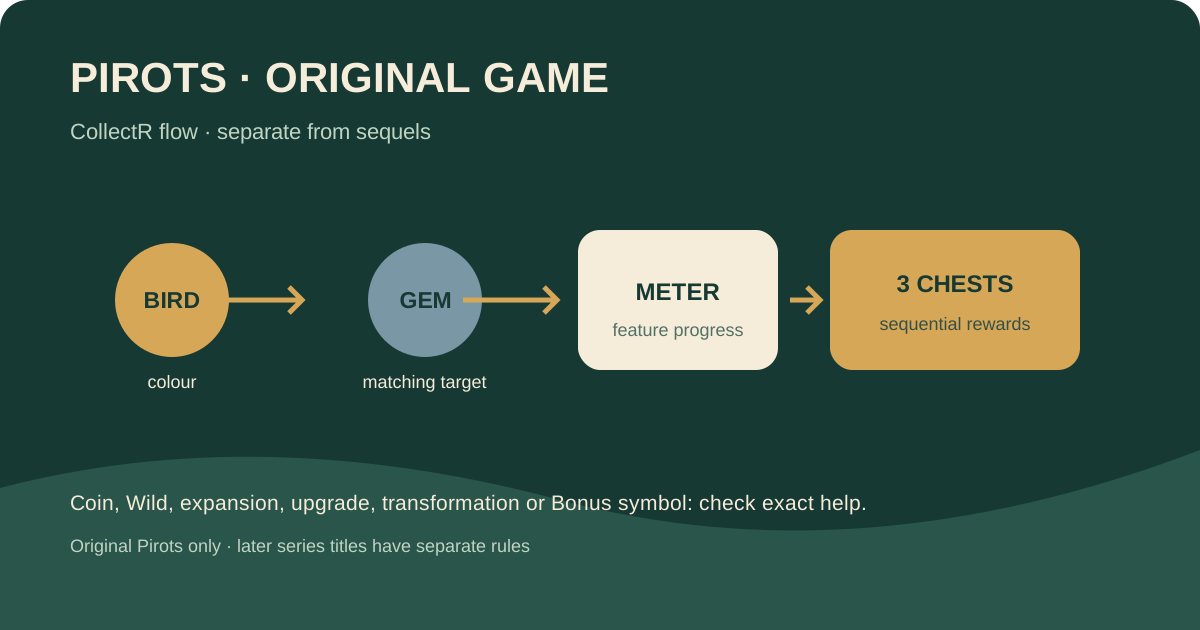
The original Pirots is a CollectR slot built around birds collecting gems of a matching colour. ELK’s official page describes a five-by-five starting grid, an expanding layout, symbol upgrades and transformations, Wilds and coin wins. Each collected symbol adds to a feature meter; when full, it awards three chests that can provide coin wins, Wilds, grid expansion, upgrades, transformations or Bonus symbols. A gem pays its displayed value when its colour matches its collector, with no minimum collection count. The birds trigger the Bonus if they collect three Bonus symbols during a game round. ELK says the grid size, gem win level and feature meter persist throughout that Bonus.
ELK’s official title page checked on 7 October 2026 states a maximum potential of 10,000 times the bet. That is a supplier-stated upper potential, not a usual outcome, a guaranteed result or a verified operator maximum for every version. The accessible official game description does not provide a current RTP, volatility label, complete paytable, stake range or a New Zealand distribution list. The game data sheet linked from the supplier page returned an access error during this review. Those values remain open until a reader can inspect current in-game help for the actual client.
This guide covers the base Pirots title alone. It does not combine it with Pirots 2, Pirots 3, Pirots 4, Pirots 5 or Pirots X. Those are separate products with distinct mechanics and their own guides in the site catalogue. Shared bird or gem imagery does not mean that a sequel has the same collection condition, board, payout table, bonus start or math model. If the title shown in a client includes a sequel number or suffix, use that title’s own rules.
What ELK’s page confirms—and what it does not
The official Pirots page is a source for the product identity and broad feature map. It identifies the CollectR concept, matching-colour interaction between birds and gems, feature meter, chest rewards, board expansion and Bonus Game. These facts provide enough to explain why the game is not simply a conventional fixed-row slot: its later states can depend on collections and feature changes, not only on the first layout.
The public summary does not include every rule needed to settle a particular spin. It does not expose a full symbol paytable in the text reviewed here, the value of every coin, the meter’s exact progress threshold, the order in which every chest result is applied, the Bonus retrigger rules, or an operator RTP. It does confirm that each collected symbol adds to the feature meter and a full meter awards three chests. Do not fill the remaining gaps with figures from Pirots 2 or another ELK title.
Game reviews may show a demo or list a numerical RTP and volatility category. Such information can help you decide what to verify, but it may refer to one particular distribution build or an old version. A review that does not disclose a current rules date is not enough to prove the value applies to a current New Zealand operator. The active help panel and paytable should be the basis for any exact number in an article.
It is equally important not to confuse a release listing with operator access. A supplier can list a product while individual casinos have different distribution arrangements, game availability and local eligibility. This research did not use a New Zealand casino account and did not confirm that any local operator offers original Pirots. The article is therefore an explanation of public game features with a verification method, not a recommendation or an availability statement.
Start with the name and version
When you open the game information screen, copy its full displayed title. “Pirots” without a number is not interchangeable with Pirots 2 or the later numbered entries. The exact product name should appear in the operator’s rules or help, and it should match the supplier catalogue. A tile image can shorten a title or hide a suffix, so verify inside the client instead of relying only on a lobby card.
The series has become large enough that an article about the original game can accidentally turn into a generic “Pirots mechanics” page. Avoid that by keeping a simple boundary: use the original product’s five-by-five starting layout and its described CollectR-to-chest route. If a rule, symbol or feature comes from another named game, link to that title’s own page rather than describing it as part of the original. This helps readers who search for the base title reach a focused explanation.
Version matching matters for settings as well as feature names. A game might have the same visible theme across two operator configurations while differing in theoretical return or stake limits. A sequel might retain the series art while using a different board or coin mechanic. Write down the title, software version if shown, help date, operator name and selected mode before comparing any settings.
If the name in the lobby and the name in the help do not match, treat that as unresolved. Check for an abbreviated label, open the information menu, or ask the operator to identify the game build. Do not assume a similarly named entry on the supplier site resolves the mismatch. The best evidence connects the title in the actual client to its own rules document.
The five-by-five starting board
ELK’s public description identifies a five-by-five starting grid. This describes the board at the beginning of the relevant game state, not every possible later layout. The same page says the grid can expand, so a player should record the initial size and then look for a separate rule that explains which event adds cells or changes the playing area. A screenshot taken in the middle of a feature can show a larger board than the starting state.
The grid dimensions alone do not define how wins are formed. The help should state whether the game uses clusters, ways, paylines or a special collection evaluation. It should say which symbols can form an ordinary paid combination, how adjacency is defined, and what role a Wild plays. The feature page identifies CollectR as central, but collection is not a substitute for the base-game paytable. A coin may be a feature object rather than a regular paying symbol.
When the grid expands, ask whether expansion adds a row, a column or another part of the board, and whether that larger area remains active for the rest of the spin, the feature or later rounds. Does the change alter symbol connection opportunities? Does it expose more cells for collections? The supplier summary confirms that an expansion can occur but the operator help supplies the exact trigger and persistence. Do not assume a larger grid automatically means a larger win.
For a clear explanation, describe the grid in stages rather than one static picture: initial board, qualifying base win or feature event, changed board, next evaluation. This sequence helps readers follow the feature without implying that each expansion pays. A new cell can change possible future layouts and nothing more; payout still depends on the rules and symbols shown in that resulting state.
How the CollectR relationship works
The official page describes a colour match between birds and gems: a gem pays its value when its colour matches its collector, without a minimum number being collected. Track both sides of the relationship. A bird’s colour identifies its collector role; a matching gem is the paid object. If a symbol transforms or a board upgrade changes the available set, the match may be affected. The help should make clear when the value is credited in the active client and how any coin symbols resolve separately.
Do not read the word “collect” as a guaranteed cash payout for every feature object. ELK says matching gems pay their value, while each collected symbol also adds to the feature meter. A full meter then awards three chests. A coin win, a matching gem payment and a meter increment are three distinguishable effects even if the animation places them in one sequence. The public page does not give the exact meter threshold or every coin value; find those in the active help.
A useful way to understand one round is to ask four questions in order. Which bird is active? Which gem colour is eligible? What event makes the bird collect? What does that collection add to—the balance, a meter, or a later feature? If the interface only animates a bird moving across the board, the payout help should still show where the result was recorded. The animation is a visual explanation, not the complete accounting record.
The color-matched structure also makes it risky to borrow a rule from another title in the series. A later Pirots game can use a bird collector but add a train, bandit, coin game, special environment or different persistence condition. Its collection language may sound familiar while the trigger and settlement differ. Always verify the full name and current help before comparing a specific bird/gem interaction.
The feature meter and three chests
ELK’s public description says that a filled feature meter leads to three chests. It lists several possible chest rewards: coin wins, a Wild, grid expansion, symbol upgrade, symbol transformation or Bonus symbols. The list gives a useful inventory but does not establish the probability, order or exact selection rule for each reward. The public page does not give an odds table, so a review must not call one chest result common or imply a frequency without evidence.
The three-chest sequence should be read as a staged feature, not assumed to be three independent spins. A first reward can alter the board or symbols before a later reward is resolved. A coin win can add value; a Wild can alter possible combinations; a grid expansion can create more active positions; an upgrade can change a symbol identity or its payscale; a transformation can change several cells; and a Bonus symbol may contribute to a separate trigger. The exact order matters because the board after chest one might be the board evaluated for chest two.
When the meter activates, note its starting state, the qualifying collection event and the number of chests the help describes. Then track each chest’s visible result and whether it affects the next chest. If the game has a transaction history or feature summary, compare the animation to that record. This makes it easier to tell whether a chest award is an immediate credit, a board modification or progress towards another game state.
Do not assign cash values to non-cash rewards. A grid expansion, Wild or upgrade can increase the number of potential combinations without itself being a payout. A Bonus symbol can be progress rather than a paid result. A coin value is only meaningful once the rules say how it is collected and settled. When a feature reward creates the conditions for a later win, keep the sequence clear but avoid counting the same symbol or coin twice.
Symbol upgrades, transformations and Wilds
The supplier describes symbols being upgraded or transformed and names Wilds among the game’s components. These words cover different operations. An upgrade may move a symbol into a higher-paying category; a transformation may change its type; a Wild may substitute in an eligible combination. The active paytable should state which symbols are eligible and whether the change persists after the current evaluation.
Check the order of operations. A chest might first transform symbols and then evaluate the board, or it might award a transformation for a following drop. The distinction can affect which symbols count together and whether a win is eligible. If two symbols can transform into the same type, the help should explain whether they form a valid group immediately. If the documentation does not state the order, do not infer it from a single observed screen.
Wild substitution should also have boundaries. A Wild might substitute for regular symbols but not coin icons, bonus symbols or special feature markers. It may be fixed to one cell, appear as a larger object or participate in an expansion. Do not assume the Wild itself always pays. The game help’s symbol list should name exclusions and any multiplier value if applicable.
For a reader comparing original Pirots with another ELK game, focus on what each symbol does in context rather than whether the artwork is reused. A gem could be a collection target here and a direct pay symbol elsewhere. A bird can be a collector in one title and part of a different mechanic in a sequel. The same visual object does not establish the same role, payout or probability across products.
Bonus entry and the bird collection condition
ELK’s public description says the birds trigger the Bonus if they collect three Bonus symbols during a game round. This is more specific than a simple “three symbols on the grid” condition: collection by the birds is part of the stated trigger. ELK also says the grid size, gem win level and feature meter persist throughout the Bonus. The operator help should clarify the active client’s exact symbol handling, the bonus duration, retrigger rules and any configuration notes.
Separate the entry condition from the bonus rules. The fact that three symbols trigger the Bonus does not explain the bonus’s starting layout, number of actions, possible retriggers, multiplier, cash-out condition or ending rule. Those details should be available in the game’s own help. If a review tells a reader only that “three symbols start the feature,” it has not yet explained what happens after entry.
The Bonus carries forward three named states: grid size, gem win level and feature meter. Its starting configuration therefore depends in part on the triggering round rather than a fully reset board. The public page does not detail every chest interaction or retrigger rule, so the current help should answer whether those parts continue identically and how later progress is resolved. Describe the three documented retained fields accurately, then leave undocumented interactions open.
The Super Bonus or bonus-like terms in later Pirots games must not be imported into the original. This article covers the original title as named in the supplier catalogue. If the actual client lists a different bonus name, open that exact game’s help and follow the published rules. A sequel’s extra symbol or stronger feature does not describe the original just because the game family shares a theme.
How to interpret the 10,000× potential figure
ELK’s official page states a maximum potential of 10,000 times the bet. This is the only headline numerical win figure used here because it is on the supplier’s own product page. It should be quoted with its source and described as supplier-stated maximum potential. It is not an estimate of average return, a prediction of a typical session or an assurance that an operator permits every customer to stake enough to reach the figure.
The maximum-potential figure needs several additional pieces of context before it can be turned into a real-currency illustration. What stake does the operator use as the basis? Does the maximum apply to base-game spins and the Bonus alike? Does a local cap limit a credit? Are feature modes treated separately? What happens if a calculated award reaches the game’s cap? The official overview does not settle those operator-level details, so no currency conversion or path-to-cap claim is made here.
A maximum number also says nothing about likelihood. An upper bound can be technically possible but extremely rare. It should not be used as the central reason to select a game. Compare the rule transparency, stake range, feature complexity, time commitment and budget instead. A reader who wants a precise probability needs a game-math document that publishes the distribution or a trustworthy explanation of the model; an isolated max-win figure cannot supply it.
Third-party reviews often repeat the supplier number. That repetition does not turn it into a local operator guarantee. Check that the review is describing the original Pirots rather than a sequel. Then confirm the number against the current supplier page and the operator’s help. If the table’s current client describes a different cap or mode, follow the active client and record the discrepancy rather than silently choosing the more attractive figure.
RTP, volatility and the evidence gap
The official public title page checked on 7 October 2026 did not expose a current RTP or volatility category in the accessible text. The linked game data sheet returned an access error. Therefore this guide does not publish an exact return percentage, a volatility label, payline count, stake range or bonus-mode return as fact. Reviews and catalogue aggregators may provide those fields, but a current operator configuration remains unverified without its own help or a versioned supplier sheet.
RTP is a theoretical value based on a defined model and a long-run sample. It cannot be read as a promise that any person receives that proportion back in one session. A slot can have the same RTP across different feature sequences while still producing varied short-term outcomes, or a selectable mode can have a different value; only the exact rules document can answer which applies. Do not combine two separate theoretical values into a single “game RTP” without understanding the wager and mode basis.
Volatility is often presented as low, medium or high, but it is a broad descriptor of outcome distribution rather than a schedule. It does not promise frequent small wins or occasional large ones for a particular session. A third-party category can be a useful comparison lead, but it is not equivalent to a mathematical distribution or an operator help screen. If the source does not define its method, attribute the label rather than presenting it as a precise measurement.
For a publication-ready numerical comparison, capture the help panel or the current official data sheet and note its version date, game mode and market. If the operator does not show a figure, record “not displayed in the available help.” This phrasing is more useful than repeating an unsupported number because it tells readers exactly what evidence they would need to resolve the question.
Comparing the original with the sequels
The original Pirots has a clear identifying role: it is the base game named “Pirots,” with a five-by-five starting grid and a CollectR sequence linking birds, matching gems and feature chests. Its family includes separate later products. A comparison can help readers choose the page relevant to the title, but it should not merge all series rules into a composite description.
When comparing the game to Pirots 2, 3, 4, 5 or X, use product-specific fields rather than general adjectives. Record the grid, central collection target, feature route, bonus trigger, persistence rules, supplier-published max potential and current RTP evidence separately for each title. “More features” is not a verifiable comparison unless the features are named and the comparison method is clear. “Higher potential” is likewise incomplete without a source and context.
This site contains separate guides for some Pirots sequels. The pages are intended to answer their own game-review queries; the original title remains this article’s subject. Readers looking for the game displayed in a client should compare its title carefully and open the corresponding guide. Shared wordmark does not justify transferring one page’s numbers or feature rules to another.
The same rule applies to game histories and preview videos. A video may feature a later sequel and use the word “Pirots” informally in its title. Verify the game title on the screen before extracting a mechanic. A useful comparison distinguishes confirmed continuity—such as a recurring theme—from actual rule continuity, which needs help text.
Mobile interface, help and demo use
A phone display can make a collection game harder to follow because the board, feature meter and result summary compete for screen space. If a specific operator client is available for review, confirm that all active cells remain visible, the current meter label can be read, and the rules can be opened without losing the current stake selection. Check whether the feature summary is scrollable and whether the close control is visible to keyboard and touch users.
An editor should not claim that the game is “fully mobile optimised” solely because the page loads in a mobile browser. Verify the game view at common phone widths and test whether help text, buttons, balance, board and any modal remain usable. The supplier page itself does not verify an operator’s mobile app, orientation handling or network behaviour. Those are client-level attributes that need a local device or a recorded operator demonstration.
If the operator supplies a demo, first identify the full title and inspect its help and paytable. Then use it to learn where the collection counter appears, how a chest reward is announced and where the result history can be opened. Do not treat a short demo sample as a probability test or as evidence that real-money settings match. A demo can provide interface familiarity but cannot establish distribution or current local availability.
The game’s visual complexity can encourage extended play. Set a spending and time limit before starting, and do not chase a chest or feature after a loss. An expanding grid or a full meter is not an indication that the next action must pay. If the controls make it difficult to monitor time or balance, stop and use the operator’s account tools rather than increasing a stake to keep a feature sequence going.
An evidence worksheet for one round
To understand a round, note the title and mode first. Record the board at the start, then identify any qualifying ordinary win, which symbols remain, and whether a bird/gem collection occurs. If the feature meter moves, write down what event the game says caused that change. If it fills, document each chest reward in order and note whether the reward is a payout or a board alteration. This simple timeline helps distinguish what the game displayed from what it credited.
Next, record one line per special symbol: symbol name, trigger, target, effect, timing, persistence and exclusions. The source page names Wilds, upgrades, transformations, coins and Bonus symbols, but the current help must fill in their exact roles. A Wild’s exclusion list matters if it cannot replace Bonus markers. A coin’s value matters only if the rules state how it is collected. An upgrade needs its own before-and-after symbol definition.
Keep the mathematical fields in a separate box: RTP, volatility, max potential, stake limits, feature-buy availability and currency. The supplier publicly states 10,000× maximum potential; the other fields were not verified by the official page in this review. Do not leave empty fields implied by a general label. It is better to say that the evidence is missing than to combine an old aggregator value with current mechanics.
Finally, capture the source date and version for every claim. The current supplier page can change; an operator can use a market-specific version; and a competitor article can remain indexed long after it stops describing the active game. A dated record makes future corrections straightforward. It also tells readers whether a statement is a stable mechanic, a supplier headline or an operator-specific configuration.
Frequently asked questions
Is this the same game as Pirots 2 or Pirots X?
No. Original Pirots is a distinct product. The sequel titles have their own supplier pages and rules. The shared series name or art is not enough to transfer a grid, collection trigger, bonus rule or RTP value from one title to another.
What is the CollectR feature?
ELK describes birds collecting gems of matching colour and a feature meter that can lead to three chests. The active help is needed to confirm exact timing, meter progress and each reward’s settlement. Collection should not automatically be read as a direct cash payout.
What do the three chests award?
The supplier page lists possible outcomes including coin wins, Wilds, grid expansion, symbol upgrades, transformations and Bonus symbols. It does not publish a complete odds table in the accessible description. Treat the list as a feature inventory, not a probability statement.
What is Pirots’ RTP?
The official public page checked here did not provide a verified current RTP, and its data-sheet link returned an access error. Check the exact operator game help. No local operator setting was confirmed for this article.
What does 10,000× mean?
ELK states a maximum potential of 10,000 times the bet. It describes an upper potential, not a typical win, a guarantee or a verified cash amount. The operator’s own help should clarify any version-specific cap or mode differences.
Does Pirots have a demo in New Zealand?
This research did not verify a New Zealand operator demo or distribution listing. Check the operator’s live lobby and local terms. A demo, if offered, can help you read the interface but cannot prove an RTP or real-money outcome.
What evidence should I use for a game review?
Use the supplier page to confirm product identity and broad mechanics, then the active game help for rules, payout and settings. Add a date and version. Use review sites to discover reader questions, not as a replacement for a current rule source.
Sources and date checked
- ELK Studios, Pirots official game page, checked 7 October 2026. The linked data sheet returned HTTP 403 during this review.
- ELK Studios, official game catalogue, checked 7 October 2026.
- Competitor search checked 7 October 2026. Results primarily surfaced pages for separately named Pirots sequels, reinforcing the need to distinguish the original from Pirots 2/3/4/5/X; no generic review was used to supply missing settings.
