Evolution game guide · South Island guide
Lightning Storm rules: wheel, chasers and five bonuses
 Best casinos available in New ZealandUpdated 7 November 2026

Lightning Storm is an Evolution live game show built around a 39-segment DigiWheel and five differently structured bonus games. This guide follows the round order, explains the Chaser bets, and separates supplier-published mechanics from operator limits and payout settings.
The short answer
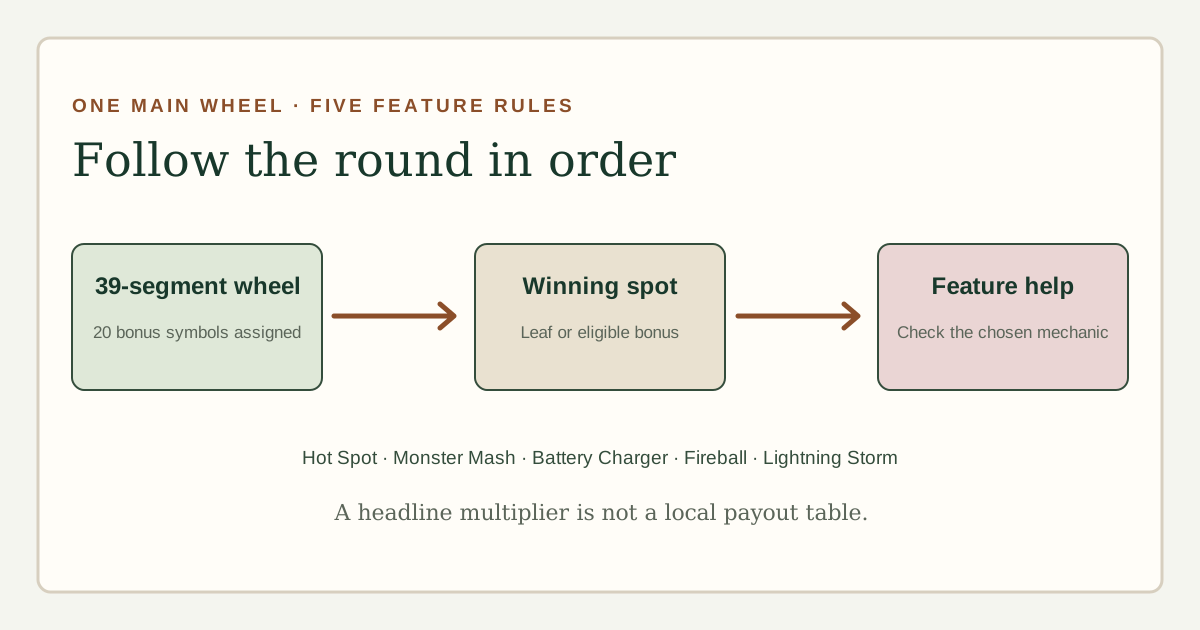
Lightning Storm is a live game show in which players choose one or more displayed bet spots before a presenter spins a 39-segment digital wheel. The wheel can resolve an instant result on a Leaf, or a numbered segment can carry a randomly assigned bonus symbol and, in some cases, a multiplier. A matching wager may then lead into one of five bonus games: Hot Spot, Monster Mash, Battery Charger, Fireball or Lightning Storm.
The important distinction is between watching a bonus and being eligible for it. Evolution says everyone can observe a bonus round, but only a player with a qualifying bet on the relevant spot can participate and win from that feature. The exact stake range, net payout table, return figures and availability are operator-specific information. Use the active game’s help panel for those details; the supplier’s public page explains the structure, not every casino configuration.
What the 39-segment DigiWheel does
The main wheel is the first decision point. Evolution describes 39 segments, with Leaf results associated with instant payouts and numbered segments used for the game’s main wager positions. The product page also says that 20 bonus-game symbols are assigned to random numbered segments during a spin. The resulting layout can therefore change from round to round: you are not looking at a permanently fixed map where a particular number always means the same bonus.
Before the betting window closes, review the current board rather than relying on a remembered wheel picture. Identify which spots accept a direct wager, where any optional Chaser choices are shown, and whether a multiplier is displayed beside a segment. The supplier’s rules explain that a bonus symbol can be paired with a random multiplier. The screen for the current round is the relevant view for what the player is selecting at that moment.
The host spins the wheel after bets close, and the flapper indicates the result. If it stops on a Leaf, the game settles according to the Leaf payout rules. If it stops on a numbered segment carrying a bonus symbol, only matching eligible wagers proceed to the feature. A player who did not place the necessary bet can still watch the presenter and the animation, but observing the outcome is not the same as having a winning selection.
The key concept is conditional eligibility. A number bet does not automatically qualify for every bonus merely because a bonus symbol appears somewhere on the wheel. The active bet must cover the winning spot under the rules that are shown for that game version. Confirm how a Chaser selection changes coverage before treating it as a substitute for a direct bet.
Reading the main bet and the Chaser options
The base wager predicts a result on the wheel. A player may select one spot or several, subject to the operator’s displayed rules and limits. If more than one spot is covered, each wager should be considered separately when thinking about total cost. A spin can settle one selection successfully while other selections lose, so a headline payout on a winning spot does not by itself explain the net result for the whole round.
Evolution’s product description names two special options: Storm Chaser and X Chaser. They alter how the player is covered when bonus symbols and multipliers appear. Storm Chaser is described as a bet that adds a chip to the spot assigned the Lightning Storm Bonus symbol. If that spot already has a bet, the wagers are summed. This is a coverage mechanic; it does not mean the player can select the bonus outcome after seeing the wheel result.
X Chaser is described as automatically covering the bet spots that have received a bonus symbol and a multiplier during the initial spin. This feature also does not allow the player to choose which symbols will appear. It is an additional way the game can allocate coverage according to the rules. Check the client’s current help for the price, settlement and exact eligibility wording of the option before selecting it.
A practical pre-spin check is to read the wager summary after placing chips. Confirm the amount assigned to each ordinary spot, any added Storm Chaser stake, and any X Chaser stake. The betting panel should make the total clear before the countdown ends. If it does not, pause and open the help screen rather than assuming the special option is included in the ordinary wager.
No betting choice can control which symbol the wheel generates, where it lands or which bonus multiplier is assigned. The Chaser names describe game options, not a technique for predicting or steering the round. Previous spins also do not fix the layout of the next spin. A past bonus sequence can be interesting to review, but it is not a reliable forecast of the next random assignment.
How segment multipliers travel into a bonus
Evolution says numbered segments that receive a bonus symbol may also receive a random multiplier in the stated range of 2x to 50x. If an eligible player’s selection reaches a bonus round through that segment, the wheel multiplier is applied to the multiplier accumulated inside the feature as described by the game rules. This is why a bonus-round result and the number printed next to the trigger spot are separate values to inspect.
Do not assume that every bonus segment has a multiplier, that every feature uses the same internal calculation, or that the largest multiplier shown on a supplier page is the result a player should expect. The public material describes possible mechanics and stated ceilings. It does not reveal a New Zealand operator’s exact configuration, wager limits, net payment conventions or all game-help detail.
When checking a result, record the sequence in order: which bet was accepted, which wheel spot won, whether the spot had a bonus symbol, whether a multiplier was attached, which bonus feature opened and what the feature’s own final result showed. Then read the credit or debit in the operator’s balance and compare it with the rules’ stake-return wording. Keeping the chain in order helps distinguish a rule misunderstanding from a screen or settlement question.
Hot Spot: select a tile before the moving area settles
Hot Spot is a multiplier-wall feature. Evolution describes a wall of hidden multipliers grouped by value, with a higher-value cluster making up the named Hot Spot. The values are shuffled and hidden. The player selects a tile, then a moving 3-by-3 area travels around the wall and stops. If that area covers the previously chosen tile, the selected value is doubled under the stated feature rule.
The sequence matters because the tile choice happens before the moving area stops. The player is not shown the final arrangement and then allowed to choose the most valuable tile. A visual map can make the process easy to follow, but it does not reveal where the selected multiplier will land. The feature is an outcome-resolution step, not a test of skill at reading a predictable pattern.
Evolution describes the feature ceiling as up to 10,000x. That is a maximum statement for the feature, not a typical result and not a promise that any given round will approach it. If a multiplier was assigned to the triggering wheel segment, the official description says the multiplier wall is adjusted before the bonus feature begins. Check the current help for how the triggering multiplier combines with the selected result in the operator’s version.
Monster Mash: additive and global multipliers are different
Monster Mash uses three horizontal reels representing body parts: head, torso and legs. Evolution describes two kinds of multipliers. Regular multipliers add to the feature’s total, while Global multipliers multiply values according to the feature’s rules. The host pulls a lever, the reels stop on a combination, and the selected body parts form the resulting monster multiplier.
This additive-versus-global distinction is easy to miss in a fast animation. A hypothetical combination of regular values 10, 10 and 5 adds to 25x, while a combination in which the values are global can multiply to 500x. Those are examples on the supplier page explaining the difference between the two labels; they are not an operator payout table or a forecast of available symbols in a future bonus.
Evolution states that a Monster Mash result is capped at 10,000x. If the triggering segment brought a multiplier into the bonus, the supplier description says regular multipliers are multiplied by it before the reels are pulled. Confirm the actual help wording and the value shown in the active client before interpreting a settlement.
Battery Charger: each battery has a distinct role
Battery Charger presents a conveyor of ten batteries. Evolution describes nine batteries as carrying Regular multipliers and one as carrying a Global multiplier that doubles the values remaining on the conveyor. A mini wheel is spun as each battery reaches the charger. A red result makes the current battery overcharge and explode, allowing the next battery to move forward; a green result with a Regular multiplier awards the attached value.
A green result with a Global multiplier affects the remaining batteries instead of paying the current value in the same way. The rules describe doubling all values left on the conveyor. The feature ends when the mini wheel lands on a green result with a Regular multiplier, or when only one battery remains; the final remaining value then determines the feature result. The actual sequence depends on the results of the mini wheel and the values assigned to the batteries.
The feature’s stated maximum is 10,000x. Evolution says an initial wheel multiplier can multiply regular values before the battery conveyor begins. When reading the active help, check whether the displayed multiplier applies to every Regular battery, how the Global value is presented, and what is paid if the feature ends with one battery. Do not infer settlement from a screenshot that omits the complete sequence.
Fireball: the 149-pocket multiplier grid
Fireball launches a ball into a floor containing 149 multiplier pockets. The official description divides pockets into Regular and Double multipliers. If the ball lands on a Regular pocket, that is the feature multiplier. If it lands on a Double pocket, the Regular multipliers are doubled and the ball is launched again. The sequence can continue until the values reach the stated feature ceiling.
The Double pocket therefore changes the values available for the next launch; it is not automatically the payout itself. The rules explain that after all multipliers reach 10,000x, the Double pockets are replaced by 10,000x values. The bonus feature maximum is capped at 10,000x. This ceiling should be attributed to the feature, not assumed to describe a casino’s separate maximum-win cap or an account-level restriction.
If the triggering wheel segment carries a multiplier, the supplier description says that Regular multipliers on the grid are multiplied before the bonus round. To understand a completed round, note the wheel value, the sequence of pockets, each Double event and the final Regular landing. The order determines which multiplier values were available at the time the ball stopped.
Lightning Storm: choose one of three strikes
The Lightning Storm Bonus is distinct from the game show’s overall name. Its billboard contains eight Regular and three Global multipliers according to Evolution’s current public rules. Lightning strikes three times. At the beginning of the feature, the player selects one of the three strikes; the multiplier associated with that selected strike is applied to the payout after the strike interacts with the billboard.
The strike can stop on one or more multipliers. Evolution says the result can be the sum of one or more selected Regular values, or that sum multiplied by one of the Global values. This means the result is determined by the particular selection and the path of the lightning, not by the largest number visible on the board. A board may display several values without making them all part of the same settlement.
Players who selected the first or second strike can observe all three strikes taking place, but their payout selection remains the strike they chose under the feature rules. The supplier states a maximum of 20,000x for this bonus. If a multiplier arrived from the main wheel, Evolution says Regular values on the board are multiplied before the feature starts. Read the exact result panel to see which Regular and Global values contributed.
Payouts, RTP and limits: what can be verified
A headline multiplier is not the same thing as a complete payout table. It tells you an upper feature value described by the supplier, not the price of a stake, the return rate of a bet type, or a likely result. The current public product page describes the wheel and bonus mechanics, but it does not provide a full New Zealand operator paytable or a universal set of stake limits for every casino.
This guide therefore does not publish a single RTP or a local minimum and maximum bet. Third-party pages may show values for one operator, currency, market or table variant. Those numbers can be useful clues for what to look for, but they should not be copied into a New Zealand statement without the current game help that applies to the operator being checked.
Before using a numeric claim, check that the source states whether it applies to the main wheel, a named bet or a specific bonus. Look for the stake basis, the currency, whether the return includes the original stake, and any multiplier condition. A figure detached from those labels can look precise while answering the wrong question.
Mobile, demo and viewing a bonus
The supplier page is an information page; it does not establish that a playable demo is available to a particular New Zealand visitor. Evolution’s showcase says free-play content and individual features can be subject to jurisdiction. An operator may also choose which games it integrates. Confirm the game’s availability and supported screen at the operator without treating a public supplier page as local access confirmation.
On a phone, make sure the full bet panel is visible before betting closes. The wheel, Chaser options and round summary should not be obscured by a cookie banner, orientation change or notification. Zooming in can hide the total wager or a feature label. If the help panel cannot be read on the device, find the desktop rules page or contact the operator before relying on an uncertain setting.
Watching a feature round is not always the same as participating. The supplier explicitly separates observation from eligibility: players need the relevant accepted bet to win from that bonus. A stream can continue while a player has no qualifying stake, and a replay can show the entire animation after betting has closed. Use the round-history or settlement information, if available, to confirm whether the account actually had an eligible selection.
A practical pre-round and post-round checklist
Before betting, confirm the title is Lightning Storm rather than another game with “Lightning” in its name. Read the current selection labels, check the currency and stake total, and note whether a Chaser option has been selected. Review the round’s displayed segment assignments if the client presents them before betting closes. Decide on a maximum amount for the session independently of the game’s headline multipliers.
After the spin, ask four questions: what did the flapper select; did the winning spot carry a bonus symbol; did the current rules show an eligible bet; and did an extra multiplier enter the bonus? If the screen moves into a feature, identify which of the five feature names appears before trying to interpret its animation. Then compare the final feature value and settlement with the operator’s rule text.
A bonus result should not be used to predict the next one. Each round has its own assignment and result sequence. A history screen describes completed outcomes; it does not show that a particular number, bonus or multiplier is due. No selection pattern changes the independently generated next round described by the supplier.
Questions readers commonly ask
How many bonus games are in Lightning Storm?
Evolution lists five: Hot Spot, Monster Mash, Battery Charger, Fireball and the Lightning Storm Bonus. The fifth is a feature inside the game that shares the overall title. Each bonus uses a different selection or resolution process, so the same explanation should not be applied to all five.
Is the wheel layout fixed every round?
The 39-segment DigiWheel is a consistent overall format, but Evolution says bonus symbols are assigned to random numbered segments during the spin. A player should check the current board and rules rather than assuming that a particular number always opens the same feature. The active game help explains how the current version displays the assignment.
Does a Chaser option guarantee a bonus win?
No. The supplier describes Storm Chaser and X Chaser as coverage options tied to assigned symbols and multipliers. They do not control which segment wins, select a desired bonus or guarantee a positive settlement. Their cost and exact result should be checked in the operator’s active paytable.
What is the maximum Lightning Storm multiplier?
Evolution’s public page lists feature ceilings of up to 10,000x for several bonuses and up to 20,000x for the Lightning Storm Bonus. These are stated maximums, not typical outcomes or promises. Operator rules may also describe local stake, account or maximum-win restrictions.
Can the same bonus be won without placing its bet?
Evolution says everyone can observe a bonus round, but only players who placed the corresponding eligible bet can participate and win. Confirm that the stake was accepted for the current round and that it covers the winning segment under the rules.
Is Lightning Storm available to New Zealand players?
The Evolution catalogue does not establish access at a specific New Zealand operator. Availability can depend on the casino, account and jurisdiction. Check the operator’s current game lobby and help, and do not infer local access from a global catalogue or another country’s review.
Sources and verification boundary
Official product source checked 6 October 2026: Evolution Lightning Storm game page. It describes the 39-segment DigiWheel, 20 randomly assigned bonus symbols, Leaf outcome, Chaser options and five bonus stages. Exact New Zealand operator limits, local payout table, RTP and account availability were not verified. The page is informational and does not link to an operator offer.
