Evolution game guide · South Island guide
Instant Super Sic Bo rules: bets, multipliers and ROLL NOW
 Best casinos available in New ZealandUpdated 7 November 2026

Instant Super Sic Bo is a three-dice game in which the player places one or more selections, then chooses when to enter a result with ROLL NOW. This guide explains the bet families, the special triple exclusions, random multipliers and why the supplier overview does not replace the operator’s payout table.
The short answer
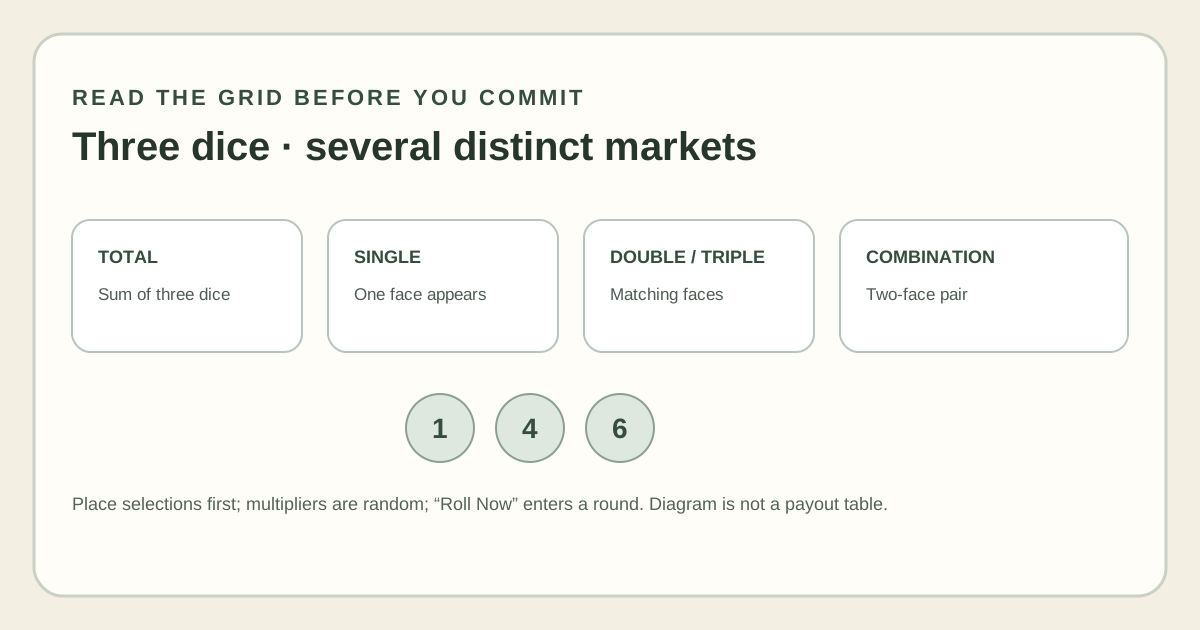
Instant Super Sic Bo uses three standard dice, each with faces from 1 to 6. Instead of waiting for a fixed live table schedule, a player can review the betting grid and choose when to enter a round by pressing “ROLL NOW”. Evolution says the dice continue to shake with short pauses for the result and that the betting window is unlimited before entry. The game has markets based on totals, odd/even or small/big outcomes, individual faces, doubles, triples and two-dice combinations. After the player enters, a random set of zero or more bet spots may receive multipliers, described by the supplier as reaching up to 1000x. That ceiling is not an expected result or a payout promise. The official Evolution page describes the mechanics but not every payout value or operator setting.
Identify the exact product before applying a Sic Bo rule
The name is important because Evolution has several dice products. Instant Super Sic Bo is the self-paced variant covered here. It is not the studio’s standard Super Sic Bo table, and it is not Lightning Sic Bo. All three may use three dice or familiar Sic Bo language, but their round timing, special features, fees and multiplier mechanics are not interchangeable. Before using any instructions, compare the title displayed in the client with the heading in its help panel.
The word “Instant” refers to when the player enters a round and how quickly the result follows, not to a promise that the interface will always respond with zero delay. The supplier describes continuously shaken dice with short breaks and a “ROLL NOW” choice after bets are placed. A live operator can still have loading time, connection delay or temporary maintenance. The rules of the outcome should remain in the help area even if the stream or animation is temporarily unavailable.
The game is best understood as two separate decisions. First, select which event the wager is meant to cover and how much is assigned to each bet spot. Second, decide when to enter the outcome using ROLL NOW. A quick result does not collapse those decisions into one. It remains useful to read the market labels and stake summary before asking the game to resolve the next shake.
The order of a round
Evolution’s public instructions imply a simple sequence. The player opens the betting grid, places one or more selections, reviews the total, and presses ROLL NOW when ready. The dice then produce the result almost immediately. Random multipliers are assigned to a selection of bet spots around the time the dice are shaken. A wager wins only if its condition matches the dice outcome; the multiplier affects a winning selection only when the game shows that multiplier on the relevant spot and its rules make it applicable.
There is no need to align an entry with a dealer countdown in the way a scheduled live table often requires. That flexibility has a practical trade-off: the player can move from one round to another without a long pause. If using the client, set a stop time and spend limit before entering. Autoplay can remove even more natural pauses, so a fixed number of rounds should be chosen with awareness of how quickly they can resolve.
Check whether chips on more than one spot are treated as separate wagers. A selection on Small and a selection on an individual face can both be active for the same result, but each has its own settlement condition and stake. The total amount committed is the sum of all active selections, not the amount on whichever spot eventually wins. A screen that shows several chips can therefore represent multiple simultaneous exposures.
If a round appears interrupted, do not assume that a repeated press created a second wager or that a result failed to settle. Use the operator’s transaction history and round ID, then compare the recorded selections with the game result. The round record is more reliable than replaying the animation from memory.
Markets based on the sum or category of the dice
Small and Big
The supplier defines Small as a three-dice total from 4 through 10 and Big as a total from 11 through 17. Both markets lose to any Triple. The exception matters because a triple’s sum can otherwise fall inside the displayed Small or Big range. If three dice show the same face, the special rule overrides the simple total category for these wagers.
Do not infer that “Small” means each die must show a low face or that “Big” means at least one die must be high. The condition is the sum of all three dice. A mixed set of faces may still add to a Small or Big result. The help panel’s category wording is the settlement rule; the appearance of one die is not sufficient.
Odd and Even
Odd/Even predicts whether the sum of all three dice is odd or even. Evolution says these selections also lose to any Triple. A player should not ignore that clause just because three matching faces produce an obvious total. It is a special settlement exception attached to the market.
For example, three matching dice always have a sum that follows the parity of three times that face. The game’s stated exception still controls the Odd/Even bet when the result is a Triple. This is a good illustration of why a market name alone is not its full rule: the category seems broad, but the help adds a defined losing condition.
Total
The Total market has 14 areas marked 4 through 17. The sum is the total of the three dice; 3 and 18 are not listed as Total bet areas in the supplier description. A selected total wins when the three faces add to that number. Evolution says payout values vary according to the winning total, but its public overview does not provide the whole table.
Totals near the centre of a range and totals at the extremes can have different payout terms. Do not fill in a remembered traditional Sic Bo schedule unless the active client confirms it. Even where the labels appear familiar, an exact operator game build may use different displayed values or a different convention for what the multiplier includes.
Markets based on faces and matching dice
Single
The Single market lets the player select one of the six faces. A win can depend on whether that face appears on one, two or all three dice; Evolution says the payout rises with the number of dice showing the selected face. This market is not the same as betting that the total equals the face value. It counts occurrences of a chosen face across the three dice.
Read whether the table displays separate rows for one appearance, two appearances and three appearances. If the exact return is not present, do not substitute a generic Sic Bo payout. Also check whether a three-of-a-kind result simultaneously qualifies for any separate Triple market; the active paytable determines how overlapping selections settle.
Double
There are six Double-labelled spots, one for each face. The supplier says a Double bet wins when two of the three dice show the same selected number. It also states that the payout is the same whether two or all three dice show that face. That rule prevents an assumption that a triple automatically improves the Double market’s return.
Double and Triple sound close, but they ask different questions. A Double selection covers a repeated face under the stated match rule. A Triple selection asks for all three dice to match the selected face. Check the paytable and any overlap rule before placing both, because the same physical dice can meet more than one descriptive condition while the operator still settles each selection according to its own row.
Triple and Any Triple
Each of six Triple areas predicts that all three dice will show the named face. Any Triple covers the set of six possible triples with one selection, according to Evolution’s description. “Any” changes the breadth of coverage, not the dice condition: all three dice still need to match one another.
The public overview does not state the exact payout for each Triple, for Any Triple, or whether each configuration presents those as separate selectable wagers. Read the active rules and check whether a displayed multiplier can apply to the specific market. Do not treat the chance of a Triple as proof of its payout value.
Combination
Evolution lists 15 possible two-dice combinations. A combination bet is a specific pair of faces rather than a total category. To understand the spot, inspect the two labels that define it and how the rules treat the third die. The public overview names the market family but does not spell out every combination’s payout condition and amount in the same detail as the other sections.
That omission makes the game-help panel especially important here. A two-face pattern can be ordered or unordered depending on its definition, and a market may distinguish whether the two selected values appear on any two dice. Do not assume a pair bet is settled from a sum alone. If the interface does not clearly explain the matching rule, avoid the selection until the paytable resolves the ambiguity.
Random multipliers: what “up to 1000x” means
Evolution says that after bets are placed and a round is entered, a number of spots from zero to several may be selected at random for multipliers up to 1000x. If a bet is placed on a winning spot that has received a multiplier, the payout is multiplied accordingly. “From zero to several” means a multiplier is not guaranteed to appear on every round. “Up to” describes the published upper limit, not the average multiplier or a predictable frequency.
Separate three conditions when checking a result: the bet must be active, its market must match the dice, and any multiplier must be attached to that bet spot in the way the rules recognise. A multiplier on an unrelated area does not make a losing wager a winner. Likewise, a winning market without a multiplier still settles under its ordinary payout rule.
The public page does not disclose the distribution of multipliers, how many may be assigned to a particular round, whether every market can receive one, or the complete mathematical return by bet type. Those are not details that can be derived from the “up to 1000x” headline. If a third-party guide publishes an RTP or a top multiplier frequency, treat it as a claim about its own source and version until it matches the operator’s current help.
The multiplier is not a separate bet on its own in the wording shown by the supplier; it changes the settlement of a qualifying selection. Still, the live rules determine the precise calculation. Check whether the amount shown is a gross return, net winnings or a multiplier of the payout table’s base value. The arithmetic convention can alter how a total is presented without changing the underlying dice result.
Autoplay and the pace of play
Autoplay allows a player to set a number of rounds and participate in a series rapidly. That is a convenience function, not a prediction tool and not a way to improve the dice outcome. A shorter decision cycle can make it easier to lose track of the combined amount staked, especially when several spots are selected in each round.
Before enabling it, confirm how many rounds are included, whether the same set of bets repeats, what stops the sequence, and whether a balance or win/loss stop can be configured. The supplier’s public overview mentions choosing the number of rounds but does not specify every operator’s control set. Use only the settings displayed in the client. If the autoplay control does not make the total stake obvious, leave it off and enter rounds manually.
A useful arithmetic check is: total per round multiplied by the number of rounds selected. If there are four bet spots at one unit each, the exposure per round is four units, not one. A 10-round autoplay sequence would then commit 40 units before considering whether some bets return a payout. This example is arithmetic only; it is not a recommended stake or a forecast.
Set the budget in currency before converting it to chips. Use a timer independent of the game, and stop when it rings. Autoplay should not be used to chase a previous loss or to extend a session because a multiplier has not appeared. Each new round is a fresh outcome under the game’s rules.
Payout table, RTP and configuration boundaries
The official Evolution page says each bet type has its own payout rate but does not publish a complete current table in the public text available for this review. It also does not give the active NZ operator’s minimum or maximum stake, currency, RTP by market, multiplier frequency, or demo access. Those fields should remain unverified here.
When reading the live help, record the exact title, version, currency, date, bet label and amount. Note whether a payout ratio includes the returned stake. For example, “5 to 1” can be presented as a net win plus stake in one interface and as a gross return in another. Use the definition printed by that client rather than assuming convention.
RTP is theoretical and configuration-specific. It does not predict a result for a short sequence of dice rolls. A published overall percentage can also hide differences between bet categories. If an operator gives an RTP figure, ask whether it applies to the selected market, the entire game or a particular settings file. If the game’s rules do not provide that scope, do not make a comparison based on one number.
Traditional Sic Bo tables from another supplier may help a reader learn terms such as Total, Double and Triple, but they are not authoritative for Evolution’s Instant Super Sic Bo. The safest source hierarchy is the active game help for that exact client, then the official supplier page for broad product mechanics. A dated third-party review is useful only as a lead to questions, not as a substitute for the current payout schedule.
A simple inspection checklist
Before selecting a wager, use these checks:
- Confirm the title is Instant Super Sic Bo, not Super Sic Bo or Lightning Sic Bo.
- Read the rule below the exact market you plan to select. Pay particular attention to Triple exclusions for Small/Big and Odd/Even.
- Confirm how the Single market counts appearances and how Double differs from Triple.
- For a Combination spot, verify precisely what pair is required and whether order matters.
- Add every selected stake to understand the full amount that will be committed.
- Check the paytable’s multiplier and stake convention; do not infer from a marketing headline.
- Before ROLL NOW, review the selections and total. Once entered, a result can appear quickly.
- If using Autoplay, multiply per-round exposure by the selected number of rounds and set a stop time first.
If the game closes or loses connection after ROLL NOW, avoid pressing the control repeatedly until checking the transaction record. Find the game’s round ID and the operator’s settlement entry. A missing animation does not on its own show whether a wager was accepted.
Common mistakes to avoid
Reading a market label without its exception. Small/Big and Odd/Even lose to any Triple in the published description.
Confusing a face bet with a total. Single counts how many dice show a selected face; Total looks at the sum of all three.
Treating Any Triple like a general three-of-a-kind bonus. Its condition is a matching triple; consult the current paytable for its exact settlement.
Assuming a multiplier will appear. The supplier explicitly says the random selection can cover zero spots.
Believing a multiplier changes the dice. It affects the payout on an eligible winning spot; it does not change the outcome condition.
Letting fast play hide the total cost. Count every active spot and every autoplay round, not just the selected chip denomination.
Mobile, demo and New Zealand access
The supplier describes an interface with a dice grid and a ROLL NOW control, but this public page does not confirm how every casino implements the client on mobile. Screen size may affect how many betting areas are visible at once. Before making a decision, ensure the selected spot, stake and total are legible; rotate the device or stop if the interface hides part of the grid.
The Evolution showcase describes itself as an educational freeplay site but also says demo availability and individual features are subject to jurisdiction. That does not establish that Instant Super Sic Bo demo is accessible to a New Zealand visitor, or that a particular operator offers it. This page makes no such availability claim.
New Zealand online casino advertising and access are subject to current law and regulator guidance. A supplier catalogue entry does not confirm local eligibility or the legality of a given operator. Check current official DIA information independently; this article is not a route to a casino account.
Questions readers commonly ask
How does ROLL NOW work?
It is the control the supplier describes for entering a result after placing bets. The player can review the grid first, then choose when to start the round. Results are described as nearly instant after entry.
Do the dice keep rolling between rounds?
Evolution says the dice are shaken continuously with short pauses for results. That explains the presentation; it does not mean that an unentered outcome counts as a round for a player.
Can Small or Even win on a Triple?
The supplier says Small/Big and Odd/Even bets lose to any Triple. Use that exception even when the triple’s total would otherwise fit the category.
Is a 1000x multiplier guaranteed?
No. Evolution says zero to several spots may be randomly selected and describes multipliers up to 1000x. The upper figure is not a per-round promise.
Where do I find exact payouts?
Open the current game help in the specific operator’s client. The public supplier overview names bet types but does not show the complete payout table in the text reviewed for this guide.
Sources and verification boundary
- Evolution: Instant Super Sic Bo — supplier description of the round control, bet families and random multipliers; checked 6 October 2026.
- DIA: Online gambling for advertisers — New Zealand advertising context; checked 6 October 2026.
The active operator payout table, RTP by bet type, bet limits, mobile implementation, demo eligibility and New Zealand availability were not independently verified. The guide does not transfer values from Super Sic Bo, Lightning Sic Bo or another market.
