Wazdan game rules · South Island guide
Fisherman’s Luck™ by Wazdan: rules, features and RTP evidence
 Best casinos available in New ZealandUpdated 7 November 2026

Wazdan’s public Fisherman’s Luck™ page describes a ten-reel, zero-line slot with Gainer symbols, Cash Out, Chance Level and Free Spins. Its Game Info panel lists RTP 96.13%, Medium volatility, a maximum win of 2,500x and release date 5 March 2026. Those are supplier-listed details, not confirmation of the configuration at any casino. Read the exact build’s help before relying on a rule or number.
The short answer
Fisherman’s Luck™ is a Wazdan slot whose official product page describes a ten-reel format with no conventional paylines and a feature sequence built around Gainer symbols, Cash Out and Free Spins. The same supplier page, checked on 8 October 2026, lists RTP 96.13%, Medium volatility, a maximum win of 2,500 times the bet and a release date of 5 March 2026. The page also names Chance Level, Volatility Levels, Buy Feature and Ultra Fast Mode. These are useful identification points, but the page is not a casino lobby or an independent test of the game.
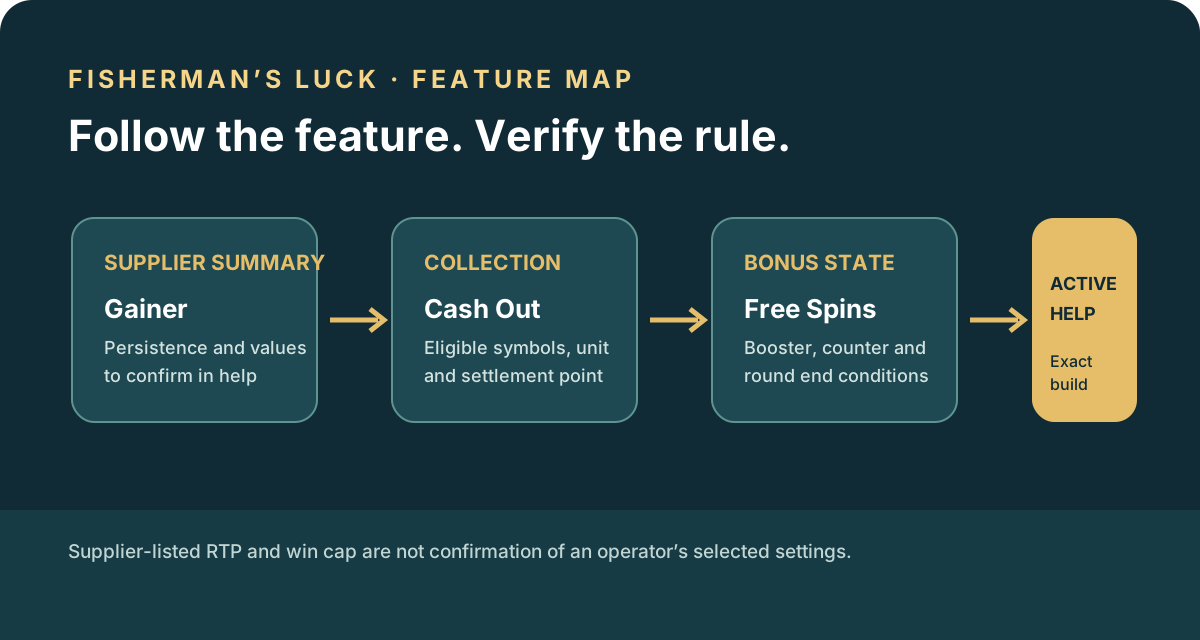
The most important distinction is between a supplier summary and the active version a casino presents. The supplier may describe a standard product, while an operator can select an allowed configuration or present a version with different settings. Before play, open the exact game’s information or help screen and note its title, version if displayed, RTP, bet unit, feature rules and any buy-feature price. If help does not show a value, say it could not be confirmed rather than importing the headline from a catalogue.
This page covers only Fisherman’s Luck™. It does not establish that a particular casino carries the game, that the game is available to people in New Zealand, or that a demo is available. It does not predict outcomes. For the difference between a supplier page and title-specific help, see the Wazdan games guide.
What Wazdan’s product page says
Wazdan’s Fisherman’s Luck page presents the game as a slot with 10 reels and 0 lines. The listed Game Info fields are RTP 96.13%, maximum win 2,500x, Medium volatility and release date 2026-03-05. Its features area names Cash Out, Chance Level, Volatility Levels, Buy Feature, Ultra Fast Mode, Free Spins and Collector. The page’s text describes individual interactions, but a headline field should not be confused with a full paytable or an operator-selected setting.
“10 reels / 0 lines” is the supplier’s format listing. It does not, by itself, explain how a winning combination is evaluated. A player accustomed to paylines may assume symbols must align across a fixed number of rows; a grid or feature-driven game may instead use its own rule. Read the help for how a symbol combination qualifies, whether positions are fixed or can change, how the feature starts, and what happens after a result. Do not infer a “ways” mechanic just because the reel count is unusual.
The number 96.13% should be quoted only as the RTP that the supplier page lists for the named title at the date checked. RTP is a long-run theoretical measure under specified game rules. It is not a return forecast for one session, a guaranteed recovery of stakes, or proof that an operator build uses that exact setting. If the active help shows a different value or no value, record the active evidence separately. The same discipline applies to the 2,500x headline maximum: retain its stated unit and context.
Read the Gainer feature as a sequence, not a promise
Wazdan describes Gainer symbols as a persistent feature element that can remain for up to 10 spins while gathering Cash and Jackpot values shown below. The supplier also says a multiplier can interact with the collected amounts. This gives the reader a useful sequence to look for: a Gainer appears, a remaining-spin state is shown, values are accumulated, and an eventual event determines how they are collected. The high-level summary does not answer every condition.
At the active help screen, check what exactly “up to 10 spins” counts. Does the counter begin on the appearance of a symbol, only after a feature trigger, or when a separate state starts? Is the spin counter reduced on every game action or only on qualifying results? Can an additional Gainer reset or extend the counter? Does a Gainer persist between regular spins, across a bonus, or only within one described feature? Wazdan’s short page cannot be used to fill in any missing details.
The values “Cash” and “Jackpot” also need precise reading. A label underneath a symbol may indicate a value, a prize tier or a collection state; the visible animation is not enough to establish whether amounts are added, substituted or multiplied. Read the paytable and feature description, and record whether the game states the value in bet multiples, coin units or currency. If it presents a jackpot label, determine whether it is fixed to the game or connected to a progressive pool. Do not infer a cash amount from an icon.
When describing a Gainer event to another person, separate what was shown from what was paid. A factual note might say, “The help describes Gainer as staying for a limited number of spins; the game showed a counter of X before the result.” A separate account statement or round history is needed to verify final settlement. This avoids turning an exciting animation into an unverified claim about a prize or likely outcome.
Cash Out: confirm the collection condition
The product page describes Cash Out symbols appearing on the upper reels and catching symbols below them, then accumulating and paying values. That is a structural explanation, not a complete rule. The exact help should say which symbol is caught, where it must land, whether the collection is immediate or waits for another event, and how the collected value is calculated. It should also distinguish cash values from any jackpot or multiplier shown in the interface.
Look for the unit attached to each value. If a feature uses a multiplier of the bet, confirm whether the reference is total bet, line bet, spin stake or a feature-specific stake. If it says a displayed symbol carries “5x,” do not silently convert that to a currency amount without knowing the chosen wager and the game’s calculation. If a Cash Out symbol can collect several items at once, check whether the total shown is before or after the feature’s multiplier. Never extrapolate from a similar Wazdan game: a shared feature name does not guarantee identical order or settlement.
The term “Cash Out” can also be used by players for a separate early-settlement or cashout option in other games. Do not confuse that generic operator control with this title’s named symbol mechanic. In this guide, Cash Out refers to the feature wording on Wazdan’s Fisherman’s Luck page. A casino might use other wording in its controls, and only the active rules determine the meaning in a specific build.
If a feature sequence seems inconsistent, save the title and round identifier, the help text, the visible sequence and the final account entry. Do not treat a screenshot of the intermediate animation as proof of a settled win. Ask the operator to explain the game result against the same round ID and rule version. No test round was played for this article.
Free Spins, Collector and feature persistence
Wazdan says that within Free Spins, a Gainer can stay until the bonus round ends. The supplier also names Gain Boosters, which extend its life, and Gain to Infinity, which keeps it active to the end. These are important distinctions because “persistent” can mean a fixed number of game actions, a state that resets, or a feature that remains until a defined endpoint. The summary gives the names and a broad relationship, but it is not a full state diagram.
Use the help screen to identify how Free Spins are triggered, how many are awarded, what symbols or events can add more, and whether retriggers are possible. Then check whether the Gainer’s remaining-spin counter changes when a Gain Booster appears. “Extends its life” requires a defined unit: one more spin, a new counter value or another rule. Gain to Infinity sounds absolute, but the practical endpoint on the supplier summary is the end of the bonus round. Do not interpret it as a persistent effect in later sessions or across a closed game.
Collector is a listed feature label. The official page needs to be read for what it collects and when. Does it collect only values displayed underneath Gainers, jackpot values, or another category? Is collection automatic, triggered by a symbol or limited to a bonus? If the supplier’s page does not state these details, mark them for active-help verification. Avoid importing an explanation from a differently named Collector game.
Feature names are not probabilities. A page can identify an event without providing its chance, average frequency or contribution to RTP. Unless the operator’s game help publishes a probability and its basis, do not estimate how often a Gainer, Booster, Collector or Free Spins event should appear. Observing a small number of rounds is not statistically sufficient to infer a probability, and this guide reports no play test.
Chance Level and Volatility Levels
Wazdan lists Chance Level and says it can increase the odds of a bonus. Its public summary describes settings at x2, x5 and x10. A setting that changes the chance of a feature may also change the price of a spin or another game parameter; the exact help should show both what is changed and the cost. The product page alone is not enough to say what an operator enables or what the active stake multiplier is.
Before choosing any setting, read the confirmation presented in the game. Record the base stake, the total stake after the selected level, and the stated feature-probability change. If the interface does not clearly state those three points, do not treat a brief label or icon as a full disclosure. A larger stake can change the amount exposed on each round, even if the user sees the same base wager field. An option that changes feature odds does not guarantee the feature or a positive result.
The supplier listing “Medium” volatility is a category, not a schedule. It does not say how many spins will pass before a feature, the size of a particular win, or what will happen next. The separate Volatility Levels feature label may indicate a user-selectable setting or a supplier feature category; verify which meaning the active version uses. Do not combine the headline Medium label with an assumption that every mode has the same distribution.
If the game help provides several theoretical RTP settings, identify the one selected for the active game. Do not average them or choose the highest catalogue figure. RTP and volatility answer different questions: RTP is a theoretical return calculation across many rounds under a particular configuration, while volatility describes a distribution pattern in broad terms. Neither predicts an individual round.
Buy Feature and optional play modes
Buy Feature appears in the supplier’s list. That name suggests a paid route to a feature, but it does not establish that a particular casino build offers the option, which feature it buys, its cost, or how the purchase affects the game’s RTP. Those facts belong to the active help and interface before any choice. If the option is absent, no conclusion about another version follows.
If buy functionality is available, record the full displayed price and whether it is a multiple of the base stake or another amount. Check which bonus state begins, whether all normal triggers are skipped, how the feature ends and whether the maximum-win field still applies. A purchase price is part of the stake at risk. It should not be framed as a shortcut to a profit or as a way to improve the chance of an eventual net gain.
Ultra Fast Mode is also named by Wazdan. It concerns presentation speed, not a change in the outcome rules unless the game documentation expressly states otherwise. Faster rounds can make elapsed time less noticeable. A player who needs to track time should use the game or platform’s time display and avoid relying on animation pace as a clock. On a platform covered by New Zealand’s minimum standards, the operator must provide means to track time; this does not establish that a supplier’s fast mode carries the required interface or is available in every venue.
Mobile support should be checked in the exact game window. The supplier catalogue may use broad compatibility language, but it cannot establish that an operator has integrated this title for a particular phone, browser or account. Note screen orientation, whether the paytable is reachable, if text can be enlarged, how the balance unit appears and whether the round history remains accessible. A small screen can hide the difference between a base stake and a feature price; verify it before confirming anything.
How to read RTP, maximum win and volatility responsibly
The product page’s three headline values serve different purposes. RTP 96.13% is the supplier-listed theoretical return figure. Maximum win 2,500x is a ceiling field expressed in bet multiples. Medium is a volatility label. A reader should preserve each exactly as displayed and attribute each to the supplier page, rather than writing “the casino offers 96.13%” or implying that a maximum win is expected.
For an operator-specific review, find the active help or rules inside the game, then compare title spelling and feature description. Check whether the help identifies an RTP variant, currency or bet range. Some products may have multiple approved theoretical settings, and a supplier’s catalogue can show one selected field without proving the casino uses it. If the operator build has no accessible help, say so in the review record and do not substitute general provider marketing.
The maximum-win figure needs a unit. “2,500x” can refer to a multiple of the bet, but confirm whether the bet means a total spin stake or a different basis in the active rules. It also does not describe probability. A ceiling tells what an allowed outcome cannot exceed under stated conditions; it does not tell how likely that ceiling is to be reached or the size of ordinary results.
Volatility cannot be used to compare titles reliably without knowing how the supplier defines its categories. “Medium” is not a promise of regular payouts, and “High” would not mean that a large win is due. Do not turn these labels into betting advice. They are descriptive game fields, not a method for managing money or predicting a result.
Checking a demo and confirming operator availability
The supplier page does not prove that a free demo is offered by a casino. If a demo button appears on an operator site, check whether it is a genuine no-stake mode, whether the rules and RTP match the paid version, whether the game is supplied by Wazdan or a third party, and whether a login or funds are required. A demo’s visible outcomes cannot establish real-money settings or expected performance. This page does not link to or test a demo.
Likewise, Wazdan’s catalogue listing does not prove distribution to any named casino, availability in New Zealand, account eligibility or local regulatory authorisation. These are separate claims requiring current operator and official evidence. A title may be listed by a supplier while absent from a casino lobby. An operator may have the game but present a configuration different from the supplier headline. A location selector does not by itself establish licensing.
New Zealand’s online casino regulatory regime has its own licensing and advertising requirements. The site does not assert that Fisherman’s Luck is available to NZ players. Anyone checking an operator should rely on current official NZ government information and the operator’s exact terms, not on a supplier catalogue or an affiliate summary.
Practical evidence checklist for one exact build
- Record the game name exactly as it appears in the lobby and help screen.
- Save the displayed version, provider name and date, if the interface provides them.
- Open the paytable before play and note the format, symbol rules and feature triggers.
- Record the active RTP setting and its unit only if the help states it.
- Check the maximum win basis, bet range, minimum and maximum total stake.
- Read the Gainer, Cash Out, Free Spins and Collector definitions in the same version.
- Verify whether Chance Level and Buy Feature are available and what each costs.
- Check demo rules separately from paid-game settings.
- Do not infer NZ availability from Wazdan’s product page.
- Keep a dated copy or screenshot of the help with personal details hidden.
This checklist is more useful than a broad claim that “the slot is exactly as the provider describes.” It allows an editor to distinguish stable supplier information from mutable operator configuration and lets a player identify what they should read before choosing whether to play. If one field cannot be verified, label it unknown. Missing evidence is not proof that the field has a particular value.
How to document a disputed feature or settlement
If a round seems to settle differently from the help, note the game title, round ID, stake, exact rule version and the order of visible events. Separate the feature animation from the final account history. For instance, a Gainer counter appearing on screen shows a displayed state; the transaction record establishes what amount the operator credited. An image may be incomplete or capture a transition. Save the round history and request a written explanation tied to the same identifier.
Avoid posting an account screenshot publicly with a username, balance, wallet address or transaction hash. Send only what support needs through a verified channel, and never share a seed phrase or private key. If the issue concerns the interpretation of the help, quote the relevant wording and ask which clause governed that build. If the issue concerns an amount, ask for the settlement calculation and ledger line. Do not continue staking to reproduce the event.
No independent test was performed for this review. The description is limited to public supplier evidence and a practical verification method. A play session cannot establish that the supplier’s theoretical RTP is correct, that every operator uses the same math, or that an observed sequence is representative. Those claims require appropriate technical evidence, not anecdotal results.
Conclusion: identify first, verify second
Fisherman’s Luck™ can be identified from Wazdan’s ten-reel, zero-line listing and feature names. The public page reports a 96.13% RTP, Medium volatility, 2,500x maximum win and 5 March 2026 release date. Its feature summary describes Gainer, Cash Out, Free Spins, Collector, Chance Level, a buy option and speed controls. Treat all such details as supplier-published and date them.
For a real decision, the active help must answer the questions the catalogue leaves open: how a feature starts and settles, what the stake basis is, which RTP is selected, how any optional setting changes the wager, and what accessibility or demo restrictions apply. The article does not confirm a New Zealand casino listing, live version or outcome. It is one title guide, not a prediction or casino recommendation. Readers wanting independent support can visit the existing safer gambling information page.
Sources and verification boundary
Reviewed 8 October 2026: Wazdan Fisherman’s Luck™ product page; Wazdan games catalogue; New Zealand DIA Online Casino Gambling Minimum Standards; DIA advertiser guidance. The numeric fields and feature summaries above are attributed to the supplier page. No operator version, demo, casino availability, independent test or game session was checked.
Sponsored offers shown by the shared site components are separate from the editorial game or account evidence above. They do not establish local eligibility or verify an operator configuration. Read the current operator terms and local requirements independently.
