Game supplier catalogue · South Island guide
Wazdan games: catalogue, feature families and game-help checks
 Best casinos available in New ZealandUpdated 7 November 2026

Wazdan is a game supplier with an official online catalogue and named feature families. The catalogue is a useful starting point for identifying a product and finding supplier-published descriptions. It does not establish that a particular casino carries a title, that a game is available to New Zealand customers, or that a supplier summary matches every operator configuration. This guide shows how to move from a catalogue card to exact game-help evidence.
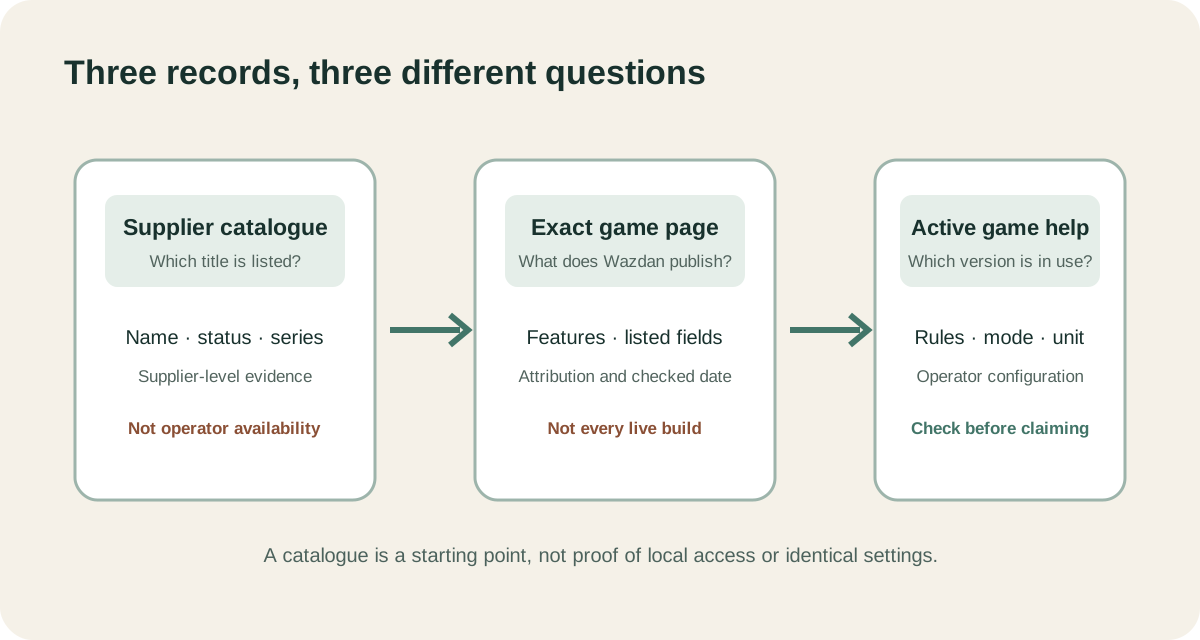
The short answer: use the catalogue to find a title, then verify its own help
Wazdan’s official games catalogue is a supplier index, not a casino lobby. Use it to match a game’s exact displayed name, identify a supplier page, and see which feature labels the studio associates with that product. Then open the individual game information and, where available, the version’s help or paytable. Finally, compare those records with the game screen and terms of the operator that actually presents it. Each source answers a different question.
The catalogue can tell an editor that Wazdan has published a page for a product and can provide supplier-level details such as the named series, feature tags, release date, volatility label or headline RTP. A marketing page may describe a mechanic in simplified form. The active operator build can still differ in settings, limits, display, availability and help version. Treat every numeric value as belonging to the page and version that states it; do not spread one figure across a whole studio or series.
This hub covers Wazdan as a supplier, its catalogue organisation, recurring feature names and a repeatable evidence check. It links to one provider guide and selected title-specific reviews on this site. It does not claim that Wazdan games are available through a New Zealand casino.
What Wazdan is, and what the supplier page is for
Wazdan’s corporate website presents the company as a game provider and its public “Games” page as a portfolio catalogue. The site describes products and categories for business customers and lists games with their own information links. A supplier’s role is to create or provide the game product; the casino operator controls its consumer-facing lobby, account, payment rules, country access and the particular game configuration it has integrated.
That separation matters in New Zealand. A Wazdan title appearing in the supplier catalogue is evidence about the supplier’s portfolio, not about which local service may offer it or whether an individual person is eligible to play. Do not convert a supplier feature statement into an operator recommendation. To answer an availability question, an editor would need current evidence from the named operator and the relevant New Zealand regulatory record. This page has no such operator evidence and makes no local access claim.
The catalogue is also not a complete mathematical specification. A feature summary may explain a trigger or named function, but a full paytable, mode-specific RTP, stake range and maximum payout may be in the live game’s help or operator configuration. If the supplier page does not show a field, leave it as not confirmed in that source rather than filling the gap from a third-party review.
How to navigate the official catalogue
The Wazdan games page provides a browsable list of titles and filters. When checked on 8 October 2026, it exposed a catalogue search and feature labels such as Chance Level, Hold the Jackpot, Cash Infinity, Collect to Infinity, Volatility Levels, Buy Feature, Ultra Fast Mode and Ultra Lite Mode. The exact interface and available labels can change. Record the date, selected filter and visible title rather than relying on a search snippet that may represent a different page state.
Start with the search field or title filter if you know the game’s name. Preserve punctuation and suffixes: a Roman numeral, “Grand,” “Burning Board,” “Platinum,” or “x3000” can be part of a separate product identity. If the catalogue shows a family label such as Coins™, note that it groups or classifies titles; it does not automatically mean every member shares the same grid, rules, payout table or settings.
Next, open the game card’s own page. Check its title, any release date or status label, the feature descriptions and any displayed values. If a card opens a game page with more than one view or language, record the exact URL. A card image, category filter and feature icon are navigation clues, not primary evidence for how a round settles.
Finally, search for an operator’s actual game entry only if the question concerns a particular casino. The operator lobby, help menu and current account terms can confirm details the supplier catalogue cannot. If that operator page cannot be accessed or the game is unavailable, stop at supplier-level information and mark operator details unverified.
Read release labels with their dates
“New,” “upcoming,” “released,” “featured” and “available” do not all mean the same thing. A card can stay in a promotional category after a release, a supplier can announce a launch before every distribution partner has integrated it, or an upcoming date can move. Record the exact label and date that the supplier shows, then compare it with a dated official release announcement and the live catalogue page.
One example from this review illustrates the issue. On 8 October 2026, the Wazdan catalogue entry for 25 Coins™ x3000 still showed an “Upcoming” label associated with 1 October 2026, while Wazdan’s own 1 October announcement described the title as launched. These two supplier sources do not line up neatly. The right editorial response is to report the mismatch and check the current game page or operator build, not to silently choose the label that sounds more current.
A supplier release date also does not guarantee that a casino has integrated the game on that date. Distribution can be staged across platforms or markets, and each operator controls its own lobby. If a page says a game was released on a particular date, word the claim as a supplier-announced release date. Avoid saying “available in New Zealand” without evidence for the exact operator, country and date.
Feature families are prompts for title-level questions
Wazdan’s catalogue uses recurring labels such as Cash Infinity, Hold the Jackpot, Collect to Infinity, Sticky to Infinity, Volatility Levels, Chance Level, Buy Feature, Ultra Fast and Ultra Lite. The labels are useful because they point to a mechanic or setting that a reader may want to inspect. The shared name alone does not prove that the feature behaves identically in every game.
For each label, ask four practical questions. What symbol or action activates it? What values or state does it carry forward? What ends the feature? How does the game show its cost, prize or settlement? A supplier page may answer some of these questions, but it may not include every condition. Check the help for the exact title and version before describing details such as persistence, retriggers, multiplier order or whether a feature is optional.
Cash Infinity and Hold the Jackpot
Several Wazdan product pages describe cash-value symbols or a respin-style feature. Those descriptions should be read within the named game. A symbol that stores a value in one title may interact differently with a collector, jackpot or other feature in another. Look for the trigger condition, the number of respins, what resets that counter, and the settlement rule when the feature ends. Do not assume a generic “cash” symbol always adds to the same pot or pays in the same unit.
Collect to Infinity and Sticky to Infinity
Collect and sticky labels suggest persistence or collection, but a useful explanation must say exactly what persists and for how long. Does a symbol stay only for a feature round, for a bonus sequence or across a series of drops? Does the collector gather values from one row or the entire grid? Can a feature retrigger, and if it does, are previous values preserved? If the official page does not resolve these points, leave the rule open and point to the in-game help.
Chance Level and selectable volatility
Some Wazdan pages describe settings that adjust the game experience. A setting name does not tell the reader its exact statistical effect, the stake adjustment or the resulting RTP. When a title offers selectable levels, note the displayed option, its cost or stake relationship, and whether the game help supplies a separate theoretical return for that mode. Do not describe a higher chance or a more volatile level as a way to predict an individual result.
One series can contain materially different games
The Coins™ family provides a clear example of why series navigation is not a substitute for a title review. The catalogue has a core 9 Coins™ product, Burning Board variants, Grand editions, different coin counts and versions with additional names or multipliers. Some pages describe nine reels, some have different maximum-win fields, and their release dates vary. The family label helps a reader find related products; it does not establish a shared paytable.
The 9 Coins™ supplier page checked on 8 October 2026 lists a nine-reel, zero-payline configuration and a supplier-stated RTP and maximum win for that named product. The 9 Coins™ Gold Burning Board™ page is a separate product page with its own listed settings and release date. The 9 Coins™ Platinum Burning Board™ and 16 Coins™ Diamond Burning Board™ pages likewise show separate product details. A page about one of these titles should not borrow the base game’s values.
The same principle applies to title strings such as “Grand Diamond Edition,” “Extremely Light,” “x5000” or “Platinum Edition.” They can indicate distinct catalogue entries, but their names do not, by themselves, explain the rules or relationship to another title. Read the individual page’s series, mechanics and release metadata. Then verify the active game’s help if the question is about current play.
Where each kind of evidence belongs
| Question | Best first source | What that source can establish | What it cannot establish alone |
|---|---|---|---|
| Is this a Wazdan-listed title? | Supplier catalogue | Current catalogue listing when checked | Casino integration or New Zealand access |
| What is the studio’s described mechanic? | Individual Wazdan game page | Supplier’s public feature summary | Every operator-specific rule or build setting |
| What RTP does the current game use? | Active game help or operator information for that build | A displayed value for the selected mode/version | A studio-wide RTP or future result |
| What is the stake range? | Operator’s game screen and terms | Limits on that operator configuration | Limits at another casino or country |
| Is a product released? | Dated supplier announcement plus live catalogue | Supplier-announced release status and current listing | Distribution to each operator or local eligibility |
| Is it available to a New Zealand customer? | Current operator information and applicable regulator records | Evidence about the named service and date | Access at all other operators |
Preserve a screenshot or written note only when it is appropriate and lawful to do so. Record the page title, source URL, checked date, selected mode and version string. That lets a later editor identify whether a changed value reflects a new catalogue page, a new game build or a different operator.
How to verify RTP, volatility and maximum win
RTP is not a provider-wide property. A published percentage belongs to a specific game configuration, mode or build when the source says so. If the supplier page lists one value, state that the supplier page lists it for that named product as checked on a date. Do not imply that every casino version uses the same setting. If the operator build does not expose the value, say that its active RTP was not confirmed.
Volatility labels are also descriptive categories, not a forecast. If a supplier calls a product “Medium-High” or “Very High,” attribute the label to that supplier page. Do not translate the label into a promised frequency of wins, a session expectation or a guarantee that a large win is possible within a set number of spins. The underlying distribution and the meaning of a label require the applicable rules or game math, not an editorial guess.
Maximum win is easy to misread. The supplier may use “x bet,” an absolute value, a jackpot amount or a feature multiplier. These quantities are not interchangeable. A multiplier in a feature description is not necessarily the maximum total payout; a max-win field without a stated unit should not be rewritten as “times stake.” Quote the exact field and unit, or say the page does not make the unit clear.
Check feature-buy prices and mode-specific returns with the same care. An optional feature can change the cost and theoretical return. Keep the base game and the chosen mode in separate rows. If the current operator help does not publish a field, do not fill it from a review site, another title in the series or an older cached page.
A practical version-check workflow
- Search the official catalogue and copy the exact title, punctuation and series label.
- Save the catalogue URL and checked date; note every release/status label exactly as displayed.
- Open the individual game page. Record the listed grid or reel structure, named mechanics and any numeric field with its unit.
- Compare the game page with a dated supplier news announcement if the release label looks inconsistent or stale.
- If evaluating one operator, find the title in its lobby and open the current help screen. Record the build/version identifier and the selected game mode.
- Make a field-by-field comparison: RTP, volatility label, maximum win, stakes, feature cost, language, demo and mobile presentation. Leave unsupported fields blank.
- Confirm that operator availability is supported by current operator evidence and that any New Zealand statement is separately checked.
- Recheck volatile details close to publication and include the date of verification in the article.
This workflow is intentionally conservative. It makes it possible to publish a useful supplier guide even when the active operator screen cannot be inspected: the supplier-level facts can be stated with clear attribution, and account-specific fields can remain unresolved. That is more informative than blending several sources into one confident-sounding but untraceable list.
Mobile, demo and help screens
An official game page may show artwork, promotional video or a play button. Those items do not guarantee that a demo will load in every location or that an operator’s mobile version matches the preview. A sample video can illustrate the layout, but it cannot confirm stake limits, current settings, or successful play through a casino account.
When the game is available in an authorised environment, open its help before choosing a stake. On a phone, check whether the paytable can be read without cropping and whether controls obscure critical wording. If a table can be expanded or scrolled, move through every page rather than relying only on the first panel. Record the selected currency or unit and the mode shown at that moment. Do not present a desktop screenshot as evidence that the mobile interface has the same controls.
Demo access is conditional. It may be disabled by a supplier, operator or jurisdiction. Do not work around a regional restriction or call a simulated session a test of real-money account settlement. A demo can be a teaching view of sequence and interface; it does not establish a casino’s cashier rules, eligibility, RTP setting or device compatibility.
New Zealand context and advertising boundary
Wazdan’s public catalogue is accessible as supplier information, but that fact is not a local operator licence or a statement that New Zealand customers can use a specific casino. Keep supplier identity, distribution, operator licensing, customer access and a game’s technical configuration as separate claims. If an article names a consumer-facing service, it needs evidence for that exact brand and date.
New Zealand’s Online Casino Gambling Regulations 2026 took effect on 3 July 2026. Regulation 40(c) describes an advertisement involving an affiliate arrangement as a prohibited form. The Department of Internal Affairs says the online casino advertising prohibition is in effect and that advertising rules apply to third parties that publish or arrange advertisements. This is an editorial compliance hold pending appropriate review, not legal advice.
The supplier guide can still explain game terminology and how to check evidence without sending the reader to an operator. If official rules, guidance or the site’s commercial model changes, the publisher should review the current primary sources before changing this page or its links.
Wazdan pages on this site
The following articles keep their assigned subject and evidence boundary. They do not claim New Zealand casino availability. Their numeric fields are supplier-published when explicitly labelled and operator settings remain unverified unless the article cites a current game-help source.
- 9 Coins™ by Wazdan: game rules, features and RTP evidence — one article for the 9 Coins™ title and the related Coins/Burning Board/Grand variants listed in that assignment.
- Throne of Elements™: Platinum by Wazdan — one title review for its supplier-described grid and feature sequence.
- Mighty Crown™: Empire of Gold by Wazdan — one title review for its three-reel layout and supplier-described Empire feature.
- Magic Fruit$: Cherries — one exact title guide for the supplier-listed grid and feature help.
- Mighty Hot™: Amazonia — a five-reel title with matching-wall and Fortune Wheel checks.
- 9 Balls — a nine-reel guide covering Penalty Kick and Hold the Jackpot evidence.
- Ox Coin™ — a title-specific guide that separates base layout, reel expansion and bonus board.
- Hot Slot™: Diamond Coins — the supplier-listed two-line format, feature labels and operator-setting checks.
- Magic Fruit$: Oranges — the Cash Out summary, separate Hold the Jackpot state and help-screen evidence.
- Easter Coins — the retained-symbol bonus summary, with triggers and payouts left to the exact help.
- Magic Fruits Dice — the listed three-reel, five-line format and supplier-described Joker condition.
- Fisherman’s Luck™ — Gainer, Cash Out, Free Spins and supplier-listed settings, kept separate from active operator help.
- Hot Slot™: 777 Cash Out — one guide for the base product and its five assigned editions, with each page’s figures kept distinct.
- Mighty Fish™: Blue Marlin — compare the five-reel title and its nine-reel Burning Board listing.
- Mighty Wild™: Panther — identify the base, Grand and Burning Board product pages before applying any setting.
- Hot Slot™: Platinum Coins — check supplier fields, named features and conflicting volatility descriptions against the exact help.
- Valentine’s Coins — follow Love Infinity persistence and the Love the Jackpot respin sequence.
- Bumba Meu Boi Coin™ — trace the Magic Coin, back matrix, Extra Life and Boi Da Fortuna descriptions.
- Mighty Wild™: Gorilla — keep Collector timing, Cash Out and the two bonus paths distinct.
- Santa’s Gifts Frenzy™ — Chance Level and feature labels, with operator rules left for active help.
- Mighty Hot™: 777 — distinguish scatters, ten ways and Gamble from unverified operator settings.
- Magic Fruits — compare the base title and assigned editions without transferring settings.
- Mighty Crown™: Legacy of Mars — map two supplier-described jackpot routes without inferring odds.
- Haunted Coins™ x1000 — keep the Coins grid, Hold the Jackpot and Chance Level tied to the exact help.
- Cash Grotto™ — trace Moving Cash Out, Sticky to Infinity and Hold the Jackpot separately.
- Hot Slot™: 777 Diamond Crown — separate Crown Scatter tiers, the Seven route and Chance Level.
- Bells of Fortune™ — distinguish Hold the Jackpot, Bells Matrix and Click 2 Grand evidence.
- Eggs of Fortune — verify Collector timing, Cash Out and the conflicting Chance Level multipliers.
- Hot Slot™: 777 Platinum Crown — check the two Grand routes and distinguish Chance Level cost from its stated effect.
- Sizzling Eggs™ — compare the base game and three assigned editions in one guide, keeping every setting edition-specific.
- Hot Slot™: 777 Hold the Jackpot™ — identify what the supplier summary says and which bonus triggers still need the exact help screen.
- Hot Slot™: Gold Coins — keep its catalogue fields, feature labels and operator rules in separate evidence columns.
- Hot Slot™: 777 Gold Crown — verify the five-Scatter Grand route and Chance Level settings in the loaded help.
- Mighty Wild™: Jaguar — preserve the 15 / 0 catalogue notation and confirm the actual board and feature rules.
- 12 Bells™ — distinguish the two named bonus routes and verify their exact trigger and settlement rules.
- One Coin™ — identify the single-reel product and verify the Coins feature rules in the active help.
- Mighty Symbols™: Jokers — keep Hold the Jackpot and Jokers Rampage as separate rules questions.
- Prosperity Reels™ — verify the Sack Symbol, Expanding Wild, Cash Rain and current RTP setting.
- 9 Lions™ Hold the Jackpot™ — separate its two named bonus routes until the exact help confirms their relationship.
- All selected game and rules guides — the site’s wider catalogue of published editorial guides.
Frequently asked questions
Does Wazdan’s catalogue prove that a game is available at a casino?
No. A supplier catalogue establishes that Wazdan lists a title on its own site at the time checked. It does not show which casino has integrated it, whether the integration is active, which game settings are selected, or whether a particular account can access it. Check the operator’s current lobby and terms for those questions.
Can the RTP shown on a supplier page be used for every casino version?
Not without evidence that the active version and mode use that same setting. Attribute the figure to the precise supplier page and title. For an operator-specific statement, find the current game help or other primary documentation for that build. If it is not published, say that it could not be confirmed.
Does “upcoming” mean the game is not released?
It is a status label that needs a date and source. A supplier’s current card may disagree with its own dated launch notice. Record both sources and describe the mismatch. A supplier release announcement still does not prove that every casino has added the product.
Do all games in the Coins™ series use the same rules?
No. The catalogue presents individual products with different names, feature descriptions, release dates and settings. A series label is useful for navigation; it is not evidence of a shared paytable or maximum win. Open the exact product page and game help for the title in question.
Does a volatility label tell me how soon a win will happen?
No. It is a category used by the supplier for a specific title or setting, not a schedule for an individual session. Do not turn a volatility label into a claim about the next spin, a likely payout interval or a guaranteed result.
Is a “maximum win x” figure the same as a feature multiplier?
No. A maximum win may be expressed as a total payout ceiling; a feature multiplier is an element of a round’s calculation. A field without a stated unit is ambiguous. Keep the wording and units exactly as shown by the primary source.
Editorial conclusion
Use Wazdan’s catalogue to identify a product and its official description. Treat feature-family names as a route to title-specific questions, not as portable rules. For every number, preserve the product, mode, unit, source and checked date. If catalogue status and launch news disagree, report the mismatch. For a casino-specific or New Zealand-specific conclusion, obtain evidence from the operator and applicable official sources.
The Wazdan pages linked above are intended to provide that title-level separation. Their job is to explain what the supplier publishes, identify what still needs current game help, and avoid suggesting that a catalogue entry is proof of local availability.
-
9 Burning Dragons — Follow the three-symbol trigger, refreshed respins and six-to-nine jackpot count ladder.
-
Magic Spins™ — Map its 29-reel zones, ten-symbol wins, position-specific cash and collection features.
-
Magic Eggs — Check five-line egg combinations, the Special Bunny and the optional Gamble feature.
-
Dwarfs Fortune™ — Trace the minecart top row, sticky values and downward Collector path.
-
Sizzling Moon™ — Keep the full-grid Grand award separate from the Moon Jackpot route.
-
Prosperity Pearls — Separate the 1,000× full-grid Grand from the 4,000× catalogue maximum, then check Pearl collection order in active help.
-
Sun of Fortune — Trace Sun of Fortune’s eight-symbol base rule, golden Bonus trigger and 1,000× Grand versus 1,450× maximum.
-
Burning Stars 3™ — Keep Burning Stars 3’s Lucky 7 base award, three-symbol trigger and six-to-nine feature ladder distinct.
-
Clover Lady™ — Check Clover Lady’s middle-row Bonus movement, retained Direwolves and two different multiplier states.
-
Unicorn Reels — Follow Unicorn Reels’ Scatter rules and separate 5×5 collection thresholds from the five-reel base game.
Sources and verification boundary
- Wazdan official Games catalogue — checked 8 October 2026; catalogue labels and filters can change.
- Wazdan: 25 Coins™ x3000 and Wazdan’s release archive — checked 8 October 2026; the captured catalogue page state and dated 1 October launch entry appeared inconsistent, so the mismatch is reported without choosing a definitive status.
- Wazdan: 9 Coins™, 9 Coins™ Gold Burning Board™, 9 Coins™ Platinum Burning Board™, and 16 Coins™ Diamond Burning Board™ — checked 8 October 2026.
- New Zealand Department of Internal Affairs: Online gambling for advertisers — checked 8 October 2026.
- Online Casino Gambling Regulations 2026 — checked 8 October 2026; regulation 40(c) addresses advertisements involving affiliate arrangements.
More selected title guides
-
Black Horse™ — compare the base listing with Cash Out Edition and Deluxe; each has edition-specific fields.
-
Hot Slot™: 777 Coins — distinguish Cash Out and jackpot tiers from the Extremely Light edition.
-
Mighty Symbols™: Diamonds — review Diamond Wild, Walking Giant Diamond and the supplier’s Free Spins summary.
-
Los Muertos™ II — check the Special symbol, Gamble wording and exact-help limits.
-
Burning Sun™ — read the listed reel/line notation and Hold the Jackpot feature boundaries.
-
Hot Slot™: 777 Rubies — distinguish the Rubies Jackpot and Magic Respin labels from the running version’s rules.
-
Hot Slot™: 777 Stars — check the Scatter route and 9 Stars Jackpot in the exact help screen.
-
9 Bells™ — review Cash Out, Cash Infinity, Bonus Matrix, Hold the Jackpot and Chance Level as separate evidence questions.
-
Book of Faith™ — follow the supplier-described expanding symbols and Collector path, then verify the active build.
-
Mighty Symbols™: Crowns — follow the Giant Crown counter and three draw positions; verify feature entry in the loaded help.
-
Moon of Fortune™ — separate its 16-position Hold the Jackpot grid, Cash symbols and Mystery paths.
-
Mystery Kingdom™: Mystery Bells — distinguish the supplier’s named features from unreported triggers and exact settlement rules.
-
Hot Slot™: Great Book of Magic — check the three-Scatter route, expanding Book Bonus and active paytable.
-
Power of Sun™: Svarog — read the 243-ways format, Cash Infinity and 15-reel Hold the Jackpot summary.
-
Hot Slot™: Mystery Jackpot Joker — check the four jackpot bands and Magic Respin price unit in active help.
-
Hot Slot™: Magic Pearls — verify the catalogue’s 25 / 0 notation, board and named features in the exact game.
-
Hot Slot™: Magic Bombs — trace Collect to Infinity, sticky jackpot symbols and Scatter awards.
-
9 Burning Stars™ — preserve the 9 / 0 notation and verify Bonus Matrix and Hold the Jackpot triggers.
-
Sizzling Kingdom™: Bison — keep Wild Rampage, Hold the Jackpot and Free Spins distinct.
Sponsored offers shown by the shared site components are separate from the editorial game or account evidence above. They do not establish local eligibility or verify an operator configuration. Read the current operator terms and local requirements independently.
