Wazdan game guides · South Island guide
Hot Slot™: 777 Rubies by Wazdan: rules, features and RTP evidence
 Best casinos available in New ZealandUpdated 7 November 2026

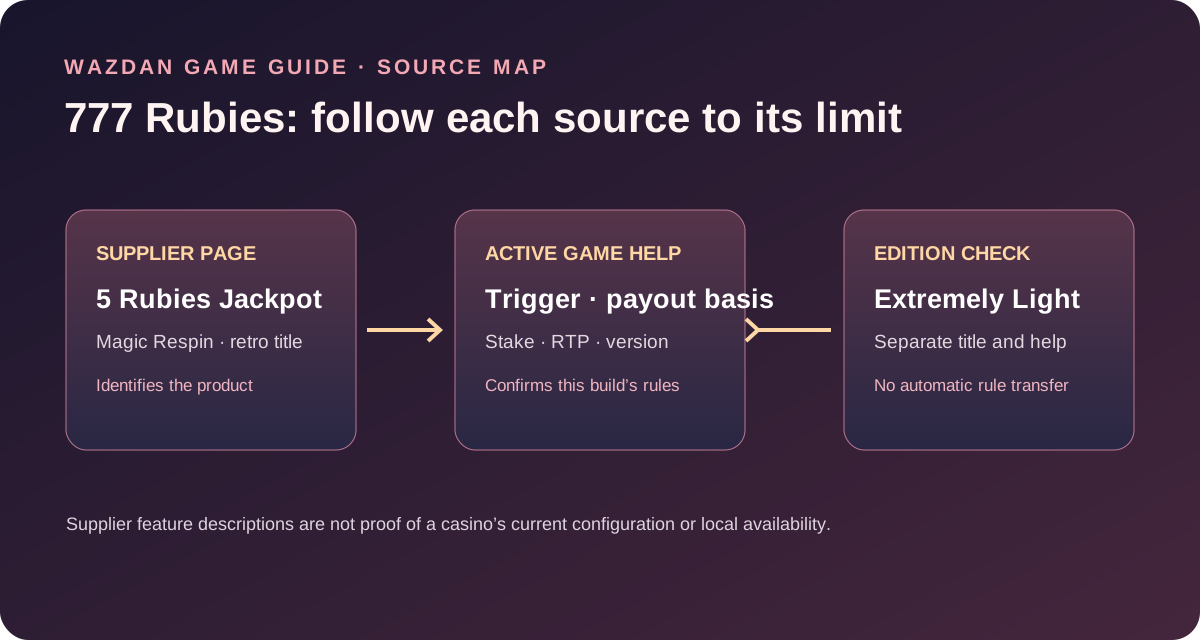
Wazdan’s official catalogue describes Hot Slot: 777 Rubies as a retro title and names 5 Rubies Jackpot and Magic Respin. Those labels identify what to inspect, but a live casino’s paytable, RTP selection, stake range and feature sequence must be confirmed in that exact build’s help. The Extremely Light edition is treated as a related title, not silently merged into the base review.
The short answer
Hot Slot™: 777 Rubies is a Wazdan slot with a retro presentation. The supplier’s public product page names the 5 Rubies Jackpot and Magic Respin. The first name describes a jackpot feature involving rubies; the second is presented as a respin feature in which reels are locked. This is enough to identify the product’s headline mechanics and prepare a checklist. It is not a full rulebook for the version launched by a casino.
Before treating any paytable, RTP, stake, jackpot tier or maximum award as current, open the game itself and read its information or help screen. The title, game identifier and version in that screen should match the lobby card. A supplier catalogue can describe a studio product, while an operator may use a different build, configuration or return setting. A third-party review may also have been written for an older version or a different market. No operator version, help screen, demo session or New Zealand availability was tested for this article.
Wazdan also lists Hot Slot™: 777 Rubies Extremely Light. Its page promotes a more mobile-oriented implementation and names the same headline features. Treat it as a separately identified edition. Do not carry the base game’s paytable or RTP to it without checking the build’s own help. The topic brief groups it with this review, so the edition comparison is covered here rather than on a second URL.
Identify the edition and the evidence
The most useful first check is not a review score; it is whether every source means the same game. Compare the full lobby title, the opening screen, the supplier’s title page and the name inside the current help menu. Record the version or game identifier if shown. Preserve suffixes such as Extremely Light: a title modifier can indicate an altered client or product presentation, and a similar-looking thumbnail is not enough to prove identical rules.
Wazdan’s official 777 Rubies product page is the primary source for the supplier’s public description. The page calls out 5 Rubies Jackpot, Magic Respin, a retro slot theme and game-information fields. Wazdan’s Extremely Light page is the supplier reference for that edition. These pages establish what the supplier publishes about its products; they do not establish which version a particular operator serves to a customer.
Use a three-column source note:
| Evidence layer | What it can establish | What it cannot establish by itself |
|---|---|---|
| Supplier product page | Product identity and supplier-described feature names | A casino’s active build or selected settings |
| In-game help | Rules and displayed settings for the opened version | New Zealand availability at other operators |
| Operator lobby and terms | Whether that operator lists a product and its own account conditions | An independent test of every game result |
An old review is a fourth, secondary layer. It can help identify terms or questions a reader may want to check, but the review’s timestamp, territory and game version matter. If two reviews give different RTP values or maximum-win fields, do not average them. Find the exact help for the version you have open, and preserve the source and date beside the value.
What the Rubies Jackpot label tells you
The supplier says the feature involves collecting five rubies and describes a Grand Jackpot award. That wording is useful as a broad feature description. It does not show the full trigger logic, whether every on-screen ruby has the same role, how the game handles a partial collection, whether a feature can be entered in more than one way, or what exactly happens when the feature ends. The help screen should answer those questions for the version actually loaded.
When checking the rules, look for the symbol name, the location where it can appear, whether the symbols must land during the same spin or can persist, and the point at which the jackpot is awarded. The wording should also tell you whether there are intermediate prize states or only one outcome. If it uses terms such as Grand, Mini or fixed jackpot, copy them exactly rather than assuming they mean a progressive pool shared across players.
“Jackpot” is not enough to infer funding. A fixed prize can be part of a game’s paytable; a progressive pool can grow through contributions; a promotional prize can be governed by operator terms. The supplier page’s feature name does not by itself identify which financial model an operator uses. If the help lists a fixed award, record the basis and unit. If a casino’s separate promotion uses jackpot wording, check that offer’s terms independently.
Do not translate a supplier-level maximum into a likely result. A cap is a ceiling for a defined configuration, not the chance of reaching it, the expected return or a prediction of what the next spin will do. The probability of a feature, the payout distribution and the return setting require evidence that the supplier catalogue’s headline text does not provide.
What Magic Respin means and what remains open
Wazdan describes Magic Respin as a feature that locks reels and helps players pursue jackpot outcomes. This establishes the broad idea of a respin with some reel state held in place. The public description does not set out the exact starting condition, how many positions are locked, whether the player makes a choice, the number of respin opportunities, or when a held symbol is released. Avoid filling those gaps with a generic respin explanation from another slot.
Read the active help for three moments: entry, continuation and settlement. Entry explains what activates Magic Respin. Continuation explains which reels remain fixed, what can change, and whether a counter or symbol state is carried forward. Settlement explains how the final combination is evaluated and whether it can award a Rubies Jackpot, another prize, or no award. A complete review should give the reader the rule in the same order the interface shows it.
If the help uses the word “locked”, distinguish a fixed reel from a locked symbol or a held position. The visual animation may make these look alike even though the rule effect differs. A screenshot can support a description of what appeared during a test, but the paytable or help text is stronger evidence for what the symbol means. This review did not run the game, so it does not claim which exact symbols or positions are retained.
Check whether the feature has an optional setting, a separate cost, a modified stake or an entry condition. If an option changes the total amount wagered, the amount displayed before confirmation matters. Do not assume a control is a free convenience just because it is shown near a spin button. The exact game help and the operator’s confirmation dialog should make the treatment visible before a paid action.
The Extremely Light edition
Wazdan’s Extremely Light page presents the edition as more mobile-oriented, with claims about lower data use and power consumption, and names 5 Rubies Jackpot and Magic Respin. Those are supplier claims about the product design. They are not an independent measurement on a particular phone, network or browser, and they do not prove that a casino’s mobile client uses that build.
Check the edition at three points: the operator lobby label, the title shown after launch, and the game identifier in help or information. If the lobby offers separate entries, save the exact labels. If a single entry changes layout depending on device, do not assume that it is Extremely Light unless the game or operator identifies it. A smaller interface may be responsive design for the same build rather than a separately configured edition.
The rules comparison should include the feature names, paytable, RTP display, stake boundaries, any volatility selector, and the controls available before a spin. Compare the same configuration settings on each version. If one version does not expose a value or option, write “not displayed” rather than copying the other edition’s number. A difference may be a real configuration choice, an interface omission or a version change; the evidence does not decide which without the active help and operator confirmation.
On a phone, check whether the help opens without covering the control needed to close it, whether table text can be enlarged, and whether the balance and stake remain legible at the same time. This is a practical usability check, not a claim that the edition complies with an accessibility standard. The official page’s battery and data description is not a substitute for testing the actual client’s loading behaviour.
Reading the paytable and payout basis
Open the paytable before play and establish the unit it uses. A listed award might be expressed as a multiplier of a total bet, a line bet, a coin value or another base unit. Those bases are not interchangeable. Check whether the game uses fixed lines, ways, scatter awards, feature awards or more than one settlement path. The supplier page’s brief product summary does not replace this table.
Record symbol names as displayed and how many are needed for each result. Then note whether matches must be on a line, whether a scatter pays in any position, and whether special symbols substitute or trigger a separate feature. If the game includes a jackpot collection path, verify whether those symbols also participate in ordinary combinations. Avoid inferring a payout from a picture of a winning screen; it can show an example, not all rules.
The total wager should be visible before the spin. If a game lets a player choose a coin denomination or bet level, identify which control changes which part of the amount. A number in NZD may be a conversion estimate rather than the unit the game settles in. The crypto balance denomination guide explains why the account display, stored unit and game stake should be treated separately.
For a screenshot or note, include the edition, help page title, stake unit and setting state. If the operator changes the RTP or volatility through a menu, record the selected value before comparing two versions. Never rely on a generic review to supply the active value for a session that was not tested.
RTP evidence and configuration
RTP is a long-run mathematical parameter associated with a specific game configuration. It is not a promise that an individual session returns that percentage and is not a forecast for a small number of spins. Even when a supplier website publishes an RTP field, the figure must be tied to the correct title and configuration before it is described as the casino’s live RTP.
On 8 October 2026, Wazdan’s product pages displayed the following supplier catalogue fields:
| Supplier page | Reels / lines field | Listed RTP | Listed maximum win | Listed volatility |
|---|---|---|---|---|
| 777 Rubies | 5 / 20 | 96.14% | 500× bet | Low, Standard, High |
| 777 Rubies Extremely Light | 5 / 20 | 96.14% | 500× bet | High |
These are quotations of the supplier page’s information panel, not the settings of a casino account. A listed release date on the supplier pages identifies the supplier’s release record, not a local operator launch. For the precise current stake range, paytable and selected return, use the help screen in the loaded build. The fields above should not be copied into an operator review without that version match.
The supplier product page is a starting reference, not proof of a casino’s selection. The active game help should identify the return information for the exact build, if it displays that information. If the game has multiple variants, the operator’s launch version and selected configuration need to be established. A value in an older review, game database or another operator’s help may describe another build.
An evidence note should say “supplier catalogue lists” or “active help displayed” instead of saying simply “the RTP is” when the source differs. Record the URL or screen, date reviewed, version and configuration. If the help screen lacks an RTP value, report that it was not visible in the available help and ask support for the current rules document. Do not reverse engineer the figure from observed wins, because a short sequence is not a reliable mathematical estimate.
No operator help screen was available for this guide. We therefore do not state an active RTP, volatility selection, stake range, payout table, maximum win configuration or local casino availability. This is a deliberate evidence boundary, not an inference that the value is unavailable everywhere.
Volatility and feature controls
If the active build offers a volatility control, find the game help’s explanation of its effect and whether changing it also alters another setting. A label such as Low, Standard or High is not a complete description of the distribution and does not rank a session’s likely result. It should not be confused with RTP. If the option appears in a supplier catalogue but not in the running client, treat it as a catalogue feature rather than a confirmed player control.
Check whether changing volatility affects the wager, possible feature access, payout distribution, or nothing beyond a named profile. The in-game explanation should be read before the setting is selected. If no explanation is supplied, ask the operator for the current rules and note the unanswered point rather than assuming the effect from another Wazdan game.
The same principle applies to speed options, gamble controls or feature-buy options if shown. A faster animation changes elapsed time, not the random outcome; a gamble feature may have its own choice and loss rule; a buy feature, if present, can involve a separate cost and different configuration. Do not assume any of these controls is enabled for 777 Rubies just because Wazdan lists them elsewhere or another edition exposes them.
Mobile and desktop checks
Run a simple display check with the game at a normal zoom. Confirm that the title, balance, total wager, spin control and information control are all visible. Open the help, read the relevant rules and close it. Check that an overlay has a visible close control, that text is not clipped, and that the paytable can be scanned without horizontal scrolling. If the game rotates the device, note whether that is optional or required.
Do not record “mobile compatible” solely because a supplier says All Platforms or Extremely Light. Verify the actual operator build on the device and browser you mean. Availability can depend on the operator, account, market, device and software version. A desktop screenshot cannot prove phone layout; a supplier’s mobile claim is not a live test of a casino’s wrapper.
Compare sound, animation and loading controls only if they change how a user operates the game. Mute and motion settings should not obscure the stake or rules. If an animation is fast, confirm that the help describes the outcome and that the round-history control is available. A test should note device model, browser, date and game version, but no device test was performed for this guide.
What other reviews cover—and the useful gap
Search results for 777 Rubies include casino game reviews that commonly lead with reels or paylines, RTP, volatility, jackpot values, demo play and a casino call to action. The sampled pages can help identify the questions a reader expects a review to answer, but their settings may be tied to a different operator, territory or date. Their details are not copied as a New Zealand configuration here.
The useful gap is version traceability. A review can show a confident number and still omit which build or help screen established it. A careful reader needs to know whether the figure is from Wazdan’s supplier catalogue, a third-party database or the exact game opened by a casino. This guide preserves those labels so that a number cannot silently jump from one source to another.
The product’s public material provides enough to identify the named jackpot and respin features, but not enough to reconstruct the complete rule sequence. A good next step is therefore a screen-by-screen check of the game help, not a claim that a third-party result matches every deployment. Where a publication shows a demo or a casino link, availability and eligibility still need independent confirmation for the reader’s location.
A repeatable review checklist
- Confirm the full game name and whether the edition is base or Extremely Light.
- Record the title and version shown in the game’s own information screen.
- Save the supplier page and date as product-identification evidence only.
- Find the rules for 5 Rubies Jackpot and copy the trigger and settlement wording exactly.
- Find the rules for Magic Respin and record entry, held state, continuation and end state.
- Check whether the jackpot is fixed, progressive or described in another explicit way.
- Read the paytable and record the payout basis and stake unit.
- Record RTP and volatility only from the exact active help or a clearly labelled supplier source.
- Note every optional purchase, stake change or control before confirming it.
- Compare the mobile and desktop help screens if both builds are relevant.
- Keep unsupported fields marked “not verified”; do not fill them from a similar title.
- Ask the operator for current game rules if the screen is incomplete or contradictory.
Questions that should be answered before relying on a review
Does the help identify the same edition shown in the lobby? Is the Rubies feature’s “five” collection condition actually described as a trigger in this build, and does it say whether symbols persist? Does Magic Respin hold a reel, a symbol or a position? Which event starts and ends that feature? Does the paytable state the exact total-bet basis? Is the displayed RTP tied to this version? Does a volatility choice change any other setting? Can the mobile client show the same help and stake values?
If the answer is “the review says so” but no source is visible, treat it as an unverified third-party claim. If the answer is “the supplier page lists the feature”, use that as a pointer to the help menu, not as evidence of every payout. If the operator cannot identify the game version, do not compare its number with another edition and do not publish it as a confirmed setting.
Responsible interpretation
A slot result is random under the game’s configuration; the previous spin does not reveal what the next one will be. A jackpot label, a respin animation or an adjustable profile does not create a reliable way to predict a result. No strategy can guarantee a win. This review describes how to read documentation; it does not encourage a stake or suggest that the product is suitable for any particular person.
If gambling is causing stress or a person wants to stop, use the site’s New Zealand safer-gambling support page for independent support information. Do not use a game review as a substitute for help or as a reason to continue after a limit. A break, time limit or self-exclusion option should be checked in the operator’s own controls.
Primary sources and review limits
Primary supplier pages checked 8 October 2026: Wazdan Hot Slot™: 777 Rubies and Wazdan Hot Slot™: 777 Rubies Extremely Light. The pages identify supplier-level product descriptions and feature names; they are not active casino game-help screens. Competitor search samples included BetMGM’s Hot Slot: 777 Rubies review and general slot-review pages; those were used to identify coverage questions, not to assert New Zealand settings. No operator build, demo, device, RTP variant or New Zealand access was tested. This article makes no availability, recommendation or outcome claim.
