Wazdan game guides · South Island guide
One Coin™ by Wazdan: game rules, features and RTP evidence
 Best casinos available in New ZealandUpdated 7 November 2026

Wazdan’s public One Coin™ page identifies a single-reel title and names Hold the Jackpot™, Mystery Multiplier™ and Chance Level™. This guide explains what the supplier page establishes, what it does not establish about a casino’s version, and how to verify paytable, RTP, stakes and rules in current game help.
The short answer
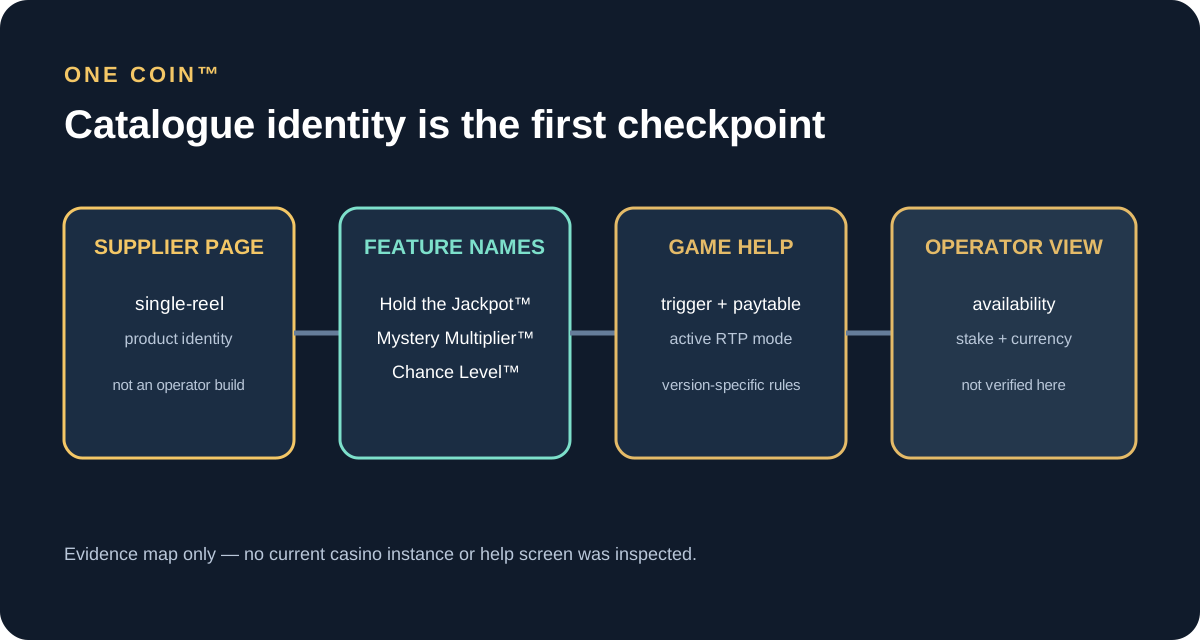
One Coin™ is a Wazdan slot title whose public product page describes a single-reel format and names features from the Coins™ family, including Hold the Jackpot™, Mystery Multiplier™ and Chance Level™. That is useful for identifying the product and knowing which labels to look for. It is not enough to certify the rules, paytable, stake range or return setting in a particular casino.
The most important point for a careful reader is source separation. A supplier catalogue page describes what the studio publishes for its title. A game’s built-in help screen describes the rules and settings associated with the running version. An operator’s lobby can determine whether that build is offered, which configuration is active and what limits apply. A title appearing in the Wazdan catalogue does not show that it is available to a person in New Zealand or at any particular casino.
This review therefore treats One Coin™ as a product to identify and inspect, not as a recommendation. The supplier’s product page was reviewed on 8 October 2026. No operator game instance, demo session or current help screen was available for this review. The exact RTP variant, volatility setting, win cap, eligible stake range, buy-feature price and mobile implementation are consequently not verified here. Do not fill those gaps with numbers copied from an older review or another Coins™ edition.
Identify the exact title before reading a review
The visible title matters. One Coin™ is a named Wazdan release within a wider Coins™ family. Similar branding does not make every related game a version of this one. Another title can add a coin count, an edition label, a Burning Board suffix, a gold or platinum variant, or a different multiplier in its name. Each can have a distinct game file, rules, mathematical configuration and release status.
Start with the complete name shown in the operator lobby, not a search result or a thumbnail alone. Compare the name to the official One Coin™ product page. Preserve the trademark styling where practical, but do not treat a punctuation difference as proof of a different game without checking the supplier identifier or game-help title. If a lobby card says “One Coin” while its help screen identifies another edition, the help screen and game identifier are the evidence that needs resolution.
Version identification is especially important when an operator carries multiple games from one series. Search engines sometimes collapse punctuation or omit trademark marks. A review can also use “One Coin” loosely for a related title. Before relying on any published value, check the title in the help menu, the supplier name, the version or build identifier if visible, and the timestamp of the page that supplied the number.
The Wazdan page includes a release date and public game-information fields. Those catalogue fields establish what Wazdan currently presents on its own page; they do not identify a casino’s build. The supplied topic brief gives the release date as 10 October 2024, which is consistent with the supplier listing checked on the review date. A supplier release date is not the same as a New Zealand launch date, an operator integration date or proof that the game can currently be opened in a particular account.
What the single-reel description tells you
Wazdan describes One Coin™ as a single-reel experience. That is a meaningful distinction from a conventional multi-reel grid because the visible game area and the way symbols are presented are not the same as a standard bank of horizontal paylines. The product page also lists no conventional payline count in its game information. Do not infer a payout rule from that absence: the paytable and help screen explain which outcomes count and how a win is settled.
The single-reel layout is a presentation detail, not an odds explanation. A narrow or visually simple reel does not imply that a player has a higher chance of a feature or that a result is easier to predict. Symbols can carry separate values or trigger bonus states, and the game mathematics can depend on the active configuration. The layout alone does not reveal symbol frequency, the probability of entering a feature or expected return.
When the game is available in a permitted demo or operator environment, inspect how the reel is framed on desktop and mobile. Look for the stake control, total stake display, spin action, balance and any information or settings control. Check whether the current bet remains visible after entering a bonus feature. If the layout shrinks on a phone, make sure the player can still identify the active stake and open the help screen without mistaking decorative elements for controls.
The single-reel format may feel unfamiliar to someone expecting paylines. The correct question is not “How many lines are active?” but “Which symbols and states does this exact version pay, and how does the help define them?” If a review gives a conventional payline answer without quoting the game’s help, it may be describing a different product. Keep the format description and settlement rules in separate notes.
Supplier-listed feature names and their limits
The official page associates One Coin™ with Hold the Jackpot™, Mystery Multiplier™ and Chance Level™. It also lists other options in the supplier’s feature panel. A feature label is a pointer to a rule set, not a complete rule. The short promotional description may not explain the trigger condition, number of selections, whether a feature is optional, how the stake changes, what ends a round, or how an award is transferred back to the base game.
The page describes Mystery Multiplier™ as a bonus-round multiplier feature. That supports saying the feature is presented as part of a bonus experience. It does not establish which symbol activates the round, how a multiplier is selected, which wins it affects, or whether the available values match every operator build. Those details should come from the active game help. Avoid taking a generic feature explanation from another Coins™ title and applying it to One Coin™.
Hold the Jackpot™ is a recurring Wazdan label. In the context of One Coin™, the public page says the feature is part of the title and connects it with the single-reel product description. It does not show the complete state diagram for the feature. Before describing the game as a “hold-and-win” format, check whether the rules actually specify a respin sequence, what resets any counter, how cash values appear, what triggers completion and which award is paid.
Chance Level™ is another supplier-named option. A product page does not provide enough detail to determine the exact price, if any, the chance adjustment, its relationship to a game mode, or whether it changes the RTP. The active help should state how the option works and the effect on the stake or feature. If the operator screen merely shows the feature name but no explanation, ask support for the current game rules rather than assuming that “chance” means a guaranteed trigger.
Wazdan’s product page also lists options such as Volatility Levels™, Buy Feature and Ultra Fast Mode. Their presence in a supplier feature list does not prove they are enabled in a particular market or game build. A feature might be disabled, configured differently, or unavailable under local rules. The operator’s visible control and the rules displayed in that same session should be checked together.
How to inspect the bonus without inventing a sequence
Use the help button or information menu before starting a paid round. Find the section that names each One Coin™ bonus feature and follow every screen in sequence. A complete explanation should answer what activates it, whether a choice is required, which values are possible, whether the player can stop or only watch, and how the final amount is calculated. If the help gives an award table, record the values with the title and build information.
For a feature involving jackpot symbols, identify whether “jackpot” means a fixed prize, a progressive pool, a game-defined award tier or simply a supplier label for one of several values. The term alone is not enough to tell you whether a prize accumulates across players or whether it resets. Look for the help’s explicit definition and any operator terms governing a progressive pool. If no definition appears, describe that as unknown instead of using the word “progressive”.
For a multiplier, check its scope. It could apply to a single symbol, a bonus win, a final feature award, or a subset of outcomes. The game help should define whether the multiplier combines with other feature values and whether it remains visible throughout the bonus. A multiplier badge on the screen is not proof that it applies to every amount shown.
Take care not to treat the biggest illustrated prize as the expected result. A top award, even when correctly stated, does not reveal how often the condition occurs. Likewise, an animation or a near-complete collection is not mathematical evidence of a likely future win. A rule review should describe the conditional sequence, not forecast when it will occur.
If an operator requires a paid spin before the help menu becomes available, do not use a wager just to unlock documentation. Exit the game or ask the operator for the rules and paytable. Information necessary to understand a product should not require risking money merely to learn what a button does.
RTP, volatility and win cap: what is and is not verified
The requested review concerns verified RTP settings, but an exact current game-help screen was not available. The supplier page contains a public information snapshot, yet the editorial standard for this page is to report a numerical RTP only when the active help for the version being described can be identified. Accordingly, this article does not present a numeric RTP as the One Coin™ setting a reader will encounter at a casino.
RTP means a theoretical return calculation over a large number of game outcomes under a defined ruleset. It is not a promise that an individual session will return a particular proportion, a prediction for the next round, or a guarantee that a balance will remain available. If an operator provides several RTP configurations, the title name alone cannot identify which is selected. Find the percentage in the game help and check whether a mode or feature choice changes the relevant rules.
Volatility is commonly used to characterise how results may vary, but a single label cannot tell a reader the timing or size of their next outcome. The supplier page may use a volatility description; the current help is still necessary to know which configuration is in use and whether selectable levels are offered. Do not describe a “higher” level as a route to a better result. It is a setting label, not a prediction.
A maximum win field also needs exact context. It may be stated as a multiple of stake, may exclude a separately defined jackpot or may apply to one mode. The current help should define its scope and the operator’s version should match the reviewed title. Since no such help was available, this guide does not publish a win-cap number. The same restraint applies to minimum and maximum stakes, buy-feature costs and bonus multipliers.
To document a verified value, record the exact in-game title, help version or build marker, the displayed RTP, the selected game mode, the access date, and whether the operator has published a configuration note. If the RTP appears only in a third-party review or search snippet, mark it as unverified. If an operator’s help and supplier page differ, record both sources and ask the operator which value controls the live game.
Paytable and stake checks
The paytable answers which symbol combinations or feature states receive an award. It should identify ordinary symbols, special symbols, substitutes, bonus markers and any limits that affect settlement. For One Coin™, the single-reel presentation makes it particularly important not to infer a paytable from a traditional line-based slot template. A one-reel title can still have rules that are specific to its symbols and bonus stages.
Check whether the stake control means amount per spin, total round cost, or a feature price. If an optional feature changes the stake, the confirmation should make the new total explicit. A control with plus and minus icons is not enough; the active amount and denomination should remain visible before a spin is committed. Do not rely on a remembered setting from a previous title.
A useful transcription keeps separate columns for base stake, feature cost, active denomination, any displayed fee and the total accepted amount. If the help states that a special mode carries a different RTP, record that separately from the base mode. Do not combine values or create a range unless the source itself explains what determines the selected setting.
The supplier page does not establish the stake range at a particular operator. Limits can depend on the integration, local configuration, currency and account rules. This review therefore does not quote a minimum or maximum bet. If the game is not available to inspect without opening an account, no account should be created for the purpose of this article; the setting remains unverified.
Mobile, sound, help and demo access
Wazdan’s product page presents general platform availability at supplier level, but it does not show how One Coin™ renders on a particular phone, browser or casino integration. Device-level claims require an actual supported environment. This page has not been played or tested on mobile and does not claim that a demo is available in New Zealand.
If an authorised demo is available where the reader is located, use it only to inspect layout and help, not to infer the operator’s real-money settings. Check whether the title, balance, denomination, stake and help control stay legible in portrait orientation. Rotate the device only if the product offers a responsive landscape layout. Look for a deliberate pause or close control and ensure that the game returns to the same page rather than losing the visible rules.
Sound and animation can be adjusted only if the active build provides those settings. Do not promise mute, reduced motion or accessibility controls from a supplier-level feature list unless they appear in the current interface. If sound is essential to a result cue, the visual status should still make the current state clear. A person using a screen reader should be able to find labelled controls and understand a dialog without relying on the artwork.
A demo from a third-party directory does not establish that the current operator uses the same version. Some directories may apply their own interface, default stakes, currency or game mode. If a demo is unavailable or blocked, note that directly; do not bypass restrictions or use a VPN to create a misleading access claim.
Reading supplier language critically
Supplier marketing pages are designed to introduce products and mechanics. They can be authoritative for the supplier’s own naming, release announcement and what its catalogue currently displays. They are not necessarily a full game manual. A statement about engagement or potential does not prove an outcome distribution, player experience or commercial result. This page does not repeat promotional claims or convert them into review findings.
When the supplier says the game is part of a popular family, that is a product relationship, not proof that every related game shares an engine configuration. When it describes a bonus as “exciting”, the adjective tells the reader nothing about its trigger rate or expected value. When a page lists several features, it does not show that each is enabled by every operator. Retain the exact level of certainty in your wording: “the supplier names this feature” is safer and more accurate than “the feature triggers in this way” when no rules are available.
A review can still be useful without pretending to have played a game. It can identify the official product, highlight the parts of the help that matter, explain how to compare a mode and a displayed RTP, and make unknowns visible. What it cannot do is supply an operator-specific verdict without an operator-specific source. No personal gameplay, demo result or performance test is claimed here.
Distinguish a related edition from a rules update
A product family can evolve. A game may receive a new edition or a deployment update without changing the consumer-facing name in an obvious way. A different title suffix usually signals a distinct catalogue entry, while a software build identifier may signal a version of the same product. These are not interchangeable. Record what the page actually shows instead of calling all editions “One Coin”.
If the operator lists a separate Coins™ title, open its own help before comparing it. Do not carry One Coin™’s feature list, format, release date or RTP into another product merely because both use coin symbols. Conversely, a new build of One Coin™ should not be treated as a new game unless Wazdan or the operator says so. The game identifier, title and help version are the reliable comparison anchors.
This matters for search results as well as play. Search snippets can combine product page text with older information. They can also omit “Grand”, “Gold”, “Platinum” or other modifiers. Use the official catalogue to identify the target and the current help to identify settings. The provider hub on this site links related assigned reviews, but each page keeps its own evidence and unknowns.
A compact pre-review evidence checklist
Before publishing a numeric statement, confirm the statement belongs to the exact One Coin™ build under discussion. Capture the source name, source type, access date and the text visible in the help. If the statement is a rate, note the selected mode and any configuration label. If it is a stake or cap, note the denomination and scope. If it is a trigger, describe the full conditions and any exceptions.
Then compare the help screen with the operator information page. If the operator’s game card gives a different RTP from the in-game help, do not silently choose the larger, newer-looking or more convenient figure. Ask for clarification. If a feature appears on the supplier page but not the current help, mark it as supplier-described and unavailable for an exact rules claim until confirmed.
Separate observed values from inferred values. “Help screen displays this percentage when this mode is selected” is observable. “This is the return a player will receive” is an overstatement. “A bigger top prize makes this game better” is an unsupported value judgement. A careful review can state what was visible and explain why it does not predict an individual session.
For this batch, the only confirmed public product source is Wazdan’s One Coin™ page, reviewed on 8 October 2026. The topic brief gives the planned canonical URL and the supplier’s release date. Current game help, a live build, demo availability and a New Zealand operator listing were not verified. The review should remain bounded by those facts.
Questions a reader should be able to answer
After reviewing a complete game help, a reader should know how the title names its ordinary and special symbols, how any bonus begins, which choices are optional, what a feature costs, what a displayed multiplier applies to, how a round settles, and which RTP setting is selected. If the help does not answer one of those questions, the gap should be explicit. A review should not fill it with a familiar rule from another Wazdan game.
The reader should also be able to distinguish the base stake from any optional feature charge, the public supplier information from the operator build, and the advertised release date from local availability. For a mobile user, the unit and stake should remain visible when the game is resized. For a person who prefers not to play, the rules should be available before any financial action.
If the review cannot answer these points, that is not a reason to guess. It is a reason to keep the article factual and limited. A named unknown helps a reader decide what to verify; a fabricated precision does the opposite. That standard applies to RTP, volatility, max win, bet limits, bonus triggers, demo access and mobile compatibility.
Conclusion: what can safely be said about One Coin™
The official Wazdan page identifies One Coin™ as a single-reel Coins™ title and associates it with Hold the Jackpot™, Mystery Multiplier™ and Chance Level™. Those supplier descriptions help identify the product and direct a reader to the relevant questions. They do not establish the current rules or numeric settings at an operator.
No exact game-help screen was available for this review. Therefore the current RTP variant, volatility selection, maximum win, stake range, bonus trigger thresholds, buy-feature price, mobile behaviour and New Zealand operator availability remain unverified. No demo was played, no operator was tested and no account was opened. A future update should add numbers only after the exact version’s help is captured and the source date recorded.
For related Wazdan title navigation, visit the site’s Wazdan game catalogue. Keep the page-level evidence separate when comparing games.
Primary sources and review limits
Wazdan, One Coin™ product page, reviewed 8 October 2026. The page provides supplier-level product wording and feature labels. The live casino build, current game help, paytable, exact RTP variant, stake range, win cap, demo status, operator availability and New Zealand eligibility were not verified. Third-party review pages were sampled to understand the search landscape but were not used as evidence for any title setting.
Sponsored offers shown by the shared site components are separate from the editorial game or account evidence above. They do not establish local eligibility or verify an operator configuration. Read the current operator terms and local requirements independently.
