Table game rules · South Island guide
Caribbean Stud Poker rules: qualify, raise and settle
 Best casinos available in New ZealandUpdated 7 November 2026

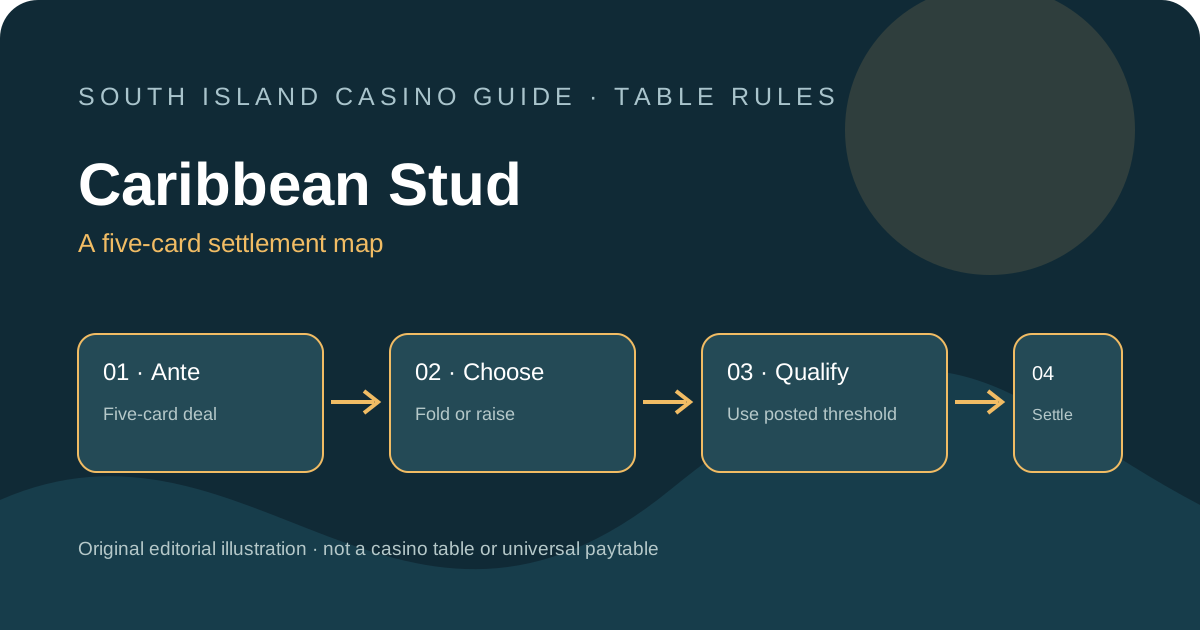
Caribbean Stud is a five-card casino game in which each player compares a private hand with the dealer’s hand. After placing an ante, a player sees five cards and chooses to fold or make the table’s required raise. The dealer qualifies on the posted threshold, commonly ace-king or better. If the dealer does not qualify, many rule sets pay the ante and return the raise; if the dealer qualifies, the higher poker hand wins and ties push. The exact raise multiple, payout schedule and optional jackpot rules must be read from the live table’s help.
The short answer
Caribbean Stud uses a five-card hand for each player and the dealer. You place an ante before the deal, then decide whether to fold or continue with a larger bet after seeing your cards. The dealer turns over a hand that must meet the table’s qualification rule, commonly ace-king or a stronger poker hand. If the dealer does not qualify, the ante is commonly paid at even money and the raise is returned. If the dealer qualifies, the higher five-card hand wins; a tie usually returns the main wagers. A paytable determines the profit paid on a winning raise, and an optional progressive jackpot, where offered, has separate terms.
The practical rule is to read the exact game help before staking. “Caribbean Stud” names a family of games, not one universal payout sheet. The qualifying threshold, raise size, ante-bonus treatment, progressive eligibility, payout cap and hand schedule can differ. The Evolution provider reference links to the public catalogue supplied for this assignment; it did not expose a Caribbean Stud rules page in the accessible catalogue, so this guide uses regulator-published rules as a clearly labelled example rather than attributing a casino-specific variant to Evolution or a New Zealand operator.
What kind of poker game is Caribbean Stud?
Caribbean Stud is a house-banked comparison game. It borrows conventional five-card poker rankings, but players are not building a shared pot against one another. Each active player compares one five-card hand with the dealer’s five-card hand. Other players’ cards do not improve your hand, and you do not choose a poker action such as drawing, exchanging cards or raising another player. Your key decision is whether the hand you can see is strong enough to continue against the dealer under the published rules.
That structure makes the dealer’s qualification rule central. In ordinary poker, a pair can win by beating an opponent’s lower pair. In Caribbean Stud, even a player hand that would be excellent against random cards does not settle in the normal way until the dealer’s hand qualifies. If the dealer fails the threshold, the ante settlement follows the table’s no-hand rule and the raise may be voided or returned. The player’s side wager, if any, is handled under its separate paytable.
The name can also cause confusion with Casino Hold’em, Caribbean Draw Poker or other house-banked poker games. They may use familiar poker words while dealing different numbers of cards, showing community cards, offering different decision points or settling extra wagers differently. This page covers the classic five-card Caribbean Stud structure only. If the title in a game lobby includes another product name or a dealer has a different procedure, use that product’s own help instead of transferring these rules.
How a round is dealt
The usual flow begins with the ante circle. If the table offers a progressive jackpot, that side wager may have to be placed at the same time, before cards are dealt; it is not automatically included in the ante. The dealer then gives each active player five cards and receives a five-card hand with one card exposed. A traditional layout has four dealer cards face down and one face up. Some electronic interfaces present the hand differently, but the decision point is the same: you can inspect your five cards while the dealer’s full hand remains unknown.
After looking at your cards, you either fold or place the required raise in the separate bet area. Folding ends the hand and normally forfeits the ante. Continuing commits an additional amount defined by the table. Many conventional versions require a raise equal to twice the ante, but players should not assume that multiplier without reading the current table help. The layout or rules screen should identify the permissible amount before the decision is made.
Once every player has chosen, the dealer reveals the hidden cards, forms the best five-card poker hand and checks qualification. This order matters: the dealer should not reveal the complete hand before a player’s decision in the ordinary format. The result is then settled in two layers. First determine whether the dealer qualifies and which hand is higher. Then apply the payout rules to the ante, raise and any independent progressive bet.
If an online interface has a history panel, it may show the exposed card, final result, or settled amount. That is a record of the completed round, not a clue about the next shuffled deal. A previous sequence of dealer non-qualifiers does not make qualification “due”. Every round is evaluated from its own dealt cards and the rules shown by that game instance.
Five-card hand rankings
The hand ranking is the familiar high-to-low poker order, with one important five-card detail: a straight can run ace-to-five as the low sequence or ten-to-ace as the high sequence. An ace does not wrap around to make king-ace-two. The New York regulator’s published Caribbean Stud rules state the order below and specify that identical hands are a push or standoff.
| Rank, highest first | What the five cards contain | Comparison detail |
|---|---|---|
| Royal flush | A, K, Q, J and 10, all one suit | The highest straight flush in the published schedule |
| Straight flush | Five consecutive ranks, all one suit | Compare the highest card; A-2-3-4-5 is the low straight flush |
| Four of a kind | Four cards of one rank | Compare the rank of the four matching cards |
| Full house | Three of one rank and a pair | Compare the three-card rank first, then the pair |
| Flush | Five cards of one suit, not consecutive | Compare the highest card, then the next card as needed |
| Straight | Five consecutive ranks, mixed suits allowed | Compare the highest card; the ace-low run is 5-high |
| Three of a kind | Three cards of one rank | Compare the trip rank, then kickers if the rules require them |
| Two pair | Two different pairs and a fifth card | Compare the higher pair, lower pair, then kicker |
| One pair | Two cards of one rank | Compare the pair, followed by the three side cards |
| High card | No pair or higher combination | Compare cards from highest downward |
The ranking names alone do not settle every comparison. Two flushes both remain flushes, so the highest card in one is compared with the highest card in the other; if those match, compare the next. Two pairs are compared first by the higher pair. A shared top pair does not automatically make a push if the second pair or kicker differs. The formal rules or game help should define how a particular client compares all remaining cards.
Suit is not normally an extra tie-breaker in standard poker hand ranking. A spade flush does not outrank an otherwise identical heart flush merely because of suit. A progressive jackpot may, however, award a separate result for a particular suited hand. That exception belongs to the side-bet schedule, not to the ordinary comparison between the player’s hand and the dealer’s hand.
Dealer qualification: what “ace-king or better” means
Many traditional rules use ace-king high as the minimum qualifying dealer hand. That means the dealer’s five cards must include at least ace and king when the best hand is otherwise high-card, or form a recognised poker combination above high card. A dealer pair qualifies because a pair ranks above a high-card hand; so do two pair, trips and all higher combinations. The exposed card by itself does not establish qualification. The dealer’s full five-card hand is assessed after the decision window closes.
Always read the exact wording. A game may phrase the threshold as “A-K or better”, “ace-king high”, or a product-specific rule. It may define a qualifying ace-king as a particular combination of ranks. Do not infer a change in qualification from a label on the table or from a memory of another Caribbean Stud product. The specific game’s help screen controls that version’s settlement.
Qualification is different from winning. A dealer can qualify with a weak pair and still lose to a player’s higher hand. Conversely, if the dealer has a qualifying hand that outranks the player, the main wagers lose. If the dealer does not qualify, the player’s hand has not “beaten” a qualifying opponent; the round uses a special no-hand settlement instead. Keeping these cases separate makes the payout logic easier to follow.
The ante and the fold-or-raise decision
The ante is the initial wager that buys entry into the comparison. It is exposed to loss if you fold and also participates in a completed comparison. The raise is an additional wager that is placed only when you continue. Together, the ante and raise create a larger total amount at risk than the ante alone. If a progressive jackpot wager is added, that is a third amount with its own result conditions; it is not a substitute for either main wager.
The player decision is not “do I like these cards?” in isolation. The useful questions are: what is the minimum raise? What hand comparison is needed for each main bet to win? What happens when the dealer does not qualify? Does the table pay a separate ante bonus for a high player hand? What is the loss if the dealer qualifies and wins? The table’s answers establish the decision’s cost and settlement. A vague feeling that a pair looks strong cannot replace those rules.
Under a two-times-ante version, a player who antes 1 unit risks a further 2 units to continue, giving 3 units across the ante and raise before any side bet. This arithmetic is not a recommendation to play that amount. It simply makes the exposure visible. If the raise multiple differs, calculate the total from the actual screen. A small ante can still lead to a materially larger decision once the raise is added, so decide the limit before cards arrive.
There is no guaranteed winning strategy. A mathematically optimal decision, if one is published for a particular schedule, depends on the exact dealer-qualification rule, raise amount, payout table, card procedure and any ante bonus. A strategy chart for one version may not transfer to a different table. If a site’s help omits a necessary rule, the responsible conclusion is “not verified” rather than to invent an action rule or promise that a hand should be raised.
Settlement: follow each wager separately
The core comparison can be summarised without pretending that every operator uses the same payout table.
| Dealer and hand result | Ante | Raise/bet | Progressive wager, if present |
|---|---|---|---|
| Player folds | Usually collected | No raise is placed | Settled under its own rules; check whether it remains eligible |
| Dealer does not qualify | Commonly pays 1:1 | Often void or returned, neither paid nor collected | May still be evaluated; rules can pay regardless of dealer qualification |
| Dealer qualifies and outranks player | Lost | Lost | Evaluated separately under its jackpot rules |
| Dealer qualifies and player outranks dealer | Often pays 1:1 | Paid at the hand’s listed odds | Evaluated separately, often based on the player’s hand |
| Dealer qualifies and hands tie | Usually returned as a push | Usually returned as a push | Side-bet result remains independent |
The table is a plain-language outline, not a universal contract. For example, the New York State Gaming Commission’s current compiled rules set an ante return at even money if the dealer has no qualifying hand and treat the bet wager as void in that case. The same published rules set both main wagers as a push when qualifying hands tie. Another jurisdiction or a particular online game may phrase or apply a rule differently, so read that product’s help.
“Pays 1:1” usually describes profit relative to the stake plus return of the original stake, but screen conventions vary. If a winning ante was 10 and the display says 1:1, ask whether the total credit shown includes the returned 10. A paytable may show “odds” while a history view shows total return. Do not add the same stake twice when calculating your result. The game’s displayed balance and written terminology should reconcile.
For a winning raise, the posted schedule commonly changes with the player’s hand. One official jurisdiction’s minimum schedule pays one pair or less at 1:1, two pair at 2:1, three of a kind at 3:1, straight at 4:1, flush at 5:1, full house at 7:1, four of a kind at 20:1, straight flush at 50:1 and royal flush at 100:1. Those are not “New Zealand odds” and should not be copied into a casino review as if universal. They are an illustration of why the displayed table, not the game name, determines the return.
Worked examples without a casino-specific offer
Suppose a rules screen shows an ante of one unit, a required raise of two units, a qualifying threshold of ace-king or better and a payout table for winning raises. These sample units are only arithmetic; they are not a real-money stake recommendation or an operator offer.
In the first example, the player holds a pair of nines. If the player folds, the ante is forfeited. If the player continues, the raise is placed. If the dealer’s final hand does not qualify, the table may pay the ante at even money and return the raise. If the dealer qualifies with a lower pair, the player’s pair of nines outranks it and both main wagers settle under their respective schedules. If the dealer qualifies with a higher pair or another stronger hand, the player loses both. The pair did not guarantee a win; it simply determined the player’s rank when compared.
In the second example, the player has an ace-high hand with no pair. A high card may still win if it outranks the dealer’s qualifying high-card hand, depending on the exact comparison rules. But if the dealer does not qualify, the special no-hand rule may return the raise rather than treating the player’s high card as a normal win on that bet. The exposed dealer card helps describe the situation but does not reveal whether the hidden cards create a pair or a stronger hand.
In the third example, both hands are a flush. Compare the top card in each flush, then the next card if the top ranks match. If all ranks match under the table’s tie rule, the main wagers push. A flush in a different suit does not automatically win. If the player also made a progressive wager, the jackpot schedule may consider the exact suit or hand independently of that push.
The point of the examples is to track the wager labels. Say “ante returned”, “raise paid at the listed odds”, or “progressive award paid” rather than calling the entire round a win without showing which amount was settled. This distinction is useful when reviewing a hand history or querying support about a result.
Reading a paytable before betting
Start with the ante and raise areas on the felt or in the interface. Confirm the raise multiple, qualifying condition, payout odds, maximum payout and tie treatment. Look for a separate progressive circle and its own award table. If only a short help pop-up appears, open the detailed game rules; a thumbnail or lobby description is not enough to calculate a return.
Check whether the listed raise schedule pays on a winning hand only or also offers an ante bonus that does not depend on beating the dealer. A “bonus” can be an extra payment for a straight or better, but the eligibility and timing vary. Do not assume it is present just because another casino’s schedule includes one. The word “bonus” could also refer to a progressive side bet or a promotional feature rather than the main game settlement.
Read “1 to 1” and “1:1” in the convention used by that table. Some rules state the profit odds; others use a table notation that includes return of the stake in the total. The game’s help should define the wording, and a low-stakes demo can show how the interface credits a completed result without requiring a real deposit. Do not mistake a demo’s simulated balance for a cash amount.
Then check the cap. A high-ranked hand can produce a theoretical multiplier, but the table may set a maximum payout per hand or per progressive award. A payout cap can be affected by the total bet, jackpot tier or local rules. The maximum amount printed for an online account is not established by an unrelated land-based schedule. Keep the relevant rule and date with any review.
Progressive jackpot: an optional side wager
Some Caribbean Stud tables offer a progressive jackpot wager. It is optional unless the game’s rules say otherwise, and it is distinct from the ante and raise. The side bet is generally settled from the player’s hand against a separate award schedule rather than from the main head-to-head result. A royal flush can be the jackpot hand, while other high combinations may receive fixed or percentage prizes. The exact qualifying hands, minimum awards, share rules and current meter are table-specific.
Do not assume that the dealer must qualify for a progressive hand to pay. The New York regulation, for example, states that a winning progressive payout wager is paid without regard to the dealer’s hand rank, even when the dealer does not qualify. That is a jurisdiction’s published rule; a game in another jurisdiction must be read on its own terms. It demonstrates why a progressive result should be checked separately from the ante and raise.
Before placing the side bet, find its cost, whether it is accepted only before the deal, which five-card hands qualify, and whether the displayed jackpot is shared among players or locations. Check if the jackpot is reset after a win and how the operator handles a delayed or disputed award. A large meter is not a forecast that a jackpot is near. The amount shown describes a prize under its rules, not the chance that a particular hand will occur.
Optional side bets often have a different mathematical return from the main game. Without the complete paytable and probabilities, a player cannot reliably compare their expected value. The sensible guide is not to describe the progressive as “worth it” or “bad value” from the headline prize alone. Compare the wager cost, exact payout conditions and published odds. If those details are missing, leave the value unassessed.
Common mistakes to avoid
The first mistake is raising before checking the cost. A raise can be a multiple of the ante, and the combined amount at risk can be more than twice the original stake. Know the total exposure while the decision is still optional.
The second mistake is treating dealer non-qualification like a win on every bet. Some common rules pay the ante and return the raise. That is different from the dealer losing a qualified comparison, where the player may win both parts. The distinction matters when reading a balance history.
The third mistake is comparing only hand labels. Two pairs can have different rankings; two flushes need a card-by-card comparison; and a matching hand can push. Suit order is not normally the poker tie-breaker, even though suits may matter to a separate jackpot tier.
The fourth mistake is copying the paytable from a video, a forum or a casino in another country. A table can vary in its raise multiplier, payout odds, cap and progressive structure. Use the active rules screen and identify the version by its game title and operator.
Finally, do not chase a jackpot after a near miss or use a losing streak as evidence that a better result is due. A progressive award is random under the game’s stated rules. It does not create a reliable strategy for the next hand. Set a spend limit in advance, take a break when the decision no longer feels clear and use the site’s existing safer gambling information if play is becoming difficult to manage.
What to verify in an online or live interface
Confirm the exact game title, the provider shown in help and whether the table is a conventional five-card version. Read the ante and raise labels, the dealer’s qualifying threshold, hand order, no-qualifier treatment, tie rule, raise payout table and progressive terms. If the client offers a rules link and a separate paytable, inspect both; the paytable may not explain the sequence that determines when a wager is void.
For a live table, note the dealer’s exposed card and wait for the full reveal before deciding what qualified. For an electronic or random-number-generated table, use the game history to see the settled result, but do not treat the previous outcomes as predictive. If a displayed result is unclear, save the round identifier, date, table title and wager labels before contacting the operator. Do not post account or payment information publicly.
The source list below includes a regulator’s current five-card rules and a separate rules manual. They establish the general structure and show a sample of how terms can be defined. They do not prove that this game is offered to New Zealand players or define any operator’s current implementation. The supplied Evolution catalogue did not provide a Caribbean Stud-specific help page in the accessible results.
Frequently asked questions
What does the ante do?
The ante is the initial wager that enters the player into the round. After seeing five cards, the player folds or places the table’s required raise. The ante and raise settle under different lines of the paytable.
Does the dealer always need ace-king?
Many common versions use ace-king high or a stronger poker hand as the qualification threshold. Read the exact game help: a different implementation may define qualification or its no-hand settlement differently.
Is the raise always double the ante?
No universal multiplier should be assumed. A traditional rules manual may require exactly double, while the active table’s rules set the applicable amount. Check before betting.
What happens when the dealer does not qualify?
A common rule pays the ante at even money and returns or voids the raise. A progressive wager, if present, may still be evaluated separately. Confirm the exact settlement on the table.
Is a flush worth more than a straight?
Yes, flush ranks above straight in standard five-card poker. The profit paid for a winning raise is not universal; it is the amount shown by the active paytable.
Does a progressive jackpot require the dealer to qualify?
Not necessarily. Some published rules settle a winning jackpot wager independently of dealer qualification. The side-bet rules decide which hands qualify and how the award is paid.
Is Caribbean Stud available in New Zealand?
This guide does not confirm availability with any New Zealand casino or online operator. Check the operator’s current game lobby, account eligibility and applicable rules before assuming access.
Sources and verification boundary
- New York State Gaming Commission, 9 NYCRR § 5324.37, Caribbean Stud Poker rules, compiled text updated 31 December 2025; accessed 7 October 2026: https://gaming.ny.gov/subchapter-b-casino-gaming-parts-5300-5330. Used for an explicitly jurisdiction-specific example of hand rankings, qualification, main-game settlement and a minimum payout schedule.
- Royal Events, Caribbean Stud Poker game instructions, accessed 7 October 2026: https://www.royal-events.com/fileadmin/user_upload/PDFs/spielanleitungen/Caribbean-Stud-Poker-Rules-Game-instructions-Royal-Events.pdf. Used as a second rules example for the deal, fold/continue sequence and a two-times-ante raise; its paytable is not presented as universal.
- Evolution Games showcase, accessed 7 October 2026: https://games.evolution.com/. The accessible catalogue did not provide a Caribbean Stud product help page; no availability or Evolution-specific rules are asserted.
- Department of Internal Affairs advertiser guidance, accessed 7 October 2026: https://www.dia.govt.nz/Online-gambling-for-advertisers. No CPA link has been placed in this article pending compliance review.
