Game supplier catalogue · South Island guide
Evolution games guide: catalogue and formats
 Best casinos available in New ZealandUpdated 7 November 2026

This guide explains how to navigate Evolution’s own game catalogue, recognise its main product formats, and check what a supplier page does—and does not—prove about a particular game. It is a supplier hub, not a directory of every Evolution Group brand or a claim of New Zealand availability.
The short answer
An Evolution games guide is most useful when it helps you move from a supplier listing to the exact game help and then to the rules shown by the casino operator you are checking. Evolution’s public showcase places live casino titles, game shows, RNG products and slots in one catalogue experience. Those labels describe broad ways of presenting games; they do not certify a particular operator’s stake range, payout table, location access or account terms. This page is the one Evolution supplier hub for the site. It explains catalogue navigation and verification. It does not try to be a second hub for every company in Evolution Group, and it does not replace the separate rules pages for individual games.
The selected game guides linked here cover several live table and game-show formats, including card comparisons, wheel games and dice. Each title belongs in one product-specific URL. If you need a game’s exact current minimum stake, payout display, side-bet rules or availability, use the relevant game help at the operator’s table and retain the title and version shown there. If the information is absent, the responsible answer is “not published in the source checked,” not an estimate copied from a different market.
What this catalogue guide covers
The boundary matters because “Evolution” can name a supplier brand, appear in the name of a group, and be used in descriptions of different content categories. Here the subject is the supplier catalogue that a reader uses to identify Evolution games and follow their official product information. That includes how to distinguish live dealer tables from game-show formats and RNG products, how to find an individual game’s own description, and how to compare that description with the rules actually displayed in an operator’s interface.
This is not an operator review, a list of New Zealand casinos, an offer page, or a claim that every title shown on a supplier page is released in every market. It does not rank the studio, assign a catalogue-wide return percentage, or review all of Evolution Group’s studios. A product page can help identify the title and explain its published mechanic. It cannot by itself show that a casino has enabled the product for an account in a particular country.
Start with the official catalogue
Evolution’s public showcase includes a search field and links to product pages. It groups and presents titles in areas such as live games, game shows and slots. The catalogue is useful as an index: search by the exact displayed title, open the matching supplier page, and confirm that the product type and wording correspond to the game you meant. A similar name or theme is not enough. For example, a title containing “Baccarat” may be a live table, a studio variant, or a different game with a related name.
Treat the catalogue as a changing index rather than a permanent inventory. Titles can be added, removed, relabelled or moved into a different section. A tile can also be accompanied by “new” language or a promotional image that says nothing about whether a particular operator currently offers it. If a catalogue result cannot be opened, record that limitation. Do not convert a search result snippet, thumbnail, or cached page into a confirmed active version.
For a careful lookup, keep a short record with the exact title, the supplier URL, the date checked, the page heading, the named product category and any visible release note. That small record makes it possible to tell a later reviewer whether a difference comes from an updated supplier page, a similarly named product, or an operator-specific setup. It is also more useful than saving an isolated screenshot with no date or URL.
Read format labels as navigation aids
Live dealer tables
Live dealer products are presented around a table or physical game environment, with a streamed dealer or presenter and a betting interface. Blackjack and baccarat are examples of familiar table-game families. A studio variant may add a special starting condition or a side bet while retaining parts of the underlying game. The exact rules still belong to that title’s help panel: a familiar name does not tell you how many decks are used, whether a commission applies, what a side bet settles against, or which actions the particular version permits.
When an interface is live, the stream and the rules panel answer different questions. The stream shows the current round. The rules explain how the round is supposed to be settled. A dealer’s explanation can make a feature easier to follow, but it should not be the only record of a material rule. If the visible action and the written help seem inconsistent, pause before placing another bet and use the operator’s round history or support route to ask about that specific hand.
Game shows and event-style products
Game-show products often use a presenter, wheel, sequence of stages or other show-like presentation. “Live” can describe the video and presentation while the outcome logic still follows defined game rules. A visually rich show can have a main result, optional side selections, bonus stages or multipliers. Do not infer that every decorative element creates a separate wager or that a highlighted value applies to every selection.
For any multi-stage title, draw the round as a sequence: when betting opens, what selections are available, when bets close, what event determines the result, and what result settles each selection. That is a better way to understand a rules page than memorising animation names. It also lets you ask a precise question: “Does this multiplier apply to my selected market?” is more answerable than “How does the whole show work?”
RNG and first-person formats
RNG is a broad label for an outcome generated by a random-number process rather than a live dealer’s physical draw. A first-person or simulated table may use a video-like interface and a betting layout familiar from a live table. The labels are not a quality rating and do not state the operator’s return setting. A title’s actual rules and configuration still need a source.
If the catalogue groups a first-person version alongside live products, keep the distinction visible. An explanation of a live dealer’s shoe, cards or table procedure should not automatically be transferred to a simulated product with the same game family. Likewise, a live-video stream is not evidence that the game is physically random in a way that has been independently tested by this article. Use the supplier’s technical information or the operator’s published controls for a claim about generation and certification.
Slots and adjacent studio brands
The wider Evolution catalogue experience may show slot titles and may introduce multiple group brands. That wider navigation is useful for browsing the group, but the scope of this page remains the Evolution provider hub requested by the owner. A slot card or another studio’s title should not be silently presented as an Evolution live-table product. Check the exact studio or brand named on that title’s own page before assigning ownership.
This distinction prevents a common catalogue error: treating a corporate group’s whole portfolio as one studio’s game list. If a reader wants another brand’s catalogue, that is a different provider task and requires a separately scoped page. This guide links only the four assigned Evolution game references in the relevant site collection, with the full game-guide index as the navigation point.
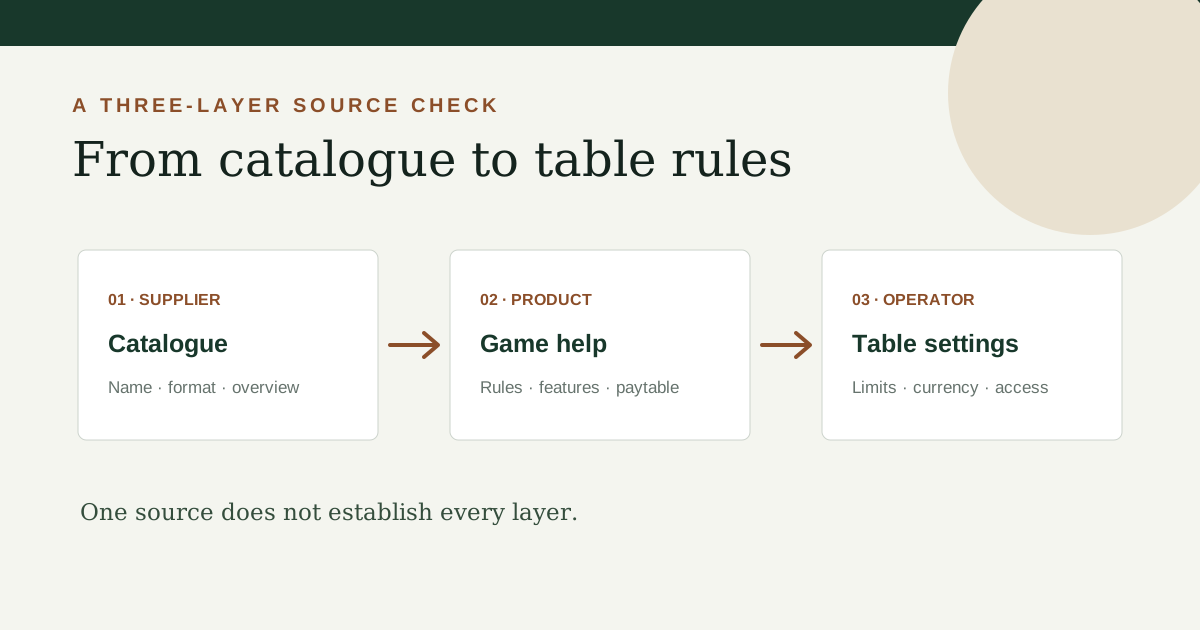
A reliable three-layer settings check
The word “settings” is often used loosely. Separate the evidence into three layers so a supplier description does not become a false operator promise.
| Evidence layer | What it can establish | What it does not establish by itself |
|---|---|---|
| Supplier catalogue or title page | Exact product naming, broad format, and the mechanic the supplier chooses to describe | That every operator carries it, or that a particular account sees it |
| Game help opened from a specific table | The displayed rules, selection labels, settlement language and version available in that session | A universal value for every casino or a legal status for the operator |
| Operator terms or account interface | The limits, currency, eligibility, cashier rules and access shown by that operator | That another operator uses the same configuration |
Start at the supplier layer to confirm identity. Then open the exact operator instance and inspect its help. Record numbers only when the relevant screen or document actually shows them. A publisher can accurately explain a rule while leaving out a paytable. An operator can supply a paytable for one jurisdiction that is not used elsewhere. Both can be true at once.
For a number to be responsibly described as verified, keep the title, the version or table identifier where available, the market, the operator, the source location and the date checked. “The game has a return of X” is incomplete if the evidence actually says “this named operator’s version in country Y displays X.” Do not calculate an implied return from one table and then strip away the assumptions. State the input values, the payout convention and whether the stake is returned.
Catalogue status and release language
The supplier showcase is evidence that a page or title appears in the catalogue at the time you inspect it. It is not a complete release ledger. If a page has a publication date, “new” label, video or play button, record what the page says, but do not assume that a video loads in every browser or that free play is enabled for every visitor. Evolution’s showcase itself states that freeplay and individual game features are subject to jurisdiction. A demo link therefore cannot establish that real-money play is allowed in a reader’s location.
When a date matters, distinguish three records: the date on an official announcement, the date a title appeared in the catalogue, and the date a named operator enabled it. They can differ. If the public supplier page has no release date, say so. The four pages in this package were listed in the official showcase on 6 October 2026, but the public material checked here does not support a claim that all four are available to New Zealand players or live at any named operator.
“Coming soon,” “new,” “available,” and “live” are not interchangeable. A future launch notice supports an expected date only if its date and scope are explicit. A tile without a status label does not reveal whether a market has access. An operator lobby is a better source for that operator’s current catalogue, subject to account and location checks, but it can change without notice.
Selected Evolution game references
The table below is a navigation map, not an endorsement or ranking. Each row links to one single-game guide on this site. The individual page explains the mechanic and identifies which values the public supplier record does not provide. It covers selected titles, not every product in the supplier’s catalogue.
| Title | Format cue from the supplier listing | What to verify in the title’s help |
|---|---|---|
| Always 6 Blackjack | Live blackjack variant with a fixed dealer up-card described by the supplier | Deck and table rules, permitted player actions, side-bet paytables, stake range and settlement details |
| Insurance Baccarat | Live baccarat variant with an insurance feature described by Evolution | What each insurance selection means, the fee and settlement, commission setting, main and side-bet tables |
| Red Baron | Crash-style game-show product | Bet window, cash-out rules, number of selectable bets, auto-cashout behaviour and the displayed payout terms |
| Always 9 Baccarat | Live baccarat variant centred on a Banker starting score of nine | The exact dealing and settlement rules, side-bet options, payout table, limits and commission wording |
| Dragon Tiger Phoenix | Three-position card comparison with Dragon, Tiger and Phoenix | Card ranking, two-card and three-card tie treatment, payout notation and stake limits |
| Super Speed Dragon Tiger | Faster two-card Dragon Tiger variant with Tie and Suited Tie selections | The current timer, tie settlement, suited-tie payout and settings for the active table |
| Ice Fishing | Virtual money wheel with Leaf positions and three fish bonus games | Exact table payout rows, the meaning of All Bonuses, stake limits and multiplier settlement |
| Super Color Game | Three-colour-dice game show with Single, Double and Triple positions | Match conditions, base payout rows, multiplier treatment and table-specific limits |
| Fireball Roulette | Single-zero roulette with a separate Fireball bonus grid | Straight-up qualification, each roulette bet’s payout, Chaser allocation and feature cap |
| Marble Race | Six-colour marble race with first-place and ordered first-and-second markets | Exact operator table help, grid notation, payout convention and limits; do not confuse it with Ezugi’s five-marble EZ Marble Race Las Vegas |
| War | Card-rank comparison with a Surrender or Go To War choice after a tie | Side-bet rules, table limits, precise account settlement and any version-specific terms |
| Race Track | Six racers selected from a pool of 50, with horse and dinosaur modes | Race-specific odds, payout convention, operator version, and the definitions used for history modes |
| Bet Stacker Blackjack | Classic seven-seat blackjack with a pre-deal rank-based Bonus Element | Base blackjack rules, exact fee display, side-bet schedules, stake limits and version identity |
| Always 8 Baccarat | Fixed Banker first card and baccarat comparison | Complete third-card rule, main and pair paytables, table-specific limits and payout convention |
| Infinite Bet Stacker Blackjack | Infinite-seat format with Bonus Element and fee | Exact base blackjack rules, added-wager accounting, Six Card Charlie, side-bet schedules and limits |
| Crazy Balls | Numbered-ball cards and four linked bonus formats | Card layout, line settlement, multiplier eligibility, bonus triggers and current paytable |
| Lightning Ball | Five regular numbers plus a separate Powerball on each ticket | Match-count payout rows, multiplier condition, ticket stake and operator limits |
| Lightning Sic Bo | Three-dice grid with fee and random Lightning markers | Exact market ranges, fee calculation, multiplier eligibility, payout table and stake limits |
| Disco Balls | Live number game with an evolving multiplier and a bonus feature | Current number range, multiplier sequence, bonus trigger and payout help |
| MONOPOLY Roulette | Single-zero roulette with marked numbers and board features | The current bonus trigger, Community Chest sequence, payouts and table limits |
| Ride Free Blackjack | Blackjack variant with free player actions and a dealer-22 rule | Eligible free actions, hand settlement, dealer-22 treatment and side-bet terms |
| Dragon Dragon | Three-outcome coin game with a published regional rules example | Current operator table, coin outcomes, payout convention and local ruleset |
These selected guides are Always 6 Blackjack, Insurance Baccarat, Red Baron, Always 9 Baccarat, Dragon Tiger Phoenix, Super Speed Dragon Tiger, Ice Fishing, Super Color Game, Fireball Roulette, Disco Balls, MONOPOLY Roulette, Ride Free Blackjack, Dragon Dragon, Marble Race, War, Race Track, Classic Bet Stacker Blackjack, Always 8 Baccarat, Infinite Bet Stacker Blackjack, Crazy Balls, Lightning Ball and Lightning Sic Bo. Keep each game’s own rule questions on its own URL. The provider hub helps readers find selected materials; it does not repeat individual reviews or claim to list every current product. NetEnt is a separate Evolution Group slot brand with its own provider catalogue guide; this Evolution-specific title list does not expand to group-wide games.
Seven additional single-title game-show guides cover Lightning Storm, Balloon Race, Crazy Time, Stock Market, Crazy Pachinko, Instant Super Sic Bo and Funky Time. They remain separate from this provider overview: use each guide for that product’s own rule sequence and source limits.
What a catalogue entry cannot tell a New Zealand reader
For a separate reference to conventional live roulette, see the live roulette rules and odds guide. It covers single-zero and double-zero wheels and excludes branded multiplier games such as the separate Fireball Roulette guide.
For the standard three-dice betting concept, use the Sic Bo betting table guide to compare bet families and theoretical outcome counts. It keeps the basic table-reading task separate from the named Lightning Sic Bo and Instant Super Sic Bo products, each of which has its own rules and feature changes.
The location in which a person is browsing, the location for which an operator configures its service, and the location whose law governs an advertisement are three separate facts. A New Zealand audience does not turn a supplier’s global product description into an NZ-specific ruleset. Similarly, a supplier’s corporate licence information is not the same as an operator’s local permission to accept customers.
The Department of Internal Affairs says transitional online casino providers may continue serving customers who were already in the market before 1 May 2026 until 1 December 2026, but providers must not advertise to people in New Zealand during that period. Its advertiser guidance says the prohibition is in effect and reaches people who publish or arrange advertisements. That is why this catalogue hub contains no operator invitation or affiliate link. The exact status and eligibility of any service must be checked against current DIA material, not inferred from an Evolution game page.
As of the date checked for this guide, a public operator register and licensing outcomes were not used as evidence for any game in these pages. Do not read a game’s supplier page as proof that an operator has won a place in a future licensing process. For consumer questions, use DIA’s current customer guidance. For a title’s mechanics, use supplier help. Those are different sources for different claims.
Reading mobile and demo information
A responsive supplier page may let a reader open game information on a phone, but a smaller screen can hide a rules icon behind an expandable panel. Before reading a number, check whether the panel is scrollable and whether its heading belongs to the selected game rather than an adjacent tile. Take care with decimal points, ratio notation and stake units: a narrow layout can make a value look like a different field.
The official showcase states that freeplay demo mode and individual game features are subject to jurisdiction. If a demo button is present, it is evidence that a demo path was offered in the session you opened, not evidence of real-money eligibility, local licensing, a matching paytable or all features. A failed video or blocked jurisdiction screen is a limitation of access; it is not evidence that a game has been withdrawn globally.
If a public demo is not offered, do not instruct readers to create an account at an operator just to inspect basic rules. Look for a public supplier help page or rules document first. If the only available copy is behind an account or jurisdiction check, state that the current table-specific values could not be verified from a public source. That honest boundary is more useful than a confident but unsourced estimate.
How this guide treats a “verified setting”
“Verified” should mean that an identifiable primary source actually displays the value and that the article preserves the source’s context. A supplier catalogue may verify a product name and a high-level feature. It does not verify a stake limit unless it publishes that limit for the relevant configuration. A regulator-hosted document may be authoritative for a named licensee in a named jurisdiction, but it does not automatically govern a second operator.
When a source shows a paytable, inspect the notes that explain how it settles. “Pays 2 to 1” can mean net winnings with the original stake returned or a total return inclusive of stake, depending on the rules. A percentage return also depends on the version and bet choice. Do not repeat a number without its unit, jurisdiction, game title and date. If the source does not say, the article should say that the meaning is not explicit.
Comparing two versions requires more than matching title text. Check whether both pages name the same side bets, commission policy, feature trigger and paytable. A cosmetic refresh may preserve mechanics, while a special edition may change them. When the source has no version number, avoid inventing one; use the visible table name and check date instead.
Questions readers can ask before using a game guide
Use the following questions to decide whether a source answers the task in front of you:
- Does the title on the operator screen exactly match the supplier page?
- Is the game live dealer, a live show, RNG, or a different format?
- What does the rules panel say about the main selection and every side bet?
- Does the page publish a paytable, stake range, currency and maximum payout?
- Are any numbers tied to a jurisdiction, operator, table or version?
- Does the operator identify account eligibility and location restrictions separately?
- Is a demo available in the current location, and is it clearly labelled as free play?
- What can be verified from public primary material, and what remains unknown?
If the answer to a settings question is “the source does not show it,” stop there. The absence of a public number is not an invitation to copy an affiliate review. Third-party pages can be useful for discovering what questions readers ask, but every material mechanic or value should be checked against the product help or a jurisdiction-specific official rules document before publication.
Common questions
Is Evolution one studio or a wider corporate group?
The official showcase uses “Evolution Games” while also describing Evolution Group and displaying a wider range of brands. For this page, the entity is the Evolution catalogue hub and the selected Evolution game references above. Other group brands do not become part of this hub’s assigned search task merely because the showcase includes them. Ezugi has a separate provider catalogue guide, and products with a similar title should be matched by their exact brand and official page. Confirm the title’s own studio label if attribution matters.
Does Evolution publish all the settings for each game?
Not necessarily. A supplier page can explain a mechanic without publishing a complete payout table, stake range or operator configuration. The selected titles have different levels of public detail. Use the individual guide for the itemised source boundary, then read the selected operator’s own help if you need a current table-specific number.
Does the catalogue confirm New Zealand availability?
No. It identifies product information on the supplier site. It does not prove a particular casino offers the game to a New Zealand customer, that a specific table is open, or that the operator is authorised locally. No New Zealand game-access claim is made here.
Does an Evolution licence prove a casino is licensed?
No. Supplier approvals concern the supplier’s role and jurisdictions. Customer-facing operator status is a separate question. Check the official regulator or register for the operator and the customer’s location rather than relying on a logo or supplier disclosure.
Caribbean Stud is a separate rules reference
Caribbean Stud rules explains the conventional five-card game using jurisdiction-labelled examples. The accessible Evolution catalogue checked for this package did not expose a title-specific help page, so this link does not claim that Evolution offers the game or that a New Zealand operator carries it.
Are free demos available everywhere?### Are free demos available everywhere?
Evolution says freeplay and individual game features are subject to jurisdiction. A visible or accessible demo in one session does not prove that every reader will see it. A demo also does not establish real-money access or identical operator settings.
Where should a reader go for one title’s rules?
Use the single-game pages linked above. They keep the supplier catalogue separate from the rule task for one product. The game-guide index lists the site’s selected supplier and game references.
For New Zealand gambling support options, use our safer gambling guide or the free Gambling Helpline on 0800 654 655 or text 8006.
Sources and date checked
- Evolution Games official catalogue — catalogue categories, selected titles, demo qualification and group wording.
- Evolution corporate brands — wider corporate portfolio context.
- DIA information for advertisers and DIA information for customers — current New Zealand advertising and transition context.
- New Zealand Online Casino Gambling Regulations 2026 — affiliate-arrangement definition and prohibited-advertisement provisions.
Official catalogue and government sources checked 6 October 2026. The catalogue and legal guidance can change. Recheck the exact supplier page, operator help and current government material before a public refresh.
Draw-poker table guide
- Video poker paytables and RTP variants — Identify the active variant, complete payout schedule and calculation assumptions before comparing theoretical returns.
