Live roulette rules · South Island guide
Live roulette guide: wheels, bets and payouts
 Best casinos available in New ZealandUpdated 7 November 2026

Live roulette uses a physical wheel and a streamed table, but the betting rules still depend on the wheel and the table help. The most useful first check is whether the layout is single-zero or double-zero. With common standard payouts, single-zero roulette has a 2.70% house edge on ordinary bets; double-zero roulette has a 5.26% edge. Those are long-run averages, not predictions for an individual session.
The short answer
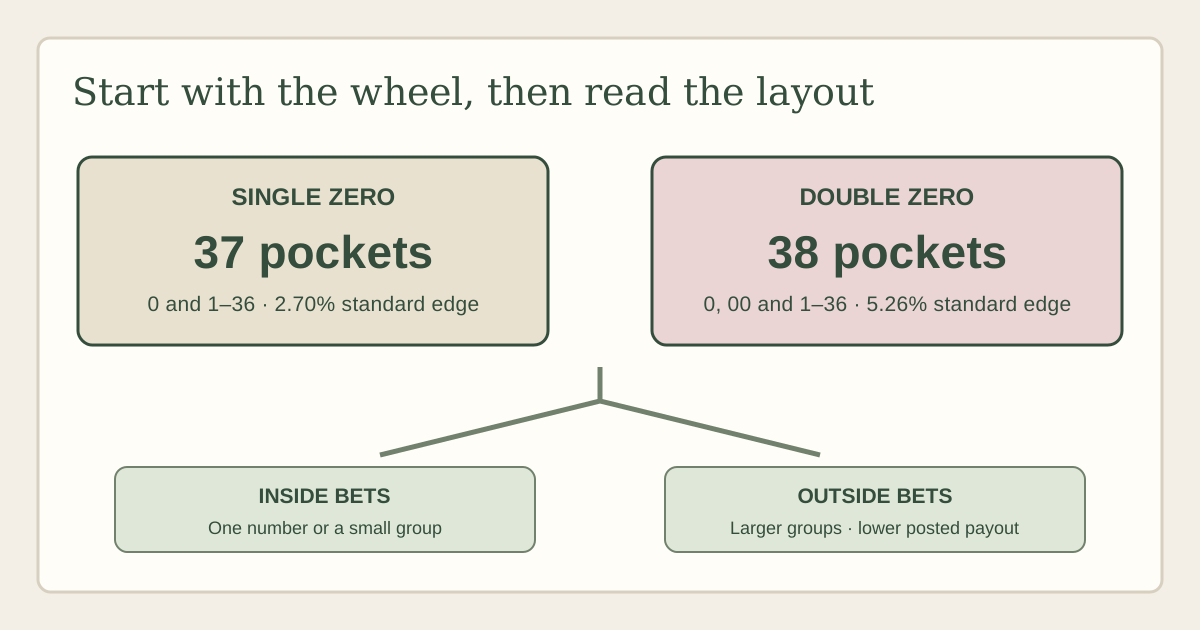
To read a live roulette table, check the wheel before choosing a bet. A standard single-zero wheel has the numbers 1–36 and one green 0 pocket; a standard double-zero wheel adds a second green 00 pocket. Under the common roulette payout schedule, the single-zero version has a house edge of 2.70% on standard bets, while double-zero roulette has a 5.26% edge. Inside bets cover a small set of numbers and pay more when they hit; outside bets cover larger groups and pay less. The zero is what makes the standard payout table favour the house over time.
“Odds” can mean three different things: the chance the ball lands on a number covered by a bet, the payout printed next to that bet, or the expected return after many rounds. A straight-up bet pays 35 to 1 but does not have a 35-in-1 chance of winning. A red bet may win more often, but the extra green pocket still makes its chance lower than one half. Keeping probability, payout and house edge separate prevents a table label from being mistaken for a promise.
This guide covers conventional live roulette using single-zero and double-zero wheels. It does not review Lightning, Fireball, double-ball or other branded multiplier products. Those products can change how a result is selected or how a payout is calculated, so their own game help must be read separately. The existing Fireball Roulette guide and MONOPOLY Roulette guide cover two distinct titles; their special rules do not apply to an ordinary roulette table.
What makes a roulette game “live”?
A live table shows a wheel round taking place in a studio or casino environment and sends the picture to a player interface. On a conventional table, the dealer opens a betting period, spins the wheel, launches the ball, closes betting and announces the result. The interface records bets on a digital layout and settles them after the result is confirmed. Some suppliers also offer automated real-wheel tables; the absence of a live dealer does not make the wheel result a standard random-number-generator slot.
A stream adds a visual record, not a change to the mathematics. Camera angles, dealer chat, a history panel or a faster countdown do not make a past number more likely to repeat or make an overdue colour due. The current round is settled by the wheel and the table rules. When a product adds a bonus wheel, multiplier selection or an extra ball, it is no longer enough to assume that a familiar-looking roulette layout settles every bet in the standard way.
A live session has a few practical stages. The betting timer appears, a player places chips on one or more marked positions, and the dealer calls that betting has closed. The ball is then launched around the wheel in the direction opposite to the wheel’s motion. Once the ball settles, the game displays the winning pocket and the result is paid according to the table’s rules. If a person joins after betting has closed, the next round is the first one in which a new wager can usually be placed.
The supplier describes its European and American tables as distinct live roulette options, and describes French Roulette as a single-zero game with the additional La Partage rule on even-money bets. Its catalogue also includes variants with different features. That is why the product title and rules panel matter more than the studio background or the shared roulette layout. A table marked “European” is not evidence that every other rule is identical to a French table or to a special-feature game.
Single-zero and double-zero wheels
A standard European or single-zero wheel has 37 pockets: 0 and 1 through 36. An American or double-zero wheel has 38 pockets: 0, 00 and 1 through 36. The numbered pockets are split between red and black, with green reserved for zero. The two wheels show a nearly identical betting grid, which can make the difference easy to miss when joining a table from a lobby card.
| Conventional wheel | Pockets | Green pockets | Standard edge on most bets |
|---|---|---|---|
| Single-zero | 37: 0 and 1–36 | 1 | 2.70% |
| Double-zero | 38: 0, 00 and 1–36 | 2 | 5.26% |
The layout is not merely cosmetic. With standard payouts, the extra 00 pocket loses on many bets without increasing the posted payout. On a straight-up number bet, the displayed win still normally pays 35 to 1 on either wheel. The ball, however, has a one-in-37 chance of landing on the chosen number on a single-zero wheel and a one-in-38 chance on a double-zero wheel. The payout has not grown to compensate for the extra pocket.
A quick visual check is to find the green area on the betting layout or the wheel diagram. One green 0 indicates the conventional single-zero format. A second green 00 indicates double-zero roulette. If the lobby calls a table “American”, “European”, “French”, “Auto” or “Live”, read the full in-game information: labels may refer to a format, ruleset or delivery method, and the interface can include table-specific limits and special rules.
The wheel’s number order is not the same as the betting grid’s order. The grid arranges numbers in rows and columns for placing bets; the physical wheel places them in a circular sequence. For basic single-zero and double-zero odds, the number sequence around the wheel does not change the count of pockets. It can matter for a neighbour or call bet if that table offers one, so use its own call-bet rules instead of inferring coverage from the table grid.
Inside bets and their standard payouts
Inside bets are placed on the numbered grid and cover a specific number or a small group. The common standard schedule pays more for smaller coverage because the event is less likely to occur. The payout ratio below means net winnings relative to the original stake; if a bet wins, the stake is also returned unless the table rules say otherwise.
| Bet | Typical placement | Numbers covered | Standard net payout |
|---|---|---|---|
| Straight up | Centre of one number | 1 | 35 to 1 |
| Split | Line between two adjacent numbers | 2 | 17 to 1 |
| Street | Edge covering a row of three | 3 | 11 to 1 |
| Corner | Intersection of four numbers | 4 | 8 to 1 |
| Six line | Edge between two adjacent rows | 6 | 5 to 1 |
For example, a winning NZ$1 straight-up stake at a standard table usually returns NZ$35 in net winnings plus the NZ$1 stake. “35 to 1” does not mean the event is expected once every 35 spins. On a 37-pocket single-zero wheel, that selected number is one pocket out of 37. On a 38-pocket double-zero wheel, it is one out of 38. The payoff ratio and probability do not match exact fair odds; the difference is the house edge.
A split, street or corner also needs a placement check. The chip must sit on the boundary or intersection named by the game interface, and the interface should highlight the covered positions. If the bet is accidentally placed inside one number rather than on a dividing line, it may become a straight-up wager instead. Before the first spin, place a low-value practice selection only if the table provides a permitted no-stake preview; otherwise use the highlighted layout and the rules panel, not the outcome of a demo spin, to confirm coverage.
A six-line, sometimes called a double street, covers two adjacent rows of the numbered grid. It is not the same as a dozen or a column even though both cover a larger group than a straight-up bet. The layout should show six highlighted values before the betting window closes. The exact terms can differ between interfaces, so a table’s own bet glossary takes precedence over an assumed name.
Outside bets and what “even money” means
Outside bets cover large groups marked around the main numbered grid. Standard examples include red or black, odd or even, low or high, a dozen and a column. The first group usually covers 18 numbers and pays 1 to 1; a dozen or column covers 12 and pays 2 to 1. The green zero pockets are not red, black, odd, even, low or high. Under ordinary rules they therefore make those outside bets lose.
| Outside bet | Typical coverage | Standard net payout |
|---|---|---|
| Red or black | 18 numbers | 1 to 1 |
| Odd or even | 18 numbers | 1 to 1 |
| Low (1–18) or high (19–36) | 18 numbers | 1 to 1 |
| Dozen | 12 numbers | 2 to 1 |
| Column | 12 numbers | 2 to 1 |
“Even money” describes the payout ratio, not a 50% chance of profit. On a single-zero wheel, red covers 18 of 37 pockets, so its chance of winning is 48.65%, not 50%. On a double-zero wheel, the same red selection covers 18 of 38 pockets, or 47.37%. A result of 0 or 00 is outside the red/black split and normally loses the full even-money stake.
A dozen or column behaves differently from an even-money bet. It covers 12 pockets and ordinarily pays 2 to 1. The probability of hitting a dozen is 12/37 on a single-zero wheel and 12/38 on a double-zero wheel. Because a zero is not included in the 1–36 dozen or column, it normally loses. The stake can be placed on a dozen mark outside the grid or a column mark at its edge; the game should highlight the intended set before a bet is accepted.
Some single-zero tables add a rule such as La Partage for eligible even-money bets. Under that rule, a zero may return half of the affected stake rather than taking the whole stake. This does not apply automatically to every European table, and it does not usually apply to inside bets, dozens or columns. Evolution’s description of French Roulette explicitly identifies a single-zero wheel and La Partage. A player should verify whether the named rule appears in the current table help and which bet families it covers.
House edge: a worked comparison
House edge is the average proportion of total stakes retained by the game over a large number of comparable rounds. It is not the chance of losing a particular round, and it does not say what a specific session will return. For standard roulette payouts, the number of green pockets creates the edge because the payout schedule is based around the 36 non-zero numbers while the wheel has additional zero pockets.
For an even-money NZ$10 bet on red at a single-zero table, 18 outcomes win NZ$10 net and 19 outcomes lose NZ$10. That includes the single zero. The expected result per spin is therefore (18 × NZ$10 − 19 × NZ$10) ÷ 37, or about −NZ$0.27. The calculation is an average across many spins. It does not predict that a player will lose 27 cents on the next round or exactly NZ$27.03 after a hundred rounds.
At a double-zero table, the same bet has 18 winning pockets and 20 losing pockets. The expected result on a NZ$10 stake is (18 × NZ$10 − 20 × NZ$10) ÷ 38, or about −NZ$0.53. The change comes from one additional losing pocket, not from a worse payout printed on the screen. A table can therefore look familiar and still have a materially different expected cost.
| Example over repeated NZ$10 wagers | Single-zero | Double-zero |
|---|---|---|
| Chance red wins on one spin | 18/37 = 48.65% | 18/38 = 47.37% |
| Standard house edge | 2.70% | 5.26% |
| Average loss per NZ$10 staked | about NZ$0.27 | about NZ$0.53 |
| Approximate expected loss over NZ$1,000 total stakes | NZ$27.03 | NZ$52.63 |
This example assumes standard payouts and no special zero rule. It compares expected loss with total amount wagered, not with the starting balance. If a player reuses returned winnings, total turnover can be greater than the amount initially deposited. The percentage applies to the stakes placed, not necessarily to the wallet balance or a planned entertainment budget.
House edge is usually the same across ordinary bet types on the same standard wheel. A straight-up bet has a low chance of winning and a large payout; an outside bet has a higher chance of winning and a smaller payout. Those different hit patterns can change the short-term ride without reducing the average mathematical cost per dollar staked. A variant that changes the payout, adds a fee or introduces a bonus condition needs its own calculation.
How to read the live table before betting
Before placing a wager, open the table information or rules panel and confirm the wheel variant, accepted bet types, displayed payouts, table minimum and maximum, currency and any special rule for zero. Do not infer a rule from a thumbnail, a dealer’s language or another table from the same provider. A studio can operate several tables with different limits, pace, wheel type or interface features.
Check that the currency is clear. If the display is in a currency other than New Zealand dollars, compare the stake in a familiar unit before deciding whether it fits a session budget. A small-looking chip is not small if it is denominated in another currency or if a saved multi-bet places several chips at once. The total stake for a round is the sum of every selected position, not the number printed on one chip.
Look at the betting timer and the placement controls. Some interfaces allow a repeat or rebet function, a saved favourite or an autoplay option. A saved layout can place many positions at once; count every chip in it before reusing it. Autoplay can continue beyond the moment a player intended to stop, so check how to pause it and whether additional bets are added to future rounds. Convenience features do not improve a wager’s odds.
If the live feed freezes, the connection drops or the screen and result history disagree, do not place another bet based on a partially loaded display. Read the table’s disconnection and round-settlement rules and use the operator’s official support channel if a result is disputed. The visible stream, account history and rules panel are the relevant records; a screenshot of a previous wheel result cannot establish what the next result will be.
The live round closes for a reason: once betting is closed, the dealer is already completing a result. Avoid racing the countdown by selecting several complex inside bets without checking their highlighted positions. If the table pace is too quick to read, choose a slower standard table if one is available or stop the session. A fast spin does not create an advantage and can make it harder to track the total amount wagered.
Wheel history, hot numbers and betting systems
A results panel is a record of earlier outcomes. It can help a person follow the stream or reconcile a completed round, but it does not forecast the next spin. On an unbiased independent wheel, each round begins without a memory of whether the previous result was red, black, a zero or a particular number. A row of the same colour does not make the other colour due.
“Hot” and “cold” labels are summaries of a selected history window. The window may start at an arbitrary point or contain few rounds, so a high count is not evidence that a number has become more likely. A tracking tool can describe data that has already happened; it cannot change the wheel’s pockets, payout table or mathematical edge. Treat a trend display as a history feature rather than betting advice.
Progression systems such as doubling after a loss change the size and timing of stakes, not the probability of a result. A losing sequence can require a rapidly rising stake, and the table limit or available balance can prevent the planned recovery bet. A win does not prove a system has overcome the house edge. If using any fixed staking plan for entertainment, define the total budget in advance and do not increase it to chase a previous result.
Coverage systems can also create a misleading sense of safety. Placing chips on many numbers makes it more likely that at least one selection may be associated with the winning pocket, but it also increases the total amount wagered. The relevant comparison is the full sum of stakes and all payouts, including losing positions, not the single winning chip shown in a celebratory animation. Read the account ledger after settlement if several bets were live.
A practical way to compare two tables
Use the same sequence whenever two live roulette tables appear similar. First identify whether each uses one or two green pockets. Then compare the payout chart, including the payout basis for a winning chip. Next check whether a zero rule such as La Partage is explicitly named and which bet families it covers. After that compare table limits, currency, round speed and any automatic repeat controls. These features affect the playing experience or exposure but should not be confused with a better wheel.
A comparison note might look like this: “Table A: single-zero, standard payouts, red loses on zero; Table B: double-zero, standard payouts, red loses on zero; both show NZ dollars, but their chip limits differ.” That compact description captures the information needed to compare ordinary outcomes. It is more useful than choosing the table with the larger bonus graphic or more camera angles.
If a feature wheel or multiplier changes the game, do not force it into this classic comparison. Read its independent rules: whether numbers are selected by the physical wheel, how the bonus is activated, whether only particular bets qualify and what happens to non-qualifying bets. A familiar roulette table around the outside of a screen does not guarantee a conventional roulette payout.
No table is suitable merely because the wheel is single-zero. Confirm that it is accessible under the rules that apply to the player, that the operator explains the game and that the person can set a limit they are prepared to lose. The rule check is about clarity, not a method for turning roulette into predictable income.
Session planning and responsible limits
Roulette has no reliable system for recovering a loss. A practical session plan begins with the amount set aside for entertainment, the time available and a stopping point. Use a stake small enough that a run of losing outcomes does not immediately make the planned session unaffordable. Do not count a future win as part of the budget, and do not borrow or use money needed for rent, bills, travel, food or savings.
A stop point should be decided before the first wager, not after a dramatic result. If the planned budget is reached, close the table rather than switching to a higher-stake game in an attempt to rebuild it. If the session is becoming difficult to stop, pause access and use the New Zealand safer gambling guide for support options. Taking a break is a practical control, not an admission of failure.
Keep an eye on total turnover. Ten small bets in one round can create more exposure than one chip of the same displayed value. Favourite-bet controls and repeat buttons should be reviewed before use, particularly if they preserve several inside and outside selections. A clear record of the round’s total stake makes it easier to compare play with the personal limit.
The house-edge calculation is not a promise about what any particular player will experience. Short sessions can produce a gain or a loss far outside the average; the average becomes meaningful only across many comparable wagers. That uncertainty is exactly why the budget should be an amount that can be lost without changing essential plans.
Frequently asked questions
Is single-zero roulette the same as French roulette?
Not necessarily. Both commonly use one zero, but French Roulette may include La Partage or another specific zero rule. A single-zero European table may use standard settlement without La Partage. Check the active table help for the wheel and the exact rule; do not infer the special rule from the number of green pockets alone.
Does a straight-up bet pay 35 times the stake in total?
The standard listing “35 to 1” usually means 35 units of net winnings for each unit staked, with the original stake returned as well. The interface should explain whether its payout display is net or total return. A NZ$1 winning straight-up wager therefore commonly produces NZ$35 profit plus the returned NZ$1 stake.
Why is the red bet not a 50/50 bet?
Red covers 18 numbered pockets. The single-zero wheel has an additional green 0; the double-zero wheel has both 0 and 00. Those green pockets are neither red nor black, so red loses on them under standard rules. The chance of red is consequently below one half.
Are outside bets cheaper than inside bets?
They usually win more often and pay less, but on a standard wheel the house edge is commonly the same across ordinary bets. The different coverage changes the frequency and size of wins, not the expected percentage retained by the game. A special rule or variant can change the calculation, so confirm the payout chart.
Does a live dealer make roulette more predictable?
No. Seeing a wheel and ball can make the event easier to follow, but it does not make a past outcome predictive of the next one. The rules, wheel type and payout schedule determine the standard mathematics. A stream does not remove the zero pocket or guarantee that a selected number will appear.
Are previous results useful for choosing the next colour?
They are useful for checking what has happened, not for predicting an independent future spin. A sequence of red outcomes does not make black due, and a number marked hot is not guaranteed to repeat. Use the history panel as a record, not as a forecast.
What should I check if a table uses “French” or “American” in its name?
Confirm the wheel pockets and read the rules panel. American usually signals the double-zero layout, but check for 00 and any extra five-number bet. French usually indicates a single-zero table and may include La Partage, yet the particular rules must still be shown. Names are a starting clue, not a replacement for the current game rules.
Does a roulette strategy change the house edge?
A staking pattern can change how much is wagered and how volatile a session feels. Under the same wheel and payout schedule, it does not remove the mathematical edge. Systems that raise stakes after a loss can increase exposure quickly and may run into a table limit before a recovery bet is possible.
Sources and verification boundary
Primary references reviewed 6 October 2026: Evolution’s live roulette catalogue for the supplier’s published European, French and American product descriptions; Nevada Gaming Control Board Live Roulette Rules of Play for a published standard single-zero payout schedule; and New Zealand DIA advertiser guidance for the current advertising transition. The rule PDF is an official regulator publication outside New Zealand and is used only to cross-check conventional bet names and payouts, not to describe New Zealand law.
The probabilities and expected-loss examples in this article are arithmetic derived from the stated pocket counts and standard payout schedule. They are not operator-specific settings. Wheel type, payouts, zero treatment, table limits, currency and live availability must be checked in the current table help. This guide does not claim that a particular live roulette table or operator is available to New Zealand accounts. Branded multiplier tables are outside this article’s scope.
