Live game rules · South Island guide
Fireball Roulette: rules, bonus numbers and multipliers
 Best casinos available in New ZealandUpdated 7 November 2026

Fireball Roulette combines a single-zero roulette wheel with an RNG-selected Fireball feature. Evolution describes three to seven Bonus Numbers in a round, possible number multipliers from 2× to 20×, and a 149-pocket bonus grid with Regular and Double multipliers capped at 2,500×. The supplier says a winning straight-up number pays 25:1 and that a straight-up bet is required to qualify for the bonus.
The short answer
Fireball Roulette is Evolution’s roulette variant with a second feature layered over a single-zero wheel. The wheel uses numbers 1 through 36 plus one zero. Evolution says that, in each round, an RNG-driven slot feature reveals between three and seven Bonus Numbers. Those numbers receive Fireball symbols; some may also reveal a multiplier from 2× to 20×. To qualify for the Fireball Bonus, a player must have a Straight Up bet on the winning Bonus Number. Evolution states that a winning straight-up roulette number pays 25:1.
The bonus sequence then uses a separate grid of 149 multiplier pockets. A Regular pocket supplies the multiplier for the feature. A Double pocket doubles all Regular multipliers and launches the ball again. Evolution says this can continue until the values reach a 2,500× cap. If the triggering Bonus Number had a multiplier, the accumulated bonus value is multiplied by it, still subject to the cap.
Those are the key supplier-published mechanics. The public page does not provide a complete table for every outside and inside roulette bet, a universal stake range, a complete probability model or a universal RTP. Check the current table help for those details and for the exact meaning of the displayed payout notation. The 2,500× ceiling is a maximum, not a typical result, a probability or a promise.
Two linked stages: roulette result and Fireball feature
The main game begins with ordinary roulette-style bet placement. The player selects one or more number or range positions on the layout. The roulette wheel spins, and the ball lands in a numbered pocket. A bet is settled against that wheel result under the table’s payout rules.
Fireball adds a qualifying feature to certain numbers. Before the wheel spin is resolved, a slot mechanism generates between three and seven Bonus Numbers for the round. Fireball symbols are assigned to random numbered bet spots. Only one symbol can be assigned to any one numbered spot in that round. Some symbols may carry a multiplier between 2× and 20×.
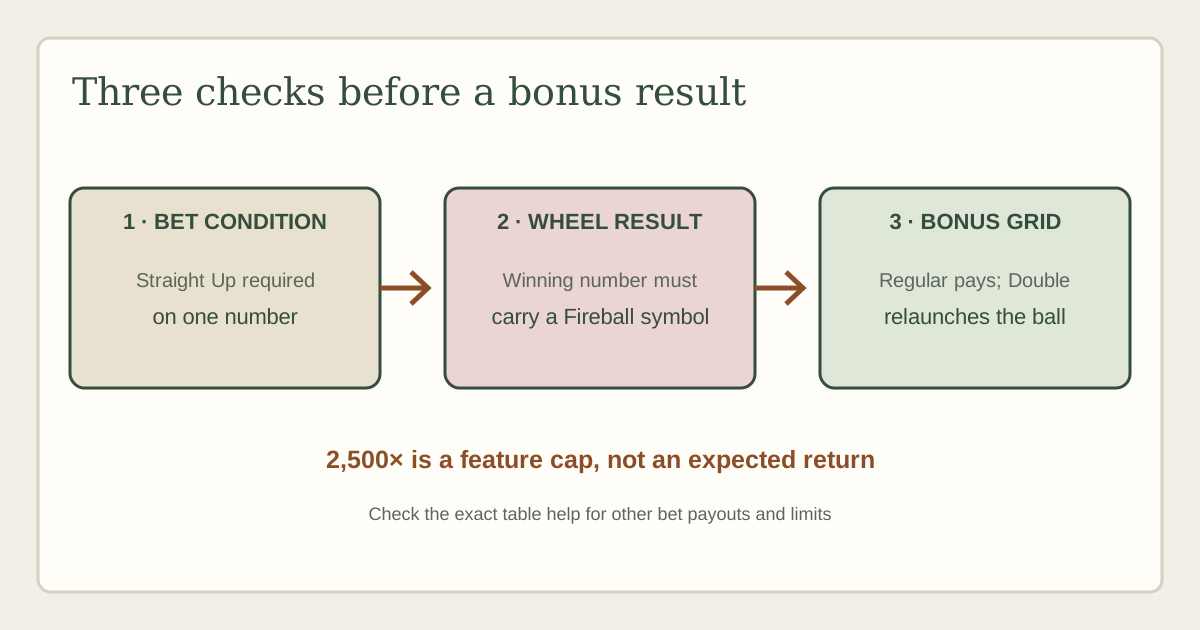
The wheel result then determines whether a player’s straight-up number selection hits a numbered spot carrying a Fireball symbol. A qualifying hit opens the Fireball Bonus game. The bonus grid resolves a further multiplier outcome. The roulette result and the bonus result are connected, but each has its own condition. A marked number that does not win on the wheel does not trigger the bonus for a straight-up bet on a different number.
This separation is essential when reading the screen. First ask whether the selected roulette bet won on the wheel. Then ask whether the winning number had a Fireball symbol and whether the player held the qualifying bet. Only after those checks does the second grid determine a bonus multiplier. A dramatic feature animation cannot make a non-qualifying bet eligible.
What a Straight Up bet does here
A Straight Up bet covers one numbered pocket. Evolution says the roulette wheel includes 1–36 and a single zero. The supplier’s public page says a win on the selected number pays 25:1. It also states that a Straight Up bet is required to participate in the Fireball Bonus. The qualifier is narrower than merely covering a range that contains the number.
That distinction matters because a roulette layout also offers bets over more than one number. A chip on a range can win a base roulette result if the wheel lands in that range, but Evolution’s overview says a straight-up bet is needed for the bonus. Do not assume that a split, street, corner, line, dozen, column or outside bet qualifies for the Fireball feature just because it covers a Bonus Number. Check the exact rule and place a straight-up position only if the table help identifies it as the required qualifier.
The phrase “pays 25:1” should be interpreted using the payout convention in the current help. Tables may describe odds as net winnings or as a multiplier used in total credit. The public overview gives the ratio but does not spell out every account-credit convention, rounding rule or stake limit. For example, if a hypothetical help panel defines 25:1 as a net ratio, a one-unit winning straight-up stake would yield 25 units of winnings plus the returned stake. That is an arithmetic illustration of a notation convention, not a statement about the exact user-interface credit in a particular casino.
Do not import the usual payout for a straight-up bet from ordinary roulette. The Fireball product page explicitly states 25:1 for its winning number, so use that product-specific value and then read the table’s description of what it includes. The bonus feature is a separate settlement pathway and should not be folded into an ordinary roulette payout without checking the rules.
Bonus Numbers and Fireball symbols
After betting time expires, an automatic slot feature generates a number between three and seven. Evolution says that value represents the number of Fireball symbols distributed for the round. Those symbols are assigned to random bet spots on the numbered layout. The supplier further says only one Fireball symbol can be assigned per numbered bet spot in the same round.
The distinction between a Bonus Number and a Fireball symbol can be easy to miss. The slot result controls how many symbols are available. A symbol is then placed on a numbered position. A Bonus Number describes a number that can be part of the feature; the fireball marker shows which particular number has a feature symbol for the round. The exact display should be interpreted according to the table’s animation and rules.
Some Fireball symbols reveal a multiplier from 2× to 20×. Evolution says a multiplier attached to the triggering Bonus Number can multiply the accumulated result in the Fireball Bonus. The page does not say every symbol has a multiplier, nor that every Bonus Number is assigned the highest factor. It says “in some cases” and gives a range. Do not present 20× as a standard bonus factor.
Because the slot generates the symbols after the betting period, the player cannot use that round’s Fireball layout as advance information when placing the original wager. The assigned symbols are not a preview of the next wheel result. Their appearance does not make the ball more likely to land on a number a player chose before the selection occurred.
The bonus-selection step should be understood as a feature assignment, not a player choice. A player does not pick which numbers will be marked. The rule description says the RNG slot reveals a count and the symbols are assigned to random bet spots. The interface may dramatise this with a lever and lava animation, but those graphics do not provide a strategy signal.
The Fireball Bonus grid
Evolution describes a grid containing 149 multiplier pockets, split into Regular and Double multipliers. The bonus ball is launched into the grid. If it lands on a Regular multiplier, that value is the multiplier for the feature result. If it lands on a Double pocket, all Regular multipliers on the board double and the ball is relaunched.
The process can repeat. Each Double result increases the Regular values before another launch. Evolution says the process continues until the multipliers reach a maximum of 2,500×. At that point, the Double pockets are replaced by 2,500× multipliers. The public overview defines that ceiling but does not list every value assigned to each of the 149 pockets or the probability of landing in them.
This second grid is not another roulette wheel. It is a separate bonus mechanic entered after a qualifying straight-up hit on a Fireball-marked winning number. The roulette wheel establishes the qualifying number; the grid establishes the bonus multiplier. Keeping the stages distinct makes it easier to understand why a player may win an ordinary roulette result without a bonus, or qualify for a bonus only when the number and mark conditions both match.
If a multiplier was attached to the triggering Bonus Number, Evolution says the total value accumulated in the bonus game is multiplied by that number’s factor. The final bonus multiplier remains capped at 2,500×. Therefore, a number-level multiplier does not remove the product’s stated maximum. The current table’s payout help should explain how the final factor is applied to the qualifying stake and how the cap is represented in account settlement.
How a complete qualifying round can be read
Imagine a player places a Straight Up stake on one number, and also places other roulette selections. After bets close, the slot feature produces a set of Fireball symbols. The player should not assume any of the additional range bets qualify for the bonus; the supplier says Straight Up is required. The roulette ball then lands on a numbered pocket.
If the ball lands on the selected number, the Straight Up selection wins according to the product’s 25:1 statement and the table’s payout convention. If that number also carries a Fireball symbol, the bonus feature opens. If it does not carry the symbol, the ordinary roulette win may settle without the Fireball Bonus. If the ball lands on a different number, the player’s straight-up bet on the original number does not qualify for that other number’s feature.
During the bonus, the ball lands on one of the 149 multiplier pockets. If it lands on a Regular pocket, that value is used for the bonus settlement. If it lands on a Double pocket, the Regular values change and the bonus ball launches again. The process follows the supplier’s stated cap. A multiplier on the triggering Bonus Number may further affect the accumulated bonus, but the final factor is capped.
This walkthrough explains rule dependencies; it does not calculate a probability or promise a payout. To compute an actual amount, you would need the accepted stake, payout notation, exact pocket values, any table-specific limits and the operator’s settlement convention. The public overview alone is not a complete calculator.
Other roulette bets and the Fireball Chaser
Evolution’s overview says players can place different roulette bets that cover one number or a range of numbers, each with its own payout rate. It does not list every payout row in the public page reviewed for this guide. A current table may display inside bets, outside bets and other groupings. Read the specific help for the exact version before calculating a return.
The product page says a Fireball Chaser bet is also available. It automatically assigns the placed chip amount to bet spots that receive the Fireball symbol. This is a named feature, not a general promise that a player is covered on every number or wins if the wheel lands elsewhere. The current table help should show how the stake is allocated, whether it is in addition to other bets, what happens when multiple symbols appear and which amounts count toward the total exposure.
Do not use Fireball Chaser as a reason to stop checking the bet slip. It can create several assigned positions and the total can be different from a single chip appearing on one number. Confirm how the interface displays the amount, whether the chosen stake is per assigned spot or a combined total, and how the bet is settled when a symbol is assigned. If that wording is absent, ask the operator before using the feature.
Other number-range bets may pay under their own roulette rules but may not qualify for the Fireball Bonus. The supplier specifically says a Straight Up bet is required for the bonus. If you want both a range bet and a feature-eligible selection, understand that they are separate stakes and can settle differently. A winning outside bet is not proof that the bonus condition has been met.
Payout limits and what is not in the public overview
The public product page confirms a 25:1 winning straight-up number ratio and the 2,500× Fireball Bonus cap. It describes three to seven Fireball symbols, number-specific factors from 2× to 20× in some cases and the 149-pocket Regular/Double grid. It does not publish a universal minimum or maximum stake, a full paytable for every roulette market, an RTP for every bet type, or a full probability distribution for the slot, wheel and bonus grid.
Some third-party guides display additional figures, a total-return cap, or a theoretical return for selected markets. Those may be copied from a specific table, language version or operator’s rule PDF. Such figures should not be generalized without comparing the exact source and date. This guide uses only the feature values visible in Evolution’s official public overview and does not report unsourced RTP or stake limits.
To verify a table, open its game rules and record the title, language, date, currency, payout rows and limits. Check whether the regular roulette payout uses net odds or total return, how the Fireball Bonus is attached to the stake, and whether any maximum wins can limit an apparent multiplier. An operator’s table can expose a configuration not shown on the general provider page.
If a result appears above a stated maximum, use the round history and written terms rather than an animation or third-party calculator. The provider’s overview says the maximum bonus multiplier is capped at 2,500×. Any account-level amount can still depend on the accepted stake and the applicable payout terms. A cap on a multiplier is not the same as a universal cash amount.
Does the feature change roulette probabilities?
The supplier overview explains the stages but does not provide a complete probability model. It would be misleading to calculate the chance of a bonus by counting only the number of Bonus Numbers. A calculation would need the random slot’s distribution, the number assignment process, the wheel’s outcome model, how many bets qualify and the exact trigger rule. The public page states three to seven symbols and the single-zero wheel but not every probability needed for a verified estimate.
Similarly, a maximum multiplier of 2,500× cannot be read as the expected value of a straight-up bet. It gives the upper boundary of one bonus feature. It does not tell how often the feature is entered or how often the maximum is reached. A high ceiling is not equivalent to a high theoretical return.
Do not use previous Fireball numbers as a way to choose the next selection. The supplier describes random symbol assignment and a roulette result, but its public page does not identify the history as predictive. If a number has been marked frequently in a short sample, that sample does not prove it will be marked again. If a number has not appeared, it is not “due.”
For a meaningful mathematical comparison, use an official table ruleset that includes the full payout and probability model. Make sure the document applies to the exact product version and jurisdiction. If those details are missing, state that the calculation cannot be verified rather than fill the gap with ordinary roulette assumptions.
A pre-round checklist for the multi-stage feature
Confirm the game title and single-zero layout. Identify the selected roulette bet types and read the payout lines. If you want the Fireball Bonus, check that you have the required Straight Up bet; do not rely on a range bet unless the help explicitly says it qualifies. Read how the Fireball Chaser allocates its stake before using it.
After placing a chip, review the slip. Confirm every number or range, the amount on each position and the total stake. The layout can support multiple positions, so a small individual chip may hide a much larger combined exposure. Check the timer and accepted state without rushing. If the bet does not appear correctly, do not assume it registered.
Once betting closes, understand that the Bonus Numbers and Fireball symbols are generated for that round. They are not available as advance information. After the wheel spins, compare the winning pocket with your accepted bets. If a bonus is shown, verify that you held the qualifying straight-up selection on that marked number. Only then follow the bonus grid result and the cap rules.
After settlement, save the round ID, time, straight-up number and result if there is a dispute. Check the account history against the paytable. Do not place a new wager as a way to test whether the first result was processed correctly.
For session boundaries, set a time and money limit before the game begins. A multi-stage feature can make a round feel unfinished while the bonus continues, so decide in advance whether the budget applies to all stages together. Do not increase the stake to recover a loss or to “buy” access to a larger possible multiplier. Stop when a preset boundary is reached.
Mobile layout and connection checks
The Fireball Roulette layout may require selecting a precise number among many nearby spots. On mobile, verify the number label and selected chip before betting closes. A tap on an adjacent number can change both the ordinary roulette outcome and whether a bonus is eligible. Use zoom or landscape orientation only if the table keeps the full number and bet slip visible.
Make sure you can distinguish ordinary bets from the Fireball Chaser control. The latter can allocate a chip to positions marked with symbols, while a Straight Up wager covers a specific number. They are not necessarily the same action. Read the help before selecting a feature that may distribute a stake across multiple spots.
If the stream buffers during symbol assignment or the bonus grid, wait for the final result and check the round history. An interrupted animation is not enough to decide that a bet lost or won. If connectivity drops after placement, confirm whether the bet was accepted before placing another one. Keep the game title, round identifier and bet details for operator support.
Avoid clicking several spots quickly to compensate for a screen delay. The betting window may close before all taps register. The accepted bet slip and settled record are the reliable checks. If the interface makes the actual exposure difficult to see, do not continue on that device.
Demo mode and New Zealand access
Evolution presents its game catalogue as a freeplay demo environment and says individual demos and features may be subject to jurisdiction. That is not proof that Fireball Roulette is available in every demo or that a live table is offered by a particular operator. It is also not proof that a visitor in New Zealand is eligible for an account or real-money wagering.
The Department of Internal Affairs states that online casino providers must not advertise to people in New Zealand during the current transition. The Online Casino Gambling Regulations 2026 define affiliate arrangements and prohibit advertisements involving them. Because this guide is a local draft, it makes no operator referral and no local availability claim. Check official DIA guidance and current operator terms before public distribution. To compare how selected provider products are documented, use the site’s game guide index. Readers looking for New Zealand support contacts can use the safer-gambling information page without following an operator offer.
A demo can help explain the sequence—roulette bets, symbol assignment, wheel result and bonus grid—where it is offered. It does not establish live table stakes, account rules, a universal payout configuration or a real-money outcome. Do not treat a play-money session as proof of a future result.
Common Fireball Roulette misunderstandings
Believing any bet that covers a Bonus Number qualifies. Evolution says a Straight Up bet is required for the bonus. Check the exact qualifier rather than infer it from a range bet.
Confusing the slot count with a win. Three to seven symbols are generated, but the roulette ball must land on a number the player selected in a qualifying way for the feature to apply.
Thinking every symbol has a 20× multiplier. The supplier says some symbols may show factors from 2× to 20×. The top of a range is not a standard assignment.
Treating the 2,500× cap as a cash amount or expected return. It is a multiplier ceiling for the bonus, not a fixed sum or probability.
Forgetting the second-stage condition. A marked number, wheel result, qualifying straight-up bet and bonus-grid result are separate stages. Verify each one.
Assuming the Chaser stake is one simple bet. Its exact allocation is set by the current table help. Check how many spots can receive a chip and how total exposure is calculated.
Using classic roulette payouts as the Fireball table. The supplier publishes a 25:1 straight-up payout for this game. Check all other positions in its own paytable.
Assuming a supplier listing proves local access. The product page does not establish that a New Zealand operator offers it or that a player is eligible.
Questions readers commonly ask
Which numbers are on the roulette wheel?
Evolution’s page describes numbers 1 through 36 and a single zero.
What is the straight-up payout?
The supplier says a winning number pays 25:1. Check the table help to understand whether the display is a net ratio or total return and how the stake is credited.
How many Bonus Numbers appear?
Evolution says the slot feature reveals between three and seven Bonus Numbers in a round, corresponding to the number of Fireball symbols assigned.
What bet qualifies for the Fireball Bonus?
The official overview says a Straight Up bet is required. A bet over a range of numbers should not be assumed to qualify unless the table help explicitly says so.
What happens in the bonus grid?
The grid has 149 Regular and Double multiplier pockets. A Regular result supplies a multiplier. A Double result doubles all Regular values and launches the ball again, subject to the supplier’s 2,500× maximum.
Does every Fireball symbol carry a number multiplier?
No such guarantee is stated. Evolution says some symbols may reveal a factor between 2× and 20×.
Is there a universal RTP or stake limit?
The public overview does not provide a complete universal RTP or stake range. Check the exact table rules and any operator terms.
Is Fireball Roulette offered in New Zealand?
The supplier catalogue does not establish operator availability or local eligibility. This guide makes no such claim; check current official information.
Sources and verification boundary
Evolution’s official Fireball Roulette page was checked on 6 October 2026. It confirms the single-zero number range, 25:1 winning-number statement, three-to-seven Bonus Numbers, random Fireball placement, possible 2×–20× number factors, straight-up bonus qualifier, 149-pocket Regular/Double grid and the 2,500× bonus cap. The public overview does not provide a complete universal table for every bet, stake limit or probability model. DIA advertiser guidance and the Online Casino Gambling Regulations 2026 were checked the same day. Secondary pages surfaced in search contain additional table-specific claims; they are not presented here as universal Evolution settings.
