Roulette betting guide · South Island guide
Roulette racetrack bets: neighbours, sectors and chip placement
 Best casinos available in New ZealandUpdated 7 November 2026

A roulette racetrack shows the physical wheel order rather than the numbered betting grid. A neighbour bet selects a centre pocket and a number of pockets on each side; the software usually places one straight-up chip on every covered number. Classic French call bets such as Voisins du Zéro, Tiers du Cylindre and Orphelins use fixed groups and specific chip placements. Confirm the wheel variant, covered numbers, chip count and table help before using a racetrack control.
The short answer
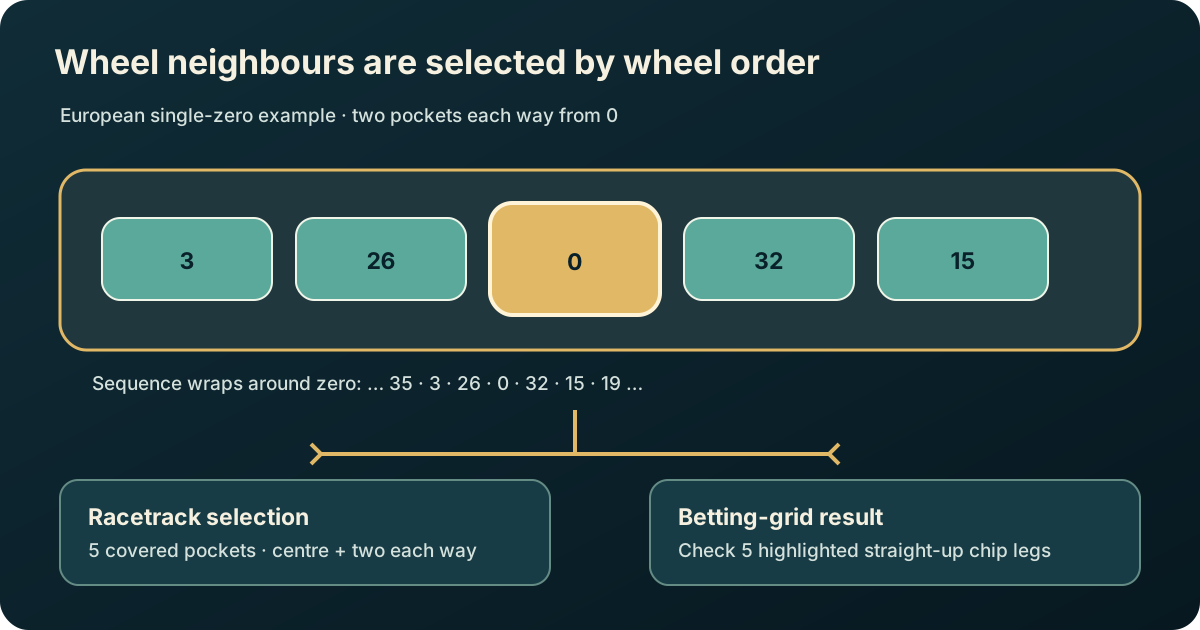
The racetrack is a diagram of the order of pockets around a roulette wheel. It is different from the betting grid, which lays out numbers in rows and columns. A neighbour bet starts with one selected wheel number and covers that number plus a specified number of nearby pockets to the left and right. If the control is set to two neighbours on each side, the group contains five pockets. In many online layouts, the racetrack selection then places five individual straight-up chips on the numbered grid.
Classic French call bets use named wheel sectors and a fixed chip pattern. On a standard European single-zero wheel, Voisins du Zéro covers 17 numbers with nine chips, Tiers du Cylindre covers 12 numbers with six chips, and Orphelins covers eight numbers with five chips. Jeu Zéro is a smaller seven-number group around zero placed with four chips. The chip pattern is important because one named bet is usually a bundle of straight-up and split/street/corner wagers, not one abstract marker.
Before using a racetrack control, check that it corresponds to the wheel version in the game help, review which numbers light up, count the chips and calculate the total stake. The word “neighbour” may mean a centre number plus a configurable group, while “call bet” can mean a named French sector or an announced wager. A racetrack shortcut does not change the wheel probability or guarantee a result. The existing live roulette guide explains the standard wheel and bet families; this page focuses on mapping wheel sectors to actual coverage.
Racetrack versus betting grid
The roulette betting grid is arranged to make number bets easy to place. Numbers 1 through 36 appear in rows, with zero set aside in its own area. A physical roulette wheel uses a circular order. Adjacent pockets on the wheel are not necessarily next to each other on the felt-style grid. That is why a neighbour bet has to be read from the racetrack rather than from the rows of the betting layout.
On a conventional European wheel, the sequence commonly begins at zero and continues: 0, 32, 15, 19, 4, 21, 2, 25, 17, 34, 6, 27, 13, 36, 11, 30, 8, 23, 10, 5, 24, 16, 33, 1, 20, 14, 31, 9, 22, 18, 29, 7, 28, 12, 35, 3, 26, then back to 0. A racetrack presents that circle as an oval or arc so the player can select a pocket and its neighbours.
The grid is still where most chips are actually accounted for. A “straight-up” chip on 17 covers only 17. A split chip sits on a boundary between two grid numbers. A street chip covers three adjacent grid numbers, and a corner covers four. If the racetrack selects a group of nearby wheel pockets, the interface must translate each selected pocket into the correct grid bet. The wheel group is a selection convenience; settlement still follows the individual placements and game rules.
This distinction helps explain why a racetrack can show a continuous wheel sector while the chips appear in multiple places on the grid. Wheel adjacency determines which numbers belong to the selection. Grid geometry determines how the wagers are physically placed. It is unsafe to infer the chip pattern from the shape of the highlighted arc alone.
A single-zero wheel has 37 pockets. A double-zero wheel has 38, with 0 and 00. The standard French sector groupings below refer to a European single-zero sequence. An American-style double-zero wheel does not use the same pocket sequence or necessarily offer the same call-bet menu. Confirm the green pockets and rules before applying any sector list.
What a neighbour bet covers
A neighbour bet is centred on a chosen number. The racetrack control lets the user include a set of pockets on either side of that centre. In the European sequence printed above, a two-neighbour group centred on 22 contains 31, 9, 22, 18 and 29: the centre plus two immediate pockets on each side. The exact left/right labels depend on the racetrack orientation, but the covered group should contain five pockets.
For a concrete example, using the sequence above, five pockets centred on 22 can be 31, 9, 22, 18 and 29 when taking two positions each way. A selection centred on 0 with two neighbours each side covers 3, 26, 0, 32 and 15. The group wraps around the end of the printed sequence: 0 is adjacent to both 26 and 32. This wraparound is why the physical wheel order, rather than the start and end of an on-screen list, controls adjacency.
In the Evolution rules document reviewed for this guide, the neighbour control uses the racetrack: the player chooses a number, and chips are placed on that number plus the selected neighbouring pockets to its right and left. A circular plus/minus control can increase or reduce the number of neighbours. The rules say each covered bet spot has its own payout odds and is highlighted. That is a product example, not a guarantee that every operator interface uses the same default number of neighbours or exact control labels.
If a neighbour bet covers five pockets with one unit on each, the total amount staked is five units. A winning pocket ordinarily wins only the chip placed on that number; the other four chips are lost for that spin under a straight-up placement model. With standard straight-up odds, the winning chip’s net win is 35 to 1, and its own stake is returned according to the normal settlement convention. The complete net result across the five-chip group must subtract the four losing units. A highlighted group is not a single five-number bet with one stake unless the help explicitly defines it that way.
The number of neighbours is a coverage control, not a way to make any single pocket more likely. If a fair single-zero wheel has equally likely pockets, a five-pocket selection covers 5 of 37 pockets. That fraction is a simple coverage share under an equal-pocket model; it is not a guarantee that one of those pockets will land, nor does it establish the expected value. The individual payouts and total stake still matter.
The classic French call bets
French call bets organise parts of the single-zero wheel into named sectors. Their labels are traditional, but the exact table’s rules determine whether a casino offers them and how it accepts them. The three familiar groups are Voisins du Zéro, Tiers du Cylindre and Orphelins. They cover the 37-pocket European wheel in a way that avoids treating the number grid as the wheel order. Their chip patterns are fixed combinations of straight-up, split, street and corner bets.
| Call bet | Wheel coverage | Typical chip count | Main idea |
|---|---|---|---|
| Voisins du Zéro | 17 pockets | 9 chips | Arc around zero on one side of the wheel |
| Tiers du Cylindre | 12 pockets | 6 chips | Opposite arc between 27 and 33 |
| Orphelins | 8 pockets | 5 chips | Two remaining arcs not covered by the first two |
| Jeu Zéro | 7 pockets | 4 chips | Small group close to zero, overlapping Voisins |
These counts describe coverage, not four disjoint selections: Jeu Zéro overlaps the Voisins area. If a player places both, some pockets may receive chips from both bundles. That increases the stake on the overlapping numbers. The button should show the resulting chip layout and total cost before the betting period closes.
The French names may appear with accents, without accents or translated labels. If the interface lists “Zero Game”, “Orphans”, “Thirds” or “Neighbours”, inspect the coverage rather than relying on the translation. A product can also offer a named sector without offering every French call bet. Do not infer that a button exists because a supplier’s general roulette rules document describes it.
Voisins du Zéro
Voisins du Zéro means neighbours of zero. In the standard European sequence above, the group covers 17 numbers around the zero side of the wheel. A common nine-chip layout comprises two chips on the 0/2/3 street, one each on the 4/7, 12/15, 18/21 and 19/22 splits, two on the 25/26/28/29 corner, and one on the 32/35 split. The total is nine chips, but the number of covered pockets is 17 because some placements cover more than one number.
This is a good example of why “number of chips” and “number of numbers covered” are not interchangeable. The 0/2/3 street placement covers three pockets with two chips; the corner covers four with two; the remaining split bets each cover two with one. Adding the coverage gives 3 + 2 + 2 + 2 + 4 + 2 + 2 = 17 pockets. Adding the chip placements gives 2 + 1 + 1 + 1 + 1 + 2 + 1 = 9 chips.
The exact placement labels on a digital layout can be small. Check the highlighted group after selecting the bet. If the game displays two chips on a corner and the total stake rises by two units, that is different from one chip on the corner. The count matters to both coverage and amount at risk. A saved favourite may also preserve a previous chip value, so inspect each placement before confirming.
Tiers du Cylindre
Tiers du Cylindre means thirds of the wheel. The typical group covers 12 pockets along the arc opposite zero: 27, 13, 36, 11, 30, 8, 23, 10, 5, 24, 16 and 33. It is commonly placed with six split bets: 5/8, 10/11, 13/16, 23/24, 27/30 and 33/36. Each split covers two numbers, giving 12 covered pockets from six chips.
The name says “thirds”, but the group covers 12 of the 37 European pockets in this common ruleset, not precisely one-third of the wheel. The historical label is not an arithmetic promise. If an interface labels the group differently, follow the exact list of numbers in that table’s help.
Tiers is often easier to verify because the six splits form a list. Compare the on-screen highlights with the six expected pairs. If one number is omitted or the wheel variant differs, stop and consult the table-specific help. Do not attempt to correct the interface by placing extra chips manually unless the rules explain that method; a manual addition could duplicate part of the call bet.
Orphelins
Orphelins means orphans. In the common European grouping, it covers the eight pockets not assigned to Voisins or Tiers: 1, 20, 14, 31, 9, 17, 34 and 6. A typical five-chip layout places one chip straight-up on 1 and one chip on each of four splits: 6/9, 14/17, 17/20 and 31/34. Four splits cover eight numbers, while the straight-up chip covers one of those eight, yielding the eight-number group with five chips. Note that 17 participates in two split placements, so a hit on 17 can settle both chips.
That overlap illustrates an important settlement detail. Coverage counts unique pockets, but chip counts count wagers. If the same number lies on two selected splits, there are two units at risk on that number. A page that says “five chips cover eight numbers” is incomplete unless the split placements make the overlap visible.
The names and patterns can be confusing if an operator uses a translated interface. Read the complete help or inspect the chips. Do not reconstruct Orphelins from the phrase “the uncovered numbers” unless the other named bets are exactly the standard European Voisins and Tiers groups.
Jeu Zéro
Jeu Zéro, or Zero Game, covers seven pockets near zero in the standard wheel sequence: 12, 35, 3, 26, 0, 32 and 15. A common four-chip pattern uses the 0/3 split, 12/15 split, a straight-up chip on 26 and the 32/35 split. The group is a subset around zero and overlaps the larger Voisins group. The term should not be confused with a bet on zero alone.
Because this group overlaps Voisins, a bettor who selects both should inspect the repeated numbers and total stake. The two calls do not necessarily merge into one chip on every common pocket. They may create several distinct wagers on the same result. The interface’s bet summary is the reliable check.
Count chips and calculate the total stake
Before confirming any call bet, count the chip units and read their denomination. If a nine-chip Voisins call uses NZ$1 per chip, the total stake is NZ$9. If the unit value is NZ$0.50, the total is NZ$4.50. A table may let the player change the chip value before selecting the call, or it may remember a previous denomination. The total shown in the bet slip takes priority over a mental estimate.
For multiple call bets, add the bundles. Selecting Voisins and Tiers at the same unit size uses 15 chips in the standard layouts. Selecting Voisins plus Jeu Zéro uses 13 chips before accounting for any manual bets. Since Jeu Zéro overlaps Voisins, several wheel numbers have more than one stake associated with them. A single result can settle multiple winning chips, but the total outlay also includes the additional overlapping chips.
The interface may express the total as credits, chips or currency. Confirm the currency code and unit value. A “1” chip can mean one unit in the table’s selected denomination rather than one New Zealand dollar. If a displayed maximum applies per selection, a multi-chip call bet might exceed it or be rejected. Check whether the limit applies to each chip, each layout position or the entire grouped wager.
If the table allows chip editing after selecting a call, make sure that an accidental double tap has not increased every leg. A call-bet button may add the same pattern each time it is pressed; it may not toggle on and off. Use a clear-bets function only after confirming whether it removes the entire layout or the selected bundle. Avoid rushing as the betting timer nears closure.
A sample neighbour placement, step by step
Suppose a European single-zero table has a racetrack control and a player wants the number 0 with two neighbours on each side. The sequence around 0 is …35, 3, 26, 0, 32, 15, 19… when read across the wrap boundary. Two neighbours on each side therefore cover 3, 26, 0, 32 and 15. The selection has five unique pockets.
If the control places one straight-up chip on each number, the user should see five chips on the grid, not one chip on a vaguely highlighted wheel arc. At a unit stake of NZ$0.20 per chip, the total is NZ$1.00. If the display instead shows one combined wager, read its terms to see how the stake is allocated. The total exposure is the sum of all individual legs.
With standard European straight-up payouts, a hit on one covered number normally pays the winning chip at the standard straight-up odds while the other four chips lose. For a one-unit example, the winning line’s 35-to-1 net payout plus return of the winning stake is offset by four losing units. Netting the whole five-unit bundle produces a smaller result than reading “35 to 1” as the return on the entire group. Always distinguish a payout on the winning line from the result of the full selection.
This example assumes a standard single-zero wheel, equal chance among its 37 pockets and the standard straight-up settlement. It is not a prediction and it does not include an operator fee, alternative payout, special rule or different currency. If the exact table has a different rule, use that table’s information instead.
Common mistakes with racetrack selections
Reading the betting grid as a wheel map. Grid neighbours and wheel neighbours are different. The racetrack follows the physical sequence; the number grid is arranged for conventional bet placement.
Counting chips as covered numbers. A split covers two numbers with one chip, a street covers three numbers with its defined placement, and a corner covers four. Conversely, a pattern can put multiple chips on one covered pocket. Count unique values and wager units separately.
Treating the call bet as one stake. Named sectors are usually bundles. A nine-chip call at one-unit denominations costs nine units, not one, unless the help explicitly uses a different total-stake mechanism.
Assuming every racetrack defaults to the same number of neighbours. Some interfaces let the user change the left and right count; defaults and maximums can differ. Read the plus/minus state and highlighted group.
Using French names on the wrong wheel. The listed call-bet groups describe a common European single-zero layout. A double-zero wheel or a game with special rules may use another sequence or omit the bets.
Assuming all neighbours have an equal payout. The selection may translate into separate straight-up, split, street or corner positions. The payout follows the actual bet placement and paytable.
Adding a call bet without checking remembered chip value. A control can reuse the previous denomination. Confirm the chip amounts and total before the round closes.
Treating a sector as a strategy. Covering adjacent numbers changes how many pockets a bundle touches and how much is staked. It does not make the wheel favour that sector or produce a reliable way to win.
A verification checklist for any racetrack table
- Confirm whether the wheel has one zero or two and open the correct rules.
- Identify the exact wheel sequence shown by the supplier or table help.
- For a neighbour selection, note the centre number and count to each side.
- Verify whether the selected group wraps across the 0/end boundary.
- Inspect the highlighted pockets after using the racetrack button.
- Count individual chips separately from the unique numbers covered.
- Check whether any number receives more than one chip through overlapping bets.
- Confirm chip denomination, account currency, minimum and maximum.
- Read the payout for each underlying straight-up, split, street or corner bet.
- Preserve the game title and rules version if the layout does not match the help.
This procedure works for a standard neighbour selection and helps audit a named call bet. It does not replace the supplier’s table-specific help. An operator may customise the interface, omit a traditional call or use a different wording for the same idea. The illuminated numbers and the recorded wager are more authoritative than a general diagram from another casino.
Frequently asked questions
What does two neighbours each way mean?
It normally means the selected centre pocket plus two adjacent wheel pockets on each side, for five numbers total. Check the table’s control and highlighted coverage because interfaces may use different default settings.
Does a racetrack bet place one chip on the whole sector?
Often it places individual chips on the covered numbers or underlying bet spots. The total stake is the sum of those placements. Read the current bet slip to confirm how the exact product handles the selection.
Are Voisins, Tiers and Orphelins available on every roulette game?
No. These are common French call-bet patterns for a European single-zero wheel. A particular game or operator may not offer them, and other wheel variants may have different rules.
Is Jeu Zéro separate from Voisins?
It is a named smaller call bet, but its seven pockets overlap the standard Voisins area. If both are selected, inspect the repeated numbers and total stake.
Does covering more neighbours improve the chance of profit?
It covers more pockets but also requires more stake. Coverage count is not the same as expected return, and it does not change the wheel’s underlying probabilities or guarantee a winning result.
How do I verify what the racetrack actually placed?
Check the highlighted grid positions, count each chip, inspect the bet summary and confirm the total before betting closes. If the outcome matters, record the table name and relevant rule text.
Neighbour coverage is a way to organise a wager, not a prediction or a lower-risk system. Set a personal limit before play, and use the site’s safer-gambling information if you want help taking a break or setting boundaries.
Sources and verification boundary
- Evolution, Live Roulette product page, checked 7 October 2026: supplier context for live roulette products; table-specific help remains controlling.
- PlayNow, Roulette rules PDF, checked 7 October 2026: an operator-specific explanation of the racetrack control and the distinction between choosing wheel neighbours and placing chips on the betting grid. It is dated 2021 and is not evidence of a current NZ table.
- Evolution, game rules PDF hosted by World Sports Betting, checked 7 October 2026: the indexed search result described neighbour bets and French call-bet names, but a direct fetch timed out. The page therefore does not treat that PDF as fully inspected primary evidence.
- Secondary cross-check checked 7 October 2026: Wild.io Academy racetrack guide explains the common neighbour control and classic call-bet chip patterns. Specific chip layouts should still be checked in the exact game’s current help before use.
- The parent live roulette rules guide remains the site’s owner for standard wheel variants and general bet families. This page is restricted to racetrack and called-bet mapping.
- No account-specific casino menu, table limits or NZ availability data was supplied. No betting system or prediction is endorsed.
