Three Card Poker rules · South Island guide
Three Card Poker rules: Ante-Play, Pair Plus and hand rankings
 Best casinos available in New ZealandUpdated 7 November 2026

Three Card Poker combines a dealer-comparison wager called Ante-Play with an optional Pair Plus wager that is judged only on the player’s three cards. The key to reading a hand is to learn the three-card ranking order, understand when the Play wager is made, and keep each settlement separate. Table-specific qualification rules and bonus payouts must be checked in the live game help.
The short answer
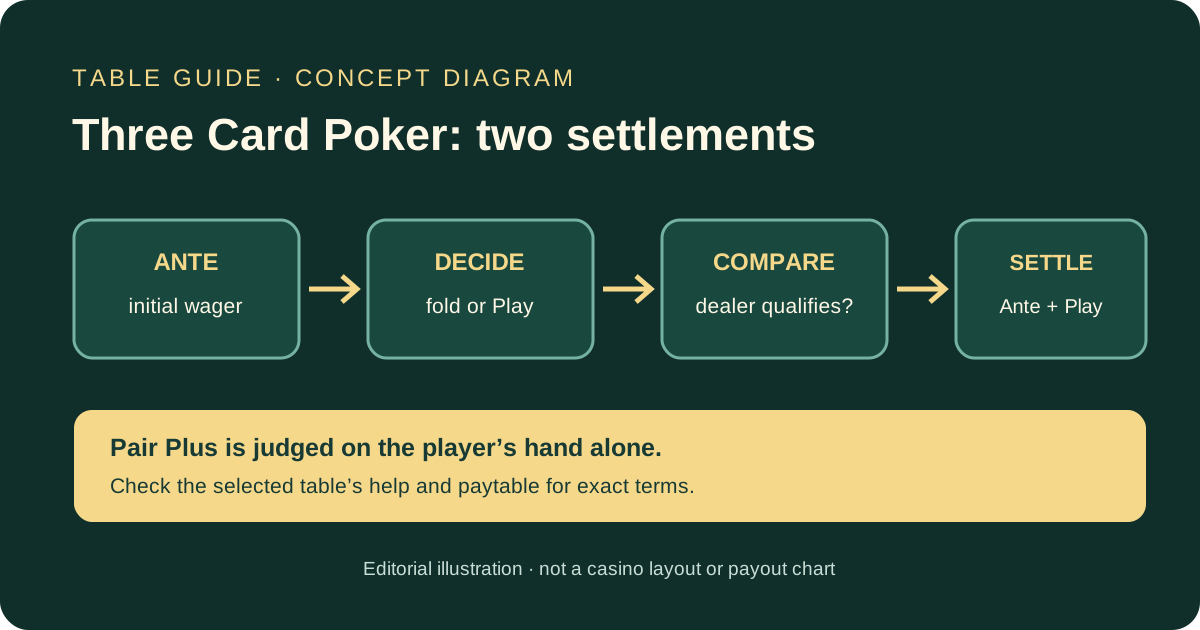
Three Card Poker is a house-banked card game in which the player and dealer each receive a three-card hand. In the main Ante-Play part, a player first places an Ante, looks at their own hand, then either folds or commits a Play wager equal to the Ante. The dealer reveals their hand and the two hands are compared using a ranking system made specifically for three cards. Pair Plus is a separate optional wager: it pays according to the player’s hand category and does not depend on whether that hand beats the dealer.
The most useful mental model is to treat the game as two settlement tracks. Ante and Play depend on the player’s decision, the dealer’s qualification rule and the comparison. Pair Plus depends on the player’s cards alone. A hand can therefore lose the dealer comparison and still meet the Pair Plus table, or win the comparison without qualifying for Pair Plus. Never assume the same card combination is paid identically in both tracks. The displayed paytable is the controlling document for the selected table.
Evolution’s public Live Three Card Poker overview says the dealer needs a Queen High hand to play, mentions an Ante Bonus for a Straight or better, and identifies Pair Plus as optional. It does not publish every table’s live payout values on that summary page. The exact qualification wording, payout schedule, available side bets and local availability must be checked in the game’s own current help. A supplier listing does not prove a particular New Zealand operator offers the title.
What the game is — and what it is not
The familiar Three Card Poker format is not a multiplayer poker tournament. Players are not trying to bluff one another, build a five-card hand from community cards, or win chips from another seat. Each hand is settled against the dealer under a fixed set of table rules. Other seats may be visible in a live studio, but their cards do not normally change how your own Ante-Play comparison is decided.
That distinction matters because the word “poker” covers very different products. Three Card Poker uses only the player’s three cards and the dealer’s three cards for the main comparison. It has a short decision after the player sees their cards. Casino Hold’em uses community cards and a different raise decision; it is not a variant of the flow described here. The site keeps those topics in separate guides so their bets and settlement rules are not mixed.
The second distinction is between the classic game and product-specific additions. Some tables show Pair Plus; some also offer separate bonus or progressive markets. Those extra circles are not automatically part of every Three Card Poker table. This article stays with Ante-Play and Pair Plus. If a live interface displays another bet, read that bet’s own rules instead of extending the explanation below to it.
The three-card hand ranking order
From strongest to weakest, the usual Three Card Poker order is: Straight Flush, Three of a Kind, Straight, Flush, Pair, then High Card. That order is unusual if a reader knows five-card poker, where a Flush generally outranks a Straight. Three Card Poker has only three cards, so its standard ordering is different. Always compare the table’s own help because a branded product can publish specific rules, but do not import five-card rankings by habit.
A Straight Flush contains three consecutive ranks of the same suit. A Three of a Kind contains three cards of one rank. A Straight has three consecutive ranks in mixed suits. A Flush has three cards of one suit that are not consecutive. A Pair has two cards of equal rank plus a different third card. High Card is the residual category: no pair, flush, straight or higher category. These labels classify a hand before it is compared with the dealer or mapped to a side-bet payout.
Within a category, ranks settle the comparison. For High Card, compare the highest rank first, then the middle rank if the first is tied, then the lowest. With a Pair, the rank of the pair decides first and the remaining card acts as the kicker if the pairs match. A Straight is compared by its high end under the table’s ace rule. Three of a Kind compares the trip rank. A Flush compares its card ranks in sequence. The suits themselves do not normally break an otherwise exact tie.
Ace treatment is a rule worth checking rather than guessing. Common Three Card Poker rules let Ace act high in the sequence A-K-Q or low in 3-2-A, while a wraparound sequence such as 2-A-K is not consecutive. This is a feature of the three-card sequence rule, not a claim that every table uses identical tie or bonus wording. The current help is the reference if the table defines a different edge case.
Here are examples of how to classify hands without calculating a payout. A hand containing three cards of one rank is Three of a Kind even if the suits differ. A same-suit sequence is a Straight Flush, not merely a Flush. Three consecutive ranks spread across suits are a Straight. Three same-suit cards with a gap in their ranks are a Flush. Two matching ranks form a Pair; a hand with three unrelated ranks and mixed suits is High Card. Naming the category first prevents the common mistake of comparing an attractive-looking card before checking the category.
Ante-Play: the main hand from start to finish
Place the initial wager
The Ante is the entry wager for the dealer-comparison track. The player chooses an amount within the table’s displayed limits before the deal. If Pair Plus is offered, it is placed in its own marked area and remains an independent decision. The interface should show each accepted wager separately; if a chip is rejected or the timer closes before confirmation, do not treat the rejected amount as part of the hand.
Once bets close, the player and dealer receive three cards each. In a live interface, the player’s cards are typically available for inspection while the dealer’s hand remains concealed until the decisions are complete. Follow the game’s on-screen order: the game may have automatic reveals or animations, but the help describes the contractual sequence. A visual flourish does not add a decision or change the wager already accepted.
Decide whether to fold or play
After seeing the three cards, the player chooses between folding and continuing. Folding gives up the Ante under the standard format; the hand does not proceed to a normal dealer comparison for that wager. Choosing Play commits a second wager, conventionally equal to the Ante. This is not a flexible raise that can be adjusted to any amount after seeing the cards. Check the table controls and rules before confirming because a misclick can commit the additional amount.
The decision is the main strategic point of the hand, but this guide does not prescribe a winning system or promise positive results. A hand-ranking explanation is not the same thing as a guaranteed decision rule. Any mathematically optimal threshold depends on the exact dealer qualification, Ante Bonus and payout configuration. If a player wants to study strategy, they need the precise current rules and an independently checked analysis that matches those terms; a slogan copied from a different table is not enough.
Dealer qualification and comparison
Evolution’s public page describes a Queen High qualification requirement. Under a commonly published classic structure, if the dealer does not qualify, the Ante is paid at even money and the Play wager is returned. When the dealer qualifies, the player’s hand is compared with the dealer’s: a higher player hand wins, a lower one loses, and a tie returns the comparison wagers. The exact display can use “push,” “stand-off” or return language; the economics should be confirmed from the table rules.
Qualification is not the same as hand strength in the abstract. It is a threshold rule applied to the dealer’s three-card hand before a normal comparison. If the dealer fails to qualify, the player has not necessarily beaten the dealer in a head-to-head comparison; instead, the posted rules determine how Ante and Play are settled in that case. This is why the rules should be read as a sequence: check qualification first, then compare if the dealer is live.
The comparison wagers are also separate from any Ante Bonus shown by the game. Evolution notes an Ante Bonus for a player Straight or better regardless of the dealer’s hand. The exact categories eligible and the pay amounts are table-specific. A winning bonus does not mean that a losing main hand is converted into a win. It is a separate line in the settlement, with its own eligibility and paytable.
Pair Plus: a separate hand-quality wager
Pair Plus asks whether the player’s three cards meet a listed hand category, usually Pair or better. The dealer’s cards are not used to decide this wager. That independence is the defining point: the player can lose the main Ante-Play comparison and still have a Pair Plus result that pays according to the posted schedule. Conversely, the player can win the dealer comparison with a high-card hand and lose Pair Plus because that hand falls below its qualifying category.
Pair Plus is not a second Ante and it does not fund the Play decision. It has its own marked area, its own result and a separate paytable. A common mistake is to assume that choosing Play is required for Pair Plus to be settled. Public rules sources describe Pair Plus as being evaluated on the player’s three cards regardless of the dealer’s hand; Evolution likewise says its Pair Plus side bet is evaluated separately at the end of the game. The selected table’s live help remains decisive on when and how the bet is returned.
Do not memorise a payout schedule from a general web page and assume it matches the live table. Pair Plus paytables can differ by casino, jurisdiction or product version. Even when category names are the same, a changed reward for a Straight or Flush changes the long-run value of the side wager. Before placing it, inspect the full schedule, including whether values are quoted as “to one” or as a total return that includes the original stake. Those terms are not interchangeable in an accounting example.
If the screen includes Pair Plus and an extra bonus bet, keep them as separate ledgers. For example, a player might have an Ante, a Pair Plus wager and a third optional area. Each accepted amount is resolved according to the printed rule for that circle. A bonus appearing in the game title does not mean the side bets share one paytable or one qualifying hand. This guide does not explain additional bets because their feature names, triggers and settlement can vary.
Read the paytable before betting
The paytable answers a narrower question than the hand-ranking chart. Rankings tell you which hand is stronger in a comparison. A paytable tells you what a specific wager returns when a qualifying result occurs. A Pair Plus schedule may have a line for Pair, Flush, Straight, Three of a Kind and Straight Flush; the Ante Bonus schedule may have fewer categories. The presence of the same hand names does not make the two schedules identical.
Look for the rule headings around the chart. Confirm whether it is attached to Pair Plus or the Ante Bonus, whether the amount shown is a net win or a total return, and whether the table has a qualification condition. If the paytable is in a collapsible help panel, expand it before starting. Record the title, table variant and currency shown. A generic screenshot from a different market cannot confirm the terms on your account.
Paytable differences should be described neutrally. A larger top award can coexist with less favourable rewards for more common qualifying hands; one headline number is not a complete comparison. Likewise, a paytable is not a forecast of how often a hand will appear. If a player cannot find a clear payout explanation, the sensible practical step is to avoid guessing and use the operator’s game support or written rules before staking.
Settlement walkthroughs without assuming a payout schedule
Imagine a player receives a Pair and chooses Play. The game first checks the dealer’s qualification rule. If the dealer qualifies, the game compares the pair with the dealer’s three-card hand. The Ante and Play result then follows that comparison. Pair Plus, if it was placed, is evaluated on the player’s Pair using its own paytable. These are two separate conclusions; the presence of a pair does not dictate what happened to the Play wager.
In another example, the player has a High Card hand and the dealer is below the published qualification threshold. Under the common classic rule described by independent rules sources, the Ante has its own even-money result while the Play amount is returned. Pair Plus would normally lose because a High Card does not meet a Pair-or-better threshold. A local table can add wording or a variant, so the actual help must be checked before using this as a statement about a named casino.
Now consider a strong hand that qualifies for an Ante Bonus but loses the dealer comparison. The table may award the bonus while settling the main wagers as a loss. That outcome can look contradictory if the player treats the hand as one bet. It is not contradictory when each line is read on its own terms: the comparison, the bonus and any side bet have separate eligibility rules.
Finally, consider an exact tie under the comparison rules. A tie is not automatically a win for either side. Common rules return the Ante and Play amounts, but that push does not erase an independent Pair Plus result. Check whether the tie is defined by equal category and equal card ranks, how Ace-low straights are handled, and whether the interface displays a returned amount or a separate push message.
Common rule-reading mistakes
The first mistake is applying five-card poker rankings. A Flush and Straight can reverse order in a three-card game. The second is treating a suit as a tiebreaker when the published rules say suits have no rank. The third is comparing the hands before checking whether the dealer qualifies. The fourth is treating Ante Bonus as part of the main win or assuming Pair Plus depends on the dealer. Each mistake comes from collapsing separate concepts into one.
Another error is assuming that “Queen high” means any hand containing a Queen automatically qualifies. A pair, a Straight or another higher category may be ranked above a Queen-high High Card, but the exact minimum qualifying hand is determined by the rules. Read the qualification sentence and any examples in the specific help panel. Do not infer an edge case from a label alone.
People also confuse a payout multiple with a return including stake. A display that says a result pays “one to one” may mean a net win plus return of the original bet, whereas a total-return format may show both together. The table’s legend or terms should define the convention. This article avoids numeric payout examples because the official public Evolution overview does not provide a current table schedule.
The final mistake is believing a past hand predicts the next deal. A run of folds, pairs or dealer qualifications is just a history of completed hands; it does not change the cards in a fresh random deal. Neither a “cold table” story nor a streak-based staking pattern changes the posted settlement rules. If a person finds it difficult to stop, take a break and use the New Zealand support links in the site’s safer gambling guide.
A practical pre-hand checklist
Before placing any chips, identify the exact game name and table version. Read the three-card ranking order, the Ace rule, the dealer qualification threshold, the fold consequence and the Play amount. Then inspect the Pair Plus schedule separately. If the interface offers an Ante Bonus or another circle, read its own rule and decide whether it falls within what you intended to play. The existence of a side-bet area is not a requirement to use it.
During a round, check that the accepted wager amounts are visible, look at the player’s hand, make the fold-or-play decision, and wait for the dealer reveal and settlement notice. Do not make a further wager to “recover” an earlier result. If the display seems inconsistent, save the game title, round ID and the help text before contacting the operator. A cropped image that omits the table name or accepted wager may not identify the relevant rule version.
After a hand, reconcile each wager independently. Ask: what happened to Ante? What happened to Play? Was the dealer qualified? Did the hands tie? Was an Ante Bonus triggered? What did Pair Plus do? This simple ledger avoids counting one paid line as if it settled every other line. It also makes a dispute easier to describe in ordinary language rather than relying on the term “poker payout” alone.
Evolution table help, online controls and mobile use
Evolution’s public Live Poker page identifies its Three Card Poker product and notes the dealer qualification and optional Pair Plus/Six Card Bonus markets. It does not certify that every casino has the same limits or offers every optional wager. Supplier documentation tells you which product family you are looking at; the operator’s launched client controls the current account-specific display, where available.
On a small screen, the betting circles and card area may be easier to see than the text for the help panel. Locate the information icon before a round, rotate or enlarge the display only if the site supports it, and check that the paytable can be read without losing the bet labels. A responsive layout should keep the accepted Ante and any Pair Plus amount visible. Do not infer a rule from animation alone if the written help is accessible.
Look for controls that let you review a completed result, including the game round history or hand details. A history feature helps verify what was dealt and how the game recorded settlement; it is not a prediction tool. If a browser reload, disconnect or delayed animation occurs, check the operator’s account history before trying to place another wager. Never assume that an unfinished animation means the accepted stake can be safely repeated.
No live table or demo was launched for this guide. A demo, when a supplier or operator offers one, may be unavailable in a user’s location and may not reproduce the account’s real-money limits or rules. It can illustrate controls but cannot establish a New Zealand operator’s availability or current paytable. Check the actual in-game help before relying on a rule, and stop if the terms are unclear.
How Three Card Poker differs from Casino Hold’em
Both games are house-banked card games, but their mechanics are different enough to deserve separate instructions. Three Card Poker deals a three-card hand and asks for a fold-or-Play decision after the Ante. Casino Hold’em uses a different sequence with community cards and a Call decision; the dealer’s qualification and any side bet are also defined by that game’s own rules. A player who moves between the tables should not carry the bet layout or settlement assumptions from one to the other.
In Three Card Poker, the central comparison uses the three-card ranking list above. In Casino Hold’em, the player’s final hand is assembled and evaluated under a separate poker-hand structure. The mere presence of the same dealer, green felt or “Ante” label does not make the games interchangeable. The site’s Casino Hold’em guide covers its separate decision flow.
The same separation applies to game variants marketed by a provider. A title may share a theme or a supplier with another product while using a new bet, tie condition or interface. Always read the official title heading and current help panel. This guide is intentionally about the classic Three Card Poker task, not a general poker directory or an account recommendation.
Frequently asked questions
Does Pair Plus depend on the dealer’s hand?
No under the standard Pair Plus concept. It is judged from the player’s three cards and paid or lost according to the table’s own Pair Plus schedule. Evolution states that its optional Pair Plus market is evaluated separately. Confirm the exact live rules before play.
What is the strongest Three Card Poker hand?
A Straight Flush is usually the strongest category, followed by Three of a Kind, Straight, Flush, Pair and High Card. The Straight ranks above Flush in the common three-card hierarchy. Check the current help for tie and Ace details.
When is the Play bet placed?
After seeing the player’s three cards. A player either folds or places the Play amount specified by the game, commonly equal to the Ante. The operator help controls the current table’s exact action and amount.
Does the dealer always compare hands?
Not necessarily. Evolution’s public page says the dealer needs Queen High to play. If the dealer fails to qualify, the table rules define how Ante and Play settle. Read that section in the active help.
Are Pair Plus payouts the same at every table?
No. Paytables can vary. Check the exact schedule displayed for the selected table rather than copying a payout multiple from another casino, territory or review.
Is Three Card Poker the same as Casino Hold’em?
No. They use different cards, decisions and settlement sequences. See the separate Casino Hold’em rules guide.
Sources and verification boundary
Checked 7 October 2026. Evolution’s public Live Poker page verifies the product identity, Queen High dealer qualification wording, Ante Bonus concept and separate optional Pair Plus evaluation. The exact live table rules and payout schedule were not supplied. The supplier’s public page does not establish a New Zealand operator listing or account availability. Pair Plus and hand-ranking descriptions were cross-checked against published general rules, but those are not substitutes for the active table help. The official New Zealand Department of Internal Affairs advertiser guidance also identifies affiliate marketing among initially prohibited advertising decisions and applies advertising rules to third parties; this local draft therefore has no casino referral buttons pending qualified review.
- Evolution Games: Live Poker and Three Card Poker
- Pagat: Three Card Poker rules — general rules reference, last update shown as 2018; not a current operator paytable.
- Gambling Regulatory Authority of Singapore: Three Card Poker rules PDF — a jurisdiction-specific example, not New Zealand rules.
- New Zealand Department of Internal Affairs: Online gambling for advertisers
- Competitor sample reviewed 7 October 2026: Official Poker Rules, CardRules+, and LearnTheOdds. These sources offer quick summaries and strategy framing; their stated schedules and strategy claims were not transferred to this page.
