Live table game rules · South Island guide
Casino Hold’em rules: dealer qualification and payouts
 Best casinos available in New ZealandUpdated 7 November 2026

Casino Hold’em is a house-banked poker table game: the player and dealer each receive two private cards, then share five community cards to make their best five-card hands. A player decides after the flop whether to fold or make a Call wager, and settlement then depends on the table’s dealer-qualification and payout rules. This guide explains one published Evolution rule configuration and shows which details must be checked on the selected table before treating a payout or qualification threshold as universal. See also: Big Bass Splash: how it works and where to play.
The short answer
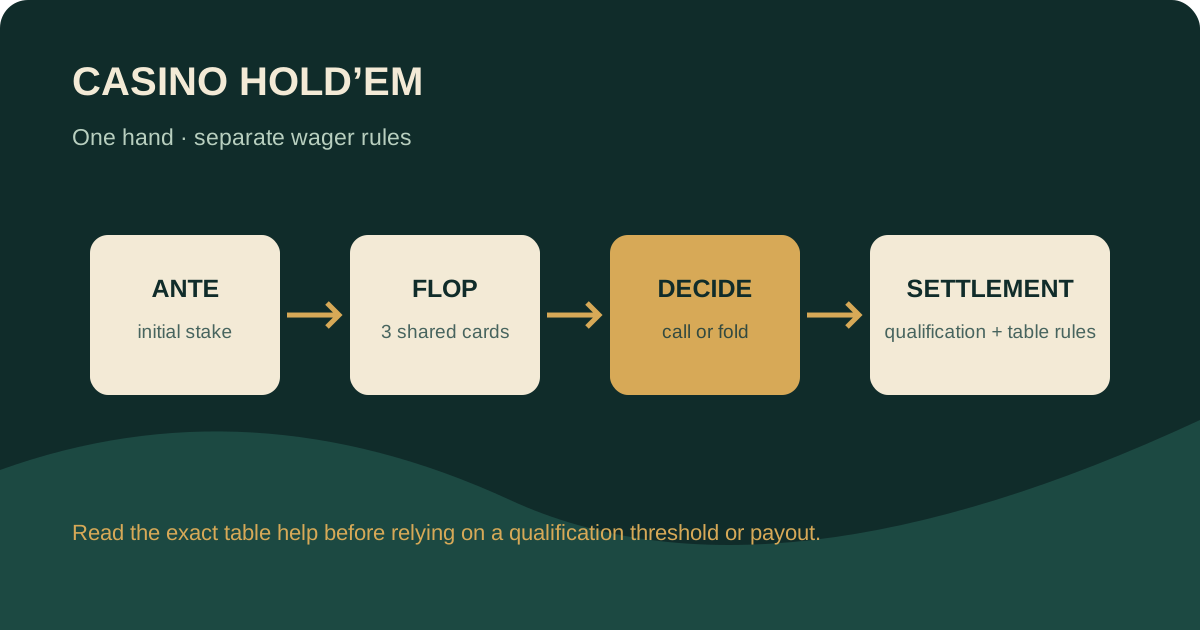
Casino Hold’em is a casino-banked comparison game built from familiar poker hand rankings. The player and dealer receive two private cards each; three community cards form the flop, then two more community cards complete the board. Each side uses its best five-card hand. Before the final cards are dealt, a player who has placed the required Ante chooses whether to fold or continue with a Call bet. If the player continues, the dealer’s hand is revealed and the game settles the wagers under the table’s qualification rule and paytable. See also: no-deposit free spins on registration in NZ.
The important phrase is “the table’s rule.” A 2024 copy of Evolution’s game rules hosted by an operator describes one configuration with a dealer qualification of a pair of fours or better and gives example payout schedules. That is useful evidence for understanding the sequence, but it is not proof that every Casino Hold’em table, software build or New Zealand-facing operator uses the same threshold or schedule. Read the help inside the chosen table before staking. The game’s name alone does not tell you whether an Ante is returned on a non-qualifying dealer, how the Ante bonus schedule works, or which optional wagers are available.
This article is about the house-banked casino game. It is not a guide to joining a Texas Hold’em cash table, entering a tournament, or playing against other customers. Poker-room rules about blinds, seats, rake, player order and split pots are a different subject. Here, the casino is the dealer’s side, and the player’s main decision is whether the hand is strong enough to continue after seeing the flop.
Evidence, date and limits
The primary source checked on 7 October 2026 was Evolution’s current Live Poker product page. It describes Casino Hold’em as a house-banked game in which a player combines two personal cards with five community cards, and it distinguishes the optional Bonus bet from the main hand. The product page is an overview, not a complete, version-stamped payout sheet. A copy of the Evolution Game Rules dated 30 December 2024 was also reviewed. It was hosted on an operator’s document server and describes a specific published rules configuration. Its contents are useful to demonstrate how a round can settle, but the hosting location and date mean readers should still match it to the rules displayed by their own table.
The rule copy says each round uses one standard 52-card deck, freshly shuffled for the game. It sets out two private cards for the player and two for the dealer, followed by a three-card flop. The player can then make a Call wager equal to twice the Ante or fold. If the player continues, the Turn and River are dealt, the dealer reveals their cards, and each side’s best five-card poker hand is evaluated. These are concrete details from the reviewed rules document, not assumptions about every table bearing the same title.
The source copy specifies a pair of fours or better as the dealer’s qualification threshold. Older or different rule sheets can show a different threshold, which is exactly why a reader should not memorize the number as a universal rule. Operator help should identify the current threshold in plain terms. If the table’s help does not expose the point clearly, pause before betting and ask the operator where its current game rules are displayed. A promotional summary, game tile or search snippet is not an adequate substitute.
No New Zealand operator account, live game client, current operator paytable, stake limits or eligibility terms were supplied for this guide. The page therefore cannot verify that a particular casino offers the game in New Zealand, which currency it uses, what minimum or maximum wager applies, or whether any side bet appears. The same caution applies to the exact payout basis and the availability of a demo mode. The useful outcome of this evidence review is a clear reading method, not a local offer claim.
What the player is comparing
Each side’s result comes from the best five cards available from that side’s two private cards plus the five shared cards. The player’s private cards are not shared with the dealer, and the dealer’s private cards are not visible when the first decision is made. The community cards are shared: they can contribute to both hands. That means a strong-looking flop is not a final result. The last two board cards can change the best hand for the player, the dealer, or both.
Poker hand rankings are ordered from high card through pair, two pair, three of a kind, straight, flush, full house, four of a kind, straight flush and royal flush. The reviewed Evolution rules copy describes the standard hierarchy and notes that Ace can be high or low when completing a straight. The table help remains the controlling explanation if a particular display labels a hand differently or uses a game-specific evaluation note. For a straight, the five ranks must form a sequence; for a flush, the five cards share a suit. A straight flush satisfies both conditions, and a royal flush is the highest ace-high straight flush.
When two hands share the same category, kickers and the relevant card ranks determine which one is higher. A pair is not evaluated only by the rank of its paired cards; the remaining cards can matter. Two pair is compared by the higher pair first, then the lower pair and then the kicker. A straight is compared by its top card, with the ace-low wheel treated according to the published ranking. The user interface may show a winning hand label, but learning how the label follows from seven available cards helps catch a misread animation.
The dealer’s qualification check is separate from hand comparison. A dealer can have a poker hand that is lower than the player’s and still fail to qualify under the threshold set by the table. Conversely, qualification does not itself mean that the dealer has won; it means the hand proceeds under the payout conditions for a qualifying dealer. Keep those two questions apart: first, did the dealer qualify? Second, if the dealer qualified, whose best hand is higher?
The round from Ante to settlement
The Ante is the entry wager in the published rules configuration. The player places it before the cards are dealt. The player’s two cards and the three-card flop are then available for the first decision. At this point the player has five visible cards but does not know the dealer’s private cards or the final board. The choice is generally to continue with a Call wager, or fold and forfeit the Ante. A Call wager is not a new independent bet on Dragon/Tiger-style outcomes; it is the continuation stake in the same hand.
In the Evolution rule copy reviewed, the Call is twice the Ante. That ratio is an important table detail: if a player starts with an Ante of one unit, continuing commits a further two units. The maximum amount at risk for the main hand is therefore not just the Ante. Optional Bonus wagers can add further exposure if selected. Before playing, translate each displayed unit into the amount charged in the account’s currency and decide what total stake is acceptable for one hand. Do not rely on a remembered ratio from another table.
If the player folds, the published example says the Ante is lost. If the player calls, the final two community cards are dealt, the dealer reveals their two cards and the game evaluates both best-five hands. The outcome stage checks dealer qualification and relative hand strength, then applies the relevant Ante and Call rules. Optional Bonus settlement is handled as its own wager according to the first five-card combination described for that bet; in the reviewed document, the Bonus decision is not erased by folding the main hand.
A clean reading order after a completed round is: identify the five-card hand shown for the player; identify the dealer’s hand; read whether the dealer qualified; check whether the player’s hand beat, tied or lost to the dealer; then inspect each wager’s separate settlement line. This order avoids treating one animation as the explanation for every stake. If the result history shows only a total credit, open the detailed hand history or table help to see which wager paid and which returned.
Dealer qualification and the main hand
“Dealer qualifies” is a gate in the payout rules. In the reviewed 2024 rule document, a pair of fours or better qualifies. If the dealer does not qualify, the Call wager is returned and the Ante is paid according to the named non-qualification schedule. If the dealer qualifies and the player wins, the table’s Ante schedule and the Call settlement apply. If the dealer qualifies and beats the player, the main wagers lose under that configuration. If both hands tie, the document says Ante and Call are returned. Exact wording and definitions should be checked against the active table because another configuration can define qualification or the non-qualifying settlement differently.
Qualification is easy to confuse with “dealer has a good hand.” A dealer might have a low pair that beats a weaker player hand yet still fail a threshold if the table uses a higher qualification requirement. Or the dealer might qualify but lose because the player has a stronger five-card hand. A rule card with examples can clarify which branch applies. If you see a message such as “dealer does not qualify,” do not interpret it as the same thing as a tie or as a win on every wager; it controls only the specific bets named in the rules.
For a hypothetical illustration, imagine a table whose help says a pair of fours qualifies and whose player has a pair of fives. If the dealer’s best five-card hand is only a pair of threes, the player may have the stronger hand but the dealer still does not qualify. Settlement follows the non-qualification clause, not the qualifying-dealer win clause. In a second hypothetical, a dealer has a pair of fours and the player has a pair of threes: both hands can be compared, but the dealer’s qualification means the qualifying branch is used. These examples explain the logic only; they do not create a payout promise for a real table.
The distinction matters most when a player is deciding whether to call after the flop. A call decision has to account for the additional amount committed and the possibility that the dealer’s qualification status changes the settlement. It is not enough to ask, “Do I have a pair?” The player must think about the quality of the visible best five, the possible final community cards, the table’s threshold, and the cost of continuing. No simple slogan replaces the paytable or guarantees a favourable decision.
Reading the hand ranking without mislabelling it
The ranking hierarchy should be read from the strongest qualifying five-card combination, not from all seven cards as if every card contributes equally. A player can hold two private cards that do not improve the board and still use the board’s best five. If the board itself shows a straight or flush, both player and dealer may share that hand unless one side’s private cards improve it. This can produce a tie even when the private cards look different.
For example, if the five community cards form a flush and neither private hand adds a stronger five-card combination, both sides can use the same board flush. If the dealer has a private card that completes a higher flush, the dealer’s hand can improve. The right comparison is not “who has more useful-looking private cards?” but “what is each side’s best five-card hand from the seven available?” This principle also explains why a pair on the flop may be superseded by a straight or flush on the river.
Players should learn the category order before using a fast live interface. A straight beats three of a kind; a flush beats a straight; a full house beats a flush. The game may highlight the category automatically, but the payout amount depends on the main comparison and the wager type, not just on the name of a hand. A full house can be a Bonus qualifying result while still losing the main hand to a higher hand if the table’s comparison rules make that possible.
When reviewing a disputed hand, note the exact five cards selected by the client and compare them with the other side. Check that an Ace-low straight has been displayed according to the table’s rule. Confirm whether the board alone creates the best hand for both sides. Then check the ranking category and kicker. Keeping screenshots or hand IDs is more useful for a support query than a general claim that a hand “looked like a win.” Do not include personal account or payment information in a public post.
The Ante payout table is not the Bonus table
The reviewed Evolution document publishes an Ante payout schedule for a non-qualifying dealer. Its example lists Royal Flush at 100:1, Straight Flush at 20:1, Four of a Kind at 10:1, Full House at 3:1, Flush at 2:1, and Straight, Three of a Kind, Two Pair, Pair or High Card at 1:1. The same document sets out a separate Bonus schedule: Royal Flush at 100:1, Straight Flush at 50:1, Four of a Kind at 40:1, Full House at 30:1, Flush at 20:1, Straight/Trips/Two Pair at 7:1, and a Pair of Aces at 7:1.
These are examples from that specific published rules copy. They should not be presented as universal Casino Hold’em payouts or assumed to apply to a current New Zealand table. Tables may use different qualifying thresholds, payout tables, return notation or side-bet terms. The figures above also describe categories and branches that are separate from the ordinary win/loss comparison. A reader should inspect the exact schedule under the game’s help icon and check whether the numbers mean net odds plus returned stake or total return including the original stake.
That odds notation distinction can materially change how a player reads a potential credit. A schedule may label a result “1:1” while the interface separately returns the original wager. Another display may describe the total credit differently. Read the table legend for the basis. Never multiply a listed figure by the Ante and assume the result includes or excludes stake without checking the wording. A screenshot of a competitor’s table is not enough to settle the accounting for another operator.
There are at least three payout questions to keep separate: how the Ante pays when the dealer fails to qualify; how Ante and Call are settled when a qualified dealer is beaten or beats the player; and how the optional Bonus bet pays for a qualifying player hand. The Bonus may be eligible based on the player’s two cards and the first three community cards, while main-hand settlement uses the complete board. The exact condition is in the active rules. Do not infer it from the word “Bonus.”
Optional Bonus and other side wagers
An optional Bonus is separate from the main choice to continue. The 2024 rule copy describes the Bonus as paying when the player’s two private cards plus the first three community cards form at least a pair of Aces or a stronger listed poker hand. In that configuration, the Bonus can remain eligible even if the player folds the main hand. The two decision tracks therefore have separate costs and settlement rules: a folded Ante can lose while the Bonus still qualifies, or the Bonus may lose while the main hand later wins.
Before selecting an optional wager, find its exact event definition and payout table. Is the Bonus judged after the flop or after all five community cards? Does it require the player’s best five of five cards or something else? Is the payout a fixed prize or does it depend on a progressive pool? What happens if the player folds? These questions are not decorative details. They define the bet. If the rule panel does not explain the trigger, do not treat the side bet as clear simply because its name sounds familiar.
Evolution’s Live Poker overview also identifies Jumbo 7 as a separate progressive side bet on some product pages. That does not establish that Jumbo 7 is attached to every Casino Hold’em table or that it uses the same hand condition as Bonus. Treat each optional bet as its own product rule. Its contribution rate, eligible combinations, maximum prize, contribution treatment and current jackpot value should come from that exact table’s published help, not from a general Casino Hold’em guide.
Side wagers make it easier to lose track of total exposure. If a player places one Ante, one optional Bonus and a progressive side bet, the total amount placed is the sum of all three stakes. A main-hand win does not automatically recover every side bet, and a side-bet win does not guarantee the main hand also wins. Set a per-round limit that counts each wager and understand which bets remain active after a fold. If the side bet’s rules are unclear, the simplest safe choice is to leave it unselected.
How to read RTP and theoretical return
The copy of the 2024 Evolution rules reviewed for this guide lists theoretical return figures of 97.84% for Ante and 93.74% for Bonus for that rule configuration. Those figures are attached to a dated document and its described schedule. They are not a universal setting for all tables, not a promise about an individual session, and not a verified value for any New Zealand operator. The table’s current in-game help should be checked for its own rules and theoretical return disclosures before any local figure is published.
RTP is a long-run mathematical estimate across a large number of plays under a defined configuration. It does not mean that a player receives that percentage back from a short session, a particular bankroll or a sequence of hands. It also does not include the personal result of a single decision. A high theoretical percentage can coexist with a losing session; the figure is not a forecast for a named player or a guarantee that the next hand will pay.
A key comparison is the wager to which an RTP figure applies. A document can list a return for Ante and a different return for Bonus. Combining them into one number would conceal that they are separate bets with different triggers and payout distributions. A table might also expose an optional side bet with separate mathematics. Do not quote one headline percentage as the return for every stake in the game unless the source explicitly defines it that way.
When checking RTP, record the exact table title, source document or client help date, bet name, percentage, and any configuration note. If the operator’s table does not show RTP, say “not stated in the available help” rather than borrowing a number from a forum or another casino. A supplier game page can confirm a product exists; it may not publish the exact operator configuration. A competitor review can be a lead to a question, but the primary source is the game help that applies to the table being discussed.
Variance, decision costs and bankroll planning
The chance of receiving a particular hand is not the same as the payout for that hand. A pair appears more often than a royal flush, but its payout may be smaller and it can still lose to the dealer’s hand. When studying a paytable, consider how often each result can occur, which branch of the dealer qualification rule applies, and the amount committed to call. A table’s house edge or RTP calculation accounts for the model’s full outcomes; a single headline hand probability does not.
Casino Hold’em contains a decision point, so two players can face different risk after seeing the same flop if they choose different actions. Folding cuts off the remaining main-hand cost but forfeits the Ante in the reviewed rules. Calling adds a larger stake but enables the player to contest the final board. The relevant question is not whether calling “feels confident,” but what the table’s rules say about the additional stake and the hands that can win. This guide does not offer a guaranteed strategy or claim to optimise play.
For a practical budget, write down the total you might commit to one hand: Ante, potential Call, and any selected side bet. If the maximum table stake is expressed as an amount per betting box, multiply by the number of boxes you might use. Decide the amount you are willing to lose before the session, avoid increasing it after a loss, and take breaks. These are general harm-minimisation practices; they do not change the game’s mathematical expectation.
Do not chase a previous result. Each hand is settled under its own shuffle and rule sequence; a past Tie or Bonus result does not make a future result “due.” The history display may help identify earlier outcomes, but it is not a forecast. If a session stops being recreational, use the operator’s available time, deposit or self-exclusion tools and contact a New Zealand support service listed on the site’s safer-gambling page.
A practical table-help checklist
Before placing an Ante, check the exact game title and open the table’s help. Record the number and type of cards, the moment when the player must decide, the Call-to-Ante ratio, the dealer qualification hand, the tie treatment and the payout basis. Confirm how “win,” “push,” “return,” “paid” and “odds” are used in the table’s own wording. A help panel that answers these points gives a much better basis for understanding the game than a third-party summary.
Next, read each additional wager independently. For Bonus, identify which cards form the qualifying hand, when those cards are evaluated, whether the wager survives a fold and which schedule applies. For a progressive side bet, confirm how the prize is funded, what combination qualifies, whether the displayed jackpot is current, and whether the game has a separate contribution or collection rule. Optional bets should be skipped until their conditions and stake are clear.
Check account and session details separately from game rules. The game help explains card settlement; the operator’s terms explain identity checks, account eligibility, supported currency, stake limits and account controls. The existence of a table in a supplier catalogue does not prove that it is available in New Zealand or to a particular customer. If the operator’s page lists a game but the launch screen rejects access, rely on the operator’s current regional terms rather than a search result.
Finally, keep a dated record if you are comparing two versions. Include the operator, table display name, rules date if visible, the relevant help text and the payout schedule. Do not publish an account name, private transaction or personal hand history without removing identifying data. If the terms change, update the guide’s version note and check the calculations again. This process prevents a correct observation about one configuration from quietly becoming a false universal rule.
Frequently asked questions
Is Casino Hold’em the same as Texas Hold’em?
No. It uses familiar poker hand rankings and community cards, but Casino Hold’em is a house-banked game. The casino is the dealer’s opponent, and the published table rules determine the Ante, Call, qualification and payouts. A Texas Hold’em poker room normally seats players against one another and has different betting rounds, blinds and settlement.
What does it mean when the dealer does not qualify?
It means the dealer’s hand has not met the qualification threshold specified by that table. In the 2024 rule copy reviewed here, the threshold is a pair of fours or better, but another table can differ. The non-qualification clause describes how Ante and Call are handled; it does not mean every wager automatically wins.
Is the Call always twice the Ante?
That ratio appears in the Evolution rule configuration reviewed for this article. Confirm it on the active table’s help panel before relying on it. The Call is a separate additional commitment made to continue after the flop, so include it when calculating the total amount at risk.
Can the Bonus pay if I fold?
The rule copy reviewed says its optional Bonus can remain eligible after a fold because it is evaluated from the player’s two cards and the first three community cards. The active table may differ, and the Bonus schedule is separate from the main hand. Check the exact trigger and fold clause before placing it.
Are the payout figures above guaranteed for a New Zealand casino?
No. They are examples in a dated 2024 rules copy, not a verified local operator paytable. Use the current help of the exact table for the qualification threshold, odds notation, RTP and each optional wager. No particular New Zealand casino or offer was verified for this article.
Does a high RTP mean I should expect to win?
No. RTP is a theoretical long-run model value for a defined bet and configuration. It does not forecast a session or guarantee a return to an individual. Ante, Bonus and progressive bets can have distinct return figures and outcome distributions.
How do I check a disputed hand?
Open the hand history if available, identify the five cards used for both sides, compare their ranking, then check dealer qualification and each wager’s separate settlement. Contact the operator with the hand identifier if something still appears inconsistent; do not rely on an animation alone.
Sources and date checked
- Evolution, Live Poker product overview, checked 7 October 2026.
- Evolution, Evolution Game Rules, 30 December 2024 copy hosted at Hollywoodbets rules PDF, Casino Hold’em section. This is a dated configuration example, not a New Zealand operator confirmation.
- Competitor pages reviewed 7 October 2026: LiveCasinos.com Casino Hold’em overview and LiveDealer.org Evolution rules summary. Their summaries help surface reader questions; the current table help remains the source to follow.
