Table game guides · South Island guide
Video poker paytables: compare the exact game first
 Best casinos available in New ZealandUpdated 7 November 2026

A video-poker RTP figure belongs to a specific game variant and complete payout schedule, not to the broad label ‘video poker’. Start by identifying the ruleset, then compare every payout row, the credit denomination and any bonus or progressive feature. A theoretical return also depends on the draw strategy used in the calculation.
The short answer
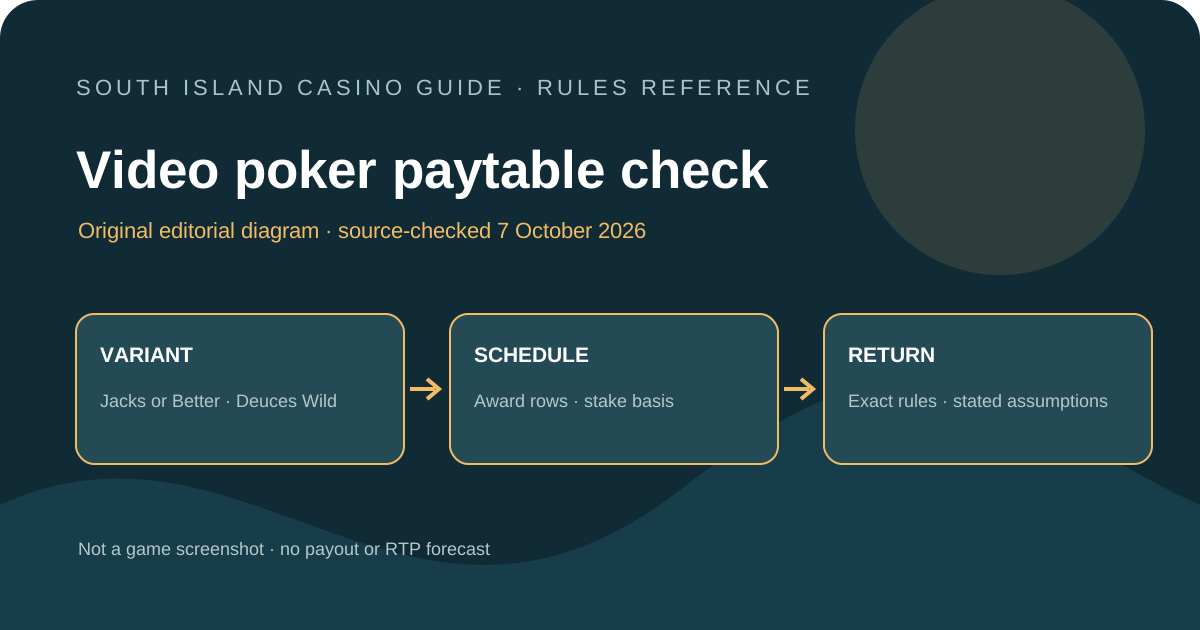
“Video poker” is a family name, not one fixed mathematical game. Before comparing a return figure, identify the exact ruleset shown in the game’s help and then read the complete paytable attached to that ruleset. Jacks or Better and Deuces Wild can use the same five-card draw interface while ranking hands and paying them differently. Even two Jacks or Better screens can differ because one pays a different amount for a full house, flush, straight or royal flush. A return estimate also depends on the number of coins staked and the decisions assumed after the initial deal. If any of those inputs are missing, a precise RTP comparison is not yet supported.
Use the game’s own “Help”, “Paytable” or “See pays” panel before staking. Record the title, variant name, each winning hand, the payout at each permitted coin level, and any optional multiplier, jackpot or side feature. Then compare like with like. The label “full pay” is not enough by itself: it can be used informally, may refer to a particular schedule, and says nothing about a different variant with the same interface. A table that omits a row or uses a progressive prize cannot be compared fairly with an ordinary fixed-pay table by looking at one headline percentage.
This guide is about that identification and comparison task. It does not claim one universal return for New Zealand, does not rank a machine as profitable, and does not reproduce the general randomness material in the site’s separate RNG guide. It explains which displayed rules matter, how to keep the arithmetic honest, and what information remains unknown when the operator’s active game help is unavailable.
Identify the actual variant before reading the numbers
Look for a named game such as Jacks or Better, Tens or Better, Deuces Wild, Bonus Poker or Double Double Bonus. Evolution’s public First Person Video Poker rules, for example, describe a selectable set of five named paytables and say that Jacks or Better is the default in that product. That is evidence about Evolution’s documented product, not proof that every operator uses the same default, includes all five options or exposes an identical configuration. The loaded client and its rules panel remain the controlling source for a particular session.
The title alone may not identify the variant completely. A machine can append words such as “Bonus”, “Deluxe”, “Progressive” or a number of hands. Those labels can correspond to a changed payout schedule, a different winning-hand definition or an extra feature. Capture the entire title exactly as it appears, including the suffix. If the menu lets you move among paytables, note whether the game name changes with the selection or whether a separate rules tab names the active choice. Do not treat a remembered menu selection as current after changing rooms or restarting a session.
For a clean record, write down four identifiers: the product title, the selected variant, the displayed paytable, and the stake unit. On a multi-hand product, also record the hand count. If the help page gives a revision date or build identifier, preserve it. Without these fields, another person cannot reproduce the comparison and a return percentage may be attached to a neighbouring variant by mistake.
What the paytable actually tells you
A paytable maps recognised final hands to awards. It does not explain every decision rule automatically. Check the game’s hand definitions, wild-card treatment, minimum qualifying hand, whether the highest matching award alone is paid, and how a progressive feature is handled. The payout rows should be read together with the game’s dealing and drawing rules. A row labelled “Two Pair”, for example, tells you an award exists; the help must still tell you whether a special pair qualifies for a separate category or whether a bonus feature changes the ordinary settlement.
Inspect the headings and units before comparing values. A row might show credits per coin, total credits for a five-coin bet, or a money amount for the chosen denomination. Those presentations can display different looking numbers for the same underlying schedule. If a screen shows “800” beside a royal flush, do not infer that the return is 800 times the cash stake until the help explains whether that number is per coin, a five-coin total, a progressive increment or a special top award.
Write every row into a small worksheet, rather than comparing only the highest prize. The lower paying hands can occur much more often than a royal flush, so a single eye-catching award is not a return estimate. A payout reduction in a common hand may affect the long-run calculation differently from a reduction in a very rare hand. The worksheet also helps identify when two pages on the internet are discussing different versions while using the same product name.
Jacks or Better: what the name does and does not promise
In a basic Jacks or Better game, a pair of Jacks, Queens, Kings or Aces is the lowest ordinary winning hand. Lower pairs do not qualify for that named row. Standard poker categories such as two pair, three of a kind, straight, flush, full house, four of a kind, straight flush and royal flush may also be listed, but the exact order and awards must be confirmed on the active table. A game help can alter the eligibility or add bonus categories, so do not import a hand ranking from a different product just because its title contains the same words.
The practical comparison is row by row. If a reference table is described by two numbers, the convention often refers to the full-house and flush awards, but that shorthand is only useful when the source names the convention and the underlying schedule. It is not a complete table and it is not a universal RTP. Two schedules with the same two-number shorthand could still differ in another row, coin-level bonus, progressive arrangement or rules detail. Read the complete displayed table rather than assuming the abbreviation proves every entry.
The final coin level can matter. Some schedules give a disproportionately larger royal-flush award at a particular maximum coin stake; other screens can have a fixed amount, a different denomination structure or no such step. The paytable should show what changes. For a comparison, keep the total amount wagered per hand explicit and do not present a payout in credits as though all credit values were equal across cabinets or operators.
Deuces Wild: wild cards change the hand categories
Deuces Wild treats the four twos as wild cards in the common form of the game, but the exact help still needs to say how a deuce substitutes and which final hands qualify. Because a deuce can complete combinations that cannot occur under ordinary high-card poker rules, the paytable may include categories such as four deuces or five of a kind. Some games use a progressive top prize or additional bonus tiers. Those entries must not be copied into a Jacks or Better table, and a Jacks or Better RTP must not be attached to a Deuces Wild selection.
Wild cards also change the decision problem after the deal. A natural hand without wild cards and a hand completed with a deuce can fall into different award rows. That is why a Deuces Wild strategy reference must match the exact rules and paytable rather than simply say “hold the highest cards”. The feature changes which replacement cards can complete a hand and the relative value of pursuing different outcomes. A short strategy slogan cannot establish that a given schedule has a particular return.
Check whether the interface distinguishes natural and wild-assisted versions of a hand, and whether the screen pays them identically. Confirm how a straight uses the Ace, whether a royal flush with a wild card has its own category, and whether a special deuce combination overrides a more general hand. These are rules questions, not details that can safely be answered from the title artwork or a review of a different Deuces Wild product.
Read a table without confusing payout units
Create a table with columns for “final hand”, “displayed award”, “unit basis” and “notes”. Copy the screen’s wording exactly. If the paytable has several stake columns, preserve each one. Then identify whether an entry is a per-coin award or a total for the selected bet. A five-coin wager can show a much larger number than a one-coin wager even when the payout schedule is otherwise proportional. The comparison requires converting both tables to the same per-hand stake basis.
Here is a deliberately simple arithmetic illustration, not a real game’s published paytable: if a hypothetical schedule pays 9 credits for a full house and the player has staked 5 credits per coin, the row’s award should be interpreted only after the help clarifies whether “9” is per coin or total. If it is 9 per coin, the total award is 45 credits; if it is already the total, multiplying it again would overstate the award fivefold. Never use an invented example value as evidence of a casino’s rules or a game’s RTP.
Check whether a feature cost is included in the stake. A side bet, bonus multiplier, progressive contribution, multi-hand purchase or optional game mode may change the total amount at risk or use a separate payout table. Keep the base hand and any add-on separate. If the display bundles them into one total, use the help text to determine how settlement is split. A comparison that treats an optional side wager as free will misstate both cost and return.
Why RTP requires more than a list of prizes
Theoretical return is the expected award divided by the amount staked, averaged over the mathematical model’s possible deals and decisions. Conceptually, the calculation adds the probability of each final paid outcome multiplied by its award, then divides by the wager. For draw poker, the probabilities depend on the starting deal, which cards are held, which are exchanged, the variant’s hand definitions, and the assumption about how decisions are made. A complete table is necessary, but it does not by itself tell you the return unless the calculation also specifies the strategy model and any feature rules.
This distinction matters when comparing published percentages. One figure may assume an optimal strategy, another may assume a simplified strategy, and a third may refer to a progressive or multi-hand product. Unless the source names those assumptions, the figures are not automatically comparable. A percentage can be mathematically valid for one configuration while being irrelevant to the game currently loaded on a different operator. Ask which version, schedule, stake level and decision model produced the number.
Avoid translating a theoretical percentage into an individual-session promise. If a mathematical model reports a hypothetical expected return, it describes an average across an extensive modelled sample; it does not predict the next hand or guarantee that a player will recover a particular amount. The percentage also does not tell a reader how long to play, how much money to set aside or whether a game is appropriate for them. Those are separate decisions, and no strategy can remove the financial risk of gambling.
How to compare two variants fairly
First confirm that both products use the same variant. Jacks or Better and Deuces Wild are not direct paytable substitutes: their hand rules differ. If both are Jacks or Better, align the full list of award rows, payline definitions, wager unit, bonus rules and any progressive contribution. Note every mismatch. A missing row is not a zero that can be silently filled from a table found elsewhere; it is an unknown until the loaded game or official rulebook answers it.
Second, inspect the wager basis. Compare awards per the same total stake, not per credit if credit values differ. If one interface supports multiple hands, distinguish a single base hand from additional hands that share held cards but receive separately drawn cards. Evolution’s public First Person Video Poker page describes a maximum of 100 hands in its own product and says the selected held cards are shared while remaining cards are populated separately. That specific product description illustrates why a “per round” figure must state whether it means one hand or several.
Third, require the same calculation method. If the source gives a theoretical return, ask whether it assumes optimal decisions and whether any optional bonus is included. If two sources disagree, do not average their percentages. Trace each figure to its exact table and assumptions. It may turn out they are both describing valid but different configurations. In a responsible guide, “not comparable from the information supplied” is a more accurate result than choosing the most attractive number.
Strategy assumptions: do not turn a return figure into a system
Video poker asks the player to choose which cards to keep after the initial deal. That decision can change the probability distribution of the final hand, so a return calculation normally requires a rule for how those decisions are made. “Perfect strategy” in a source is shorthand for an optimisation assumption tied to one mathematical game and paytable. It does not mean that a human player can guarantee that return in a session or that the same strategy chart applies to every variant.
The right editorial use of a strategy reference is narrow: identify which paytable and rules it covers, whether it ranks all possible holds or offers a simplified chart, and what objective it optimises. Do not convert this into advice to chase a particular prize or to increase a stake after losses. A decision can be mathematically best among the available card choices while still leading to a losing hand. The choice affects expectation over repeated modelled trials; it does not reveal what the next draw will be.
If a source says “optimal” without giving the product, table and assumptions, treat the claim as incomplete. Record the information needed to reproduce it. For a casual reader, the useful outcome is knowing whether a published percentage assumes decisions that the reader actually intends to make. The percentage cannot tell the reader whether they can maintain that decision quality or whether playing remains within a sensible entertainment budget.
Multi-hand play changes the comparison unit
Some video-poker interfaces let a player start with one visible hand, select held cards and then play additional hands that use the same held selection. Evolution’s First Person product says a player can purchase up to 99 additional hands, for a maximum of 100 in a round. Its public rules explain that all virtual hands keep the selected cards while their remaining cards come from separate virtual draws. The specific operator game may differ, so verify the loaded help before assuming this arrangement.
More hands multiply the amount staked per round. If one hand costs a chosen stake and the interface adds several more hands, the total exposure is the per-hand wager multiplied by the number of hands, with any optional feature cost considered separately. The screen may emphasise a single decision while the balance covers many hands. Before pressing deal, read the total wager field and confirm that it matches the amount you intended to risk for the whole round.
Do not infer that playing more hands improves the return percentage. It may produce more results from the same held choice, but the theoretical return is still specific to rules, paytable and strategy assumptions. A player should compare return per unit staked and separately understand the total stake. Multi-hand mode can also create more simultaneous outcomes to follow, which makes it easier to overlook a total-cost figure or confuse an award from one hand with a round-wide result.
Progressive awards and special features
A progressive jackpot is not interchangeable with a fixed award printed in an ordinary table. Its current value may change as contributions are added and after a top prize is won. The game help should identify the qualifying hand, contribution, seed or reset conditions, and whether a separate side bet is required. If those details are absent, the ordinary paytable alone cannot tell you the total return or the exact amount awarded in a progressive outcome.
The same caution applies to multipliers, bonus hands and feature purchases. Ask whether the add-on is mandatory or optional, whether it changes the stake, which outcomes it affects and where its awards are displayed. For a comparison, keep the base game schedule distinct from the feature schedule. A web page that lists the top jackpot without explaining the added wager or conditional eligibility does not provide enough information to compare the offer fairly.
Evolution notes on its First Person game page that bonus-buy and jackpot features may not be available in every jurisdiction when the game is offered by an online casino. That is a product-level availability caveat, not confirmation of access in New Zealand. A rule panel can be market-specific, and an operator may enable only some features. Confirm the actual loaded menu and help rather than relying on a general product page or another country’s review.
RTP, volatility and hit frequency answer different questions
RTP is an expected-return calculation under stated assumptions. Volatility describes the distribution of results around that expectation, and hit frequency describes how often a defined event occurs under a particular model. Neither volatility nor hit frequency can replace the paytable. A game could award many small results or fewer larger results, and an isolated session can look very different from the mathematical average. A return percentage alone does not describe the pattern of outcomes.
Also check what “hit” means. One source may count any paid outcome, another may count a net-positive hand, and a third may include a feature trigger. Without the definition and sample or calculation method, a hit-frequency number is not a stable comparison. It is particularly risky to interpret “wins on one in so many hands” as a promise about the timing of the next result; averages do not schedule outcomes.
For this topic, the practical check is to read the game’s own information panel for its theoretical return and determine whether the percentage is linked to the currently selected variant. If the panel shows no percentage, record that as unavailable. Do not borrow an RTP from a different paytable, a regional review or an old product sheet. The number should be traceable to the current configuration or not stated as a fact.
What to check on a phone or desktop screen
On a compact display, the paytable may be behind a help icon or require horizontal scrolling. Open it before selecting a stake and verify that every row is visible. If the interface uses several screens, note whether a tab changes the game variant, award table or just the presentation. A partly visible table can hide a different low-hand threshold or a special award. Rotate or resize the browser if text is clipped, and do not rely on colour alone to tell whether a hand has been selected.
On desktop, check whether additional hands or bonus options are enabled by default. A wider layout can show a total stake that is easy to miss among multiple hand panels. Look for the distinction between bet per hand, number of hands and total bet. Before a draw, check the hold markers against the chosen cards; if the game has a decision timer, use its help to understand what default action occurs when no selection is made.
These are interface checks, not claims that a particular game has been tested on a device. This guide has not loaded a New Zealand operator’s client. Use the actual product help to confirm accessibility, control labels, hand count, and any default action. If you cannot read a material rule before wagering, stop and seek the operator’s published explanation rather than guessing from a screenshot or third-party description.
A practical pre-play comparison worksheet
Before considering a game, fill in the following fields from its live help: complete title; provider; named variant; minimum qualifying hand; wild-card definition; all payout rows; whether awards are per coin or total; wager denomination; number of hands; optional features; progressive contribution and conditions; displayed theoretical return; calculation assumptions; and date checked. This is a documentation exercise, not a method for finding a guaranteed edge. If a field is missing, mark it “not shown” instead of supplying an assumed value.
Next, compare the worksheet with the exact configuration you intend to evaluate. Matching names are not sufficient if the payout rows differ. If any row changes, label the schedules separately. If a bonus or progressive feature is involved, make a second worksheet for that feature and its cost. Keep one result per exact table, and link each number to the source that supports it. This prevents a statement about one operator or jurisdiction from being presented as a universal product fact.
Finally, decide whether the source supports a useful conclusion. You may be able to say that the help panel identifies a variant and lists its awards even if it does not publish an RTP. You may be able to compare two displayed award schedules without computing expected return. If you cannot verify the mathematical assumptions, state that the return is unconfirmed. A complete limitation is more informative than an unsupported percentage.
Common comparison mistakes
The first common mistake is using a result from the wrong variant. Deuces Wild contains wild-card rules that affect both winning hands and decisions; Jacks or Better has a different minimum qualifying pair. The second is treating an abbreviated schedule label as a complete table. The third is comparing credits, coins and cash without converting to a common stake basis. Each error can produce a precise-looking but irrelevant number.
Another error is quoting a return from a competitor page without checking its date, market and source. A review can describe a different paytable, an old version or a promotional feature. Even a reputable page may not show the operator help that a particular player sees. Trace the figure back to the primary rules or data sheet and confirm that the exact table appears in the loaded game. If the source chain stops at a secondary summary, qualify the claim rather than presenting it as verified.
The final mistake is turning a theoretical return into a prediction or promise. A high long-run percentage is not a guarantee, and the game’s short-term result can differ greatly. A “best table” label does not eliminate risk, and a strategy chart cannot make a losing session impossible. Use the information to understand the configuration, not to justify larger stakes, chase losses or keep playing beyond a personal limit.
New Zealand scope and access checks
The site’s declared audience is New Zealand, but that does not establish that a particular game or operator is available to a reader. Evolution’s product page describes its own First Person Video Poker rules and includes a warning that some features may not be available in every jurisdiction. It does not certify the New Zealand status of an operator, game build, bonus or jackpot. Availability must be checked on the operator’s own current terms and in the loaded client; this guide has not tested such access.
New Zealand’s Department of Internal Affairs states that the Online Casino Gambling Act came into force on 1 May 2026, that the current advertising prohibition is in effect, and that affiliate marketing is among the initial regulatory decisions described as prohibited. The same guidance says the three-stage licensing process is expected to finish in early 2027, with restricted advertising permitted for licensed operators. Those are advertising-system facts, not a statement that any particular site or game has been authorised. Recheck the official guidance before a public update.
Because this page is intended to answer a rules question, it contains no casino promotion. If you are concerned about gambling or want support, use the site’s New Zealand safer-gambling support page. Treat the game as paid entertainment, set a firm limit before a session, and stop when that limit is reached. A paytable comparison cannot make gambling a source of income.
Questions readers ask
Does “Jacks or Better” tell me the RTP?
No. It identifies a broad hand rule, not one complete payout schedule or calculation. Read every row, coin level and optional feature in the active help. The RTP, if published, must refer to that exact configuration and state the strategy assumptions used in the calculation.
Is a higher royal-flush prize enough to choose a table?
No. It is one row. Other awards, stake units, qualifying hands and any progressive or bonus conditions also matter. A single top prize cannot establish the total expected return.
Does Evolution’s First Person Video Poker always use Jacks or Better?
Evolution’s public page says Jacks or Better is the default in that product and lists other choices. An operator’s current integration may expose a different selection or market-specific options. Check the loaded help; do not assume the default is universal.
Does Deuces Wild use the same strategy as Jacks or Better?
No. Wild twos alter hand formation, award categories and the value of possible holds. A strategy or return calculation must name the exact variant and paytable to be relevant.
Can I calculate RTP from a paytable screenshot?
Not from a screenshot alone. You need the complete game rules, payout units, all possible outcomes and the decision model used for card holds. If any input is missing, the screenshot supports a table transcription, not a verified return calculation.
Does playing more hands improve the percentage?
More hands increase the total amount staked in a round. They do not, by themselves, prove a better return percentage. Read the product rules and total wager display, then treat each hand count as a different exposure amount.
Can one session show whether a table has the quoted RTP?
No. A short run cannot validate a long-run theoretical figure. It can show what the interface paid in those hands, but it does not reveal whether a published calculation matches the configuration or its assumptions.
Related site guides
For the supplier’s game catalogue, see the site’s Evolution provider guide. For practical limits and support information, use the existing safer gambling guide.
Sources and verification boundary
- Evolution First Person Video Poker rules — opened 7 October 2026; variant choices, hand flow and multi-hand description.
- Atlantic Lottery: Game King Video Poker how to play — official lottery operator help surfaced in search on 7 October 2026; direct page fetch was blocked, so no table values are transcribed here.
- Evolution Live Poker catalogue — official catalogue, accessed 7 October 2026; distinguishes dealer games from draw video poker.
- New Zealand DIA guidance for online-gambling advertisers — checked 7 October 2026.
No specific casino paytable, New Zealand operator configuration, exact RTP, strategy calculation or current availability was supplied or verified. No universal return percentage is claimed.
