ELK Studios game guide · South Island guide
Gladiatoro: ELK Studios rules, features and RTP checks
 Best casinos available in New ZealandUpdated 7 November 2026

Gladiatoro is ELK Studios’ Toro-themed slot with a five-reel, four-row starting layout, a walking Wild, coin values and a character-led bonus. ELK describes Toro, Matador and Diaz as separate roles, gives a 10,000× maximum-win potential, and explains an X-iter menu. Public sources do not verify the active RTP, volatility or New Zealand operator configuration.
The short answer
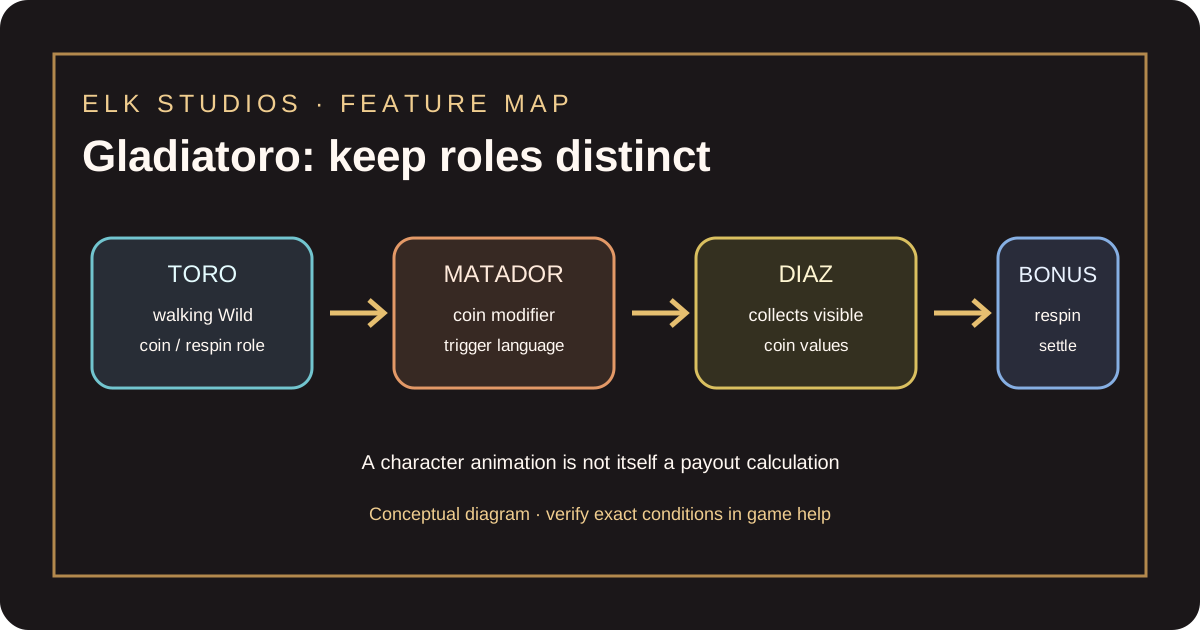
Gladiatoro is an ELK Studios slot with five reels and four rows in its supplier description. Its central interactions involve Toro, a walking Wild that moves left and doubles coin values it passes; Matador, which can raise coin values and can be involved in Toro’s Wild trail; and Diaz, the collector that gathers coin values. Three bonus coins anywhere in view trigger the Bonus Game. The supplier gives a 10,000× maximum-win potential tied to filling the grid with sticky symbols at the end of the bonus.
Those supplier facts explain the broad mechanic, but they are not a full current paytable. ELK’s public page does not state a verified RTP percentage, volatility rating, exact win-frequency statistic, wager limits, or every respin and expansion rule. Some third-party pages disagree on layout and ways to win, so this guide does not promote those values as confirmed. Use the information panel in the exact game client for the operator’s configuration and current settlement rules.
Quick facts and what still needs checking
| Item | Public ELK description | Check in the active game help |
|---|---|---|
| Starting layout | Five reels by four rows | Whether the layout expands and which feature triggers that change |
| Toro | Walking Wild; moves left, awards respins and doubles coins he crosses | Movement timing, number of steps and exact coin interaction |
| Matador | Can raise coin values; interacts with Toro Goes Wild | Trigger condition, sticky duration and coin effect order |
| Diaz | Collects visible coins and pays the collected value | Eligibility, timing and which coin symbols count |
| Bonus entry | Three bonus coins anywhere in view | Entry timing, initial counter and exact symbol requirements |
| Maximum potential | Up to 10,000× the bet | Cap handling and the qualifying end-of-bonus condition |
| RTP and volatility | Not stated in the public product text reviewed | Operator value, variants, volatility wording and build context |
Use the left column to recognise the game. Use the right column to verify a playable version. The official product page is the primary source for its public feature vocabulary; the client help supplies the rules that a broad marketing description omits.
Start with the exact title and layout
Confirm that the client says Gladiatoro and credits ELK Studios. This may sound obvious, but Toro appears in several distinct ELK titles. A shared character does not mean shared movement, bonus or coin rules. The ELK Gladiatoro product page identifies this release separately and describes its five-reel, four-row starting layout.
Some independent pages show a larger grid, different ways-to-win counts, or a different starting and expanded layout. Those details may reflect an operator client, market, version or an error. Do not combine the figures. If the game help in the client lists a level-up coin or a variable grid, record the exact initial and expanded dimensions shown there, along with the trigger. If it does not, do not import an expansion rule from a review.
The distinction between a starting layout and a later feature state is useful. A diagram can show five reels and four rows while a feature animation adds positions. The page should say which state the number describes. Before reading payout values, inspect the help’s layout diagram and note whether the game uses paylines, ways, connected symbols, or another rule. The public page alone does not supply all of that information.
Toro: the walking Wild and coin route
ELK describes Toro as a walking Wild. As Toro moves leftwards, he awards respins. The supplier also says he doubles the value of coins he walks over. This combines a symbol-substitution role with a coin-modifier role, but the public summary does not define whether these actions resolve at the same moment or whether a coin may be doubled more than once in a particular sequence.
When reading the in-game example, follow Toro’s route one reel at a time. Note the starting column, the direction of travel, when the respin is awarded, and whether crossed coins remain visible. Then check how their displayed values change. This makes it easier to distinguish a Wild helping a symbol win from a coin amount being modified for a later collection.
Do not assume every appearance of Toro begins the same path. The help should clarify whether he is a regular symbol, whether a separate feature requires another icon, and how many respins the movement supplies. If a coin is crossed by Toro before Diaz appears, the help should say whether the doubled amount is what Diaz collects. Do not infer an unlisted sequence from animation alone.
Matador: a coin modifier and a trigger character
The supplier says the Matador randomly increases coin values. ELK also describes Toro Goes Wild as a feature triggered when Toro and a Matador are in view at the same time. During this feature, Toro knocks all Matadors off and leaves a trail of Wilds behind. The Matador therefore has two important roles in the public description: it is involved in coin-value changes and it participates in a Toro interaction.
These are not necessarily one event. The active help should explain whether a Matador’s coin increase is a separate random feature, whether it can be persistent, and how a symbol combination with Toro activates the Wild trail. Check whether “in view” means anywhere on the current grid or within a defined area. The supplier overview does not specify a distance or sequence.
There is a naming trap in secondary descriptions: some pages shorten the feature text or attach the collector role to the wrong character heading. ELK’s own page lists the roles separately, so this guide follows that source: Matador is associated with a random increase to coin values; Diaz is the collector. Use the loaded help if a label differs, and do not silently reproduce a contradictory heading.
Diaz: collect visible coin values
Diaz is described as a collector symbol. ELK says Diaz collects all coins in view and pays the collected value. That is different from Toro’s movement and from the Matador’s value increase. A useful reading order is therefore: identify coin values, see whether a modifier changes them, and then check whether Diaz’s collection settles them.
The public product page does not identify every coin type or state whether all visible coin values are eligible in every mode. It also does not provide a full table of coin denominations or a multiplier scope. The client’s paytable should answer whether a coin can be collected by ordinary Diaz or only by a persistent version, whether a coin must be within a particular reel area, and what occurs if a value changes earlier in the same round.
If several values are on screen, resist reducing the event to a single “coin win” until the game help shows how the total is calculated. Record what the feature collects, what is paid, and whether any coins remain after the collection. Those distinctions are especially important during respins, when the board can retain some symbols while replacing others.
Toro Goes Wild: the character interaction
When Toro and a Matador are in view together, the supplier says Toro Goes Wild starts. Toro removes all Matadors and leaves a trail of Wilds. This is a character interaction rather than a generic Wild substitution. The help should show whether the action happens before or after a symbol evaluation and whether the newly created Wild trail immediately participates in a win check.
Do not assume the trail is permanent or that it replaces every symbol on the route. The public summary says Toro leaves a trail of Wilds, but does not state how long those Wilds remain, whether they are locked during a respin, or what happens if the path reaches the end of the grid. Those details can alter the visible action without changing the core feature name.
When watching the feature, track the original Matador positions, Toro’s movement path, the cells converted to Wilds, and the following evaluation. This gives a clear account of what the feature did. It also prevents a misleading explanation such as “Toro turns the whole board Wild,” which is broader than the source supports.
Bonus coins, respins and persistence
ELK says three bonus coins anywhere in view trigger the Bonus Game. The public description says the bonus is played with coins, Level Up, Toro, Matadors and Diaz, and that the Matador and Diaz can appear in persistent versions. If an additional symbol lands in the bonus, the respin counter resets to three. These points define the broad state of the feature.
The public page does not state the initial counter, every retrigger limit, the exact role of Level Up, or which symbols are locked between respins. “Persistent version” means the character can remain in a relevant state, but the help should clarify when it appears and what it retains. Avoid converting this into an assumption that every Matador or Diaz remains locked for the entire feature.
The reset rule is also specific: ELK says an additional symbol during the Bonus Game resets the counter to three. Find the help wording for what counts as “an additional symbol.” It may refer to a named trigger rather than any symbol appearing on the grid. The visible counter and rule illustration should be treated as the guide to the active build.
The 10,000× maximum-win condition
ELK lists a 10,000× maximum-win potential and says filling the entire grid with sticky symbols at the end of the Bonus Game awards that maximum. This tells you the stated end condition at a high level. It does not mean that every full-looking screen qualifies, that a player can intentionally fill the grid, or that the result is a common outcome.
To interpret the cap, check whether the operator help says the game ends immediately when a result reaches the maximum or applies the cap at settlement. Note the bet unit used in the screen. A multiple of “bet” generally references the configured stake, but the display should specify whether the amount is per spin, per line or another unit. Never convert the multiplier into NZD without a verified stake and currency.
A maximum-win number is not an evaluation of fairness or value. It says nothing by itself about the probability of the event, RTP, or typical round. Treat it as a ceiling that helps distinguish a published feature limit from a regular payout. If the paytable does not make the cap condition clear, do not invent a route based on a third-party screenshot.
RTP, volatility and conflicting review data
The official Gladiatoro product page does not publish an RTP percentage or volatility label in the public text reviewed for this guide. Independent review pages frequently show a 94% figure and classify the game as high or medium-high volatility, but that does not establish the setting of a specific operator client. Some also differ on grid expansion and ways-to-win counts.
RTP is a theoretical long-run return statistic, not a session forecast. Volatility describes the distribution of results, not whether the next feature is near. A stated maximum of 10,000× does not make that outcome probable. If the exact setting matters to your comparison, use the game help screen and record the operator, title, currency, date and any build label.
If there is a discrepancy between the help and an outside review, treat the live help as the primary setting for that client. Do not average values from different countries or choose the figure that looks most attractive. If no RTP line appears, report it as unknown rather than filling the gap with the most common number online.
X-iter: optional cost is separate from the base bet
ELK describes five X-iter options. The public example of the low end costs 3× the bet and increases the chance of triggering the Bonus by more than three times. At the high end, a 500× Super Bonus guarantees a persistent character from the start. The public summary does not list all five mode names, their full conditions or any applicable restrictions.
Before choosing an option, read its complete label and confirm the total amount shown on the final screen. A 500× mode is a substantial multiple of the chosen stake, not a small extra. The guaranteed character condition is not a guaranteed return. Ask whether the mode changes the displayed RTP, whether its outcome is subject to the same cap, and whether an operator promotion excludes purchased features.
X-iter can be ignored while you learn the standard rules. If you do not understand the price or resulting state, close the menu. The game’s normal feature sequence can be read from the information panel without paying to enter a mode. Keep a predetermined limit and do not chase a bonus after a losing round.
Mobile, help and a safe first read
ELK recommends 1600×900 for a desktop browser and a 16:9 ratio when scaling is required. That does not verify how every mobile version renders. On a phone, check that the bonus counter, coin values, Matador and Diaz labels, and the X-iter price are all readable before you interact. If a detail is too small, open the in-game help rather than relying on a quick animation.
A demo, if made available in a permitted environment, can help you recognise the characters and follow a respin. It cannot prove the RTP setting of a New Zealand account or forecast future outcomes. A short demo sample is not a statistical test of volatility. Do not assume that an overseas demo or casino listing confirms availability to New Zealand customers.
This guide does not direct readers to a casino. The game’s presence on an ELK catalogue page does not establish an operator offer or local eligibility. Check current information from the provider and relevant local authorities before making an access assumption.
A compact method for reading one feature round
First, note the base layout and identify each icon from the paytable. Next, track the coins separately from Wilds and character symbols. If Toro moves, record the respin and the coin values he crosses. If Matador appears, check whether it changes those values or activates Toro Goes Wild. If Diaz appears, note the coins collected and the amount shown at settlement.
When three bonus coins trigger the feature, write down the initial counter and any symbols that the client says are persistent. During each respin, note what resets the counter and whether a character remains locked. At the end, compare the visible state with the help’s stated maximum-win condition. This structured observation helps you learn rules; it does not create a winning strategy.
For a settings comparison, separately record RTP, volatility, coin values, grid dimensions, X-iter costs and the maximum-win cap. Do not combine a number from one screen with a feature description from another. If the same title appears under two different operator menus, verify that the provider and version are identical before comparing them.
Frequently asked questions
What does Toro do in Gladiatoro?
ELK describes Toro as a walking Wild that moves left, awards respins and doubles coin values he passes. The active help supplies the exact movement sequence and timing.
What does Diaz do?
Diaz is the collector. The supplier says it collects coin values in view and pays the collected value. The paytable should explain which coins qualify in each state.
What does Matador do?
The supplier says Matador can randomly increase coin values and participates in Toro Goes Wild when Toro and a Matador are in view together. It should not be confused with Diaz’s collection role.
How does the Bonus Game start?
Three bonus coins anywhere in view trigger it, according to ELK. The public page describes a respin counter and says an additional symbol in the bonus resets that counter to three; verify the precise symbol rule in the client.
What is Gladiatoro’s RTP?
The official public page reviewed here does not state an RTP percentage. Check the exact operator help. Third-party figures are not proof of a New Zealand game configuration.
Is Gladiatoro a high-volatility game?
The ELK public page reviewed here does not publish a volatility rating. Use the active game help if it provides one; do not infer volatility from the 10,000× maximum-win potential.
Does Gladiatoro have an expanding grid?
Some external reviews describe extra rows or grid expansion, while ELK’s public summary identifies a five-reel, four-row starting layout. If the live game shows a different state, confirm the trigger and dimensions in its own help rather than merging third-party descriptions.
Can I play Gladiatoro in New Zealand?
This guide does not verify an operator listing, eligibility or a demo for New Zealand accounts. A supplier page and an overseas review cannot confirm current local access.
Sources and scope
- Primary source reviewed 7 October 2026: ELK Studios Gladiatoro product page for the starting layout, character descriptions, bonus and maximum-win condition.
- Catalogue context: ELK Studios games catalogue.
- New Zealand advertising context: DIA guidance for advertisers.
- Competitor pages reviewed 7 October 2026: Casinos in Canada, FruitySlots, Gambling.com, and AboutSlots. They surface common questions but vary on grid size, ways, volatility and RTP; their figures are not treated as verified NZ settings.
No operator help file, New Zealand account view, RTP variant data, search-volume dataset or verified NZ availability evidence was supplied. Differences in secondary listings are described as unknowns rather than silently reconciled.
