ELK Studios game rules · South Island guide
Knockout Diamonds review: Knockout Spins and rules
 Best casinos available in New ZealandUpdated 7 November 2026

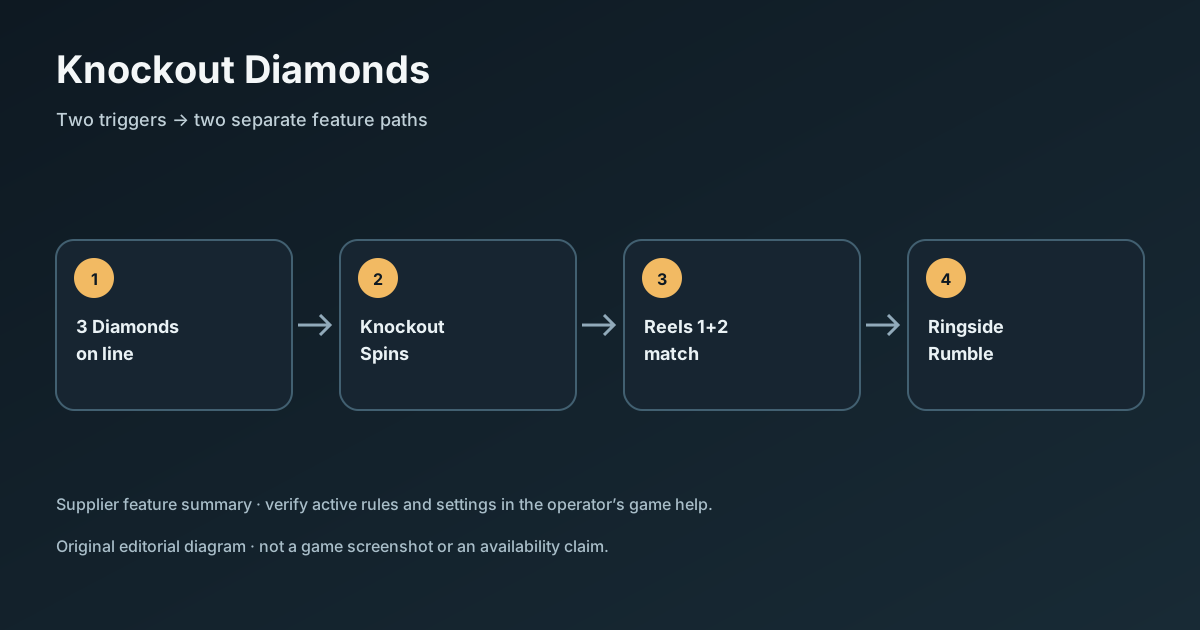
Knockout Diamonds is an ELK Studios Classic Series slot with one payline, Multiplier Wilds, Knockout Spins and a separate Ringside Rumble. Three Knockout Diamonds on the line trigger the free-spin counter; matching symbol sets on the first two reels trigger locked respins on the third. This guide separates those rules from settings that are not published in the accessible official summary.
The short answer
Knockout Diamonds is the eighth ELK Classic Series slot, described by the supplier as a one-line game with Multiplier Wilds and two separate features. The first, Knockout Spins, starts when three Knockout Diamonds land on the payline. It awards three free spins; a win or another Knockout Diamond on the line resets the counter. Collecting diamonds increases the feature award, and the supplier publishes a maximum win of 2,500 times the bet. A separate Ringside Rumble starts from identical symbol sets on reels one and two; those reels lock while reel three respins three times. The Wild and Multiplier Wild substitute for symbols except the Bonus symbol.
That describes the publicly documented feature logic, not the complete operator math. ELK’s product page does not publish an RTP or volatility rating in the accessible text, and its Game Data Sheet could not be opened on 7 October 2026. Secondary reviews display figures and labels, but they cannot prove which configuration is selected at an operator. No New Zealand game listing, demo or casino setting was verified. The steps below explain what is confirmed and how to check the missing fields without treating a headline claim as a guarantee.
Confirm the title and the Classic Series format
Before comparing a review, confirm the exact title is Knockout Diamonds and that ELK Studios is named as supplier. A lobby card can use a cropped logo, while a directory may shorten the title. Record what the actual information panel says, including any version/date field. Knockout Diamonds is a one-line title according to the supplier’s page; that fact distinguishes it from multi-line or ways-based games, but it does not provide every symbol award or settlement condition.
Classic Series is the supplier’s series label, not a complete description of the game math. Similar presentation across a series does not mean two titles have the same RTP, line paytable, free-spin values, or max win. A review that borrows a table from another Classic Series slot is not evidence for this title. The name of the exact game must appear beside each numerical setting you record.
An operator’s current help panel should be the next stop. Look for title, version, line structure, bonus rules, Wild restrictions, stakes and theoretical return. If the supplier page and operator panel use different labels, do not assume that they are interchangeable. Ask the operator to identify the applicable version. This is particularly important where a game has been configured for more than one market or where a reviewer has captured an old client.
The one payline: what it means and what it does not
ELK describes Knockout Diamonds as a one-line slot. A payline is the route or arrangement whose symbol combination the game evaluates. It does not mean that only one symbol can matter: bonus symbols may have a separate trigger, and feature conditions can use the positions or symbol sets on more than one reel. The current paytable is needed to see which ordinary combinations pay and whether a symbol needs to appear in a particular order.
Do not infer every rule from the word “line”. The accessible supplier page confirms that three Knockout Diamonds on the payline start Knockout Spins. It also says identical symbol sets on reels one and two start Ringside Rumble. Those are distinct triggers, and the second uses a condition across two reels rather than simply describing an ordinary line win. The help panel must resolve precisely what “identical symbol sets” means in the operator’s displayed grid.
When inspecting an outcome, first identify the line’s visible positions and then compare the symbol pattern with the paytable. Keep a second note for any feature trigger. A line win may occur in the same action as a feature, but that does not make the award and feature counter the same thing. If the game history shows one settlement followed by an extra sequence, describe them separately and report the final round result in the currency shown.
The current supplier summary does not provide all line combinations or ordinary-symbol awards. Avoid reproducing a payout table from an old review without checking the title, version and active help. A single incorrect award can affect both a reader’s understanding and an RTP comparison. An editorial guide can explain how to read the line while leaving values blank until the correct table is available.
Knockout Diamonds symbols and feature entry
The Knockout Diamonds symbols are not just another paying symbol in the public description: three landing on the payline trigger the feature. If the current game displays them elsewhere, verify whether those positions count for any collection effect or whether the line condition remains essential. The product page ties the entry trigger to the payline, so a general “three anywhere” statement should not be substituted unless the active help says so.
The supplier says Knockout Spins start with three free spins. During the feature, every win or another Knockout Diamond on the payline resets the free-spin counter. This creates a loop: the feature can continue when one of the specified events happens before the counter expires. It is still a finite counter, not an unlimited guarantee. The display and help should identify whether the reset returns the meter to three or changes any other state as well.
Diamond collection boosts the feature award. The supplier states that collecting ten reaches a maximum of 2,500 times the bet, and that three Knockout Diamonds on the line during Knockout Spins can award the maximum payout. The cap is a published supplier figure. It does not mean a reader can expect ten symbols, that a bonus will reach the cap, or that every market uses the same stake base without verification. Record whether “bet” means the original paid spin’s total stake or another unit under the client’s rules.
For a clear explanation, make a small event log: initial trigger, free-spin count, each win or diamond that resets the counter, total collected diamonds, and final settlement. This lets a reader understand how the feature progressed without claiming a particular frequency or prediction. Do not convert the collected-symbol ladder into a payout schedule unless the current paytable publishes each rung.
Ringside Rumble: locked reels and three respins
Ringside Rumble is independent from Knockout Spins. ELK says identical symbol sets on reels one and two trigger it; the first two reels lock and reel three respins three times. The sequence is straightforward once the trigger and the locked area are separated. The feature condition is assessed, reels one and two remain fixed for the feature, and reel three is the part that changes. Each respin may create a new combination under the paytable, but an animation or a repeated symbol is not itself a guaranteed award.
The public wording does not list every qualifying set or how the game treats Wild substitutions when determining identical symbols. It also does not specify whether the three respins are always consumed or whether a result can end them early. These details belong to the help panel. Do not import an explanation from another game’s locked-reel feature simply because both use the word “Rumble” or show three respins.
When you review this sequence, compare the visible locked symbols with the changing reel. Note if the game presents a payout after each reel-three result or only after the final one. Then compare the total with the round history. If a line win and the Rumble feature occur together, identify which amount the interface adds to the round and whether a later feature continues from it. This avoids double-counting a displayed subtotal.
The feature’s one-reel movement can make the game feel different from the main action, but it does not provide a player-controlled strategy. The player does not choose which symbols reel three displays. There is no evidence in the official summary that timing, stopping the animation, or a particular stake can alter the random outcome. Describe the mechanical sequence without claiming control or predicting a specific result.
Wild and Multiplier Wild restrictions
ELK says both the ordinary Wild and the Multiplier Wild substitute for any symbol except the Bonus symbol. That exception matters: it prevents a reader from assuming a Wild can satisfy a feature trigger that requires Bonus symbols. The multiplier component changes the value of an eligible result under the exact game rule; it does not necessarily multiply every feature payout or every symbol award. The operator’s help should explain which wins qualify, how multiple multipliers combine, and when the multiplier is applied.
Read symbol substitution and multiplier scope as separate clauses. First ask which symbol a Wild can replace. Then ask whether the multiplier attaches to a single winning combination, a reel position, or a feature event. A static screenshot cannot resolve the general rule. If the help panel offers an example, note the stake basis and how the total is calculated. Do not describe a multiplier as “x times the whole round” unless the official rule explicitly says that.
Also determine whether Wild symbols appear on every reel or in a limited set of positions; the product summary does not provide that complete distribution. The paytable may show the Wild award separately from substitution. A symbol that substitutes for a regular symbol can still have a separate combination payout, but no such award should be assumed from another title. Report only what the current paytable lists.
Bonus exclusion is especially relevant near the feature trigger. If three Knockout Diamonds start the free-spin feature, a Wild that cannot substitute for Bonus symbols should not be counted as a missing Diamond or a substitute trigger. Likewise, an ordinary Bonus symbol may have a role outside a paid line. Check exact icon names and trigger wording, and avoid blending “Bonus” and “Knockout Diamonds” into one symbol group.
Walkthrough: how to read one paid action
Suppose an ordinary paid action displays a potential line combination and a matching set across the first two reels. Do not decide the result from the artwork alone. Check whether the line pays under the table; separately check if the first-two-reel condition activates Ringside Rumble. If it does, hold the first two reels conceptually fixed and follow the three reel-three respins. The final win is whatever the game history records, not the sum of each animation unless the help defines each intermediate value as a settled award.
Now imagine three Knockout Diamonds land on the required line. The entry rule says the Knockout Spins feature starts and awards three free spins. During the feature, a paying result or another line Diamond resets the counter. A reader should distinguish a counter reset from a new paid spin: the free spin remains part of the original feature. Collecting diamonds increases an award ladder, but the game’s help is needed for every step and final settlement. No specific result is implied by this walkthrough.
If three Diamonds land on the line during Knockout Spins, ELK’s public description states that the maximum payout can be achieved at that point. The round history should show how the award is recorded and whether any remaining counter is cleared. Record the exact final value displayed and the wager unit. Do not interpret the published 2,500× cap as a promise that this event will occur or as the amount of a normal feature entry.
Keep one record for all parts of the round: original wager, main line result, feature name, counter changes, any collection total, and final credited amount. This simple structure is more useful than a review that lists a series of features but does not explain how they relate to the initial action.
RTP and the active game configuration
RTP, or theoretical return to player, is a long-run mathematical measure tied to the configuration and assumptions used in the calculation. It does not predict the result of a single session. ELK’s readable Knockout Diamonds product page names the features and maximum win but does not provide a verified RTP in its accessible text. Its Game Data Sheet link returned HTTP 403 when checked on 7 October 2026. I therefore do not state a number as the current or universal RTP.
Several secondary pages report rounded RTP values. Those may reflect a particular operator, market, date or review dataset. The fact that two pages show the same percentage does not establish that a third operator uses it. Before publishing or relying on a number, find it in the exact operator’s current information panel, record its date and confirm that the value applies to the selected version and mode. If a slot lobby lists one value and the detailed rules list another, ask the operator which one is active.
Do not estimate RTP by dividing recent payouts by recent stakes. Short samples can be dominated by a small number of outcomes and do not reveal the game’s theoretical calculation. A feature that appears often in one short session also does not set the long-run return. Avoid statements such as “this game pays back 96%” unless the source is clear and the wording makes the theoretical, long-term nature explicit.
If the operator provides multiple settings, state the selected one and the source. Do not publish an unlabelled range as though it were a choice a player can make. Some installations may select the math before play and show only the active setting; in that case record that single value. A review cannot assume that the RTP is selectable or that the highest displayed figure is available to the account.
Volatility, maximum win and stake limits
Volatility describes outcome distribution, but “medium” and “high” are labels whose scale varies among suppliers and reviewers. The official accessible summary does not give Knockout Diamonds a volatility score. A secondary review may offer a label, yet without its source scale and current build that rating remains a review claim. Do not deduce volatility from a one-line format, a max-win number, or the presence of free spins.
The supplier does state a maximum win of 2,500 times the bet. This can be reported as a supplier-published cap, with the exact wording. The active client should still clarify how it defines the bet: total stake, per-line stake, or another unit. The cap is an upper rule, not an expected result or a minimum feature payout. Do not translate it into New Zealand dollars without a verified stake and currency.
The accessible official summary does not publish an operator stake range. Check the bet controls and help for minimum and maximum stake, currency, denomination and whether an optional mode uses a different cost. A value displayed in a UK, European or other currency cannot be reused as a New Zealand setting. If the interface only shows a token or coin amount, explain that unit instead of converting it without an exchange rate and operator basis.
Hit rate should not be collapsed into volatility. A hit can mean any payout, a line win above stake, or a feature event. Ask how a statistic is defined before comparing it. No official hit-frequency figure was established here, and none is needed to understand the rules.
What other reviews leave uncertain
The competitor sample checked on 7 October 2026 included Casinos.com, SlotCatalog, Bigwinboard and GamingSlots, as well as ELK’s product page. Those pages can help a reader recognise the game’s boxing theme and the names Knockout Spins and Ringside Rumble. Some secondary pages publish a volatility label or a rounded RTP. They do not all provide a direct route from those values to the current operator build, so the figures should not be combined into one definitive configuration.
The clearest practical difference is the treatment of the exact feature language. The supplier explicitly says the Diamond trigger is on the payline, that a win or a further Diamond resets the counter, and that the first two reels lock for the Rumble while the third spins three times. An external review may expand this into payout ladders or symbol patterns, but that expansion should be checked against the official help. This guide keeps the public mechanics and operator-dependent math separate.
The official published 2,500× maximum is a specific useful fact. It is more defensible than a monetary conversion or a payout table copied from an old review. A reader can verify the multiplier cap in the product source and then ask the operator to explain its stake basis. This source-led approach avoids the common problem of mixing one source’s game rules with another’s local currency or RTP setting.
Desktop, phone and demo considerations
ELK recommends a 1600×900 desktop resolution, or a 16:9 ratio if scaling is required. That note helps preserve the feature display but does not guarantee compatibility with every browser or operator. On desktop, make sure the single payline can be seen clearly, the locked reel state remains legible and the help button is accessible. If a scaled window hides the counter or bonus symbols, use the game’s help panel rather than guessing from a cropped screen.
On a phone, check that the line, stake, feature counter and information button are still readable. The three-reel respin feature may animate across a small grid, so confirm the locked first and second reels are visually distinct from reel three. If the rules panel is a separate scroll region, make sure no payout row is hidden under a fixed footer or browser control. This article did not launch the game on a phone and does not certify device compatibility or accessibility.
No demo availability for New Zealand was confirmed. An ELK “play” link, a review’s embedded game, or an old casino list does not establish that a free version is enabled for a local visitor. If an authorised demo appears, use it to learn the controls and where the rule panels are. Do not treat a short demonstration as a way to measure RTP, volatility or the chance of collecting ten Diamonds.
Availability and New Zealand context
The existence of a supplier product page does not establish that an operator carries Knockout Diamonds or that it is available to a particular account. No operator integration or New Zealand access was checked. Avoid “play in NZ” claims until the operator’s current terms, game list and local eligibility have been reviewed. A secondary casino directory can be outdated or refer to another country’s site.
The Department of Internal Affairs’ advertiser guidance, checked 7 October 2026, says the online casino advertising prohibition is in effect and covers third parties who publish or arrange advertisements. It also identifies affiliate marketing among initial advertising decisions. This page therefore has no CPA button or offer link. The owner should obtain an appropriate compliance review before any affiliate promotion is considered. Neutral rules information does not by itself establish a conclusion about every publication or fact pattern.
A practical rules-panel audit
When the exact client is accessible, make a short record in this order: game name and provider; help version/date; one-line paytable and ordinary symbols; Bonus and Knockout Diamond trigger wording; Wild and Multiplier Wild substitution exception; Ringside Rumble trigger; locked-reel and respin count; Knockout Spins start and reset rule; collected-Diamond awards; final cap and stake basis. Then note RTP, volatility, hit-rate definition, currency, bet limits and any modes as separate settings.
If the help does not explain whether a win resets the counter, ask specifically whether any win or only a qualifying line win does so. If it does not say how Wilds affect an identical set, ask whether the Rumble condition permits substitutions. A precise question gets a more useful answer than asking generally whether the game “works as reviewed”. Capture the support response date and do not present it as a supplier-wide rule unless it is documented for that operator.
Check the round history after a feature. Confirm the original wager, any feature sequence, cumulative win and final balance change. A win multiplier may be displayed as a symbol but its scope should be confirmed. A cap should be interpreted according to the stake unit in the rules. These steps help readers understand what is displayed without claiming they can influence the random result.
Common mistakes and responsible limits
The most frequent misreading is treating Knockout Spins and Ringside Rumble as one feature. They have separate triggers and different structures. Another is assuming a Wild can stand in for a Bonus symbol, even though ELK expressly excludes that substitution. A third is reading a reset counter as an unlimited guarantee. The counter can reset on the specified conditions, but the feature still has rules and an end state.
Do not describe the 2,500× maximum as a likely outcome, and do not convert it into a cash amount without the exact stake and currency. A large multiplier describes a ceiling, not a typical result. Nor does a secondary RTP percentage prove what an operator has configured. Keep claims tied to their source and date.
Feature counters can make a round last longer than a normal action. Decide in advance whether to use real money, set a spending and time limit, and stop when either is reached. Do not increase the stake to recover a previous result or keep playing because a Diamond or feature seems “due.” If gambling stops being entertainment, take a break and use independent support. The site’s New Zealand safer-gambling guide provides help links and practical steps.
Questions readers ask
How do Knockout Spins start?
ELK says three Knockout Diamonds on the payline award three free spins. Check the operator’s help for any configuration-specific detail and the full collection ladder.
What resets the Knockout Spins counter?
The supplier says a win or another Knockout Diamond on the payline resets the free-spin counter. Confirm the precise display behaviour in the active help.
What triggers Ringside Rumble?
ELK describes identical symbol sets on reels one and two as the trigger. Those reels lock and reel three respins three times; the help should clarify eligible sets and Wild treatment.
What is the published maximum win?
ELK’s product page publishes a maximum of 2,500 times the bet. The operator’s rules must clarify the wager unit and settlement.
Is the RTP or volatility confirmed for New Zealand?
No active New Zealand operator configuration or accessible official Game Data Sheet was verified for this article. Check the current operator help; secondary figures are not a substitute.
Does a Multiplier Wild multiply every feature award?
The public page confirms that Multiplier Wilds exist and that Wilds do not substitute for the Bonus symbol, but the accessible summary does not define all multiplier scope. Read the current help before stating which win is affected.
Related references
The ELK Studios provider guide explains how supplier pages differ from an operator’s configured help. The New Zealand safer-gambling guide provides support resources. This title-specific page does not establish distribution or availability.
Sources and verification boundary
- ELK Studios: Knockout Diamonds product page — checked 7 October 2026; one-line format, triggers, Wild restriction, respins and published cap.
- ELK Studios: Games catalogue — checked 7 October 2026; title identification.
- ELK Studios Game Data Sheet linked from the official product page — opened 7 October 2026; HTTP 403; RTP and volatility were not confirmed.
- New Zealand DIA: Online gambling for advertisers — checked 7 October 2026; advertising and third-party context.
- Competitor sample checked 7 October 2026: Casinos.com, SlotCatalog, Bigwinboard, GamingSlots. Their RTP and volatility descriptions were not used as the selected New Zealand configuration.
No game client, operator lobby, account, demo, phone or desktop gameplay was tested. Exact RTP, volatility, hit rate, stake limits, current interface details and New Zealand operator availability remain unverified. No CPA links were added while the current DIA advertising requirements are under review.
