ELK Studios game rules · South Island guide
Katmandu Gold review: Avalanche, Ice Climber and Free Drops
 Best casinos available in New ZealandUpdated 7 November 2026

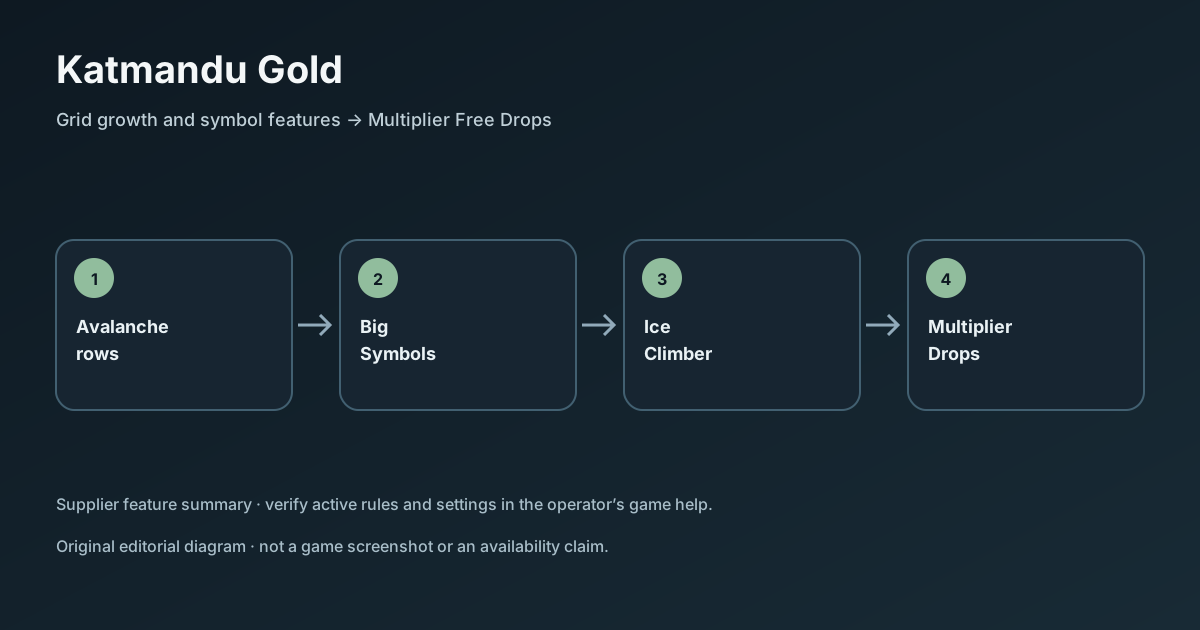
Katmandu Gold is an ELK Gold Series slot where wins can grow the grid through Avalanches, while Big Symbols, Expanding Win and Ice Climber alter symbol positions. Three or more Bonus symbols start Multiplier Free Drops, where Bonus symbols can increase a multiplier. This guide explains those states without importing unverified RTP or win-cap figures from secondary reviews.
The short answer
Katmandu Gold is the fifth ELK Studios Gold Series title in the supplier’s catalogue. Its public product page describes a six-reel slot with Avalanches that can add rows, Big Symbols, an Expanding Win feature and an Ice Climber feature. Three or more Bonus symbols start Multiplier Free Drops. Bonus symbols that appear in that feature add to the multiplier for the remaining drops. The supplier also describes a bonus-purchase option in its public feature summary; whether a particular operator enables any such option must be verified in its own current help and local context.
The feature combination makes the order of events important. A win may clear symbols and grow the grid; a Big Symbol occupies more than one position; Ice Climber transforms symbols above itself; Expanding Win replaces a path under its own condition; and a bonus can preserve a multiplier across drops. These effects are not interchangeable. The current ELK Game Data Sheet was linked but returned HTTP 403 when checked on 7 October 2026. I therefore do not state an active RTP, volatility, win cap or stake range, and I do not claim that a New Zealand operator offers the game.
Establish that the game is Katmandu Gold
Confirm the full game name in the loading screen, supplier label and rules panel. ELK has several Gold-named games, and the series identity does not make their features or math identical. A page about another Gold title can help a reader recognise the visual family, but its return percentage, cap, symbols and bonus purchase price cannot be copied into this one. If the casino lobby shortens the title, use the help panel to verify the complete name before comparing sources.
Record the date on which the rules were inspected and any version shown. Then verify that the client uses the feature names discussed here: Avalanche, Big Symbols, Expanding Win, Ice Climber and Multiplier Free Drops. If a translated operator interface uses a different name, map the label to the rule text rather than relying on the artwork. A snow or mountain theme does not reveal how a symbol transforms or whether the bonus multiplier persists.
The supplier page is a primary source for broad product features. The operator help is required for the settings of the specific game instance. Third-party reviews are a useful index to questions people ask, but they may refer to a different market, an earlier release or a special mode. The distinction is especially important for RTP, stake range, volatility and bonus purchase terms.
Reels, rows and “ways” as a changing grid
ELK describes a six-reel grid whose row count can rise during a sequence. The public feature page says Avalanches add rows and gives a maximum of 531,441 ways. A ways count is a count of possible symbol combinations across reels in a particular grid state; it is not the chance of winning or a multiplier on every award. The displayed maximum belongs to the largest described arrangement, not necessarily the starting state or every spin.
When an Avalanche occurs, first identify the winning symbols that are removed. Then look at the spaces they leave and the symbols that fall into them. A later winning arrangement can continue the feature, with additional rows becoming part of the grid according to the rule. Read the help for the exact maximum rows, how many rows can be added per event and whether the board resets before the next paid action. Avoid describing the maximum ways count as permanently active if it only appears after a progression sequence.
The word “ways” also does not supply a payout value. The paytable determines how many matching symbols are needed and what an eligible combination returns. Wild substitution, symbol size and feature transformations may influence which combinations exist, but they do not remove the need to apply the table. A visually large grid can offer many symbol paths while still producing no winning combination in a particular round.
For a written walkthrough, use a state table: rows at start, winning symbols removed, next row added, new symbols, next evaluation, final credited result. This is clearer than saying the slot simply “has over half a million ways.” It also lets a reader tell what was a feature state and what was a mathematical settlement.
Avalanche: a cascade, not a new wager
An Avalanche is a sequence that follows a qualifying win. The symbols that form the win disappear, leaving positions for new symbols. If a further win forms, the sequence can continue. ELK’s public summary connects Avalanche to row growth, so each stage can change both the arrangement and the size of the evaluation grid. The next step is part of the current round unless the rules explicitly say otherwise; a cascade should not be mistaken for a new paid spin.
The exact order should be taken from the in-game help. Does the game evaluate a win before adding a row? Does it add one row per Avalanche or use another rule? Are new symbols dropped at once or in separate stages? What stops the sequence? These questions matter because the same terms are used across many reel games with different timing. Do not assume Katmandu Gold follows a generic cascade model.
After an Avalanche, compare the grid before and after. The clear symbols can be identified separately from symbols newly entering the expanded row. If an eligible win appears after the drop, the game may repeat the check; if not, the round proceeds to its next defined state. The feature description explains the mechanic but not the probability that any chain continues. No amount of row growth makes a payout certain.
The history panel can show how the sequence settles. If intermediate win values are visible, check whether they are subtotals or final awards. Avoid adding the same amount twice because it appears both as an event and in the round total. Record the final credited value once, along with the original stake and currency. This procedure helps reconcile the screen without inferring the game’s RTP from a single round.
Big Symbols and position accounting
Big Symbols occupy multiple grid positions. ELK names them as a feature, but the accessible public summary does not fully set out their possible dimensions, frequency or payout treatment. The operator’s current paytable should explain how a large symbol is evaluated: whether it counts once as a symbol, covers every cell it occupies for ways evaluation, or follows a separate win rule. Do not infer a 2×2, 3×3 or 4×4 range from an unrelated review unless the exact current help confirms it.
The practical reading task is spatial. Identify the symbol’s footprint and count the affected cells. Then check whether overlapping features can use those cells, how a Big Symbol interacts with an Avalanche and whether it can be removed by a win. A large illustration can make it difficult to see the underlying grid positions; a clear help diagram is more reliable than estimating from a scaled screen.
Big Symbols should not be described as “four symbols” simply because they cover four cells unless that is the paytable’s evaluation rule. Some games evaluate an expanded symbol as one object across its footprint. Others count positions differently. The wording can affect how a reader interprets ways and payouts, so quote the current help’s precise explanation and preserve the difference between a visual cell and a paying symbol.
If the interface displays a Big Symbol during a round, note the size, the reel positions and what happens after a win. Do not assume it remains for the next spin. The state duration may be limited to the active sequence. A screenshot is an example of one event, not evidence of the full persistence rule.
Ice Climber: transformation and added space
ELK describes Ice Climber as a feature in which the Ice Climber symbol transforms itself and symbols above into higher-value symbols or Wilds, and can fill gaps below with Wilds. The key is to separate transformation from settlement. A high-paying symbol or Wild appearing after a climb changes the grid; the game still evaluates the result under its win rules. A transformation can improve a possible combination without guaranteeing one.
Read the vertical scope carefully. The feature description refers to the Climber and symbols above it, and also to gaps below. The active help should explain whether the Climber moves, which positions count as above or below, whether the feature repeats, and what happens at the grid edge. If a row has just been added by an Avalanche, confirm how that new position affects the Climber’s range. Do not invent a path through the grid based on a single illustration.
The transform target matters too. ELK says symbols can become high-value symbols or Wilds, but that does not tell a reviewer which outcome occurs in each instance. Check whether the game presents a random selection, a fixed sequence, or a condition that chooses the result. If the help does not publish a probability or a selection rule, describe the outcome categories without assigning odds.
For readers trying to follow an animated round, trace the Climber’s location, the affected symbols, the new values, any Wilds filling spaces and the subsequent evaluation. If an Avalanche follows, list it as another stage. This step-by-step account is more accurate than saying Ice Climber “turns the whole reel into wins.”
Expanding Win and feature boundaries
Expanding Win is a named feature on ELK’s product page. The accessible summary does not explain every qualifying arrangement or exactly how the expansion is settled. The current help must say what initiates the event, which symbols or path expand, how long the expanded state lasts and whether any symbols are excluded. These are the details that distinguish an actual rule from a generic description of expanding symbols.
If the feature expands a symbol across a route, track the route separately from an Avalanche. An expansion changes positions under one trigger; an Avalanche removes symbols after a win and can create a new grid state. They can appear in the same title and even in a connected sequence, but the labels describe different actions. A review should not say the expansion adds rows unless the rules assign row growth to it.
Check the interaction with Wild and Bonus symbols. A symbol might expand only if it is eligible, and a feature may exclude a particular icon. If the game help does not specify a combined event, do not improvise how two features resolve when they appear together. State the individual published rules and mark the combined order as unknown.
This caution makes the explanation useful to a person reading an operator’s client. It gives them exact questions to check: which symbol triggered the expansion, what did it cover, did the grid change before settlement, and did the paytable evaluate the expanded positions once or as a series? Those details are more actionable than describing the feature as exciting or powerful.
Multiplier Free Drops: entry and persistence
ELK’s public description says three or more Bonus symbols trigger Multiplier Free Drops. Bonus symbols in that feature add one to the multiplier for the remaining drops. This means the multiplier is a carried state: the player should read its value and how long it persists, not treat it as a separate payout. The exact initial award, trigger ladder, retrigger and terminal conditions belong to the operator’s help and must be checked there.
At entry, record the number of Bonus symbols, the number of drops awarded, the starting multiplier and any feature mode named by the client. Then note when a new Bonus symbol increases the multiplier. The supplier’s summary says the increase applies to remaining drops; it does not disclose every timing detail or whether the multiplier acts on all possible awards. The help should state when it is applied and when it resets.
A bonus symbol can both start the feature and later affect the multiplier, but its role depends on the game state. Do not write that every Bonus symbol increases the multiplier in base play. Separate entry, retrigger and multiplier collection. Likewise, do not assume the multiplier resets to a particular value after the bonus unless the rules show it.
If the operator exposes a cumulative win and a multiplier indicator, capture both in your notes. A multiplier does not mean every drop pays that multiple; it only affects eligible awards as defined by the help. If the interface labels a “Super Bonus,” record the terms separately and verify any cost before selection. No purchase price or RTP adjustment is reported here because the accessible official data sheet could not be checked.
Bonus purchase: treat cost as an independent decision
ELK’s product summary mentions a bonus-purchase feature for Multiplier Free Drops. That public statement confirms the feature category, but it does not establish that every operator enables it, what the current price is, or which choices appear in New Zealand. Any price must be checked in the actual client immediately before selection. A figure in a foreign-market review may be stale or tied to a different configuration.
If an option is present, calculate the total amount in the displayed currency before choosing it. A cost expressed as a multiple of the base bet is not a payout multiple and does not promise a positive result. Read whether the purchase enters a standard or enhanced mode, what each mode changes and whether the operator help lists a separate return setting. A feature purchase may carry a materially larger stake than an ordinary spin; it should not be framed as a shortcut to profit.
Do not recommend a purchase or use a review to pressure someone into trying one. A responsible guide explains what the menu means and where the cost appears. If terms or costs are not visible, do not select the feature. If the game is in demo mode, confirm that the credits are fictional and still do not use that sample to estimate long-run return.
Because the linked official Game Data Sheet was inaccessible, this page cannot establish the current mathematical relationship between base play and any purchased mode. It records only the public feature description and leaves the active operator price, eligibility, RTP and availability unverified.
RTP, volatility and cap: what the source supports
RTP is a theoretical long-run figure, not a per-session promise. A valid number needs a source, a title/build, a market or operator context and, where relevant, a specific mode. ELK’s readable Katmandu Gold product page explains features but does not provide a verifiable active RTP in the accessible text. The linked official Game Data Sheet returned HTTP 403 on 7 October 2026. Accordingly, no RTP value is stated as confirmed here.
Secondary reviews publish several percentages, volatility labels and win-cap numbers for Katmandu Gold. The sampled pages do not all make clear whether a number refers to base play, a purchased mode, a certain date or a particular market. Some even mix maximum win information from one configuration with bonus purchase descriptions from another. Those entries may help a reader discover what the operator’s help should contain, but they are not proof of the current account’s setting.
Volatility also requires attribution. A numerical score on one site and a “high” rating on another may use different scales. Do not infer volatility from the 531,441 ways headline, the row-growth feature or the existence of a multiplier. The official accessible page does not state a current rating. If a supplier’s data sheet or operator help becomes available, report the label exactly and identify its publisher.
The accessible official summary does not establish Katmandu Gold’s maximum win or local stake limits. A secondary win cap is not safe to repeat without the applicable data sheet. Check whether the active help expresses a cap per spin, round or stake multiple, and whether bonus sequences stop when it is reached. Record minimum and maximum stake with currency, date and operator. Until then, those fields remain unverified rather than inferred.
What competitor pages get right and where they diverge
The sample checked on 7 October 2026 included SlotCatalog, Casino Hipster, Online-Slot.co.uk, Casinos.com and AllSlotsOnline, as well as ELK’s product page. These reviews can help a reader recognise the big-symbol, avalanche and bonus themes. Several explain that the grid may grow and that Free Drops can carry a multiplier. This is useful orientation, but readers should still inspect which version and market each review describes.
The main gap is numerical traceability. Secondary pages show different return percentages, volatility labels and caps, and some discuss bonus-purchase prices in currencies or jurisdictions unrelated to New Zealand. A page can present a detailed table without proving its applicability to another operator. The official public page supports the feature names, general progression and maximum ways count; it does not settle every payout figure. This article explains the rules the supplier actually documents and treats the math fields as open checks.
Another frequent simplification is describing a maximum ways count as a fixed game property. ELK ties 531,441 ways to the expanding-row setup. That is more precise than saying the game always has that many ways. The row state can change, so a review should distinguish the grid at entry from the largest feature-described state. The same standard applies to Big Symbols: a visual size range is not a paytable unless the official help states it.
Screen, mobile and demo verification
ELK’s product material recommends a desktop presentation around 1600×900 and a 16:9 ratio if the game must be scaled. That gives a reference for viewing the full grid, but does not prove that every casino client is supported on every device. On desktop, confirm that a newly added row does not fall outside the game window and that the Ice Climber’s affected positions remain legible.
On a phone, test the paytable and rules panel before play. Check that long symbol descriptions scroll, that the full stake and currency remain visible, and that a feature menu does not obscure a cost. A large symbol may fill much of a small display; use the help’s diagram if individual grid cells are hard to count. This review did not operate a casino client on a phone and does not claim that the current mobile version was tested.
Demo status is operator- and location-dependent. A supplier page’s play button or a third-party review’s embedded demo does not confirm access in New Zealand. If an authorised demo is available, use it only to learn the controls and read the feature sequence. It cannot validate the active RTP, volatility or feature probabilities through a small number of rounds. No demo was opened for this article.
New Zealand availability and advertising boundary
No New Zealand operator integration was checked. A listing on the ELK catalogue proves the supplier documents the title, not that any particular operator carries it or that a reader is eligible to play it. Verify the operator’s current game list, terms and official local status before making an availability statement. Do not equate an overseas review’s currency or bonus offer with a New Zealand configuration.
The Department of Internal Affairs’ guidance checked 7 October 2026 says the online casino advertising prohibition is in effect and covers third parties who publish or arrange an advertisement. It identifies affiliate marketing among the initial advertising decisions. This page therefore contains no casino CPA link or promotional button. The owner should have a qualified compliance review before adding any such promotion. This article does not offer legal advice or decide how the law applies to every publication.
A useful sequence for reading the live help
Read the ordinary paytable first: symbols, winning condition, Wild exceptions and stake denomination. Next, read the cascade rule: what clears, how a row is added, what ends an Avalanche and what resets before the next paid spin. Then inspect Big Symbols, Ice Climber and Expanding Win separately. Note each feature’s trigger, affected positions, duration, evaluation order and exclusions. If an interaction is missing, keep that uncertainty explicit.
For Free Drops, record the exact Bonus-symbol trigger, drops awarded, multiplier starting value, increment event, scope of wins affected, retrigger condition and reset point. If a purchase option is displayed, note its price and mode terms separately. Confirm whether the client shows a different RTP for that mode, but never assume an adjustment that is not written in the active help.
Finally, record RTP, volatility, cap and stake bounds from the same version. Include currency, market, operator, date and source. The values should not be stitched together from multiple sources. If the operator panel omits one, contact support or leave it unresolved. A transparent list of unknowns is more useful than an apparently complete table whose numbers cannot be tied to the game a reader would actually see.
Common mistakes and a responsible approach
Do not call 531,441 ways a 531,441× win. The ways count describes combinations in an expanded grid, while a payout depends on the symbol pattern and paytable. Do not treat an Avalanche as another paid spin, or a bonus multiplier as a guaranteed multiple on every event. Do not assume a purchased mode’s price is the same across operators or markets. Each phrase answers a separate question and should be checked against a separate line of help.
The mountain artwork can make Ice Climber’s movement look like a predictable path. The animation is not a player control or strategy. Similarly, a growing grid does not make a future combination due. Describe the state transitions and avoid language implying that the player can control or forecast them.
Before any real-money play, decide how much time and money you are prepared to spend, and stop when the limit is reached. Optional feature purchases, if present, deserve a separate decision because they may cost multiple times the base bet. Do not chase losses or rely on a past session to forecast future rounds. If gambling no longer feels manageable, take a break and see the site’s New Zealand safer-gambling page for support information.
Questions readers ask
How many ways does Katmandu Gold have?
ELK’s public summary describes an expanding-row game with up to 531,441 ways. That is the stated maximum configuration, not the count on every starting grid or a payout multiplier.
What starts Multiplier Free Drops?
The supplier says three or more Bonus symbols trigger the feature. The exact award ladder, retrigger rules and starting multiplier must be checked in the active operator help.
What does Ice Climber do?
ELK describes it transforming itself and symbols above into higher-value symbols or Wilds, and filling gaps below with Wilds. The live help should clarify its exact movement and evaluation order.
Is a bonus-purchase option always available?
No universal operator availability was verified. ELK’s page mentions the feature, but an operator may configure the menu differently or restrict it by market. Read the screen and price before making any choice.
What are the confirmed RTP and maximum win?
No current official accessible data sheet or New Zealand operator setting was verified for this guide. Secondary numbers should not be treated as the active configuration.
Does a Big Symbol count as one symbol or several?
That depends on the specific evaluation rule. The current paytable must explain how its footprint is counted; do not infer it from the number of cells it covers.
Related references
The ELK Studios provider guide points to the supplier’s catalogue and explains the difference between supplier and operator information. The safer-gambling guide lists New Zealand support options. Neither confirms that Katmandu Gold is available through a particular operator.
Sources and verification boundary
- ELK Studios: Katmandu Gold product page — checked 7 October 2026; series position, Avalanche row growth, maximum ways, Big Symbols, Ice Climber, Expanding Win and Free Drops summary.
- ELK Studios: Games catalogue — checked 7 October 2026; title identification.
- ELK Studios Game Data Sheet linked from the product page — opened 7 October 2026; HTTP 403; active RTP, volatility, cap and stake limits were not verified.
- New Zealand DIA: Online gambling for advertisers — checked 7 October 2026; advertiser and third-party guidance.
- Competitor sample checked 7 October 2026: SlotCatalog, Casino Hipster, Online-Slot.co.uk, AllSlotsOnline, Casinos.com. Conflicting settings and market-specific offer details were not adopted.
No client, bonus purchase, operator account, demo or mobile version was tested. Exact RTP variants, volatility, win cap, stake range, New Zealand distribution and current interface remain unverified. No CPA links were added while the current DIA advertiser requirements are under review.
