ELK Studios game rules · South Island guide
Orbitfall: rules, feature sequence and settings to check
 Best casinos available in New ZealandUpdated 7 November 2026

Orbitfall is an ELK Studios cluster slot whose public description connects winning symbols, blockers, released features, level progression, a Lazer effect, Alien Attack and a final battle. The supplier page establishes those named relationships, but it does not establish the current operator build’s RTP, volatility, limits or New Zealand availability.
The short answer
Orbitfall is best approached as a board-state game rather than a conventional row of independent spins. ELK’s public product page describes matching-symbol clusters, blockers that can release feature symbols, a sequence of levels, an end-stage change to the blocker pattern, a Lazer feature, possible Alien Attacks and a bonus game. That outline gives a reader a useful map: first understand a qualifying cluster, then follow what it changes, and only then interpret the next board or feature event.
That supplier outline is not the operator’s full rules file. No live operator help screen was supplied for this review, so the active RTP configuration, any alternative return settings, volatility label, hit frequency, bet range, win cap, feature-mode cost and local demo status are not stated. Those are configuration facts, not safe inferences from artwork or from a review written for another country. ELK lists the title in its catalogue; this page does not claim that a New Zealand account can access it.
Identify the product before reading a review
Start with the exact name shown in the game’s information panel and confirm that the provider is ELK Studios. The official Orbitfall page and ELK’s games catalogue establish that the supplier documents a product under this name. They do not establish whether a particular casino currently carries the title, which configuration that casino serves, or whether a New Zealand account is eligible.
Keep four things separate while researching: the supplier’s public feature overview, the in-client help for the build you can actually access, an operator’s catalogue and terms, and an independent reviewer’s account. A review might give a helpful description of an animation or may show an older interface. Unless it identifies the same operator configuration and date, it cannot settle the exact settings question. A table copied across review sites can also repeat one old number many times without becoming current game help.
If you later inspect an authorised client, note the operator name, the display date, the title spelling and any version or rules revision that the client exposes. Open help before starting a paid round. If the title is absent, stop there: supplier documentation is still useful for understanding the product, but it is not proof of distribution. Do not use a search result, a generic provider badge or a broken Play button as evidence that your account can launch the game.
What the cluster board means
ELK describes Orbitfall as a cluster slot. A cluster system evaluates groups under the title’s stated matching and adjacency rules rather than paying a conventional fixed line pattern. The exact qualifying condition and how Wilds join a cluster belong to the current paytable. A graphic that shows several matching icons close together does not answer whether diagonal contact counts, whether every matching group pays separately, or whether one symbol can take part in more than one winning group.
The safe first step is to find the base-game section of help and read it alongside the symbol table. Establish how a normal result is formed, how a win is valued relative to the selected stake, what happens to symbols after a winning evaluation and whether the board changes before the next check. These are separate rule questions. A cascade or symbol removal can make the screen look like one extended event, but it may contain several evaluations and settlements.
When comparing a cluster game with a line slot, avoid saying that one format necessarily wins more often or pays better. The format describes how combinations are recognised. It does not by itself disclose the return, distribution of outcomes or frequency of a feature. Those depend on the game’s math and the specific configuration. If the help uses a special meaning for a term such as “cluster”, quote or paraphrase that meaning rather than importing a definition from a different game.
Blockers are part of the board logic
The supplier says that winning symbols fire vertically and destroy blockers, and that blockers can contain feature symbols released when destroyed. A blocker therefore has two roles in the public description: it is an obstacle in the visible board and a container that may conceal an additional game element. The distinction matters because a screen full of blockers is not automatically a screen full of active features. A contained symbol becomes relevant only when the game’s stated removal process reveals or activates it.
When reviewing a round, follow the sequence rather than describing only the animation. Ask which cluster qualified, which path or column was affected, which blockers were removed, whether any feature icons emerged and when the game evaluated the resulting state. If a blocker is destroyed but no visible payout appears, the result might still affect progression or reveal a modifier; the help must say which. Do not tell readers that each cleared blocker releases a prize or that clearing the screen is guaranteed.
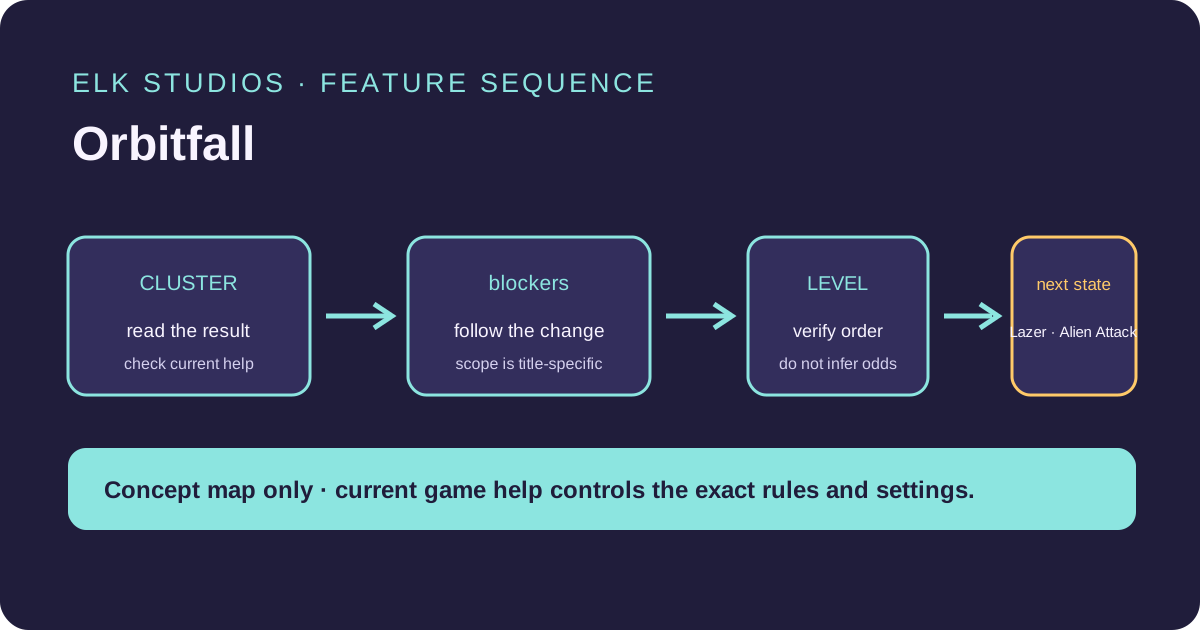
An editorial diagram can make this relationship easier to follow, but it must be labelled as a conceptual aid. It should not imitate the game screen or pretend to show a recorded result. The diagram accompanying this guide separates a winning event, a blocker change, a possible feature release and a later board check. It intentionally leaves symbol counts and payout values out because they must be confirmed against the active help.
Levels and the change in board state
ELK’s overview says that after blockers are cleared, remaining symbols carry forward to the next level. It describes a distinct final-level behaviour in which a redrop causes the blocker arrangement to move and another blocker row to enter. This makes state persistence central to the title’s explanation: the reader needs to know what carries forward, what is newly introduced and whether the next level continues evaluating the prior board or begins a separate state.
The public overview establishes the broad progression idea, not every condition. It does not substitute for a complete operator explanation of when a level transition occurs, how the last remaining symbols are treated, whether any counter resets, or what “cleared” means in the current client. Those details are important for an accurate walkthrough. Avoid inventing a number of levels, a required count of removed blockers or a promised feature trigger unless current help explicitly provides it.
To understand progression without relying on a lucky sample, use the rules page and, if a legitimate demo is available to you, observe the state labels. Record the board immediately before a transition and after it. Mark which symbols visibly persist, which blockers move or arrive, and whether the game announces a new level. A single short session can teach the interface, but it cannot establish transition probabilities or an average time to reach the final state.
The level system also affects how a reviewer should describe pace. A feature that can appear after progress does not make progress predictable. The game may present a visible route while the outcome of the next play remains uncertain. Do not describe a partly cleared board as “nearly due” or imply that prior losses make the next transition more likely. Progress graphics explain state; they do not provide an independent forecast of future results.
The final battle and end-stage wording
The supplier names a final battle feature and describes an end-stage change involving blockers moving down and a new row appearing above. That language signals that the board may become more demanding at a particular stage, but it is not enough to claim what the player must do or what payout the event produces. The phrase “final battle” is a product label, not a promise of a win and not a universal term with the same rules across other titles.
Look for a dedicated help entry describing how the battle starts, which parts of the board remain eligible, what resolves the event and how the round ends. If the client shows an enemy, a progress bar or a changing blocker wall, check whether those elements have a mechanical role or are decorative. Separate the trigger condition from the effect, and both from the result settlement. That keeps a feature summary accurate even if the interface changes.
It is also useful to distinguish an advertised “potential” from a practical expectation. A ceiling, if the current game help confirms one, says only that a result cannot exceed a defined limit under that configuration. It does not estimate how often the limit occurs. This article omits a numeric ceiling because the assigned rule requires numbers to come from current game help, which was not supplied. Third-party figures may differ by version, jurisdiction or mode.
Alien Attack and symbol removal
ELK’s public description says an Alien Attack may occur at the end of a game and that selected columns have payout symbols removed. The useful editorial point is the timing: the event is described as occurring after a game’s earlier activity, not necessarily as the opening move of a new round. The word “may” also matters; it does not say that every round includes the event.
To verify the effect in a current client, read whether the removed symbols are already settled wins, symbols left after prior checks, or a separate set that is excluded from the next evaluation. Check what happens to Wilds, blockers and feature symbols if they are in the affected area. The supplier overview speaks specifically about payout symbols; do not broaden that into “everything on the board disappears.”
A reviewer should also say whether the attack changes the result already recorded or is part of a final sequence before settlement. The round history, help text and final amount should agree. If the client does not make the ordering clear, keep the ordering unresolved in the article rather than recreating a rule from animation timing. Those distinctions help the reader follow what happened without implying that removed symbols have a cash value of their own.
Lazer: charge, activation and scope
The supplier describes a payout symbol carrying a Lazer feature. When that symbol participates in a winning combination, it charges the Lazer, which can remove a full column when activated. This is a linked mechanism: a symbol’s participation changes a feature state, and that feature state can later affect the board. The concise product page does not publish the full charge rule, activation threshold, reset timing or exact treatment of the removed column.
The help panel should answer each step independently. What qualifies a symbol to carry the feature? Does it have to be part of a settled win? What increases the charge? What visual state tells you the feature is ready? Does activation remove symbols before another cluster check, after one, or as part of a separate result? What happens if a column contains blockers or a feature symbol? Unless the current help answers, do not present these as confirmed rules.
When describing the Lazer, use words such as “can” or “the supplier describes” where the source itself is conditional. Avoid replacing that with “clears a column every time”. A column removal can change the board but does not inherently create a payout. It may reveal a feature symbol, remove an existing symbol or leave a new state for the next check. The paytable and round history decide which description is accurate for the operator’s build.
Bonus game and the separate X-iter menu
ELK’s product page names a bonus game and separately describes X-iter as an optional menu of modes. These should not be collapsed into a single “bonus buy” summary. A naturally triggered feature and a paid entry option, where available, are different routes with different starting conditions. The public supplier overview does not establish whether an operator offers each mode, its current cost, or whether the mode is permitted for a particular account.
If an authorised client exposes a bonus game, use the help to confirm its trigger, starting state, continuation rules, persistent features and settlement. The supplier’s broad overview can direct you to the right section, but it is not a substitute for the exact conditions. Avoid repeating a number of free rounds or a feature-entry price from a review site. Those are numerical terms and the correct source for this page is the current in-game help.
If X-iter appears, read its price and complete terms before considering it. Treat the displayed cost as an amount at risk, not as a way to improve the expected outcome. A selected mode may alter the entry state or how often the interface says a feature can trigger, yet that does not guarantee a payout. If the price or rules are unclear, do not select it. The editorial purpose is to explain the setting, not recommend an optional wager.
RTP, volatility and the win cap
No current operator help panel was available for Orbitfall. This guide therefore does not publish an RTP percentage, any RTP variants, a volatility label, hit frequency, minimum or maximum stake, payout cap, or mode price. The supplier product page and several review pages show why the distinction matters: a product overview or a market-specific review can report headline figures, but it cannot establish the configuration currently served to a New Zealand reader.
RTP is a theoretical return for a defined game configuration over a very large number of plays. It is not the amount a player should expect back from one evening, and it does not promise a minimum session result. If a version selector or help panel lists alternatives, identify the configuration that is actually active rather than presenting every available setting as one universal value. An unlabelled percentage is incomplete evidence.
Volatility is a broad description of how outcomes are distributed. It cannot tell a reader when a feature will happen or how much a particular session will return. A win cap, if verified, is a limit rather than a typical result. Hit frequency, when defined, should not be described as the chance of a net-positive spin unless the game help specifically says what its statistic counts. Keep these concepts separate when evaluating a published review.
When you can check the live help, record the exact label, active mode, date, operator and unit. Note whether “maximum win” is expressed against the total stake and whether the displayed return includes the original wager. If an operator does not disclose a value, leave it unknown. A missing setting is a real evidence gap, not a reason to choose the most common number in search results.
How to assess a demo without overclaiming
ELK’s public page includes supplier-level Play or asset links, but that does not prove a free-play version is open to every visitor or that it is available in New Zealand. A demo can be a useful way to learn the interface and follow a Lazer or blocker event without risking cash when the operator genuinely provides one. It does not prove the real-money version’s active RTP, eligibility, or whether the feature menu is configured the same way.
Before opening a demo, identify the website providing it and check whether it is an official operator or a third-party embed. Read its own terms and see whether the title, rules version and help panel are visible. If the demo uses a different language or currency, do not assume that the same configuration would apply to another account. No demo was launched for this guide and no New Zealand operator client was supplied.
Use a demo to learn labels and event order, not to estimate long-run value. A small number of sample rounds is especially poor evidence about a rare event. Record only what the interface actually shows: for example, where the Lazer counter sits or how a blocker changes. Do not turn one observed feature into a claim about how often it occurs, and do not imply that a free-mode outcome predicts a cash session.
Mobile play and reading the help on a small screen
The supplier recommends a desktop aspect ratio for game launch. That is not a certification of mobile usability. A casino may place the game inside a responsive web view, a browser frame or an app shell, each of which can affect how well the board and help panel fit. No phone, app or specific operator build was tested for this review, so there is no claim that Orbitfall has been tested on a particular device.
On a small screen, first confirm that the complete board is visible and that the help controls remain reachable without obscuring a wager or spin control. Open the paytable and check whether long feature entries scroll to completion. If a modal clips text, rotate the screen only if the operator supports it, zoom only when the interface remains operable, and avoid making a wager while the rules are hard to read.
Screen rotation and browser resizing can affect presentation without changing game rules, but do not assume that all controls remain in the same place. Locate the balance display, stake selector, spin control, help, history, mute and exit before starting. If the help panel cannot be read or a label is cut off, close the client and seek an accessible rules source rather than relying on memory.
A practical review checklist for Orbitfall
An evidence-led review can be completed in a short sequence. First record the operator and whether the title is actually listed for the relevant account. Then open the information panel and record the exact build or revision if one is shown. Read the core cluster rule and symbol table before describing feature activity. Keep game mechanics, account eligibility and promotional terms in separate notes.
For the board sequence, verify the cluster condition, the Wild treatment, blocker contents, how an item is released and the precise moment a new evaluation occurs. Check what persists during level changes and which behaviour changes at the final stage. For each named feature, write down its trigger, what state it changes, its effect on other symbols and how the round eventually settles. Leave any undocumented transition marked as unknown.
For financial settings, record only values displayed by the current help. Capture the active RTP, alternatives if explicitly listed, any volatility description, stake bounds, cap and optional-mode price with the applicable mode and currency. A screenshot of a help screen can preserve the exact wording, but it should be stored and shared in accordance with the operator’s rules and privacy protections. Do not publish account identifiers or personal balances.
Finally, distinguish a verified observation from an editorial explanation. “The help panel lists this feature” is evidence. “The game often reaches the final level” needs data that the public product summary does not provide. “The demo showed a Lazer activation” describes one observation, not its likelihood. This vocabulary makes the guide useful without pretending to be a laboratory test or an operator’s official manual.
Common interpretation mistakes
One mistake is treating the presence of a feature icon as a settled win. A contained feature, a charged counter and a credited result are different states. Another is assuming a cleared blocker necessarily adds money. The official overview says a blocker may contain a feature symbol; the active help must say what release means and how the result is evaluated.
Another common shortcut is assuming progression means a bonus is due. A board can carry visible state and still have uncertain outcomes. A level label, partial meter or increasingly dramatic animation is not evidence of a near-term payout. Do not increase a stake because the board appears close to a named stage, and do not keep playing to recover an earlier loss.
Readers should also avoid mixing “maximum” figures from separate modes. If a supplier page, demo and casino help each show a different term, determine which configuration each one describes before comparing. A headline payout ceiling is not the same as a return percentage, and neither tells you how long a session will last. If no current help is available, the correct answer is that the setting remains unverified.
Finally, a provider listing is not a local approval or eligibility notice. The game appearing on ELK’s catalogue confirms a supplier record. It does not establish that a New Zealand resident can use the title on a specific website, nor that the website itself can lawfully advertise to people in New Zealand. Check the current DIA guidance and operator information independently.
Set limits around a feature-heavy game
Before any lawful play, decide what you can afford to lose and how long you intend to spend. Include optional mode prices in the same limit as ordinary rounds. Do not borrow, use money set aside for bills or treat an earlier stake as a target to win back. If the game’s rules are unclear, delay play until the information can be read.
Features can make time pass quickly because each result may trigger several animations or board changes. Use a timer outside the game and take breaks. A sequence that feels active is not proof of better value, and an inactive stretch does not make a feature “due”. If you find yourself raising the limit, chasing losses or hiding play, stop and seek help. The site’s New Zealand safer gambling guide lists support options and ways to take a break.
Keep the guide’s role in view: this is a rules and verification reference, not a promise that play is available or profitable. It is possible to understand how a feature is intended to work and still decide the game is not suitable for you. The most practical outcome of reading help may be choosing not to play because a setting or condition remains uncertain.
Frequently asked questions
What type of game is Orbitfall?
ELK describes Orbitfall as a cluster slot. Its public page names blockers, feature releases, level progression, a Lazer effect, Alien Attack, a final battle and a bonus game. The full cluster and payout rules should be read in the current operator help.
What do the blockers do?
The supplier says winning symbols can destroy blockers and blockers may contain feature symbols. The current help must explain the exact removal sequence and what a released symbol does. A blocker is not itself a guaranteed payout.
Does the game always trigger Alien Attack?
The supplier describes Alien Attack as something that may happen at the end of a game. This does not mean that every round triggers it, nor does the public summary establish a probability.
What RTP does Orbitfall use?
No current operator help was supplied, so this guide does not state an RTP or alternative settings. A review-site figure is not treated as the active configuration for a New Zealand account.
Is Orbitfall available in New Zealand?
This page does not verify availability with an operator. ELK’s catalogue confirms supplier documentation only. Check the current operator’s terms and applicable New Zealand information before relying on a listing.
Is a demo available?
That depends on the website and account. A supplier Play link does not establish that a New Zealand visitor can launch a free demo. No demo was tested for this guide.
Can I use X-iter?
ELK names X-iter as an optional set of modes, but the supplier page does not establish the current operator’s offering, price or eligibility. Read the live help before selecting any paid mode.
Sources and verification boundary
Supplier primary sources rechecked 6 October 2026: ELK Studios’ Orbitfall product page for its public feature outline and ELK’s official games catalogue for supplier-level listing. The current assignment’s numeric-settings rule requires in-game help; no operator help panel was supplied. The competitor pages listed here were opened in the earlier review pass; search listings were spot-checked again 6 October 2026: OLBG’s Orbitfall review, About Slots’ Orbitfall page, Slot Gods’ review, and Game-Dog’s review. Their market-specific numeric claims are not used as active NZ settings.
The New Zealand advertising context in the article was checked against the DIA advertiser guidance on 6 October 2026. This is not a legal determination about any particular site or route.
The page paraphrases rather than reproduces ELK’s promotional text. Release date, live configuration, exact game-help numbers, operator access, demo availability, search volume and ranking are not verified. No game client, account or CPA route was opened. The New Zealand advertising notice in the site template remains in place; the requested in-text CPA buttons are omitted pending a lawful basis for publication.
