ELK Studios game rules · South Island guide
Katmandu X ELK Studios slot review: rules and features
 Best casinos available in New ZealandUpdated 7 November 2026

Katmandu X is an ELK Studios slot built around a six-by-six cluster grid, dropping symbols and a multiplier that can persist across a sequence. The supplier also describes Big Symbols, Multiplier Wilds, Exploding Wilds, a Bonus and a Super Bonus. This guide explains how those parts fit together, what the supplier’s page does and does not establish, and how to verify RTP, volatility, payout cap and current rules in the exact game help before assuming an operator offers the same version.
The short answer
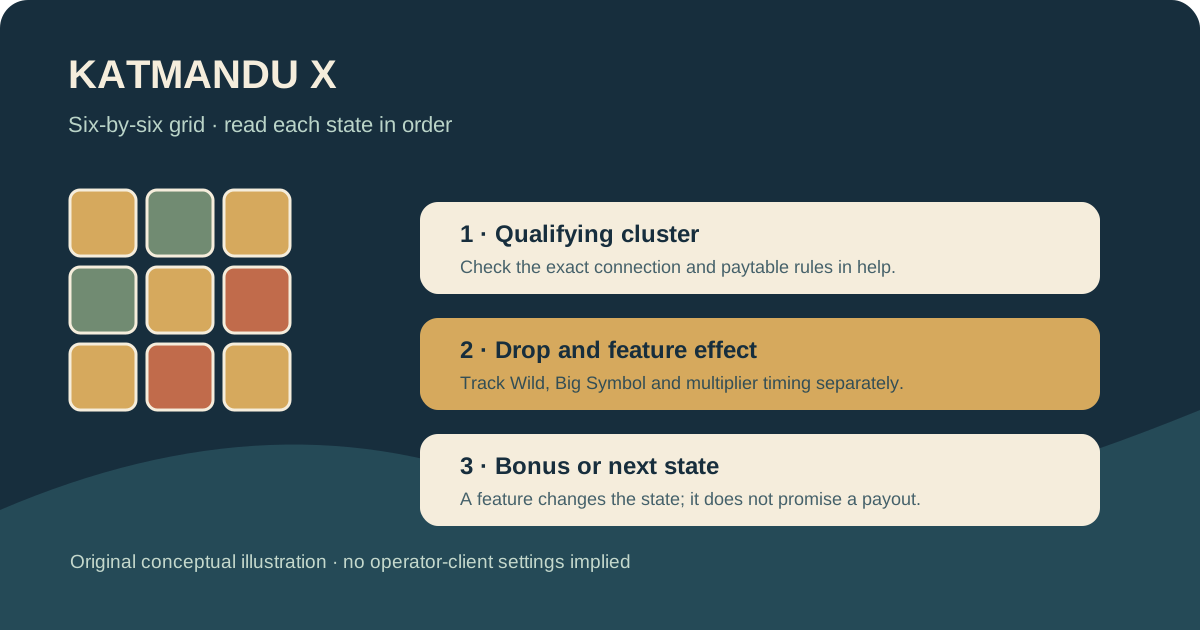
Katmandu X is a six-by-six grid slot where the supplier describes cluster wins and symbols that drop into the spaces left behind. The public feature outline names Big Symbols, Multiplier Wilds, Exploding Wilds, a standard Bonus and a Super Bonus. It also describes a multiplier that can remain active through a sequence of drops. A useful way to read a round is to distinguish the initial symbol layout, any qualifying cluster, the symbols removed, the next drop, and the resulting multiplier state. A feature animation is a change in the game state, not proof that a winning payout has settled.
ELK’s official title page, checked 7 October 2026, publishes a maximum potential of 25,000 times the bet. That number is a supplier headline about potential, not a typical result, a guaranteed prize or a statement that any New Zealand casino has the title. The official public page does not provide a current operator RTP, volatility label, precise paytable, wager range or a full versioned game data sheet. Its linked game data sheet returned an access error during this review. For those settings, the active game’s own help and the specific operator’s information must be checked.
The aim here is to help a reader understand the evidence and the feature relationships in one place. It is not a claim of personal play, a test result, or an account-level availability check. Katmandu X should also be kept separate from other ELK titles with an X in the name or from later games that use different grids and feature sequences. Similar artwork or a shared supplier does not make two titles’ settings interchangeable.
What the official page establishes
The supplier page identifies Katmandu X as its own game and describes a six-by-six layout. It names the broad ways the feature system can alter a spin: symbols form a cluster, symbols may drop, the multiplier can persist, and special Wild or oversized-symbol features may change the next evaluation. The page describes a Bonus and a Super Bonus as distinct game states. These are enough to map the reader’s questions and explain the general sequence without guessing at the exact math.
The page does not show every rule needed to calculate a real settlement. It does identify the core sequence: each win increases the progressive multiplier, every winning cluster generates a Wild, Wilds that connect to more than one cluster split between those clusters, and multiple Wilds in a winning cluster merge into a Multiplier Wild. An Exploding Wild removes surrounding symbols, increases the progressive multiplier and generates a redrop. The accessible page does not provide a complete symbol paytable, current RTP variants, volatility or operator-specific stake limits. A review should not silently fill those gaps with figures copied from another game or market.
Some competitor reviews list a specific RTP, volatility class and maximum bet. Those pages can be useful as a checklist of questions, but the supplier’s data sheet or active client help should decide the answer for the version being described. A competitor can be reporting a particular operator build, a historical release or a variant that is not the one a reader sees. If the source’s version and date are missing, the number should remain unverified rather than be repeated as current.
This distinction is particularly important for a title whose name contains “X.” The suffix can encourage readers to assume it means the same mode or purchase feature used elsewhere in a supplier portfolio. It does not prove that a specific feature-buy menu exists in this game, that the menu is enabled in a particular territory, or that an option has one universal RTP. Check the game’s actual help and visible controls before describing such an option.
How to read the six-by-six grid
A six-by-six grid has six vertical columns and six positions in each column at the point described by the supplier. A grid shape alone does not tell you how wins are evaluated. A game may pay for matching symbols connected in a cluster, but the help must define what counts as connected, how many symbols are required, which symbol types are eligible, and whether the cluster must touch a particular starting edge. Do not infer those rules merely from a screenshot or from another cluster slot.
The practical first question is: what exactly makes a winning group? Look for the game’s help entry that labels a cluster or winning combination. Does it require adjacent symbols horizontally and vertically, diagonal adjacency, or a different connection rule? Is a symbol removed only if it participates in a valid combination? Does a Wild substitute for regular symbols, and are there symbols it cannot replace? Those details affect what remains on the board after a win and which spaces are available to refill.
Once a qualifying group is identified, check how the game handles the empty positions. The official overview uses the language of symbols dropping, but the active help should confirm whether new symbols enter from above, whether all cleared positions refill at once, and whether the game checks for another win before the sequence ends. A drop can create a new cluster, which can create another drop. It is useful to treat each drop as a distinct state rather than mentally treating the whole animation as one giant combination.
Keep the displayed board size distinct from any feature that changes symbol dimensions. Big Symbols can occupy more than one ordinary position, but the public summary does not by itself establish how a larger symbol is counted for cluster connection or payout. Read whether a Big Symbol is a single expanded object, multiple matching positions, or a symbol with its own valuation. If it overlaps the edge of a grid or covers a visible cell, the help should explain how the other positions resolve.
Clusters, drops and ways of settling a result
Cluster games can be difficult to follow because the board changes more than once before the final credit appears. To understand a result, separate the initial layout, each cluster that the game recognises, the symbol removal, any new drop, and the end of the chain. This makes it easier to see which group contributed to a payout and which feature changed the later state. It also avoids counting a symbol twice when it appears in a follow-on animation.
Use the in-game paytable to learn whether a cluster’s value depends on the number of matching symbols, the symbol identity, or both. A lower symbol may require a larger group than a premium symbol; a Wild may substitute but not have a separate direct value. The supplier page does not publish a full current paytable in the accessible text, so this guide does not invent a smallest cluster or a table of prize values. Record the actual values from the active help if comparing versions.
ELK states that every win increases the total progressive multiplier and that the updated value applies to all upcoming wins. This makes order central: a win updates the multiplier for later wins in the round, so a reader should not apply the new value backwards to an earlier result. The supplier’s overview describes the direction of the change but does not publish the complete symbol paytable or every operator setting. The active help should still be checked for the client’s exact display and settlement details.
A useful hand-written ledger has one line per state: cluster count and symbol, feature symbol present, drop result, multiplier displayed, and settled win if shown. This is an observation aid, not a way to predict the next outcome. It can help explain a completed round to support or identify a confusing help entry. It does not improve the random outcome, establish the game’s return, or show that a feature is “due.”
Persistent multiplier: what persistence does and does not mean
ELK describes a persistent multiplier as part of Katmandu X. Persistence usually means that a stated value remains available across more than one step or spin, but the exact scope is always title-specific. The active game help should say when the multiplier starts, what causes it to increase, whether it applies to all eligible wins or only certain symbols, and what ends or resets it. Do not assume that a value carries from one independent paid spin into another simply because it remains visible during a drop sequence.
The word “multiplier” describes a mathematical operation, not a promise of a larger payout. If a rule says a qualifying win is multiplied, check the base value to which it applies. A multiplier of a win is different from a multiplier of the stake, and a feature’s visual “x” marker can refer to a specific prize or phase rather than the whole game. The help page should define whether it multiplies a cluster payout, an individual symbol amount, a bonus award or a round total.
The timing of the multiplier matters. Suppose one cluster wins and a feature increases the meter before the next drop. The question is whether the first win uses the old value and the following one uses the new value, or whether the game changes the value before settling the first cluster. A single animation may not reveal the order. The official rules text or a recorded example in help should. If the source is silent, describe the visible sequence without asserting a calculation formula.
Persistence should also be scoped to the right game state. A feature might persist over consecutive drops in a spin, through a bonus round, or for a limited number of later actions. Those are materially different. The available supplier overview establishes that persistence is part of the product description, but not every reset condition. Readers should open the help’s feature section and note the exact start and end conditions rather than relying on the adjective alone.
Big Symbols and their practical role
Big Symbols are a named feature in the supplier’s description. An enlarged symbol can affect several positions on the board, but that visual footprint does not automatically tell the player how it scores. It could behave like several adjacent matching icons, have a separate payscale, or interact with clusters in a specific way. The operator help needs to explain its size, whether it can be a Wild, how it connects to ordinary symbols, and whether any blocked or covered cells are still evaluated.
When a Big Symbol appears, first identify its symbol type. If it is a premium icon, the next question is whether the game counts it once or by occupied positions for a cluster. If it has Wild status, find out whether it substitutes for every standard symbol or excludes bonus markers. A symbol can have a large animation without being a Wild. The label in the paytable, not the artwork, determines its role.
The second question is how a Big Symbol interacts with the drop sequence. If part of the symbol belongs to a winning cluster, does the complete large symbol disappear, or only the relevant cells? Does the empty area refill in a way that preserves the board’s shape? Does a Big Symbol remain fixed through one step? The official overview does not specify these low-level settlement details in the accessible text, so the guide cannot turn them into firm claims.
This is a good example of why a feature label can be accurate while still incomplete. “Big” tells you about size but not about payment. “Wild” tells you about substitution but not about value or excluded targets. A responsible review explains what the supplier confirms and then gives the reader a short list of questions for the game’s own help. It does not present a plausible interpretation as if it were a published rule.
Multiplier Wilds and Exploding Wilds
The official Katmandu X page names Multiplier Wilds and Exploding Wilds. These labels suggest two distinct roles: one combines Wild substitution with a multiplier property, and another feature changes or clears symbols through an explosion event. That is a useful high-level identification, but it is not the full mechanic. The help panel must define when each symbol appears, which regular icons it can substitute for, and whether its effect applies immediately or only during a later drop.
For a Multiplier Wild, check whether the number shown belongs to that one Wild, an entire connected cluster, a whole cascade or a broader bonus state. If multiple multiplier symbols are present, find whether the values add or multiply and how a maximum is applied. Do not calculate a payout using a familiar formula unless the game explicitly describes it. A symbol’s animation can reveal when it is on the grid without explaining the settlement order.
For an Exploding Wild, the key issue is the affected area. Does the explosion remove only adjacent icons, convert them, clear an entire row, or trigger the next set of drops? Does the Wild itself remain, vanish or leave a multiplier behind? Is the feature available in the base game and the bonus, or restricted to one? These are testable help questions. The public summary names the feature but does not answer all of them, so operator-specific details remain unverified here.
When two special effects occur in one sequence, resist the assumption that the most dramatic animation controls all of the other rules. One feature may change a group, and another may alter the value of a qualifying result. The order can matter. Write down which event appears first and look for a line in the official help describing interaction. If no interaction rule is stated, call it unknown instead of extrapolating from a similar ELK title.
Bonus and Super Bonus boundaries
ELK’s public description identifies both a Bonus and a Super Bonus. It states that three Bonus symbols trigger the Bonus, that the progressive multiplier persists through the Bonus, and that additional free drops can be triggered. One Super Bonus symbol together with two Bonus symbols starts the Super Bonus, which has a guaranteed Super Wild Strike in every free drop. Those are supplier-published conditions. The in-game help still matters for the active operator build, bonus paytable, free-drop count and any version-specific settlement detail.
A bonus state may use the same grid as the base game while changing the number of drops, the persistence of a multiplier, or the availability of special symbols. Those are important differences because they alter the sequence, not just the artwork. Check whether the bonus begins with a fixed multiplier, whether it can be retriggered, what stops it, and whether any accumulated value carries over. If the help uses a “free drop” or “free spin” label, note which exact action is free and whether its award has any special limits.
The Super Bonus is a distinct supplier-described feature state, not evidence of a paid entry option. Its confirmed difference is the combined symbol trigger and guaranteed Super Wild Strike at the start of every free drop. A bonus’s name does not establish a higher expected return or an increased chance of winning. To compare its rules, create a two-column note: trigger; starting layout; multiplier state; Wild Strike behavior; retrigger; end condition; payout cap. Fill the remaining fields only from active help. The supplier headline maximum does not explain how likely the maximum is.
ELK’s official page identifies X-iter for Katmandu X and describes five game modes, ranging from a 2× bet mode with more than double the chance to trigger a Bonus to a 500× bet Super Bonus entry. Those are supplier-level mode descriptions, not proof that a particular operator enables the menu or that it is available in New Zealand. Check the exact client’s menu, price, RTP disclosure and mode rules before giving a market-specific account of any paid route.
Reading RTP, volatility and the maximum potential
No reliable current RTP value or volatility label was available from the official Katmandu X information page checked for this article, and its linked game data sheet returned an access error. The 25,000× maximum potential is shown by ELK, but that does not fill the other fields. Third-party pages list values, yet without a transparent source and a version matching the operator client, those numbers should not be treated as verified settings for New Zealand. The exact help screen is the right place to confirm them.
RTP is a long-run theoretical model value for a particular game configuration. It is not a promise that an individual session returns a set percentage, nor does it indicate how soon a win occurs. If a game has multiple configurations or feature modes, each may have a separate theoretical value. When recording an RTP, record its source, date, mode, and whether it applies to a feature purchase or ordinary play. If the help does not state a value, report that it was not stated in the available evidence.
Volatility describes the shape of outcome variation, but labels such as low, medium or high are broad summaries rather than precise forecasts. The official description reviewed here does not assign a published volatility category. A third party’s label could reflect a particular build or its own interpretation. Readers should not translate “high” into “large wins are likely” or a quiet sequence into evidence that a larger result is due. A volatile game can still produce any sequence allowed by its math model.
Maximum potential is an upper-bound marketing figure, not an expected win. The supplier page states 25,000 times the bet. This should be attributed to the supplier and kept distinct from any operator cap, displayed win limit, currency amount or contribution condition. A game help screen may express a cap differently or include special exclusions. Do not convert the number into a cash amount without a verified stake and currency. The cap does not describe how often a maximum outcome occurs.
A careful way to compare a review with game help
Third-party reviews are useful when they add screenshots, explain feature flow in plain language, or identify where a player may be confused. They are less reliable when they repeat a percentage without a version, combine a max potential with an unrelated volatility claim, or compare the title with a sequel as if their paytables match. On 7 October 2026, search results for Katmandu X included slot catalogues and independent reviews, some of which supplied numerical settings not available in ELK’s public data sheet during this check.
Use a comparison table for your own notes, not as an endorsement list. Give each claim a field: game title, mechanic, RTP, volatility, maximum potential, bet range, feature access and regional availability. Next to each claim, add the source and date. A supplier feature page can support the mechanic name. A current operator client can support its own settings and access. A third-party review can guide further investigation, but should not overrule a dated help panel for the version in play.
If two reliable-looking sources disagree, compare their dates, title labels and described modes before deciding one is wrong. An operator may use a lower RTP configuration than the supplier’s general model. A review may refer to a bonus mode while another refers to the base game. A version change or jurisdictional restriction can explain a discrepancy. If the sources cannot be reconciled, state the disagreement and avoid selecting the more attractive figure.
Do not use a test video or demo result as evidence of expected return. A video demonstrates one sequence, not a statistically meaningful sample. A demo can show interface and basic flow while using a version that differs from real-play settings. It can be helpful for identifying buttons and reading animations, but any published numerical setting still needs the game’s current help or official configuration document.
New Zealand availability and account-specific terms
ELK’s “Live now” or game-catalogue listing, where displayed, is a supplier-side release indicator. It does not show that a particular casino distributes the game in New Zealand, that an account can launch it, or that the same game settings are used in every market. Availability must be verified on the relevant operator’s own current site and in its game lobby. This review did not use a New Zealand account or operator client and makes no local access claim.
Separate game facts from account terms. The help inside the game should explain the rules, paytable, RTP disclosure and feature sequence. The operator’s terms may explain age and identity checks, account eligibility, responsible-gambling tools, accepted payment methods and local access restrictions. A catalogue page usually cannot answer all those questions. A search engine result or affiliate listing may be stale even when the product remains in the supplier catalogue.
For a New Zealand reader, use current official operator information and check the terms before registering or depositing. If the game does not appear after sign-in or displays a regional access notice, that is more relevant than a review that says “available now” in another market. Do not attempt to bypass a location block. If an operator does not clearly state the rules, game availability, or account restrictions, ask its support team before acting.
Regulatory and advertising requirements can change, so a game article should avoid unsupported inducements or claims that direct readers into an unverified offer. This page does not include a live casino promotion or tell readers that a particular operator is suitable. It is an editorial explanation of a game’s published feature outline and the evidence still needed for a specific configuration.
Mobile, controls and demo checks
The supplier recommends a desktop resolution on its product page for the optimal experience. That recommendation does not prove the game cannot run on a phone, nor does it verify a specific mobile implementation. A phone’s view may reposition the six-by-six board, shrink the paytable or place controls behind an expandable panel. If checking a supported client, open the help at the same screen width at which the game will be used and confirm that each feature explanation remains readable.
A responsive interface should keep the grid, bet amount, balance and action controls distinguishable without hiding the current game state. On mobile, make sure an open help panel can be dismissed with a visible control, the game does not crop the multiplier display, and the player can scroll the paytable without accidentally changing the stake. If a screen rotates, verify that no portion of the rules becomes inaccessible. These are usability checks, not evidence of game fairness or improved odds.
If a demo is offered, treat it as a way to understand navigation, not a promise that the real-money version has identical settings. Check whether the demo contains the same game title, software version, feature list and paytable. A demo may use virtual credits and not require an account, but access conditions vary by operator. The official public Katmandu X page checked here does not establish a New Zealand demo route.
Before interacting with any game, understand the cost of a spin and set a time and spending limit. If promotional or account controls obscure the game’s rules, use the help panel or pause. Do not increase a stake to chase a feature, and do not treat demo play as proof that a paid mode is favourable. Features can add steps and visual variety without changing the uncertainty inherent in the outcome.
A reader’s feature-verification worksheet
Start with the title exactly as displayed and the source date. Write “Katmandu X” rather than shortening it to “Katmandu” if the active client shows the X suffix. Next, record the base board shape and the game’s win definition. Note whether the help calls the wins clusters, how it defines connection, and what happens after a qualifying cluster. This provides the skeleton for understanding all later effects.
For each feature, use one row with four questions: what triggers it, what state changes, how the change affects an eligible win, and what resets it? For the persistent multiplier, find the relevant start and reset. For Big Symbols, identify size and scoring. For Multiplier Wilds, identify substitution and multiplier scope. For Exploding Wilds, identify affected symbols and next-drop treatment. For Bonus and Super Bonus, record separate triggers and end conditions. An empty field means the available source did not answer it; it is not permission to guess.
Create a second block for math settings: RTP, volatility, maximum potential, stake range, currency, and any paid feature option. Add the source document, version and date to each field individually. Do not fill a missing operator field with a third-party number unless the operator confirms it. If the game help shows one value and a review another, keep both in your note and investigate the version difference before publishing a comparison.
Finally, record what remains outside the game rules: country eligibility, operator availability, age or identity terms and safer-gambling controls. Those are account or regulatory facts, not symbol mechanics. Keeping them separate gives the reader a more accurate decision path and helps editors update only the fields that actually changed when an operator or supplier revises a page.
Frequently asked questions
Is Katmandu X a six-reel slot?
The supplier describes a six-by-six grid. That wording indicates six columns and six positions in the described layout, but it is not a full rule specification. Check the active game help for the exact way wins are evaluated and whether a feature changes the grid.
What is Katmandu X’s RTP?
The official public game page checked on 7 October 2026 did not expose a verified current RTP, and its data-sheet link returned an access error. Use the help shown in the exact operator’s game client. Do not treat a third-party value as universal.
What is its maximum win?
ELK’s official page states a maximum potential of 25,000 times the bet. This is a supplier-published potential, not a typical payout or guarantee. Confirm how the active operator’s help describes any cap or excluded mode.
Does the game have X-iter or a bonus buy?
The accessible official game summary identifies a Bonus and a Super Bonus but does not establish that a paid entry option is available in every version. Check the actual game menu and help; a supplier portfolio feature should not be assumed to exist in each title or territory.
Is Katmandu X available in New Zealand?
This review did not verify a New Zealand operator listing or account launch. A supplier’s catalogue or release label is not proof of local distribution. Check the current operator’s own lobby and regional terms.
What should I check before using a demo?
Confirm that it is the exact title, read its help and paytable, and treat play as interface familiarisation. A demo session cannot establish expected return or prove that a real-money client uses the same configuration.
Are Big Symbols and Multiplier Wilds interchangeable?
No. The supplier names them as separate feature concepts. The game help must explain whether a Big Symbol is simply enlarged, whether it has Wild behaviour, and what a Multiplier Wild multiplies. Do not infer the interaction from artwork.
Sources and date checked
- ELK Studios, Katmandu X official game page, checked 7 October 2026. The linked game data sheet returned HTTP 403 during this review.
- ELK Studios, official game catalogue, checked 7 October 2026.
- Competitor pages reviewed 7 October 2026: Hideous Slots, No Deposit Casino Guide, Fruity Slots and SlotCatalog. Their reported settings were not used as operator-verified New Zealand values.
