ELK Studios game guide · South Island guide
Skibblings: rules, features and settings to check
 Best casinos available in New ZealandUpdated 7 November 2026

Skibblings is built around lanterns between the reels, hero symbols that interact with those lanterns and a cannon that collects Skibblings for a later feature. ELK’s public page outlines those relationships, but current operator help is needed for exact rules, RTP variants and payout settings.
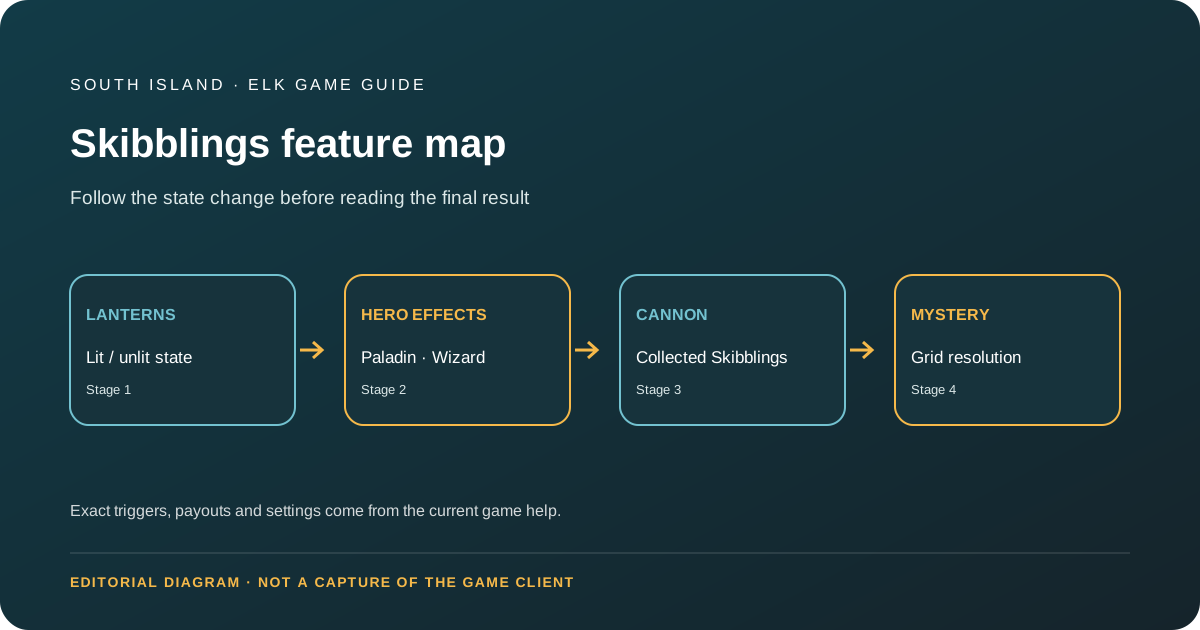
The short answer
Skibblings is an ELK Studios slot whose public feature summary centres on three connected ideas: lanterns positioned between reels, Paladin and Wizard symbols that interact with lit or unlit lanterns, and a cannon that stores Skibblings before a Cannon Blast resolves them as mystery symbols or mystery-symbol multipliers. A Skibbling King can add mystery symbols to the grid or add bonus symbols to reels. That gives readers a useful map of the feature language, but it does not replace the current help panel inside the exact casino build.
This review therefore separates supplier-described mechanics from facts that still need operator confirmation. No current operator game-help sheet was supplied for this assignment. The page does not state a configured RTP, volatility, stake range, feature probability, maximum payout, bonus-buy price or exact release date. It also does not claim that Skibblings is available to New Zealand accounts. ELK’s catalogue listing establishes that the studio documents the title; availability and settings are separate questions.
Identify the exact title before comparing details
Start with the title, provider label and help panel visible in the game client. Compare the spelling with ELK’s Skibblings page and the ELK game catalogue. These sources help confirm which supplier product a page is describing. They do not prove that every casino integration uses the same build, shows the same modes or exposes the title in New Zealand.
Record the operator name, the date the help panel was opened and any build, revision or mode label shown. A useful note distinguishes the standard game from an optional feature menu, a bonus state and a demo environment. If the lobby says “Skibblings” but the client’s information panel uses another label, preserve both exact strings and flag the mismatch for follow-up instead of silently normalising it.
The product name is distinctive, but similarity to another ELK title does not establish shared math or rules. A familiar cannon, lantern, Wild, bonus or “X-iter” label can describe a different interaction elsewhere. Keep this page about Skibblings alone and use other ELK pages only as navigation, not as evidence for this title’s settings.
Read the screen as a set of states
The best way to follow a feature-heavy round is to label each visible element by its job. A payout symbol belongs to the paytable. A lantern has a lit or unlit state. Paladin and Wizard are feature symbols with different lantern interactions. Skibblings can be collected into a cannon, and the cannon’s later effect changes grid positions into mystery outcomes. Treating these as one undifferentiated “bonus animation” makes it difficult to understand why the board changed.
At the start of a round, note what the client identifies as the active grid, where lanterns sit relative to the reels and what counters or collection areas are visible. After a win or feature animation, pause and ask which state changed: did a lantern light, did a hero activate, did the cannon collect something, or did symbols on the grid become mystery symbols? This sequence-based method is more reliable than trying to infer a rule from colour, sound or animation alone.
Do not assume that an effect shown at the end of a spin belongs to the next paid round. A game may settle a feature before ending the round, but only its current rules and history can establish the boundary. If the client offers round history, compare the displayed initial wager, all feature steps and the settled result. Describe an unclear transition as unresolved rather than inventing a timing rule.
Lanterns: track the state change, not the decoration
ELK’s public summary says a win crossing a lit lantern can add Skibblings to the cannon, while the Wizard lights unlit lanterns and the Paladin collects from lit lanterns when each takes part in a win. The useful concept is the relationship between a win path and the lantern state. A lantern is not merely background art if it changes what the hero symbols can do.
When reviewing a loaded build, look for a rule that defines what “crosses” a lantern means. The grid positions and lantern markers may be adjacent, aligned or connected by a path; the visual design should not be treated as a complete definition. Check whether the win needs to pass through the marked position, touch a neighbouring reel or meet another rule in the help panel. The public overview does not explain every geometry or priority rule.
Then inspect how the game marks a lantern as lit. Does it begin in a known state, change after a Wizard, remain lit for the next event, or reset at the end of the round? Record what the help explicitly says about persistence and what the client visibly shows. If the game has multiple lantern states, use the exact terms from its information panel rather than abbreviating them in a way that could hide a difference.
The distinction between lighting and collecting matters. Lighting an unlit lantern changes a later opportunity; collecting from a lit lantern appears to transfer stored Skibblings to the cannon. Those are two steps, not a guaranteed payout. The subsequent cannon effect still needs its own resolution and the resulting mystery symbols must form a qualifying outcome before a payout can be established.
Paladin: a collection effect with a condition
The supplier describes the Paladin as collecting Skibblings from lit lanterns when it activates as part of a win. That sentence gives the feature’s high-level role and one condition: the symbol must activate in a winning context. It does not establish what symbols form the win, which positions qualify, how many lanterns are checked or whether a collection effect also changes the round’s settlement.
To read a Paladin event, identify the winning combination first, then follow the game’s sequence. Note the Paladin’s position, which lanterns visibly respond and whether a cannon counter or another display changes. The help panel should clarify whether all eligible lit lanterns are collected together or whether the event evaluates them individually. Do not infer a collection amount from the animation duration or the number of visible creatures.
If the feature appears with a Wizard in the same round, do not assume an order based on the symbols’ screen positions. One could light lanterns and another could collect from them; the question is whether the new lights are included immediately or only in a later event. This is exactly the sort of interaction that needs either a clearly worded rule or a documented game-history example from the active client.
For a concise review, describe Paladin as a lantern-to-cannon collection feature and list the activation and persistence details only when the current help supports them. That keeps the explanation concrete while avoiding an unsupported claim that every Paladin win fills the cannon or guarantees a follow-up feature.
Wizard: the other half of the lantern interaction
ELK’s public description assigns the Wizard a different job: it lights unlit lanterns. That makes the Wizard a state-changing feature, not a direct synonym for the Paladin. In a review, keep “lights” and “collects” separate. The former can prepare lanterns; the latter can move stored Skibblings into the cannon when the appropriate conditions are met.
The help panel should answer whether Wizard needs to be part of a qualifying win, how the game identifies an unlit lantern, whether the lighting lasts and what happens if every visible lantern is already lit. The supplier summary names the interaction but does not provide the full priority logic. If the active rules do not say what happens when no eligible lantern remains, note that limit instead of predicting a replacement effect.
Look at one event at a time. A Wizard graphic can appear alongside other feature animations, but an animation does not prove which state was used first. If a lantern changes colour before another symbol activates, the visual ordering may be only presentational. Use the help text and round record to distinguish a true rules sequence from a decorative sequence.
The practical value of the Wizard description is that it suggests what a reader should monitor: unlit markers, newly lit markers and whether later wins can interact with them. It does not support a statement about how often Wizards appear or whether they improve the theoretical return. Those are configuration or probability questions and should remain unanswered until an authoritative current source is available.
Skibbling King: distinguish mystery and bonus outcomes
The Skibbling King may add mystery symbols to the grid or add bonus symbols to reels, according to the public product page. These outcomes are different. A mystery symbol affects how a grid position is resolved; a bonus symbol can contribute to a separate feature condition. A review should name the observed branch instead of describing both as one generic King effect.
The current game help is needed to explain whether the King selects an outcome randomly, whether the two outcomes have different trigger conditions, which reels or spaces can be affected and when the resulting symbols are evaluated. Do not assume that the King guarantees a mystery or bonus outcome on every appearance. The wording “may” signals possibility, not certainty.
When a mystery symbol appears, check whether it resolves into a chosen symbol type, whether all mystery positions share one result or whether each can resolve separately. The supplier summary does not answer those details. Similarly, if bonus symbols appear, check whether their position matters and how they relate to the bonus activation rule. Do not borrow scatter rules or trigger thresholds from a different ELK slot.
This split is important for readers deciding whether they understand a round. A King animation may look like a single event, but the game’s outcome can branch into a board-resolution event or a bonus-progress event. Explain only the branch that the interface and help establish, and keep any unknown random selection or trigger logic explicit.
Cannon Blast: stored pieces are not the same as a settled win
ELK names Cannon Blast as a feature that resolves at the end of a round after the cannon has been armed. It describes the collected Skibblings as becoming mystery symbols or mystery-symbol multipliers. This shows why the cannon is an accumulator: collecting pieces and firing the cannon are separate stages. The public overview does not provide enough evidence here to publish an operator-specific threshold or outcome distribution.
When the cannon activates in a client, record what enters the cannon, how the game signals that it is ready, what is placed on the grid and when the paytable evaluates the new state. Then check whether the resulting positions remain mystery symbols, reveal before evaluation or have a multiplier applied to a qualifying result. The visible cannon animation alone cannot answer any of those settlement questions.
A multiplier feature needs particularly careful wording. A multiplier can modify an eligible win, but its presence does not create a win by itself. If a mystery-symbol multiplier is shown, the help should explain which result it multiplies and whether it attaches to a symbol, a group or a feature total. Avoid phrases such as “every cannon blast pays” or “a full cannon guarantees a big win”. Neither follows from the supplier-level description.
In the article’s review boundary, the cannon is the central bridge between the lanterns and the final grid outcome. A useful guide traces that bridge without assigning unsupported figures: lantern interaction, Skibbling collection, ready state, Cannon Blast, mystery resolution and final settlement. This remains useful even when the exact build’s numeric fields are unavailable.
Mystery symbols and multipliers: questions the paytable must settle
“Mystery” can describe several different rules. A symbol might reveal into one common symbol type, resolve independently for each position or be selected from a restricted set. A multiplier may attach to one position or to a winning combination. The title-specific help, not a general slot glossary, decides which meaning applies to Skibblings.
Open the symbol panel and look for separate entries for ordinary Mystery and any Mystery Multiplier. Compare the label, icon and explanation in the paytable. If both have similar artwork, record their actual names to avoid collapsing them into one category. Then find the order of operations: whether an effect transforms symbols before the payline or ways evaluation, whether a multiplier applies before or after other adjustments and how the game displays the settled amount.
If the public rule list is silent on one of these details, an editor can still help by telling the reader exactly where the uncertainty is. For example: “The public supplier page confirms the mystery-symbol result, but the operator help was not supplied, so symbol-selection and multiplier aggregation are not verified.” This is more useful than copying a competitor’s explanation that may describe another build.
Do not use an apparent large number on a symbol as evidence of a likely payout. A multiplier label shows a rule parameter, not a probability, and a probability does not say what the underlying winning result will be. A responsible review separates symbol behaviour, odds and payout calculations instead of blending them into a forecast.
Bonus state and persistence
ELK says the Skibbling King can add bonus symbols, but exact bonus entry and bonus-round rules need the active client’s help. The reader should look for the title’s precise trigger, the initial bonus state, how any extra symbols affect the feature and whether the cannon retains collected Skibblings during a bonus. Do not infer persistence just because another ELK game keeps a counter between spins.
The most useful comparison is between a base-game round and a bonus round. Is the lantern layout the same? Does the cannon collect using the same rule? Are Paladin, Wizard and Skibbling King still active? Does the bonus change which symbols can appear, how a respin works or when a round ends? The public summary available for this assignment is not a complete answer to these questions.
If the game history records entry and exit states, use it to verify what was carried across. A counter that remains on screen may be decorative or may represent an actual stored feature state. Conversely, a reset animation may happen between bonus spins while the game retains another state elsewhere. The rules and history should be read together.
The article does not assign an expected frequency to bonus entry or describe it as an attainable goal. A bonus is a feature state, not a reliable route to a return. For someone assessing whether the game suits them, the better question is whether the feature’s sequence, visual density and risk profile are comfortable after reading the actual information panel.
Ordinary wins, symbol values and the paytable
Before studying the special mechanics, locate the basic win condition. The current paytable should define the active reel or grid layout, matching rules, any paylines, ways or cluster condition, the Wild’s role and whether wins can cascade or respin. None of those technical details should be imported from Skibblings screenshots or another title’s product sheet if the current build may differ.
Check how the game presents the stake and result. Confirm whether listed symbol values are multiples of the selected bet, whether a feature result is displayed separately from a normal win and how the history shows the total credited. The help should make the unit clear; a figure without a bet basis is easy to misread. This guide does not publish a paytable because no live client paytable was available.
If several outcomes occur in one round, find out whether the game shows a gross feature value, each individual win and a final total. Never add visible intermediate values unless the rules say they are cumulative. Some interface totals can replace earlier displayed values, and a feature animation can contain values that are not separately settled.
For a practical review, note whether small wins, mystery-symbol events and cannon resolutions are itemised in the history. A clear history supports learning and lets readers compare what the help promised with what the interface reports. If only a final total is available, say that the breakdown was not verified rather than implying a full audit of the game’s math.
RTP, volatility and win cap: what remains unverified
No current operator game-help screen was supplied for Skibblings. This page therefore does not state an RTP percentage or variant, volatility label, hit frequency, stake limits, maximum win, buy-feature price or probability. Those are exactly the settings most likely to differ by distribution channel or be represented inconsistently on review aggregators. A number published for another market cannot fill the gap.
RTP is a long-run theoretical return for a defined game configuration. It is not a prediction for a person’s session, and it does not promise that a particular run will return that share. Volatility describes a broad pattern of outcome distribution and does not say when a feature will appear. A maximum payout is a cap, not a target or expected result. These definitions help interpret a future help panel without substituting for its values.
When the exact client is available, open the information or paytable menu and record each setting with its wording and displayed mode. If the game lists multiple RTP options, make clear which one the operator build says is active and whether the same help screen lists alternatives. If a demo does not identify its configuration, do not assume that the demo percentage matches real play.
The safest current answer is simple: those settings need to be checked in the loaded game. No search-volume, popularity, win-rate or review-score data was provided for this package, so none is claimed here.
Optional modes and X-iter
ELK uses X-iter as a label for optional game modes on some of its titles. A search result or supplier-wide page does not establish which modes are present in a specific Skibblings client. The operator help should identify available modes, their cost basis, any changed starting state and whether the mode uses the same RTP or another configuration. This article does not advertise or price a mode that has not been verified in the current game.
Before selecting any optional mode, read all displayed terms. Distinguish a mode that changes the chance of a feature from one that starts a bonus immediately. A higher entry price is still a wager; it does not turn the outcome into a guaranteed profit. Compare the whole cost with the normal stake basis, and check how the game displays the amount before confirming the choice.
If the mode menu is unavailable in the account or region being checked, record that fact as an access limitation. Do not look for a workaround or use a different casino’s demonstration to infer local availability. A guide can remain complete about the question even when its answer is “not verified for this build”.
Feature-buy terminology is also easy to overstate. An option that changes a feature probability is not “better odds” in an ordinary sense unless the help defines the comparison and the math context. Avoid recommendation language such as “best buy”, “value mode” or “guaranteed bonus” unless the exact terms support the description and the review has a defensible basis for the judgement.
A practical inspection sequence
Use a repeatable order when the real game information panel can be opened. First confirm the client title and provider. Next read the basic bet and paytable rules. Then identify the lanterns, hero symbols and cannon display. After that, read the Skibbling King, mystery-symbol and bonus entries separately. Finish with RTP, volatility, stake, cap and optional-mode details, recording the exact mode and date.
For each mechanic, write down four items: trigger, state changed, timing and settlement. “Trigger” says what starts the feature. “State changed” says what persists or transforms. “Timing” says whether the effect occurs within the same round. “Settlement” says how the final result is credited. A short fact sheet organised this way makes it harder to confuse an illustration with a rule.
Keep a source hierarchy. The current game help is the first source for the active configuration. The operator’s own lobby or game-information page can establish whether a title is listed. ELK’s public product page is useful for supplier-named mechanics and catalogue identity. A third-party review may help identify questions, but its numbers and availability claims should not override the current client.
Save a note of what could not be inspected. If no operator game client is accessible, identify the missing evidence rather than using invented screenshots, a copied table or a “tested” label. This makes the guide straightforward to update when an exact source becomes available.
A no-money demo, if one is legitimately available
Demo access is not guaranteed by an official supplier listing. If an operator or a separately authorised demo page offers a free-play mode, confirm the interface’s own description of demo credits and whether the help screen appears to be the same build. Do not assume the demo uses the same settings or state as a real-money operator version.
A structured demo check should focus on comprehension, not outcomes. Can you find the paytable? Can you tell whether a lantern is lit? Does the help distinguish Wizard from Paladin? Is the cannon state visible? Does the history show how mystery positions were resolved? These questions test whether the game communicates its rules clearly without pretending that a short run establishes the mathematics.
Do not infer a bonus probability from a brief session. If an optional mode appears, do not select it merely to make the feature easier to observe; it can change the stake and the configuration. If a tutorial or autoplay control is present, the reader should understand it before use and be able to stop the round without pressure.
No demo link or live Skibblings client was provided for this assignment, so the article does not claim that a demo was opened or tested. The page tells the reader what to inspect if an authorised version is made available.
Mobile and accessibility checks
Small screens can make lantern markers and a cannon counter hard to distinguish from reel symbols. If viewing the game on a phone, check that the full play area fits without cropped positions, that controls do not cover the current state and that the help panel can be enlarged or scrolled. Rotate the device only if the game provides a clear orientation option, and avoid claiming a verified mobile experience without examining the exact client.
For accessibility, look for readable contrast between lit and unlit lanterns, a text label in addition to colour, and a focusable route through help and settings. Sound effects should not be the only indication of a state change. If the game relies on a sound cue to signal cannon readiness, a visual or text equivalent would make the event easier to follow with sound muted.
The design diagram on this page is an original editorial map, not a screenshot and not a representation of a tested game screen. Its arrows show a conceptual relationship from lanterns through collection to Cannon Blast. The loaded client’s layout may differ. Alt text describes the diagram so a screen-reader user receives the same high-level orientation.
How this guide differs from a generic review
Third-party reviews can be useful for seeing what topics readers ask about. The pages checked for this assignment typically lead with a feature summary, demo button and numeric specification panel. Some give detailed narrative descriptions, while others rely on a short table. Those formats do not establish which operator build or market supplied the figures, and their values should not be treated as New Zealand settings.
This page takes a narrower evidence approach. It explains the public relationship between lanterns, hero symbols, the cannon and mystery outcomes, then names the specific questions that need current game help. It does not repeat a promotional win cap, a review score, a subjective session report or a demo claim. Readers can use it as a checklist even if they never follow an external link.
The choice is deliberate because “verified settings” is part of the assigned intent. A single number without a configuration label can create false certainty. If a later editor obtains the precise operator panel, the relevant fields can be added here with the operator, mode and check date; there is no need to create separate RTP, demo, bonus or rules URLs.
Availability in New Zealand is a separate check
ELK’s product catalogue is not a casino lobby and does not identify the accounts or countries for which an operator serves Skibblings. A supplier page confirms the supplier’s documented product. A casino’s title listing is a separate claim, and access may still vary by location, account status, device or operator terms.
Do not treat search results, affiliate comparison tables or another region’s demo as evidence that the title is available to a New Zealand resident. If a named operator is eventually checked, use the operator’s current terms and lobby information, note the location and date, and avoid implying that one account result applies to every reader. No operator was specified here, so local availability remains unverified.
New Zealand’s online-casino advertising regime also affects publication of commercial links. The Department of Internal Affairs currently says the advertising prohibition is in effect, covers third parties and identifies affiliate marketing among initial prohibited advertising decisions. For that reason this draft contains no offer button or affiliate route. This is a publication hold pending compliance review, not a claim that the game itself is unavailable.
A decision framework for readers
Before spending time with any slot, decide what information you need to see in the help panel. For Skibblings, that means the base pay rule, Wild treatment, lantern-state duration, Paladin and Wizard conditions, Skibbling King branches, Cannon Blast resolution, bonus persistence and active settings. If a key rule is missing or confusing, stop and seek clarification rather than guessing from the animation.
Then consider your own limits independently of the feature design. A cannon that gathers symbols may make a sequence feel like progress, but stored symbols are not money and they do not predict the next result. Set a time and spending limit in advance if gambling is legal and appropriate for you, and do not increase it to chase a feature or recover a loss. If gambling stops feeling recreational, use the support options listed on the site’s New Zealand safer-gambling page.
Use a simple go/no-go test: Can you find the exact rules? Are the displayed settings clear? Do you understand which actions change the stake? Is the actual version available through an operator you can independently verify? If any answer is no, there is no need to proceed. The game guide is useful without a promotional click.
Frequently asked questions
What is the main idea behind Skibblings?
ELK describes lanterns between reels, Paladin and Wizard effects that interact with lit and unlit lanterns, and a cannon that can resolve collected Skibblings as mystery symbols or mystery-symbol multipliers. The current help is needed for exact event rules.
Does the Skibbling King always create mystery symbols?
No such guarantee is established by the public summary. ELK says the King may add mystery symbols or bonus symbols. The active game help should explain the possible outcomes and when they are evaluated.
What is Skibblings’ RTP or volatility?
No current operator game-help screen was provided, so this guide does not state a percentage or volatility label. Check the information panel in the exact build and mode you can access.
Is Skibblings available to play in New Zealand?
That is not confirmed here. A provider catalogue listing does not establish operator access or local account eligibility; check an operator’s current information if lawful and appropriate.
Can a demo prove how often Cannon Blast appears?
A short demo cannot establish a probability. It may help you understand the interface and feature sequence, but the exact rules and math require the current help and configuration documentation.
Sources and verification boundary
- ELK Studios: Skibblings — official public feature summary, checked 6 October 2026.
- ELK Studios: games catalogue — catalogue identity, checked 6 October 2026.
- Competitor sample and access notes:
research/batch13/SOURCE-REVIEW.md, checked 6 October 2026. - New Zealand DIA guidance for advertisers, checked 6 October 2026.
No active operator game-help sheet or named New Zealand casino build was available. Numerical settings, exact probabilities, mode pricing, demo access and local availability are not verified. The assigned CPA pair is withheld pending compliance review; the existing route was not opened or modified.
