ELK Studios game rules · South Island guide
Frogblox review: Feature Shelf, frogs and bonus rules
 Best casinos available in New ZealandUpdated 7 November 2026

Frogblox combines a Feature Shelf with jumping frogs, symbol collection, blockers and Avalanche-style redrops. The bonus can begin when blockers are removed, and ELK says the active global multiplier and remaining redrops carry into the feature. This guide explains how those states connect and which settings cannot be verified without current operator help.
The short answer
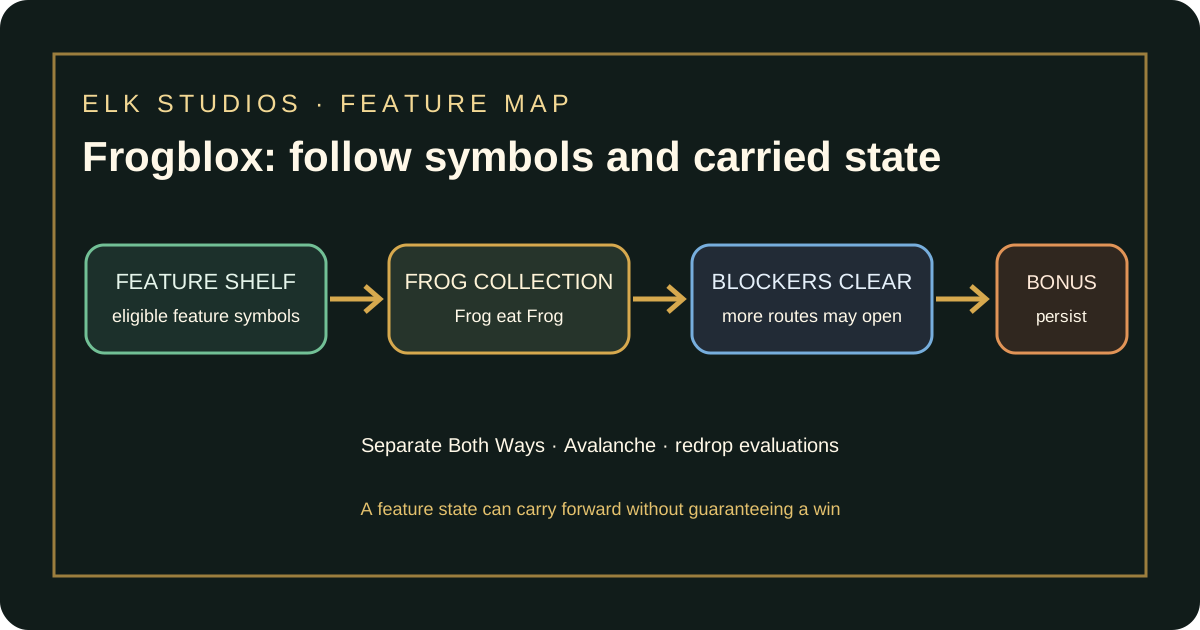
Frogblox is ELK Studios’ slot built around a Feature Shelf and frogs that can interact with symbols on that shelf. The game’s feature summary names blockers, Wilds, symbol multipliers, a global multiplier, Big Symbols, jumping frogs, Both Ways, redrops and a bonus game. A win can clear participating symbols and create an Avalanche; blockers connected to the win can also be removed, changing the number of possible ways for a later evaluation. A frog feature can collect symbols from the shelf, which is a different event from an ordinary paying combination.
The bonus begins when the main grid’s blockers are all removed, according to ELK’s public product page. The supplier says the bonus awards free drops and carries the active global multiplier and remaining redrops into that state. That makes the board state at entry important: a bonus is not necessarily a clean restart. The current operator help should explain exact collection conditions, Both Ways, the blocker rule, which values persist and what ends the feature.
This review intentionally does not give an RTP, volatility rating, win ceiling, stake range or New Zealand availability claim. No current local operator help was supplied. Several competing pages display different reel counts and mathematical values, so a reader should rely on the game’s own current help for configuration-specific facts. A supplier overview can explain named mechanics; it cannot establish what a New Zealand operator has loaded.
Confirm the title and separate source levels
Before comparing reviews, confirm that the title shown in the game is Frogblox and the provider is ELK Studios. The official product page describes the game as a slot with a Feature Shelf, frogs and blockers. It is not another ELK frog or jungle game, and its rules should not be borrowed from a title that happens to use tumble wins or collection mechanics.
Use a hierarchy of evidence. The current operator’s help and paytable explain the version offered in that account. The supplier page explains the broad product design and feature vocabulary. A third-party review may show a demo session or summarize a prior configuration. Those are not interchangeable sources. A review that confidently states a reel layout different from the official product page should be treated as a prompt to verify the current game, not as a new rule.
Search results for Frogblox include useful descriptions of the shelf and frog interactions, but also varying reel descriptions and mode details. For example, some pages give a layout or RTP figure without identifying the operator build; another describes a different reel count than the supplier page. This guide leaves those numbers out. The disagreement is exactly why the active help should be used for a factual review.
The title’s theme places an explorer in a fictional temple setting. The character and story give the visual frame, but the underlying decisions depend on the game’s rules. A design impression is not evidence of a mathematical property, and a colourful frog animation does not tell you whether a value has been collected or settled.
The Feature Shelf and the main grid
The Feature Shelf is a source of feature symbols that can enter the main game. The reader should understand what sits on the shelf, how a feature symbol becomes available and which event moves it to the grid. If a frog pulls down a symbol, that action has its own rule. If an Avalanche clears a position and allows a new symbol to drop, that is another mechanism. The shelf, grid and round history should be read as separate layers.
Start by identifying the main grid’s blockers. A blocker occupies a position and restricts how the board can form a result. The official description says connected blockers can explode when they are linked to winning symbols, increasing the ways to win. This does not mean every blocker disappears when any symbol pays. The help should define what “connected” means, how a blocker becomes linked and whether a blocker can remain when a nearby win resolves.
A symbol on the Feature Shelf is not automatically part of the main-grid paytable. It may be a feature modifier waiting to enter play. Ask whether it has a displayed value before it is collected, whether collection changes its value or type, and when the game applies the result. If the rules describe a shelf symbol as “collected,” do not assume that means a cash prize; it may change a meter, a multiplier or a later round state.
The board can change more than once within the same paid round. A paying combination may clear symbols, blockers may be removed, new symbols may drop and the shelf may send down another feature. Each stage should be checked in order. A sequence of animations can look like one continuous event, but the final amount depends on the game’s evaluation and settlement rules.
Blockers and changing ways to win
Blockers affect the spaces where symbols can appear or connect. Removing one opens a position; it does not itself create a win. If connected blockers explode after a paying result, the next board can have more routes available than the starting board. “More ways” describes the changed set of possible connections, not a guarantee that the next group of symbols will match.
A useful way to explain the mechanic is to compare before and after states. In the first state, a blocker interrupts a possible route. A qualifying win then clears its symbols and a connected blocker. The next drop fills the new spaces. The game reevaluates under its Both Ways and paytable rules. If no qualifying symbols connect, the round can end without another award. This example describes a possible sequence and does not say how often it happens.
The help should clarify whether blockers disappear only when connected to a win, whether a specific feature can remove them independently, and what counts as “all blockers.” That last condition matters because ELK says clearing all blockers triggers the bonus. A reader needs to know which grid is checked, when the check occurs and whether the bonus begins immediately or after the current chain resolves.
Do not count a visual blocker as a symbol that can pay. It may be an obstacle, a trigger condition or a space that changes the board. Use the paytable’s category and the game history to identify its role. If a reviewer calls a blocker a “symbol,” make sure that wording does not blur the difference between an ordinary pay symbol and a feature object.
Frogs, collection and Frog-eats-Frog
The supplier describes frogs jumping from the shelf and collecting features. Its “Frog eat Frog” feature occurs when one frog pulls another frog down from the Feature Shelf; ELK says that action collects all feature symbols from the shelf. The words are vivid, but the reader still needs to know when the frog can jump, which target it may pull, whether every shelf symbol is eligible and where the collected features go.
Collection is a state change. It may move one or more feature symbols from the shelf into the current round. It is not necessarily a direct win. Check whether the game displays the collection as a set of symbols, a meter, a new grid state or a result added to the balance. If the help does not define how a collected symbol settles, explain only what is visible and leave the award interpretation open.
The public description says that frogs collect feature symbols from the shelf’s bottom row and that blockers may be removed if there are no features to collect. That suggests two possible actions: collect something available, or clear a blocker when the shelf cannot provide a feature. The current help should confirm the order and whether this conditional action applies to every frog event. Do not convert an “if none are available” rule into a claim that a frog always removes a blocker.
When reviewing a frog event, record the starting shelf, which frog moved, what it pulled, which symbols disappeared from the shelf, and the resulting main-grid state. This lets you distinguish one frog’s collection from the next Avalanche or redrop. If multiple effects occur, use the round history to see which came first; a screenshot of the final grid may not reveal the causal sequence.
A frog collecting a multiplier symbol and a global multiplier changing are related but distinct claims. The first describes the target. The second describes a value applied across some scope. Check whether a symbol multiplier belongs to one eligible win, whether the global multiplier persists and how each one is combined. Never assume that two multiplier labels multiply each other in a particular order without the paytable saying so.
Both Ways and paying combinations
ELK lists Both Ways as a feature. The active help should show which directions count, which symbols qualify and whether the same combination can be paid in both directions in one evaluation. “Both Ways” does not mean every symbol on the grid counts, nor does it override blockers or the game’s connection requirements.
Read the symbol paytable and line or ways diagram together. A symbol group can look connected while a blocker prevents a valid route. A Wild may help complete an eligible combination, but the help should say what it can substitute for. A Big Symbol may occupy multiple positions and affect the visible path; its footprint does not automatically mean that it counts as several separate symbols. Check the paytable for how an oversized symbol is evaluated.
After each win, follow the Avalanche rule. The supplier says symbols that form part of a win explode and leave spaces for further drops. Additional symbols can enter, and another win may continue the cycle. The feature is a chain of evaluations inside one round, not necessarily a collection of new paid spins. The history screen should distinguish the original wager from the subsequent drops.
A round can therefore have three separate counts in a player’s notes: the number of paid base actions, the number of symbol-drop evaluations and the number of settled wins. These counts should not be conflated. A free drop or redrop is an additional evaluation under the current round, whereas a new base action begins a new stake decision. The game help should define exactly how the interface labels those events.
Bonus entry and what carries forward
ELK says removing all blockers from the main grid triggers the bonus and awards a set of free drops. The supplier also says the current global multiplier and remaining redrops are carried into the bonus. This is a persistence rule: the feature entry depends on the state that exists just before the transition. It is therefore worth noting whether the multiplier was active and whether a redrop remained when the bonus began.
Do not assume the bonus starts from a blank state. A persistent multiplier can influence later eligible outcomes, while a remaining redrop can change the number of evaluations available. The exact help should state whether the feature shelf itself carries, which symbols are retained and how a new bonus state interacts with any Wilds on the grid. If only the multiplier and remaining redrops are named, do not extend persistence to other features.
The phrase “free drops” describes a mode action, not a guaranteed award. Each drop still needs to form a qualifying result. A global multiplier can remain active even when a drop pays nothing. If the game adds a drop during the bonus, identify whether it comes from a retrigger, a feature symbol or a remaining redrop carried in from the base round. Different causes may have different rules.
For clarity, describe a bonus in stages: trigger condition, initial board, retained state, drop evaluation, any retrigger and exit condition. The game’s help may use different names, so preserve its language. If the supplier’s overview and operator screen disagree, prefer the active operator help for that version and note the difference in the review log.
X-iter and optional modes
ELK lists X-iter as a way to select particular scenarios, including a mode associated with a Super Bonus and a global multiplier starting state. Which modes appear may differ by operator and jurisdiction. Before choosing one, inspect the live menu for the price, exact state and any separate conditions. A mode description from another market is not a promise that the same option is available locally.
A feature-entry purchase is not the same as a normal spin. It pays for a named route or setup, and its result remains uncertain. A larger starting multiplier does not guarantee a qualifying win. If the option advertises increased feature chances, find the baseline and definition in the operator’s rules before paraphrasing the claim. Without that detail, do not call the purchase better value.
Check whether the game displays an RTP for each option, whether a mode is restricted to eligible accounts, and whether a purchase confirmation can be cancelled. If the price is unclear, back out. No reviewer should supply a missing purchase amount from memory or from a screenshot of a different currency. This page has no verified New Zealand operator menu to quote.
RTP, volatility and win cap
The current New Zealand operator configuration was not available for this review, so no numerical RTP, volatility, stake range or maximum-win claim is made. Third-party results provide useful questions but vary in their details. Some use a supplier description, others summarise one casino’s build, and some repeat values without identifying the version. Those sources should not be merged into a single supposed local fact.
RTP is a theoretical average tied to a defined game configuration. It does not predict a short session or tell you what one feature will return. If a casino displays variants, confirm which value applies to the open game and note whether it applies to the optional mode. If no value is displayed, say so. A number from an overseas review is not evidence of the setting used by a New Zealand operator.
Volatility is about the shape of the distribution, not an outcome schedule. A “high” label cannot say when a frog feature will occur or how long a losing sequence will last. A reviewer who plays a limited number of rounds can describe their observations, but cannot establish the underlying mathematical setting from that sample alone.
A maximum-win figure, if disclosed in the current help, is a ceiling under specified rules. It is not a likely payout, a goal or a promised return. Check whether it applies to ordinary play, a bonus or a feature-entry mode. The supplier’s promotional summary may express a potential figure, but this guide does not treat that as an operator-confirmed local cap.
This separation helps readers compare evidence. A supplier page can confirm feature terminology. A current operator help panel can confirm the active RTP or stake range. A third-party review can show how one reviewer interpreted the game. Label each source by what it can support; do not place all three in one fact table without a scope note.
Mobile play and demo access
The official supplier page describes the game’s desktop display recommendation, but that does not prove mobile support at every operator. On a phone, the shelf and grid should be visible well enough to follow where a feature symbol came from. Check whether blocker removal is easy to see, whether the multiplier remains readable and whether the help panel can open without losing the round.
The controls need to distinguish a new paid action from an in-round drop. Confirm that the spin button, stake control, help icon and any feature-entry option are separate and accessible. If the screen rotates or the browser reconnects, verify the board and account history before continuing. A paused animation is not evidence that an additional stake was placed.
A demo may or may not be offered by an operator in New Zealand. If one is visible, confirm that it is clearly marked as practice play and that the title and rules match the review. The demo can show where the Feature Shelf, help and history are located. It cannot establish the game’s real-money RTP, exact operator configuration or how frequently features occur.
Use one demo event as an example, not a test result. Write what appeared and what changed. Then use the help panel to explain the rule. Do not report “I tested the volatility” after a handful of rounds. A mathematical claim requires a disclosed source, not a memorable animation.
A practical checklist for the game help
Look for the rule on blockers first: what counts as all blockers removed, what makes a blocker connected to a win, and which event can remove one when the Feature Shelf is empty. Then check the shelf: how feature symbols are selected, where they enter and whether they can remain. Next review frog collection, Both Ways, Wild substitution, Big Symbols and Avalanche order. Finish with the bonus’s retained state and exit condition.
For the numerical panel, make separate entries for RTP and any variant, volatility or rating scale, stake range, maximum win and any feature-entry price. Do not fill an empty field with the most common value found in search. Record the game build, operator, market, mode and date beside each value. If the help shows a number but the context is unclear, the value is not yet verified for that claim.
A review editor can use a confidence label for each statement: supplier summary, current operator help, observed interface or unresolved. That system discourages invented certainty. A statement such as “ELK describes the bonus as carrying the active global multiplier” is appropriately narrow. “Every casino version retains the same multiplier” would need broader evidence and should not be made here.
Finally, ensure the wording distinguishes a feature from an award. A frog can collect a symbol, a blocker can disappear, a multiplier can remain, a redrop can occur and the round can still settle with no additional win. Accurate language helps readers understand what the game does without suggesting that any mechanic guarantees a profitable result.
New Zealand context and responsible play
The site’s New Zealand focus does not confirm that Frogblox is available at any particular operator to a New Zealand resident. Verify the current operator’s game list, terms and territorial conditions. An ELK catalogue entry proves only that ELK lists the title; a foreign demo site is not evidence of a local offer.
The Department of Internal Affairs states that online casino gambling advertising is prohibited in New Zealand and identifies affiliate marketing among initial prohibited advertising decisions. This guide therefore has no casino registration or affiliate button. Any promotional placement remains on hold for qualified review under current guidance. This is an implementation decision, not legal advice, and the rules should be checked again before publication.
If gambling is legally available and you choose to play, set a spending limit and time limit in advance. Use only money you can afford to lose; do not borrow, chase losses or keep playing because a multiplier has carried into a bonus. A persistent feature state is a game rule, not a forecast of what happens next. Stop if gambling begins affecting essential bills, work, sleep or relationships, and seek independent support.
Frequently asked questions
What does the Feature Shelf do?
It holds feature symbols that can enter the main game under the supplier’s described mechanics. The current help should explain how symbols are released, which row or position is affected and whether a collected feature becomes an immediate award or a state change.
How does Frog eat Frog work?
ELK describes one frog pulling another down from the shelf and collecting the feature symbols there. Confirm the exact trigger and target in the active help. A collection effect should not be reported as cash unless the settlement screen or rules say it is paid directly.
What happens when blockers are removed?
The supplier says connected blockers can be removed during a win, increasing the possible ways to form a later result. Removing all blockers is described as the bonus trigger. The current help must define the connection and bonus check; a blocker disappearing does not itself guarantee a win.
Does the bonus keep the multiplier?
ELK’s public description says the active global multiplier and remaining redrops carry into the bonus. Verify how the current operator version defines the entry state, eligible wins and reset. A retained multiplier does not guarantee that a later drop pays.
What does Both Ways mean here?
ELK lists Both Ways among the features. The paytable should state which directions qualify and how a result is evaluated. Do not assume that all symbols or routes count simply because the name suggests two directions.
What is Frogblox’s current RTP in New Zealand?
This review does not verify one because no current New Zealand operator help was supplied. Use the value shown for the exact title, operator and mode. Do not transfer a third-party value from another market.
Can I use a demo to test volatility?
A demo can help you learn the interface, but a short session cannot measure volatility, RTP or feature frequency. Use the current help for configuration facts and label an observed round as an example only.
Is Frogblox offered by a New Zealand casino?
No operator availability was verified in this review. Check a current operator’s game list and terms; an ELK listing does not establish a local offer.
Sources and verification boundary
- ELK Studios, Frogblox product page and game catalogue, checked 7 October 2026. Used for supplier feature names and broad mechanics.
- Competitor pages reviewed 7 October 2026: HideousSlots, Gambling.com UK, LuckyMobileSlots, AboutSlots, FruitySlots, and SlotCatalog. Their configuration-specific numbers were not used as New Zealand settings; the reel-layout and ways descriptions were inconsistent with the supplier page.
- Search review also found competitor demo/review pages with no clear current operator build. The available results did not establish a New Zealand availability claim.
- New Zealand advertising context: Department of Internal Affairs advertiser guidance, checked 7 October 2026.
