ELK Studios game rules · South Island guide
Buggin slot review: rules, feature wilds and RTP checks
 Best casinos available in New ZealandUpdated 7 November 2026

Buggin is a 7-reel, 7-row ELK Studios slot whose public summary combines cluster wins with generated Wilds, a progress meter and five Feature Wilds. A full meter collects a Feature Wild that releases after wins stop; multiple Wilds in one winning cluster can merge into a multiplier Wild. Three Bonus symbols start seven free drops, while a separate Super Bonus trigger starts with the highest number of unlocked Feature Wilds so far.
The short answer
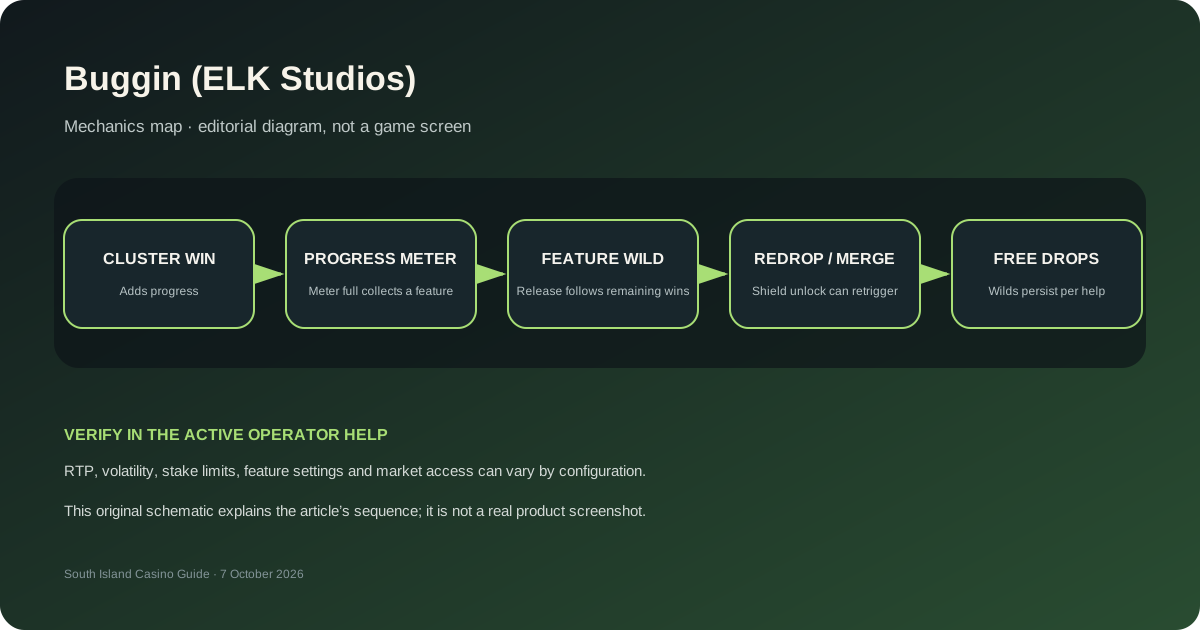
Buggin is a 7-reel, 7-row ELK Studios slot built around clusters and Wild features. ELK’s official summary says each cluster win adds progress; when the meter fills, it collects a Feature Wild, which releases when there are no more wins. Winning clusters generate Wilds, multiple Wilds within one winning cluster can merge into a multiplier Wild, and an unlocked shield can trigger a Wild Redrop with prefilled Feature Wilds. There are five Feature Wilds, but the publicly accessible supplier summary does not name each effect.
Three Bonus symbols trigger a bonus game with seven free drops, and ordinary Wild symbols remain sticky between those drops. A trigger containing two Bonus symbols and one Super Bonus symbol starts the Super Bonus; ELK says its drops begin with a refill of the maximum number of Feature Wilds unlocked so far. The official page states potential up to 10,000 times the bet. It does not display a current RTP, volatility field or operator-specific configuration in the text available for this check.
That is enough to understand the broad feature flow, but not enough to quote a number for a particular casino version. The linked supplier data sheet returned 403 during research on 7 October 2026. This guide therefore explains how to read the mechanics and which exact values remain unverified. It does not claim the game is available to New Zealand accounts. Current Department of Internal Affairs advertiser guidance also means this page has no casino offer or affiliate button pending qualified review.
Confirm the game identity before reading a review
The title in ELK’s catalogue is Buggin. Its visual setting is a garden of insects, but the rules are not inferred from the theme. Confirm the title and provider in the actual game help, then compare the heading with the exact operator listing. A publisher may label the title “Buggin slot,” “Buggin by ELK” or shorten it to “Buggin”; what matters is that the provider and game version match.
A title page may show an “upcoming” label before release or a “live now” label after release. On ELK’s current page, Buggin is marked live. That is a supplier catalogue status, not a live operator inventory or a New Zealand eligibility guarantee. A casino’s lobby, terms and displayed game help are separate sources. If one is not available, leave the claim open instead of treating the supplier’s public page as proof of local access.
The title is also distinct from other ELK games with Wilds, cluster systems or progress meters. A shared studio vocabulary does not mean the same Wild has the same substitution rule or that a full meter produces the same effect across games. Use this page only for Buggin’s described interactions. For each symbol, rely on Buggin’s own paytable and help, not on a mechanic remembered from a different title.
The product has a “7 reels, 7 rows” description. That gives the starting screen geometry, but it does not by itself state exactly how clusters are evaluated. Some cluster games require a minimum number of matching symbols and define adjacency in different ways. The paytable should say which symbols qualify, how many are needed and whether horizontal, vertical or diagonal connections count. Do not assume a generic cluster rule before reading the exact help.
Start with one cluster and follow the settlement
In a cluster format, the reader looks for a group of matching symbols that satisfies the displayed connection rule, rather than tracing one of a fixed set of paylines. A 7×7 grid may create many possible group shapes, but grid size alone does not tell you whether two symbols touching diagonally belong to the same cluster or whether a minimum group size applies. Those details are not specified in the short official summary and need the current in-game paytable.
When a qualifying cluster appears, follow the game’s sequence: identify the paying symbols, observe their removal or clearing if that is how the version presents the win, then see what new symbols or Wilds appear. ELK specifically says each winning cluster generates a Wild. That makes the next state potentially different from the first evaluation. It does not establish whether every Wild immediately creates a new win, whether the process repeats only after a new qualifying cluster or how simultaneous features are ordered. Use the game help for those exact conditions.
The distinction between “cluster wins” and “Wild generation” matters. A cluster is a qualifying group under the paytable. A Wild is a symbol with a substitution role, subject to exclusions and its own evaluation. A generated Wild can help form a later cluster, but that possibility is not the same as an automatic extra award. If a result screen shows both a cluster and Wild appearing, check which event triggered the payout and which state is carried into the next evaluation.
A practical observation note can use four columns: symbol group; whether the game marked it as a win; Wilds created or retained; and the total shown after settlement. This can make the animation intelligible without trying to infer a probability or simulate the slot. If a displayed cluster seems to break the help rule, save the round record and use the operator’s support channel rather than assuming the game counted hidden positions.
The progress meter and five Feature Wilds
Each cluster win adds to Buggin’s progress meter, according to ELK. When the meter becomes full, it collects a Feature Wild. The Feature Wild releases when there are no more wins. This is a stateful sequence: a paying cluster contributes progress; a full meter records or collects a special Wild; and a later stopping condition releases that feature. The public summary confirms this structure but not every possible meter reset or release interaction.
The phrase “five different Feature Wilds” confirms that the title contains five types. It does not identify each type’s effect in the accessible provider text. Some third-party reviews name various modifiers, but they differ in terminology and detail; importing that list without a current product help source would turn a review claim into a supposed rule. The exact five names, symbols, whether they are random or ordered, and their individual effects should be taken from the version’s help or official data sheet.
For a reliable read, open the Feature Wild explanation and record the name and effect of each one exactly as shown. Note whether it changes symbol size, expands a grid, upgrades a symbol, adds a multiplier or removes something; do not compress separate effects into a vague “power-up.” If a Feature Wild has a trigger animation, identify when the game counts it as collected and when it actually releases. The release point can determine whether it contributes to a current cascade or a later one.
The meter’s contribution is a progress rule, not a countdown to a win. A partially filled meter does not guarantee that a particular type of Wild will appear on the next spin. A full meter collects a feature according to the official summary, but it does not guarantee that the feature makes a paying cluster. Separate “feature becomes available” from “feature produces an award.” This difference keeps the explanation accurate even when several animations happen close together.
Generated Wilds, merging and the multiplier question
ELK says every winning cluster generates a Wild, and that multiple Wilds in a winning cluster can merge into a multiplier Wild. This means Wild placement and cluster evaluation can interact. The word “can” is important: the public description identifies the possibility but does not say every cluster with two Wilds must merge, which multipliers are possible or whether the resulting multiplier applies to the cluster already settled or a later one.
Wild substitution and Wild multiplier are different roles. An ordinary Wild substitutes for other symbols if the paytable allows it. A multiplier Wild changes an award by a specified factor, subject to a target and timing rule. A symbol that combines these roles should be read in the help carefully: it may substitute and multiply, or the game may define it as one role at a time. The icon’s animation or label cannot replace the rule text.
The right questions are: Which symbols can a Wild replace? Can the Wild itself be part of a cluster? When do several Wilds count as “in” one winning cluster? How is the multiplier shown? Does it apply to the current win, a new win formed after a drop, or a broader amount? Is it retained between successive evaluations? How does the game display a cap if the multiplier pushes a payout toward the maximum? If the help does not answer one of these, label that field unconfirmed rather than extrapolating from another ELK game.
An illustrative sequence may help. Suppose a qualifying cluster appears, the game adds progress, and Wilds are generated. If a later cluster includes multiple Wilds, the Wild Merge feature may convert them into a multiplier Wild. The next question is not “how big will the result be?” but “what rule says the multiplier now applies to?” That question can only be answered by the active Buggin help and the settled results screen.
Wild Redrops and the locked shield
The supplier page describes Wild Redrops as a feature triggered by unlocking a locked shield, with prefilled Feature Wilds. This is separate from a basic Wild appearing after a winning cluster. The shield condition is the feature gate; the redrop is the resulting state; prefilled Feature Wilds are part of the setup. Those should not be treated as a generic free-spin bonus or as evidence that a monetary win has occurred.
The public summary leaves several practical questions for the exact help panel. What unlocks the shield? Does a single win or a meter state contribute? How many redrops can occur? Do they continue until a non-win? Which Feature Wild positions start filled? Are the Wilds used immediately or released later? Do the redrops happen in the base game, bonus game or both? The answer may be visible in a demo or a rules screen, but a clip from another market is not enough to set the New Zealand operator version.
When reviewing a screen recording, track the shield separately from the progress meter. If a meter fills near the same time as the shield unlocks, the animations may look related even if their rules are independent. Check whether the game help expressly links them. If not, explain that both systems are present but do not claim one always triggers the other.
The redrop is an opportunity for the game to show another feature state, not a prediction of a successful cluster. A prefilled Feature Wild can have an effect described in the help, but its presence does not guarantee a win or a positive return after the original wager. An accurate guide should tell the reader what the symbol changes and how the outcome settles, rather than describing the redrop as “free money.”
Bonus game and Super Bonus: count symbols and carry states
ELK states that three Bonus symbols trigger the bonus game with seven free drops. Wild symbols are sticky between free drops. “Sticky” means they remain in their defined position or state across the sequence rather than disappearing immediately after one evaluation; the exact positioning and whether all Wild forms qualify should be checked in help. Seven free drops describe the feature’s starting structure, but only current rules can confirm retriggers, reset conditions or any additional drops.
The Super Bonus trigger is specified as two Bonus symbols and one Super Bonus symbol. ELK says the free drops start with a refill of the maximum number of Feature Wilds unlocked so far. This wording ties the start setup to the player’s prior feature progress; it does not mean the player chooses a number or that the game provides a cash award for filling the meter. Check precisely what “maximum number unlocked so far” means in the help: whether it refers to types, positions or another tracked counter.
There are at least three states worth following into the bonus: sticky ordinary Wilds, Feature Wild inventory and any grid or meter state that the rules say persists. A state can carry, reset or transform. Do not assume that because one Wild is sticky all features persist, or because a bonus begins with refilled Feature Wilds the normal progress meter also remains full. The bonus help should describe those transitions.
In the ordinary bonus, note what counts as the three Bonus symbols and whether they must appear in one event. In the Super Bonus, distinguish the special symbol requirement from the seven-free-drop rule. The supplier page confirms seven free drops for the base bonus but does not provide a separate Super Bonus count or exact free-drop payout rules in the accessible text. Keep those values blank until you can verify the game help.
RTP, volatility and maximum win: what is actually confirmed
ELK’s public page says Buggin has a potential of up to 10,000 times the bet. This is the source-backed maximum potential in the accessible supplier summary. It does not mean the game regularly returns 10,000x, that the maximum can be targeted through play, or that a player should increase a stake to pursue it. A cap is an upper boundary, not a likely outcome.
RTP is a theoretical percentage for a defined version and a very large number of game rounds. It is not a session guarantee. Volatility is a separate descriptor of how outcomes are distributed. A title could have a published RTP and a high-variance label, but neither one tells a user what the next 20 spins or seven free drops will return. A single session cannot verify either figure.
Competitor pages reviewed for this article often state 94% for Buggin, and their variance labels do not always agree. The accessible official game page does not display RTP or a volatility field, and its linked Game Data Sheet could not be fetched because it returned 403 on 7 October 2026. That is why this guide does not assert a universal 94% setting or call the game “medium” or “high” variance. The operator help or an official configuration sheet for the exact version is required to verify a current figure.
When checking RTP, record the value, exact title, supplier, operator, version or jurisdiction if shown, and date checked. If two sources differ, prefer the active game help or provider documentation tied to the version, not a generic directory. If the field is missing, say it was not published in the sources accessed. Do not convert a review-site value into a promise that every New Zealand-facing operator uses it.
X-iter and feature-entry costs
ELK says X-iter provides five modes for Buggin. The supplier page describes a range from a 3x-bet option with more than triple the chance to trigger the bonus to a 500x-bet Super Bonus with prefilled Feature Wilds. The exact names and intermediate mode rules should be checked in the game menu because they are not listed in detail in the public summary captured here.
The multiplier on the mode cost is not a payout multiplier. A mode costing 3x the chosen bet means the amount paid to enter the feature is multiple times that base amount, subject to the game’s definition. A 500x mode exposes far more of the session budget at once than an ordinary spin. Check whether a menu asks for confirmation, whether it states the effective stake and whether a displayed RTP applies to the selected mode.
The phrase “more than triple the chance” refers to the chance of triggering the bonus according to ELK’s summary; it does not by itself say that the bonus will return more than three times the ordinary bet or that total expected value improves. Likewise, a Super Bonus starts with prefetched feature Wilds, but the feature result remains uncertain. Read the complete mode description and calculate its cash cost before selecting it.
If a specific casino version does not offer a mode, that absence may reflect the operator build or jurisdiction. Do not claim the title universally includes a playable feature-buy control solely because a supplier page lists X-iter. The menu in the exact game instance is the direct check, and local eligibility still needs separate confirmation.
A neutral example of a Buggin round
This is a hypothetical reading exercise, not a recorded test. Imagine a new round begins on a 7×7 screen. The player checks the paytable’s cluster rule and observes the symbols that form the first qualified group. After settlement, the game adds progress and generates a Wild. The player should record those as two distinct events: cluster award and Wild generation. The Wild may participate in the next eligible group only under the help’s substitution and adjacency rules.
In a later evaluation, a qualifying cluster contributes enough progress to fill the meter. A Feature Wild is collected and waits for its release condition. The grid then shows no further wins, so the feature releases according to the game summary. The reader checks what effect it has, whether it changes the current state and whether any multiplier or extra symbols appear. No payout value is inferred from a large animation.
Suppose multiple Wilds appear in a later winning cluster. The Wild Merge may combine them into a multiplier Wild. The reader opens the help to see its target and timing. If a locked shield is unlocked, a Wild Redrop can occur with prefilled Feature Wilds. That sequence may make the board look more active, but the award still depends on an actual qualifying cluster and the paytable.
If three Bonus symbols trigger seven free drops, the reader notes which Wilds remain sticky. If the trigger instead contains two Bonus symbols and one Super Bonus symbol, the different bonus path begins with its Feature Wild refill. The exact outcome is the game’s settled award. This walk-through teaches the reader what to observe; it does not claim that the features occur at any particular frequency.
Mobile, demo and practical help checks
ELK recommends 1600 × 900 desktop resolution and a 16:9 ratio if scaling is needed. That is a display recommendation, not a verified phone compatibility guarantee. On mobile, check that the 7×7 grid, progress meter, shield, Feature Wild display and help button can all be read without hiding essential information. If the layout changes to a smaller or scrollable panel, make sure you can inspect the current wager and current game state before confirming another action.
For any demo, confirm that it is the same title and identify whether the demo supplies the same help text as the real-money build. Freeplay may depend on location or operator settings. A demo is useful for learning where the meter and paytable are, but it cannot confirm the operator’s current RTP, cash-game bet range, account eligibility or withdrawal terms. This review did not launch a game or test a device.
Use the help panel in a planned order: paytable and cluster requirement; standard Wild behaviour; Feature Wild list; progress-meter fill and release; Wild Redrop unlock; bonus trigger and sticky state; Super Bonus setup; X-iter mode names and costs; RTP/variance/max-win fields; and mobile controls. Save the date and exact title if you are documenting a field that may change.
If a crucial field is not available, leave it unresolved. A missing RTP is not an invitation to borrow a number from another version. A missing feature name is not permission to reconstruct it from a video. Clear sourcing is more useful than a false sense of completeness.
How to decide whether the format suits your preferences
Buggin asks a player to follow a sequence of states rather than watch only for a line hit. Readers who enjoy connecting features may appreciate the interaction among clusters, generated Wilds, a meter, stored Feature Wilds and drops. Readers who prefer an immediately legible fixed-line game may find it helpful to take time with the instructions first. These are usability observations, not evidence of a financial edge.
The most useful evaluation is whether the feature chain is understandable. Can you tell why a cluster paid? Can you see progress being added? Do you know when a Feature Wild is collected and when it releases? Can the help distinguish a normal Wild from a multiplier Wild? Does the shield tell you what unlocks? The answers tell you how much explanation you need before risking a stake.
Financial suitability is a separate question. The actual wager range, exact RTP and any feature-mode price need current operator help. The 10,000x maximum potential should not be used to justify a larger budget, and an advertised feature mode is not guaranteed to produce profit. Set a fixed entertainment amount and stopping point before play; do not borrow or chase a loss. For New Zealand support and break options, use our safer gambling guide.
Questions readers ask
How big is Buggin’s grid?
ELK describes Buggin as a 7-reel, 7-row slot. The exact cluster connection and minimum symbol count should be confirmed from the in-game paytable; the grid dimensions alone do not settle those rules.
What happens when the progress meter fills?
ELK says it collects a Feature Wild, which releases when there are no more wins. The public summary identifies five Feature Wild types but does not name their effects, so consult the exact game help for each one.
How many free drops does the bonus start with?
The supplier says three Bonus symbols trigger seven free drops. It also says Wilds are sticky between those drops. Retriggers and state persistence beyond that statement should be checked in the active version’s help.
What triggers the Super Bonus?
The supplier’s public description says two Bonus symbols and one Super Bonus symbol trigger the Super Bonus. Its drops start with a refill of the maximum number of Feature Wilds unlocked so far.
What is Buggin’s RTP?
The supplier page checked for this article does not show a current RTP value or variant list, and its linked data sheet returned 403. Third-party pages give values but are not enough to confirm a particular operator’s version. Check the exact game help.
What is the maximum win?
ELK’s public product summary says potential up to 10,000 times the bet. That is a maximum potential, not a typical outcome or a forecast.
Can I play Buggin in New Zealand?
No particular New Zealand operator or account was verified. Supplier catalogue status does not prove local access. Check lawful operator information and its current game lobby and terms.
Sources and date checked
Checked 7 October 2026. Primary source: ELK Studios’ Buggin product page and ELK’s game catalogue. The linked Buggin Game Data Sheet returned HTTP 403 in the research view. Competitor pages reviewed: All Slot Sites, Fruity Slots, Online-Slot.co.uk and JohnSlots. They offer more detail but disagree on variance wording and do not prove a particular operator’s configuration; their RTP claims are not treated here as current verified settings. Separate New Zealand search-volume data was not supplied. DIA advertiser guidance checked 7 October 2026.
