Evolution game guide · South Island guide
Crazy Pachinko rules: reels, Top-Up and the live bonus
 Best casinos available in New ZealandUpdated 7 November 2026

Crazy Pachinko combines a reel-based qualification phase with an optional multiplier Top-Up and a live Pachinko Bonus. This guide explains how the stages connect, what Sticky Scatters and spin modes do, and why the supplier’s public overview cannot confirm a New Zealand operator’s current stake or payout settings.
The short answer
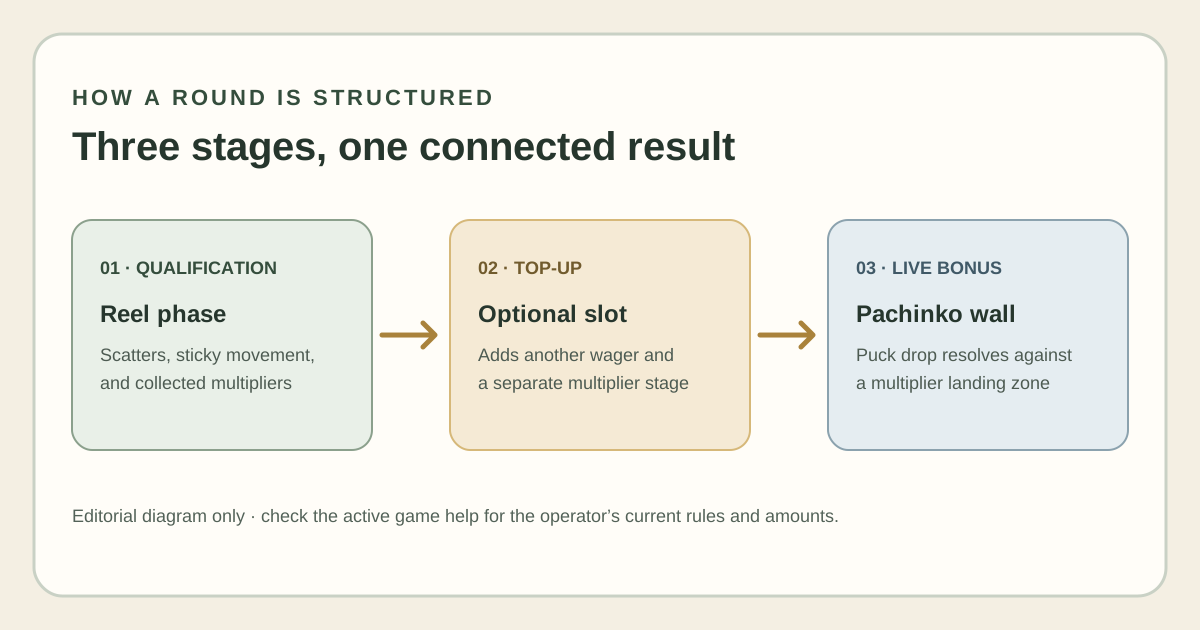
Crazy Pachinko is an Evolution game that begins with reels and can progress to a live Pachinko Bonus. The supplier describes three connected stages: qualification, an optional Top-Up phase, and the puck drop on the Pachinko wall. A player qualifies by collecting three Scatter symbols in one spin. Sticky Scatters can slide down by one row between spins before disappearing, and a Scatter may carry a multiplier used later in the bonus. The Top-Up stage can add further multiplier value, but it is an additional wagered phase, not a free animation. The live host then drops a puck from a randomised zone; the landing multiplier is combined with the values accumulated earlier. The official Evolution overview does not publish a complete, current operator paytable or New Zealand availability. Confirm those in the particular game client before treating any amount as applicable.
What kind of game is it?
Crazy Pachinko sits between a reel game and a live game show. The qualification stage looks and behaves like a short slot-style sequence: the player selects a stake and spin mode, then the reels determine whether three Scatters appear together. If qualification succeeds, the game changes presentation. A Top-Up slot may offer a chance to increase the accumulated multiplier, and a live presenter controls the final physical puck drop. The visible switch from software-driven reels to a streamed host is why a simple label such as “slot” or “live table” does not explain the whole product.
The main round has a clear causal order. First, qualification determines access and can contribute Scatter multipliers. Second, Top-Up can contribute additional multiplier value if that phase is entered and played. Third, the live wall resolves the result using a Pachinko multiplier. The wall does not replace the earlier stages: its landing zone is only one component of the settlement path. If you are reading a game-history entry or trying to understand a result, identify which phase produced each displayed value before adding anything together.
This page covers only Crazy Pachinko by Evolution. It does not treat the Pachinko feature inside Crazy Time or Crazy Balls as the same complete game. Those products may share a visual motif or named mechanic, but their wager menus, qualifying events and bonus rules are separate. A feature name is not a substitute for matching the exact game title in the help panel.
Qualification: how the Scatter sequence works
The published objective is to land three Scatter symbols in a single qualification spin. Evolution also describes Sticky Scatters: a Scatter can move down one row on the next spin, then move again, and disappear after reaching the bottom row. This gives a player a way to understand why a Scatter seen on one spin may still be visible on a later one, while also making clear that a displayed Scatter is not automatically a completed qualification. The required set must satisfy the rule shown for the active version.
Some Scatter symbols can carry multipliers, with the supplier’s overview describing values up to 10x. Those values belong to the feature’s multiplier calculation, not to a guaranteed cash amount by themselves. A multiplier is not a currency balance: its eventual effect depends on the applicable wager, the game’s settlement formula, any phase-specific rules and the operator’s displayed help. Do not multiply a displayed number by your stake until the game explains whether the value is a multiplier of the base bet, a bonus-stage value, or another measure.
Qualification reels may also show ordinary paying symbols. The short supplier page focuses on the bonus path and does not provide a complete payout table for those line combinations. If the operator’s live help includes a paytable, check the line count, which symbols pay, whether a Wild substitutes, and how wins are counted. If a public overview omits those details, record the gap rather than importing values from a third-party review or another Evolution title.
Sticky behaviour is a timing rule, not a player-controlled hold feature. The public wording says the symbols slide down and eventually disappear. It does not say that the player can choose to retain or reposition them. Prior reel layouts also do not establish what the next reel outcome will be. A visible feature state can explain the current sequence; it cannot forecast the next one.
The three spin modes
Evolution names Normal as the default mode, XXXtreme Spin, and Feature Buy. The supplier says XXXtreme Spin provides one Scatter per spin, while Feature Buy skips the qualification wait and moves directly to Top-Up. Those are different paths through the product. The words “guaranteed Scatter” describe the mode’s qualification condition as presented by the supplier; they do not imply a guaranteed net profit, a positive return, or that the live bonus must exceed all wagers paid to reach it.
The public supplier overview does not state the current price of XXXtreme Spin, the Feature Buy price, minimum and maximum stakes, or whether each mode is enabled in a particular operator’s version. Those are material terms because the qualification mode changes how much can be committed before the live stage. Read the selected-mode label, stake amount and total cost in the active client before confirming. If changing modes resets a stake or changes a per-spin amount, the interface should make that visible before play.
Normal mode is the reference path because Evolution identifies it as the default, but “default” does not mean cheapest in every operator implementation or most suitable for every player. The amount shown in the wager summary is what matters. For XXXtreme Spin, check whether the displayed amount is per qualification attempt or whether the client presents another billing basis. For Feature Buy, confirm whether the purchase takes the player straight to Top-Up and what separate decisions remain after that purchase.
An optional mode should be evaluated by its cost and rules, not by the impression that it is faster. A shorter route to a bonus may increase the amount at risk before any final result. If you cannot tell whether a mode price replaces or adds to a base bet, do not guess; open the help panel or leave the choice unselected.
Top-Up: what the second slot changes
After qualifying, the Top-Up phase offers another slot-based way to add multiplier values before the live bonus. Evolution describes 16 sectors at the bottom of that slot and says a bigger Top-Up bet corresponds to a bigger value of multipliers. The supplier overview does not provide a full sector-by-sector payout table, the exact price or the complete relationship between the selected amount and each outcome. The phase therefore needs its own review rather than being treated as a decorative prelude.
Before accepting Top-Up, find the amount that will be charged and the unit used for that amount. The interface may show the selection as a wager, a multiplier contribution, or a value tied to the base stake; these are not interchangeable. Record whether the choice is optional, what the lowest and highest permitted selections are, whether the amount is added to the qualification stake, and what happens if no Top-Up is taken. The game’s own text should answer those questions.
The 16 sectors are positions on the Top-Up presentation. Their count alone does not tell you the chance of landing in a particular sector or the value distribution. Nor does an impressive maximum sector establish the expected result. To compare modes accurately, you would need the complete current rules and mathematical information for the exact configuration, not just the largest visible multiplier. If the operator does not disclose those fields, state that they were unavailable in the source checked.
Top-Up can also complicate a basic cost calculation. Consider a hypothetical budget of 20 dollars for entertainment: the relevant question is not “what multiplier might appear?” but “how many qualification attempts and Top-Up selections fit within my fixed 20-dollar limit?” No particular amount is recommended here; the example simply illustrates that a separate phase can consume a separate part of a budget. Choose any limit before starting and do not increase it to recover earlier losses.
The live Pachinko Bonus and the DOUBLE zone
The final phase uses a live presenter and a large Pachinko wall. Evolution describes Pachinko multipliers from 10x to 200x on the wall, with previously collected multipliers from qualification and Top-Up combined with the wall result. The presenter drops a puck from a randomised drop zone. The landing zone’s multiplier is applied in the way the game rules specify to determine the final amount. A DOUBLE zone changes the sequence: the values on the wall increase and the puck is dropped again.
The phrase “dropped again” matters. A DOUBLE is not described as a direct cash payout or as a promise that the final result will be doubled exactly once. The official overview says all wall multipliers increase before another drop; a later drop can land on a different value or on another DOUBLE if the current rules permit. The current game help should define how the wall changes, how many repeat drops can occur, and whether any maximum cap interrupts the sequence. The public page does not state those details, so this guide does not invent them.
It helps to separate the stages in a result record: the Scatter multiplier total, any Top-Up contribution, the wall multiplier, and any DOUBLE re-drop sequence. The displayed final settlement may use a formula that combines these parts. Do not assume simple multiplication order from the animation. A presentation that visually shows values being added or increased is not a substitute for the formal settlement wording.
The live element is a presentation feature, not evidence that the player can influence a puck’s path. The supplier describes a randomised drop zone. The player’s earlier choices determine which wager and which accumulated values are in play; they do not steer the physical puck after it is released. Watching previous drops may explain what the interface labels mean, but it does not create a reliable prediction for the next one.
Payouts, RTP and information the public page does not settle
The official overview provides selected mechanics and multiplier ranges, but it is not a complete game-help sheet. It does not show a full reel-symbol paytable, a current operator stake range, a country-specific RTP, the exact payout basis for every phase, or a verified maximum cash win. It would be misleading to state those fields as settled facts on the basis of a feature summary. This guide therefore reports the public mechanics and leaves configuration-specific values to the active client.
RTP is a theoretical long-run measure for a defined configuration. It is not a promise about one session, one bonus, or a fixed number of qualification spins. A third-party page may publish a percentage for a specific jurisdiction or operator build. That number cannot be transferred to a New Zealand-facing product without evidence that the exact version and settings match. Even an official supplier value needs a scope label: game, mode, currency, jurisdiction and date.
When a help panel gives a payout table, read whether each entry is expressed as “to 1”, a return including the original stake, or a net win. For instance, a table that pays 2 units plus the stake is not equivalent to a table that returns 2 units in total. The distinction changes the arithmetic. Also check whether a Top-Up stake is settled separately, whether qualification line wins are credited before the bonus, and what happens to a bet after a disconnect or interrupted stream.
No single displayed high multiplier is enough to compare value. You would need the probability distribution for the result, the cost of each chosen mode, the selection’s eligibility, the relevant paytable and the session’s total stake. If one component is missing, the conclusion should remain limited. “Up to” describes a ceiling or listed range, not a likely outcome.
A practical pre-round checklist
Use this sequence before a round if the game is lawfully available to you and you have chosen to play:
- Confirm that the game title in the help panel is Crazy Pachinko, not a similarly themed feature inside another game.
- Read the current stake and currency. Do not convert an example from another country into a New Zealand limit.
- Check which spin mode is active and what it costs. Confirm whether XXXtreme Spin and Feature Buy are optional additions or replace another amount.
- Open the Scatter and symbol help. Verify Sticky Scatter movement, qualification requirements and whether a multiplier has any stated cap.
- Before Top-Up, confirm the amount selected, whether it is charged separately, and what the 16 sectors mean in that client.
- Read the Pachinko settlement text for the wall values, DOUBLE sequence and any maximum payout.
- Set a time and spend limit before the first wager. Stop at either limit, whether the session is ahead or behind.
If a client offers a game history, save the round ID and timestamp when asking a question about a settlement. That is more useful to customer support than a description such as “the puck hit the double twice”. The record can identify the exact build and show which help text was presented at that time.
Common misunderstandings
A Scatter is not necessarily qualification. The rule describes three Scatters in one spin. A single Scatter, even if sticky, does not itself mean the bonus has started.
A multiplier is not money. It needs a defined stake and settlement basis. The display may show a feature multiplier while the final payout still depends on other conditions.
Top-Up is not free. Evolution describes it as a bet. Treat it as an additional cost unless the exact client states otherwise.
Feature Buy does not remove the rest of the rules. The public page says it jumps to Top-Up. The player still needs to understand the price, Top-Up decision and live bonus settlement.
The wall’s largest number is not an expected payout. A maximum or range says nothing by itself about how often a result appears.
A live stream does not confirm local access. A supplier page may be globally visible while an operator limits products by market or account. No New Zealand availability claim is made here.
Mobile, demo and New Zealand availability
Evolution’s public page identifies the game but does not establish that every operator has enabled it for mobile, that a free-play version is available to a New Zealand visitor, or that a real-money version is legally offered to that visitor. Mobile performance can depend on the casino client, browser, connection, screen dimensions and stream delivery. Do not infer a device guarantee from the fact that a title has a web page.
If an operator provides a demo or practice mode, check that the interface labels it as such and that it uses the same rules you are trying to learn. A free-play balance is not proof that a real-money configuration has the same stake limits or payout settings. If no demo control is present on the official public page, this guide does not claim one is available.
For New Zealand readers, availability must be checked with current official information from the operator and regulator. This page is an editorial description of supplier-published mechanics, not an invitation to access an offshore casino. It does not verify eligibility, registration status, or account terms.
Questions readers commonly ask
How do you qualify for the Crazy Pachinko bonus?
Evolution says qualification occurs when three Scatter symbols appear in one qualification spin. Sticky Scatters can move down a row between spins before disappearing, but the active client’s help is authoritative for the exact build.
What does XXXtreme Spin do?
The public overview describes it as providing one Scatter per spin. It does not publish the current price or every operator setting. Check the amount shown before selecting it.
Is Top-Up required?
The supplier presents Top-Up as a phase that can boost multipliers before the live bonus. It is a wagered option. Whether a particular path can omit it should be clear in the game’s current help and interface.
What happens if the puck lands on DOUBLE?
Evolution says the multipliers on the wall increase and the puck is dropped again. The public summary does not provide the full cap and repeat-drop wording, so use the active help panel for settlement details.
Is Crazy Pachinko available in New Zealand?
This article does not establish local operator availability. A supplier catalogue page is not proof that a title is enabled for a specific country, account or device.
Sources and verification boundary
- Evolution: Crazy Pachinko — supplier overview of qualification, Sticky Scatters, modes, Top-Up and live bonus; checked 6 October 2026.
- DIA: Online gambling for advertisers — checked 6 October 2026 for New Zealand advertising context.
This page reports the supplier’s public overview. The active operator game help, payout table, bet limits, mode prices, RTP, maximum cash cap, demo status and local availability were not available for direct verification. No operator or New Zealand access is implied.
Pachinko also appears as one of the four bonus rounds inside Crazy Time. Our bonus round comparison sets it beside Coin Flip, Cash Hunt and the Crazy Time wheel, and payouts and limits covers its stated 10,000x ceiling.
