Live game rules · South Island guide
Dragon Dragon: rules and verified payout settings
 Best casinos available in New ZealandUpdated 7 November 2026

Dragon Dragon uses two bowls, each with a red-or-gold coin, and offers three outcome selections. Evolution’s public page explains the round but not a New Zealand paytable; a separate Austrian rules supplement provides one dated, jurisdiction-specific example.
The short answer
Dragon Dragon is a live two-coin prediction game. Evolution says each of two bowls contains one coin with a Red Dragon side and a Gold Dragon side. Before the bowls are opened, the player predicts whether both coins will show red, both will show gold, or the two will show different sides. After betting closes, the dealer shakes the bowls in turn and reveals the result.
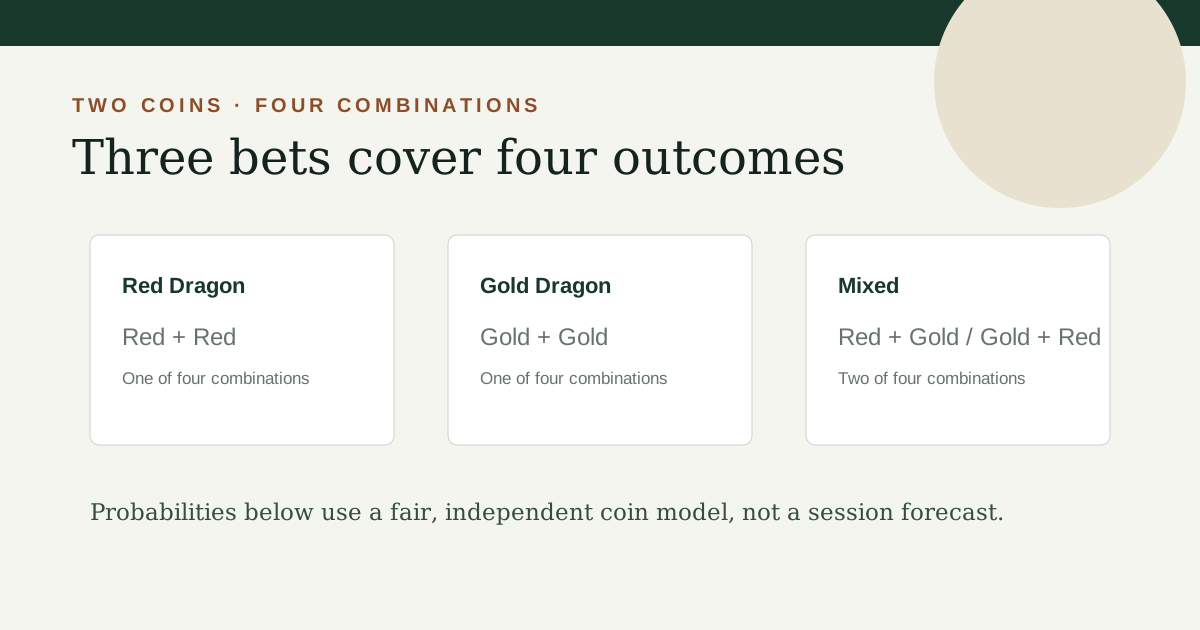
The four ordered combinations group into three wager outcomes: Red plus Red, Gold plus Gold, or a mixed pair. The supplier’s page explains this central sequence but does not display a complete payout table, stake range, RTP or New Zealand-specific setting in the public description used here.
An Austrian supplement to the official game conditions published in April 2026 shows one operator’s payout example: 2.90:1 for both Red or both Gold, and 0.95:1 for Mixed, with the stake returned on a win. It also states a 97.50% average payout and gives EUR limits for that Austrian version. Those figures must not be treated as the settings for a New Zealand customer or for every casino carrying the game.
How a round works
The game begins with a betting period. During that window, the interface presents the available outcomes and the player may choose one or more selections if the operator permits them. When betting closes, the dealer shakes the first bowl and then the second, before lifting the covers to reveal the coin faces.
The dealer’s sequence matters because the outcome is the combination of both coins, not the result of one coin on its own. A Red coin under the first bowl does not settle a Red Dragon bet until the second coin is also revealed as Red. If the two coins differ, the result belongs to the Mixed category.
The supplier’s published description is brief by design: two bowls, two colours and three main predictions. It does not describe a multiplier ladder, board, side-bet menu or bonus feature in the page reviewed here. Do not infer that a feature exists from another Evolution game or from a casino’s promotional banner.
For an actual table, read the displayed game rules before betting. Verify the title, the current operator’s bet options, payout notation, minimum and maximum stakes, currency and any maximum payout clause. Those details are not supplied universally by the public provider page.
Map the four combinations to three bets
Each coin can reveal one of two faces. If the face order is counted, there are four possible combinations:
| First bowl | Second bowl | Outcome category |
|---|---|---|
| Red | Red | Red Dragon |
| Gold | Gold | Gold Dragon |
| Red | Gold | Mixed |
| Gold | Red | Mixed |
The two mixed orders are different sequences of coin faces but belong to the same wager category. This is why there are four ordered combinations but three bet labels. A screen may show the outcomes with artwork or abbreviations, so match the label to the official rules before selecting a wager.
The provider page says the goal is to predict whether both coins reveal red, both reveal gold or the coins show different sides. It does not say that the player can choose which bowl is opened first or influence how the dealer shakes the bowls. Treat each round as a new event and do not use a previous sequence as proof of the next result.
If a casino interface abbreviates “Dragon Dragon” to represent Mixed, read the rule legend. Product branding and bet labels can be similar, and the game title itself should not be confused with a separate “Red Dragon” or “Gold Dragon” selection.
A careful probability model
For a basic probability illustration, assume each coin has two equally likely faces and the two face results are independent. Under those assumptions, each ordered combination has probability one quarter: Red-Red, Gold-Gold, Red-Gold and Gold-Red. The Red Dragon category therefore covers one of four combinations, Gold Dragon covers one of four, and Mixed covers two of four.
This is a mathematical model to explain the grouping, not a claim that a short live session will follow those proportions or proof that a particular operator’s equipment has been independently audited here. The Evolution description explains the physical game sequence; the public page does not provide an independent technical report about randomness. A player should use the applicable rules and operator information for questions about game integrity.
The model helps explain why the three outcomes do not have identical frequencies. Under a fair independent two-coin model, Mixed contains two combinations while each matching-colour outcome contains one. A more frequent category would ordinarily need a smaller payout to keep the theoretical return comparable. That relationship describes the mathematics of the example, not a strategy recommendation.
Observed results can vary widely over short sequences. Four Mixed results in a row do not make Red-Red “due,” and a recent Red Dragon result does not make Gold Dragon less likely on the next independent round. A history display is a record of prior results; it is not a forecast.
What the Austrian payout supplement says
The Austrian Electronic Content Platform published a 2026 supplement for Österreichische Lotterien Gesellschaft m.b.H. and the title “Elektronische Lotterien Live Casino Dragon Dragon.” The document describes the same two bowls and red-or-gold coins and gives a table for the three outcome categories. It also states that the stake remains with the player on a win.
That particular published ruleset lists 2.90:1 for Red Dragon and Gold Dragon, and 0.95:1 for the Mixed result. It reports an average payout of approximately 97.50%. The same document sets a minimum starting stake of EUR 0.50 and a maximum of EUR 500.00 for that ruleset. These are facts about the cited Austrian supplement, not an Evolution-wide guarantee or a New Zealand stake range.
This is a useful example of why “verified payout” needs a version and jurisdiction attached. An official operator or regulator-published rules document can establish the values for the product it governs. It cannot establish a different casino’s settings unless the relevant operator points to that same ruleset and the same configuration.
The Evolution product page and the Austrian supplement answer different questions. The first is a supplier overview of the gameplay. The second is an official document for a named operator and jurisdiction. When they do not provide the same level of detail, preserve that difference rather than blending all values into a single universal table.
Check payout notation before doing arithmetic
Odds such as 2.90:1 are often written as winnings relative to a stake, while some interfaces emphasize the total returned amount. The Austrian document’s note says the stake remains on a winning wager, which helps interpret its table. A reader should still check the operator’s own settlement display to see how winnings and returned stake are presented.
For example, if a hypothetical one-unit bet wins under the Austrian supplement’s 2.90:1 notation and the original stake is returned, the total returned would be the original unit plus the stated winnings. The exact unit is only an arithmetic illustration; the EUR limits in that document apply to its own version, and the example does not set a New Zealand stake or currency.
For the Mixed selection in that same supplement, the notation is 0.95:1 with the stake returned on a win. That produces a smaller win amount per successful wager than the matching-colour selections, while the fair independent coin model assigns Mixed two of the four ordered combinations. Both the payout and probability are needed to understand the theoretical return.
Do not compare odds without checking whether the quoted number is net profit or total return. A rate that includes the stake can look larger than one stated as winnings alone. Similarly, a table’s phrase “payout” may not explain treatment of an original wager until a note or example clarifies it.
How the 97.50% example is calculated
Using the assumptions above and the payout convention described in the Austrian supplement, the long-run return can be checked with a simple expectation calculation. For a one-unit Red Dragon stake, a win occurs in one of four equally likely combinations. A winning result returns the original unit plus 2.90 units of winnings, for 3.90 units total. A loss returns zero. The modelled gross return is therefore one quarter of 3.90, or 0.975 units per unit staked.
Gold Dragon uses the same structure and listed rate in that supplement, so the same calculation applies. For Mixed, two of the four combinations win. A one-unit winning wager returns the original unit plus 0.95 units of winnings, or 1.95 units total. Half of 1.95 is again 0.975. This matches the document’s stated approximate average payout of 97.50%.
This is a theoretical average across a very large number of independent trials under the stated assumptions. It does not predict the return in ten rounds, one evening or any individual account session. A real sequence can finish above or below the average by a wide amount. The calculation also cannot be carried over if an operator changes the payout, adds a separate wager, changes a rule or uses another settings profile.
The remaining 2.5% in the calculation is sometimes described as the theoretical house edge for that wager configuration. It is not a fee charged on every round or a guaranteed amount lost by an individual. It is the difference between total stake and modelled return averaged over a very large volume under those assumptions.
Bet frequency is not a recommendation
Under the fair independent two-coin model, Mixed covers half of the ordered combinations, while each matching-colour bet covers one quarter. That means Mixed would occur more often in the model. It does not mean that Mixed is automatically the better choice: the payout is smaller in the cited Austrian rules, and the official table is still only an example for that operator’s version.
A frequent win can feel reassuring, but frequency alone says nothing about net result. A less frequent outcome can pay more when it occurs; a more frequent outcome can have a smaller payout. To compare bets mathematically, use a matching configuration’s probability, payout, stake-return convention and any extra rule. Do not select a bet because it produced a recent win or because the history board appears to show a pattern.
This page does not recommend choosing one of the three outcomes. The simplest practical comparison is to understand what each label covers and to make no wager if the displayed rules are unclear. A theoretical return is a way to describe a model, not a reason to gamble or a promise that one selection will perform better for an individual.
What the supplier page does not settle
The supplier’s public page identifies the basic mechanic but does not provide every operator setting. It does not give a universal stake range, currency, maximum payout, table speed, account eligibility, New Zealand availability or complete game history policy. It also does not provide the Austrian supplement’s payout table on the same page.
Before an operator-specific article publishes a number, it should identify the source, the title, the rules version and the country. If a paytable appears in a casino’s lobby but the game help is not accessible, record that limitation instead of treating a screenshot from another operator as confirmation.
The published Austrian minimum and maximum are denominated in euros. They cannot be converted into a New Zealand operator’s stakes by using an exchange rate alone. The operator might use different limits, an NZD balance, other constraints or no availability at all. Currency conversion is not rules verification.
Similarly, the approximate 97.50% return in the supplement is not a promise for all installations. Do not describe it as a global Evolution RTP without a supplier or operator source that confirms the same settings for the exact version in question.
Live controls, history and disputed rounds
Before betting closes, read each selection label and the displayed amount. If the game permits more than one wager, check the combined stake, not only the value beside the last button pressed. The provider’s public overview describes three main outcomes, but the operator’s interface determines which controls are present and how they are entered.
After the reveal, check the two faces in order and compare them with the selected outcome. A Mixed result includes Red-Gold and Gold-Red. Red-Red and Gold-Gold are separate categories. If the visible labels or recorded result appear inconsistent, do not assume a settlement error from a cropped screenshot; note the full round time and ask the operator to inspect the game history.
On mobile, the faces and wager labels may be smaller than the art. Use text descriptions and any information icon. A game animation may show bowl shaking before it reveals the final outcome, but the motion itself does not change the rules. The result is the two exposed coin sides once the round completes.
New Zealand context and responsible play
No claim is made here that a particular casino offers Dragon Dragon to a New Zealand customer. Evolution’s supplier page describes a product, while a casino operator decides which products and settings are available to its customers. The Austrian supplement is not evidence of New Zealand access or of New Zealand operator licensing.
As checked on 6 October 2026, the Department of Internal Affairs says online casino advertising is prohibited during the transition and explains that advertiser requirements can apply to third parties that publish or arrange an advertisement. This guide therefore contains no affiliate link or operator invitation. Consult the Department’s current guidance for legal status and timing.
The R20 entry rule for land-based New Zealand casino areas is not a substitute for the age and identity rules of an online account. Read the relevant operator conditions and local requirements. Do not use another jurisdiction’s demo, age gate or rules page to infer that an online service is available to you.
Set a time and spend limit before any gambling and do not chase a loss. If gambling is causing stress or affecting someone close to you, New Zealand’s Gambling Helpline offers free, confidential support at 0800 654 655 or by text on 8006.
Common questions
What are the three Dragon Dragon bets?
The supplier describes Red Dragon for two red faces, Gold Dragon for two gold faces and Dragon Dragon for different faces. The Mixed category therefore includes both Red-Gold and Gold-Red. Check the operator’s on-screen legend if it abbreviates or stylises a label.
What payouts does Evolution publish?
Evolution’s public game page describes the basic round but does not show a full payout table in the text consulted here. An Austrian official rules supplement for a named operator lists 2.90:1 on Red and Gold and 0.95:1 on Mixed, with the stake returned on a win. Treat those as the settings in that supplement only.
Is 97.50% the New Zealand RTP?
No. The approximate 97.50% figure appears in the Austrian supplement cited on this page. It is tied to that operator’s rules and payout table. The Evolution overview does not publish a New Zealand-specific RTP, and the figure should not be transferred to another casino without matching primary evidence.
Why does Mixed have two combinations?
There are two ordered mixed sequences: Red in the first bowl and Gold in the second, or Gold first and Red second. Both resolve to the Mixed wager category. Under a fair independent coin model, that is two of the four ordered combinations.
Can recent outcomes predict the next round?
No reliable prediction follows from the history alone. Under the independent coin model, a past Red or Mixed result does not alter the next coin result. Short sequences can depart from the long-run proportions and should not be treated as signals.
Are the Austrian limits the same in New Zealand?
No such claim is made. The supplement gives EUR 0.50 and EUR 500.00 for its own named ruleset. A different operator may show different limits, currency or access conditions. Check the exact current game help for the relevant account and location.
For help or a break from gambling, our safer gambling guide lists New Zealand support options.
Sources and date checked
- Evolution official Dragon Dragon game page
- Austrian EVI publication: Dragon Dragon supplementary conditions — jurisdiction-specific rules for Österreichische Lotterien Gesellschaft m.b.H.
- DIA guidance for online gambling advertisers
- DIA information for online casino customers
- New Zealand Gambling Helpline
Evolution and regulator-published rules reviewed 6 October 2026. Verify any casino’s exact rules, currency and limits separately before relying on a payout setting.
