Live game rules · South Island guide
Always 6 Blackjack: rules and table checks
 Best casinos available in New ZealandUpdated 7 November 2026

Always 6 Blackjack is Evolution’s live blackjack variant in which the dealer’s up-card is fixed at six, according to the supplier’s product information. This guide explains the rule’s practical meaning and how to verify the table-specific actions and payouts without assuming that standard blackjack settings apply.
The short answer
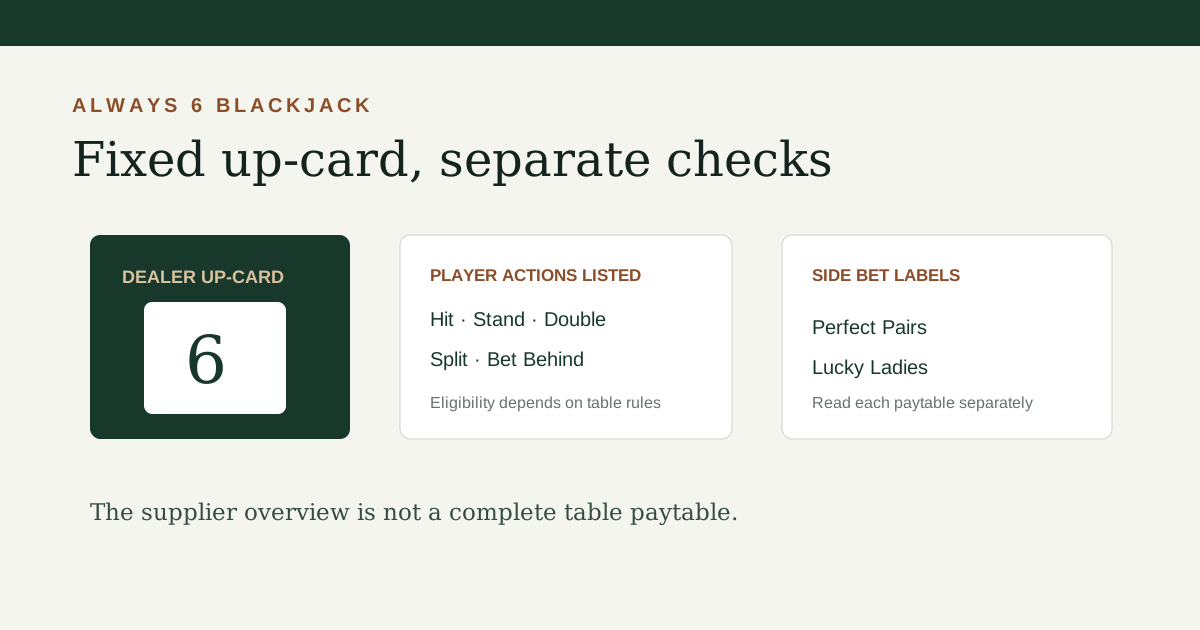
Always 6 Blackjack changes the familiar blackjack decision by fixing the dealer’s visible card at six, as described by Evolution. The supplier page also identifies a six-deck game, player actions including Hit, Stand, Double, Split and Bet Behind, and side bets called Perfect Pairs and Lucky Ladies. That information identifies the product and gives a useful first map of the table. It is not a complete, universal rule sheet: the public material checked for this guide does not establish every payout, minimum or maximum stake, maximum bet, settlement exception or New Zealand operator setting.
The dealer’s six is a starting condition, not a guarantee that a player hand will win. Your own total, the remaining rule decisions and the precise settlement rules still matter. Before relying on a strategy chart or a payout figure, open the help for the exact Always 6 Blackjack table in question. A familiar blackjack layout is not proof that it uses the same rules as another Evolution table or another casino.
Identify the exact product first
The official catalogue lists Always 6 Blackjack under Evolution’s live blackjack products. The title matters because “blackjack” can refer to many versions with different deck counts, dealer behaviour, doubling restrictions, split rules, natural payouts and side bets. The game name alone does not supply all of those details. Confirm the full title on the table screen, check that the help panel belongs to that title, and note any version or table label the operator displays.
Evolution’s public description calls it a twist on classic blackjack and highlights the dealer up-card. The official page reviewed here is a product overview, not a complete set of operator terms. If a casino interface says “Always 6” but the help is unavailable, a search result or third-party review cannot fill in the missing rules with certainty. Record that the table-specific detail could not be checked, then wait until the operator provides its rules.
This page covers the one game only. It explains the central fixed-card mechanic, the actions named in the supplier material, side-bet terminology, probability and settings verification. It does not create separate pages for a demo, RTP, bonus or side bet. For other titles, return to the Evolution catalogue guide or game-guide index.
What a fixed dealer six means
In ordinary blackjack, the dealer receives a visible up-card and another card whose value is not initially exposed. In this title, Evolution describes the dealer up-card as six each round. That removes one changing piece of information from the opening decision: the visible card is not selected from a new distribution each hand. It does not remove the dealer’s later play, turn the table into a player win, or disclose the dealer’s final total before the hand is resolved.
If you are new to blackjack, a hand total is formed from the card values under the game’s rules. Number cards are normally counted at face value, picture cards normally count as ten, and an ace may count as one or eleven without busting the hand. The table’s help should confirm the exact conventions used by this version. A soft total includes an ace counted as eleven; a hard total either has no ace or counts the ace as one. These labels are useful because the same displayed number can behave differently when an ace can change value.
A fixed six can influence a basic-strategy decision because a player compares their hand with the dealer’s exposed state. But a strategy chart only applies when its assumptions match the game: number of decks, dealer draw or stand rule, blackjack payout, split restrictions, surrender options and doubling options all affect a decision table. This guide does not publish a strategy chart because the complete Always 6 settings were not available in the public supplier text reviewed here. A generic chart labelled “six-deck blackjack” can still be wrong if the remaining table rules differ.
Understand the listed player actions
Hit
Hit asks for another card. The decision increases the hand’s total, but can also push it over the permitted limit. A card’s outcome is not controlled by the fixed dealer six. Before using Hit, read how the interface identifies your current total and whether a soft ace can adjust from eleven to one. On a small phone screen, make sure the action button corresponds to the hand you intend to play, especially if split hands are shown side by side.
Stand
Stand ends the player’s card-taking decisions for that hand and leaves the current total for comparison under the table’s rules. It does not guarantee a push or a win. The dealer still completes the hand according to the published procedure. If a game has unusual dealer rules, a standard blackjack assumption may not apply; check the written help rather than relying on the animation or the title’s familiarity.
Double
Doubling generally means increasing a wager in exchange for a defined final card or a limited continuation, but the exact option depends on the table. The supplier listing names Double as an available action, while the operator’s help must establish which totals are eligible, whether it is available after a split, whether it doubles the full main bet, and what happens if the next card makes the hand bust. Treat “Double” as an action label, not a universal promise of one specific rule.
Split
Split is an option associated with a pair, but tables vary in which pairs can be split, how many times resplitting is allowed, whether aces receive one card, and whether a split hand can later double. When split is selected, the original hand becomes separate hands under the table’s procedure. Check the total exposure: if an additional wager is required for the second hand, your possible loss can exceed the first displayed stake.
Bet Behind
Bet Behind is listed by the supplier as a selectable way to wager on another player’s hand. It does not make you the person choosing that hand’s Hit, Stand, Double or Split actions. Before using it, verify whether the table allows a behind bet on every seat, whether it shares the seated player’s decisions, how ties settle and whether any seat-specific limit applies. If the operator screen does not explain how a behind wager is settled, do not infer its treatment from a different live blackjack table.
Main wager, side wagers and total exposure
The main blackjack wager is settled from the hand outcome described in the table rules. A side bet is a separate selection with its own qualifying condition and payout table. Evolution’s listing names Perfect Pairs and Lucky Ladies for this product. That confirms the supplier identifies those options; it does not provide all qualifying card combinations, payouts or settings in the public description.
Perfect Pairs is a label commonly used for a wager about the player’s opening cards forming a pair, but variants can distinguish exact rank, colour or suit. Do not assume that two cards with the same value qualify if their ranks differ, or that a same-rank pair pays the same in every side-bet version. Read the version’s table. Lucky Ladies is another named side bet; the title alone is insufficient to establish its qualifying total, any suit condition, bonus multiplier, tie treatment or payout.
Before betting, add the main bet, every side bet, any behind bet, and the additional amount needed for a split or double if those actions are later chosen. The screen may display a total only after a wager is placed, so work out the exposure before committing. A side bet can lose even when the main hand wins. Conversely, a losing main hand does not tell you whether a separate side selection qualified; each market settles by its own rule.
Side bets are not a way to improve the main hand. They usually ask a different question about cards and use a different outcome distribution. Because Evolution’s public description does not publish the Always 6 side-bet paytables, this page does not assign an RTP or recommend staking on them. A payout table is needed to evaluate a side wager mathematically.
Six decks and what that does not tell you
The official product information consulted identifies six decks. That describes the announced product configuration, but it does not answer every card procedure. The table help should say how the shoe is handled, when the dealer’s cards are exposed, how reshuffling is managed where applicable, and whether the same rules apply to the specific table instance. Do not infer a counting advantage or a card sequence from a published deck count alone.
Deck count matters to blackjack calculations because the composition of cards remaining can affect probabilities. A chart or expected-return figure developed for one deck configuration should not be transferred to another without checking the assumptions. Even with the same deck count, a change to blackjack payout or dealer procedure can change the comparison. This is why a single “blackjack RTP” figure without a table name is incomplete.
The words “six decks” should also not be confused with six cards in a hand, six-player capacity or six rounds. The number describes the game’s deck configuration in the supplier’s product information. The physical or digital shoe’s operational details should come from the current rules help, particularly if a player is reading an operator-specific disclosure.
Payout table: what can and cannot be stated
The public supplier page reviewed for this article names the product and describes its fixed dealer card. It does not show a full primary-source payout table in the text available here. Therefore, this guide does not assign a return percentage, a dealer-22 rule, a special natural payout or the settlement of each side bet. If a casino’s exact table help shows those values, they should be documented with the operator, market, title and date rather than presented as an Evolution-wide constant.
When you inspect a table, look for at least the following: what pays as a natural blackjack, whether the original stake is returned as well as winnings, how a push settles, whether the dealer must hit or stand on a soft total, how a dealer bust is handled, what happens when both hands have the same total, and any maximum payout clause. For side bets, find the full list of winning combinations and the exact payout notation. If a table gives “x to 1,” determine whether that is profit or total return.
A useful way to compare two documents is to build a field-by-field checklist. Mark a field “confirmed” only when the table’s own rules state it. Use “not shown” for a missing value and “not applicable” only when the help explicitly says the rule does not apply. Do not fill gaps from a competitor’s game review. Several third-party pages publish numbers for blackjack variants, but unless the named table and jurisdiction match and a primary operator document confirms them, those numbers are not a verified setting for this product.
How to read a sample hand without turning it into advice
Consider a hypothetical player hand with a total that permits more than one legal action. The dealer’s visible six is known, but the unseen card and future draw are not. To assess a decision mathematically, you would need the exact rule configuration, the value distribution remaining in the shoe, and a model of how each possible result settles. A story such as “six is a weak dealer card, always double” ignores the player’s total and the game’s restrictions. It is too broad to be reliable.
For an explanatory example only, imagine that the player holds a hard total and the operator’s interface shows Hit, Stand and Double. The safe reading order is: check the total and whether an ace is flexible; open the help to confirm the action is allowed for this total; check whether a Double commits an additional equal stake; then decide whether to continue at all. This is an interface-reading example, not an instruction to place a bet or a recommendation for a particular hand.
If the hand is split, repeat the same check for each resulting hand. An action that is available on the first hand may be treated differently on a split hand. Some tables restrict doubling after a split or apply a special rule to split aces. The supplier list does not resolve those details. Ask the table-specific help to do so.
Demo, mobile and session display
Evolution’s catalogue notes that freeplay demos and individual game features can depend on jurisdiction. If a demo is shown, it demonstrates the interface in that session, not the eligibility of a real-money account. It may not use the same limits or cashier currency as an operator. If a demo is not available, do not use a third-party screenshot to claim that a particular person in New Zealand can play.
On mobile, keep the rules panel open long enough to read the labels and scroll through the whole paytable. A collapsed “i” icon can contain more than one section. Make sure the selected table is still Always 6 Blackjack after switching from a lobby preview. If portrait layout truncates the last line, rotate or enlarge the rules panel before treating the visible portion as a complete list.
Use the on-screen history for a completed hand only as a record. It can help you capture the round identifier and its result if you need to ask the operator a settlement question. A sequence of prior outcomes does not forecast the next hand. A fixed up-card also does not make the dealer’s unseen card known. If a history entry and the displayed rules appear inconsistent, save the time, table title and round reference and ask support to review the exact event.
New Zealand context and responsible play
This guide describes a supplier’s game. It does not say Always 6 Blackjack is available at a particular casino in New Zealand, nor that a particular operator has a New Zealand licence. The Department of Internal Affairs says online casino providers must not advertise to people in New Zealand during the current transition period; its advertiser guidance also describes obligations for third parties publishing or arranging advertising. This page contains no operator offer or affiliate link. Current government guidance should be checked again before any public distribution.
Keep a time and spend limit before starting any gambling session, and stop when either limit is reached. Do not increase a stake to recover a previous loss. A game rule describes settlement; it does not make the outcome predictable. If gambling is affecting you or someone close to you, New Zealand’s Gambling Helpline is free and confidential at 0800 654 655 or by text on 8006. Our safer gambling guide lists local support options.
Common questions
What is the “six” in Always 6 Blackjack?
Evolution describes the dealer’s up-card as a six each round. It is the fixed visible dealer card, not a promise that the dealer’s final hand will total six. The full hand still resolves under the table’s rules.
How many decks does the game use?
The official product information reviewed for this guide identifies six decks. Check the current game help for the table you are viewing in case the operator labels a specific version or rule set separately.
Which actions are listed by Evolution?
The supplier information names Hit, Stand, Double, Split and Bet Behind. The exact eligibility and settlement of each action should be confirmed in the game help for the selected table.
What are Perfect Pairs and Lucky Ladies?
They are the two side-bet names listed by Evolution for this product. The public description consulted here does not publish the exact winning combinations or complete payout tables. Read the table’s help before making any side selection.
What is the return percentage or RTP?
No universal Always 6 Blackjack RTP was verified from the supplier page used here. A percentage needs a specific rules configuration and bet type. If the selected operator publishes one, retain its market, table and date context.
Does this game have a demo for New Zealand?
Evolution says freeplay and some game features are subject to jurisdiction. A demo visible elsewhere is not proof of access in New Zealand. This guide makes no New Zealand availability claim.
Can a standard blackjack strategy chart be used?
Only if its assumptions match the table’s rules. Check deck count, dealer procedure, blackjack payout, split and double restrictions, and other available options. A chart for a different ruleset may not fit this title.
For the wider studio catalogue, see the Evolution games guide. For New Zealand support, see safer gambling information.
Sources and date checked
- Evolution official Always 6 Blackjack page — product naming and published format information.
- Evolution Games official catalogue — title listing and demo jurisdiction notice.
- DIA guidance for advertisers and DIA information for customers — New Zealand transition and advertising context.
- Online Casino Gambling Regulations 2026 — affiliate arrangement and advertising provisions.
Official supplier and government pages checked 6 October 2026. The publicly accessible supplier description did not provide a complete operator paytable, RTP, stake range or New Zealand access setting; verify those on the actual table before describing them.
