Live game rules · South Island guide
Red Baron: crash rules and cash-out checks
 Best casinos available in New ZealandUpdated 7 November 2026

Red Baron is Evolution’s crash-style game-show product. The supplier describes a rising multiplier, up to three independent bets in a round, optional auto-cashout and a maximum multiplier of 20,000×; a round can end immediately at 1.00×. This guide explains the sequence and the details that need table-specific verification.
The short answer
Red Baron is an Evolution crash-style game. In the supplier’s description, a multiplier rises during a round and a player must cash out before the plane flies away. Evolution says the game supports up to three independent bets in a round, optional auto-cashout for each bet at a chosen multiplier, and multipliers up to 20,000×. Each bet must be cashed out separately. The round may crash immediately at 1.00×; Evolution says a random-number generator determines when the plane flies away, and an unsettled bet is lost. The provider also describes versions with or without a live presenter.
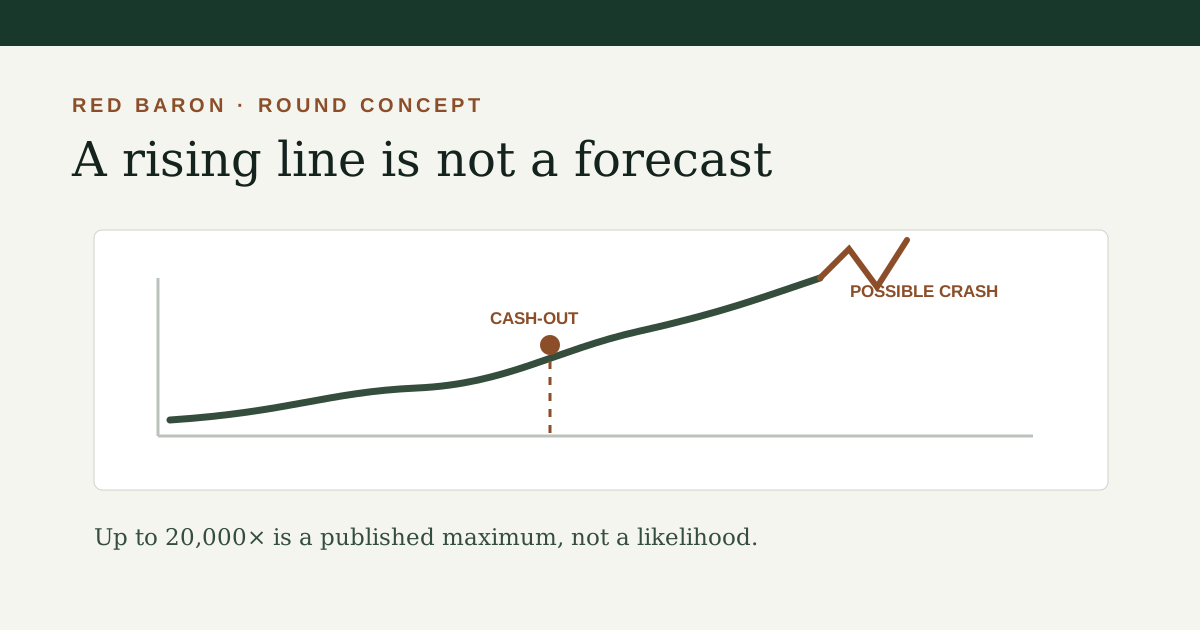
Those are product-level points, not a probability forecast. “Up to 20,000×” is a ceiling in the supplier description; it does not say how often high multipliers occur or promise that any particular round will reach one. The public official page checked here does not publish a complete payout table, minimum and maximum stakes, a universal RTP or New Zealand operator availability. Check the current game help at the exact table before treating any such value as verified.
What a crash round asks the player to do
A crash game presents a multiplier that increases while a round is active. A player can choose a point to cash out. If the wager is cashed out while the round is still active, the displayed multiplier is used under the game’s settlement rules. If the crash occurs first, the unsettled wager loses. The decision window can be brief, and the central task is timing rather than choosing cards or numbers from a paytable.
For example, a display might show a multiplier rising from one point to another while the aircraft remains in the scene. That visual change is part of the interface; it is not evidence of a pattern or a signal about a future result. The game rules determine when a bet is considered cashed out and whether the final settlement includes the original stake. Read those details before interpreting any on-screen amount.
The most important distinction is between the multiplier currently shown and a multiplier that has already been locked for your bet. Before cash-out, a rising value can continue or the round can end. After a valid cash-out, the game should record the settled multiplier for that selection. The exact display and confirmation state are operator-interface details, so consult the current help and round history.
The documented Red Baron features
Crash point and multiplier ceiling
Evolution’s product page calls Red Baron a crash game and states that the multiplier can rise up to 20,000×. It also warns that the plane can fly away immediately at 1.00×. These two endpoints describe a possible range in the product overview, not the likelihood distribution within it. A maximum is not an expected value, and a low possible endpoint does not tell you how frequently early crashes occur.
Do not derive a “safe cash-out target” from the advertised ceiling. The page does not publish a probability table for reaching each multiplier. Without a verified distribution and the exact payout rules, a calculation based only on the maximum would be misleading. It is also not possible to infer the game’s return percentage from a screenshot of one round or from a short sequence of outcomes.
Up to three bets
The official product description says a player can place up to three independent bets per round. “Independent” is important: Evolution states that each bet must be cashed out separately. A player might have more than one active line visible, so a settled result for one line does not necessarily settle the others.
Before confirming multiple bets, total their stake amounts. The interface may show one amount for each position. If all three are active, the total exposure is the sum of all active bets, not the value shown in the last button. Check whether each line has its own manual cash-out control and whether an auto-cashout value can be set separately. Do not assume that one cash-out instruction applies to all three selections unless the table explicitly says so.
Optional auto-cashout
Evolution says auto-cashout can be enabled for each bet and set to a chosen multiplier. That provides a specific per-bet setting, but the public overview does not define every operator’s control flow, timing behaviour or treatment of a setting after reconnection. The game help should say when the threshold is applied, whether it can be changed after bets are placed, and what happens if the round crashes before the threshold is reached.
An automated threshold removes the need to press the button at a moment, but it does not remove the risk that the crash comes first. It also does not guarantee that a target is reached. If the game disconnects or a device lags, the table’s server-side rules and history should determine the settlement. Do not rely on an animation alone to infer whether an automatic cash-out was accepted.
Presenter and non-presenter versions
The supplier describes versions with and without a live presenter. This is a presentation choice, not proof of different odds or different cash-out rules. If two versions look different, compare the title, table help, terms and version identifier before assuming they settle identically. Conversely, do not claim that the presence of a presenter changes the game’s mathematical model without a primary source.
How a multiplier display works
The multiplier expresses a factor used in settlement after a successful cash-out, according to the game’s payout rules. A simple arithmetic illustration can clarify the display: if a hypothetical wager of 4 units were settled at a factor of 1.5, multiplying 4 by 1.5 gives 6 units as a gross factor calculation. This example is not a Red Baron payout quote. The actual table help must define whether that displayed figure includes the returned stake and how rounding or currency precision is handled.
A multiplier can look small early in a round and much larger later. That visual growth does not make the later stage more likely to continue. Each round’s display should be read as the state of that round, not a forecast. If a previous round crashed early, there is no rule-based reason to expect the next round to go further. If a previous round lasted a long time, that history does not guarantee a long next round either.
The crash event closes the opportunity to cash out for that round. A player who has not completed a valid cash-out before that event does not receive the displayed multiplier as a win. The product overview explicitly says a bet is lost if it is not cashed out before the plane flies away. Use the round history to distinguish a confirmed cash-out from a click that did not register before the result.
Manual cash-out, timing and interface checks
Manual cash-out depends on a player action while the round is active. On a desktop screen, the control may be close to other bet buttons. On a phone, a smaller viewport can make it easier to tap the wrong line or miss a confirmation label. Before a round begins, identify the button for each active bet and check that the displayed amount and cash-out control correspond to the same line.
The exact technical latency, server timing and disconnect procedure are not stated in the supplier overview checked here. Do not promise that a manual click is instantaneous or that a brief network interruption will be ignored. If a settlement is disputed, capture the game title, round identifier, time, bet line, chosen cash-out action and account history. The operator is the right source for investigating a particular account event.
An animation can continue after an outcome event or display a transition. The written settlement record, not a frame of the animation, is what you need to understand the outcome. Check whether the interface clearly labels a settled bet, a pending bet and a lost bet. If the language is ambiguous, avoid committing another wager until you understand the status.
Auto-cashout: questions to answer in the help panel
If the table exposes an automatic threshold, look for the following before using it:
- Is the setting entered as a multiplier, amount or another value?
- Does it apply to one bet line or every active bet?
- Can it be changed after the current bet is confirmed?
- What happens if the crash occurs at or below the selected threshold?
- Does the system cash out at the threshold shown, or at the next available event?
- How does the history record show that the automatic instruction succeeded?
- Does a disconnect affect the instruction, and which rule governs reconnection?
These are verification questions, not claims that every version has a particular control. Evolution’s public page confirms optional auto-cashout but does not answer all of them. An operator help panel or official rule document for that exact instance should be the source. If no answer is visible, the setting is not verified from the public material available here.
Why a high maximum is not an expected return
A maximum multiplier describes a possible upper bound. To calculate expected return, a reader needs the probability of each relevant crash point, the payout rule at each successful cash-out, any house margin and the treatment of the stake. The maximum alone supplies none of those inputs. A claim that a game has a particular RTP should point to a primary source for the same product configuration, not a competitor’s review that repeats a number without explaining the model.
Likewise, a long list of previous results is not enough to infer a distribution. A sample of several rounds is too small to establish the rate of rare events. A high multiplier displayed once does not show that it is common, and a run of early crashes does not establish that a large one is due. Product-specific statistical claims require documentation from the supplier or the relevant operator.
This guide does not assign Red Baron an RTP because the official page reviewed did not provide one. It does not reproduce a third-party “97%” value as if Evolution confirmed it. If a particular casino’s rules show a return percentage, attach the named operator, market, version and date to that information. If the source leaves one of those elements unclear, explain the gap.
Round-by-round exposure and record keeping
A practical session ledger can list the time, each of up to three bet amounts, the cash-out state for each, and the final round identifier. This is useful for understanding total exposure and resolving an account-history question. It is not a betting system. If the interface records only a combined amount, note that limitation rather than reverse-engineering the exact line values from a balance screenshot.
For example, suppose three independent selections are entered with different amounts. If one is cashed out and two remain active at the crash, the final account change depends on the table’s settlement of each line. Looking only at the successful selection could hide the two losing amounts. The operator’s round record should be checked for every line. This is why “I cashed out that round” is less precise than “I cashed out line two before the round ended; the other two lines remained active.”
Do not use a high multiplier to justify increasing a later stake. Red Baron’s product description makes clear that a crash can occur at 1.00×. A past round’s outcome does not reduce the risk of the next round. Set a limit on the total amount and session length before play and stop when either is reached.
Game versions, release status and catalogue checks
Evolution’s official showcase listed Red Baron when checked on 6 October 2026, and the product page describes it as a crash game. A separate Evolution announcement describes its launch as a strategic crash game and mentions two presentation versions. The material reviewed here does not provide a universal current release date by market, nor a roster of operators carrying the game in New Zealand. A supplier announcement is not an operator availability confirmation.
If the name appears in an operator lobby, confirm that the help page belongs to Red Baron and not a similarly themed product. If the operator labels a presenter version or a variant, note the exact label. Do not assume the same settings across versions solely because the art looks similar. A later product update may change interface behaviour without changing the name; date the settings check.
The wider Evolution games guide helps distinguish catalogue categories. Red Baron’s rules stay on this single game URL. The game index lists all selected provider and game references without claiming that every linked title is offered by a particular casino.
Mobile, demo and accessibility
If a demo is offered, use it only to inspect the interface and read the rules. Evolution says freeplay and individual game features are subject to jurisdiction. A demo session does not prove account eligibility or match a real-money operator’s settings. It can also omit a cashier flow, account limits or other terms that only the operator controls.
On mobile, a rising multiplier and cash-out control may occupy most of the screen, with the rules hidden behind a menu. Read the help before beginning a round. Verify text contrast, that the cash-out button has a clear label, and that multiple bet lines are not obscured by sticky panels. If the game requires a fast tap that is difficult with assistive technology or a small display, do not treat that as an obligation to keep playing. The game should be understandable through its stated rules and labels.
If a browser cannot play the stream or a video fails, the failure does not establish that the product is absent. Record that the preview did not load in that session. Read public rule text where available and do not bypass a jurisdiction gate.
New Zealand context and responsible play
No claim is made that Red Baron is offered by any named operator to a New Zealand customer. Evolution’s game listing identifies a supplier product; it does not establish local operator permission, account eligibility or a New Zealand stake range. The Department of Internal Affairs says online casino providers must not advertise to people in New Zealand during the transition. Its advertiser guidance covers third parties that publish or arrange advertising. This guide therefore includes no operator offer or affiliate route.
Fast rounds can make it easy to lose track of elapsed time. Decide a time and spend cap before starting, keep the amounts visible, and stop when you reach the limit. Avoid chasing a loss or increasing the stake because a previous round ended early. A displayed maximum does not make an outcome more predictable. If gambling is causing harm, call the free New Zealand Gambling Helpline on 0800 654 655 or text 8006. Our safer gambling guide lists support information.
Common questions
What happens if the plane flies away before I cash out?
Evolution says that a bet not cashed out before the plane flies away is lost. Check the current game help for the exact settlement display and use the round history if a specific result needs review.
What is the highest multiplier?
The official product overview says the multiplier can rise up to 20,000×. That is a maximum described by the supplier, not a prediction or a statement about how likely any round is to reach it.
Can a round crash immediately?
Evolution’s page says the crash can occur at 1.00×. Do not use previous results to predict whether the next round will last longer.
How many separate bets are available?
The supplier describes up to three independent bets in a round. Check the current operator interface to see how each line is entered and cashed out.
Does auto-cashout guarantee the selected multiplier?
No guarantee is stated. The supplier confirms the option exists, but the exact trigger and settlement behavior must be checked in the table help. A crash can occur before a threshold is reached.
Does Red Baron have a verified RTP?
No universal RTP was confirmed in the Evolution public page used for this guide. A third-party claim should not be treated as authoritative without matching primary documentation for the exact table.
Is Red Baron available in New Zealand?
This guide does not claim that it is. Supplier catalogue presence does not establish availability from a named operator or customer eligibility in New Zealand.
For other Evolution catalogue entries, see the provider guide. For support, visit safer gambling.
Sources and date checked
- Evolution official Red Baron game page — crash mechanic and feature summary.
- Evolution launch announcement — product announcement and presenter-version context.
- Evolution Games catalogue — listing and demo jurisdiction notice.
- DIA guidance for advertisers, DIA information for customers, and Online Casino Gambling Regulations 2026 — New Zealand advertising context.
Official supplier and government sources checked 6 October 2026. The public source did not verify a complete paytable, RTP, stake range or New Zealand operator availability. Check the exact rules panel before relying on table-specific claims.
