Live game rules · South Island guide
Dragon Tiger Phoenix: rules, bets and table settings
 Best casinos available in New ZealandUpdated 7 November 2026

Dragon Tiger Phoenix is an Evolution card game in which the player predicts whether Dragon, Tiger or Phoenix will draw the highest card, with a separate Tie bet. Evolution’s public overview says a two-card tie pays 7:1 and all three matching values can pay up to 20:1. It does not establish every table setting, stake limit, RTP or New Zealand operator availability.
The short answer
Dragon Tiger Phoenix is a three-way card comparison from Evolution. Its official product page describes a round in which Dragon, Tiger and Phoenix each draw a card and the player predicts which hand will have the highest value. Evolution also lists a Tie selection. The supplier says a tie between two matching card values pays 7:1, while a result in which all three values match can pay up to 20:1. Those are the headline rules in the supplier’s public overview, not a complete, universal paytable.
Before treating a figure as the terms of a particular game, open the help panel on the actual table. The public overview does not establish the exact card ranking for every implementation, all tie-settlement cases, minimum or maximum stakes, a theoretical return figure, or which casino offers the table to people in New Zealand. A supplier catalogue entry proves that the supplier describes a product; it does not prove that a given operator carries it, that it is available in a location, or that every table uses identical settings.
The practical task is simple to state: select one of the three hand outcomes, or the tie market if listed, before betting closes; then compare the cards and read the posted payout for the selection you made. The important discipline is to separate the result rule, the bet condition and the payment rule. A bet can be easy to understand while its return still depends on a table-specific paytable.
What the three names mean in the round
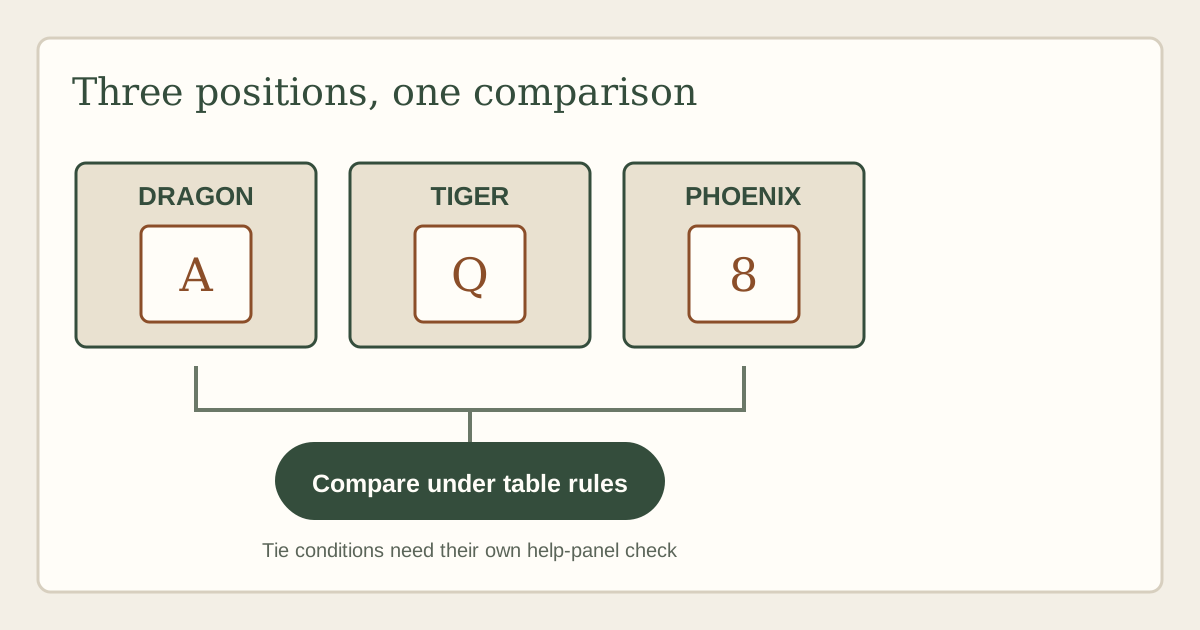
The three labels are competing hand positions. “Dragon” and “Tiger” are familiar from the two-hand comparison game, while “Phoenix” adds a third named result. Evolution describes this as a three-card showdown and states that the goal is to predict which hand draws the highest card. That description is enough to identify the game’s central comparison, but it does not invite assumptions about other games that happen to use animal names.
Treat each label as a position on the current game layout, not as a special card type or a player identity. The Dragon position is not a player who makes strategic choices; neither are Tiger and Phoenix. The visible cards and the table’s rules determine which selection, if any, matches the settled result. If the interface presents a dealer, cards, animations or a themed background, those are ways of presenting the round. They do not add a separate decision unless the help expressly describes one.
The supplier overview says two matching values can produce a tie payout, and all three matching values correspond to a separate higher tie description. It does not give enough detail to infer how a two-way tie among three hands affects the third hand’s selection in every case. Do not fill that gap from a standard Dragon Tiger rule, a baccarat rule or a different supplier’s table. A three-position product can define ties differently from a two-position product even if both share names or visual motifs.
A round, from choosing a market to reading the result
At the start of a round, the interface shows the available bet positions and the time remaining to place a wager. Identify the exact position before placing a chip. A main selection may correspond to Dragon, Tiger or Phoenix. A tie selection may be shown separately, and it may have subconditions or a distinct payout line. The official overview identifies the named markets, but the table’s help panel is where a player should confirm how the current layout represents them.
When betting closes, no new selection should be assumed to count for that round. The dealing stage then produces the cards that are compared under the displayed rules. Wait until the interface marks the round as settled; do not read an animation partway through as a final result. A visual highlight can explain which card or hand is being shown, but the settled history and payout line establish whether a wager won, pushed, lost or remained pending.
After settlement, compare the result against the bet slip rather than against a remembered tap. Confirm that the card result corresponds to the selection, that the amount shown was the amount actually accepted, and that the credited return follows the table’s paytable. This is especially useful when the interface permits several positions in one round. If the table offers multiple wager types, a winning main bet does not automatically mean that a separate tie wager also won, and vice versa.
The cycle is a sequence of independent decisions. A previous round’s Dragon result does not make Tiger “due”; a tie does not change the next deck state in any way shown by the product overview. Unless the current help says otherwise, use each settled round as its own outcome and avoid treating the history panel as a forecast.
Main selections and tie selections are different tasks
A Dragon, Tiger or Phoenix selection asks which named hand will have the highest card under the game’s ranking rule. A Tie wager asks whether the result meets the table’s tie condition. These are not interchangeable forms of the same prediction. The first task compares competing values; the second depends on equality as the product defines it. A person should read the bet label and its corresponding condition before choosing rather than infer it from colour, position or icon.
For a simple arithmetic illustration, imagine a table showing a hypothetical one-unit stake and a hypothetical 1:1 net payout for a correct main selection. If that selection wins, the table might return the original unit and one unit of winnings, depending on whether its displayed number is written as net odds or total return. This example is not a Dragon Tiger Phoenix payout claim. It exists to show why “pays 1:1” and “returns two units including stake” can describe related arithmetic from different conventions. Always read the table’s notation.
Tie markets often use larger displayed ratios because their outcomes are defined more narrowly than choosing one of several hand labels, but the words “Tie” and “pays more” do not tell you the probability of the event. A large ratio alone cannot show whether a wager is favourable, fair or suitable. To compare expected returns, a reader would need the full distribution of possible card outcomes and the precise settlement rules. The public overview is not a full mathematical model.
The tie figures Evolution does publish are useful, but they must be read carefully. It identifies 7:1 for two cards matching in value and says an all-three match can pay up to 20:1. The phrase “up to” does not mean every relevant table pays the maximum, and it does not say how a tie bet interacts with a third card that differs. Check the live help for exact qualifying outcomes, whether a tie selection is split into multiple positions, and whether the displayed ratio includes or excludes the stake. For other supplier references, start at the site’s game guide index. The New Zealand safer-gambling page lists local support routes if a session is causing distress or affecting essential spending.
What the published tie figures do and do not tell you
The supplier page is the primary source for the two figures above. It describes a matching pair at 7:1 and an all-three matching result at up to 20:1. Use that as a supplier-level summary. Do not promote either number into a complete payout table: the page does not enumerate each bet spot, every payout, stake range, fees, return percentage or jurisdiction-specific configuration.
“Value” and “suit” also need to be kept separate. Evolution’s Dragon Tiger Phoenix overview discusses matching values in its description. It does not, on that page, give a separate suited-tie payout or say that suit changes a Dragon Tiger Phoenix result. Another product, including Super Speed Dragon Tiger, may list a suited tie as a market. That neighbouring fact is not evidence about this title. Confirm any extra selection from the Dragon Tiger Phoenix help itself.
If two cards have the same value, a reader might naturally ask whether that automatically makes the overall result a tie, whether the third hand can still be the high result, or whether the pair receives the tie payout while another selection settles separately. These are precisely the kinds of conditions the short supplier summary leaves open. A responsible guide should identify the question rather than invent a rule to make the page sound complete. The game help should define the event, the winning selections and the order in which each market settles.
The all-three figure is also not a promise that a player can obtain 20 units from any stake in any situation. It is a multiplier-style headline from the supplier’s overview. The operator’s table may describe the base payout as gross return, net winnings, or a multiplier applied to a winning bet. It may also specify stake caps, currency rounding or limits. For a precise amount, use the actual accepted stake and the exact payout convention shown by the table, then compare with the account’s settled round record.
How to read the table help before a first round
Open the information or rules control before placing a wager. Start with the exact displayed title. A similar title, a provider badge or an old browser tab is not enough to verify the version. Confirm that the game is Dragon Tiger Phoenix and not a two-hand Dragon Tiger, Super Speed Dragon Tiger or another Evolution product. Distinguishing similar titles prevents one table’s tie rules from being carried into another.
Next, locate the section naming the hand outcomes and card ranking. The help should tell you what “highest” means, including how face cards and the ace are treated, if those details are part of the product rules. This guide does not supply a ranking sequence because the public page checked for this article does not publish one. A familiar convention may be common in card games, but a common convention is not a substitute for the current game’s rules.
Then inspect each bet position. Write down, in plain language, what has to happen for that position to win. If there are separate tie lines, note whether a pair, a three-way tie or another specified condition applies. Read the payout notation beside the position and determine whether it describes profit alone or total return including the original stake. If the terminology is unclear, do not place the wager until the operator’s help explains it.
Finally, check operational details: minimum and maximum chips; whether several selections can be combined; when the betting window closes; how a cancelled or rejected chip appears; how the result is shown in history; and what happens after a connection interruption. Those points are not established by the marketing overview. Their importance is practical: you need to know both what you selected and how the operator records the selection before a result can be evaluated.
A neutral way to compare the available bets
The first comparison is between the main hand choices. Ask whether they settle on mutually exclusive outcomes and what the table does when values match. If the main choices are mutually exclusive, putting a stake on more than one hand changes the total exposure and may create several losing positions when a different result appears. Do not assume that covering all three hands is a hedge that guarantees a net return. Any such conclusion requires the actual payout and tie rules.
The second comparison is between a main choice and the tie market. The tie payout can be numerically larger, but it may apply under a narrower condition. A potential return is not a probability, and the game’s visual story does not make a rare result more likely. Ask which exact event triggers the payout and how often that event can occur under the defined dealing model. If the help does not provide enough information to work that out, leave the probability question unanswered rather than borrow a number from an unrelated Dragon Tiger table.
The third comparison concerns usability. A main hand selection may be easier for a beginner to map to the result, while a tie line requires careful reading of the equality condition. Ease of reading is not a statement about expected value. It is simply a way to reduce interface mistakes: select only after you can state what event your chip covers in one sentence.
One practical pre-round note might say: “I am selecting Phoenix; the table says the highest card among three positions wins; I have checked the tie treatment and the payout notation.” If you cannot fill those blanks from the displayed help, you do not yet have the information needed to judge that wager. There is no need to make a selection just because the countdown is running.
Limits of strategy in a card-comparison game
The supplier describes a prediction game, not a skill test with player decisions after the cards appear. The meaningful pre-round action is selecting a market and a stake. There is no evidence on the public overview that a player can influence the cards, change the deal or improve a random result by reading past outcomes. The visual names Dragon, Tiger and Phoenix should not be read as signals, and a streak of one name does not establish that another is next.
If the game is dealt from a shoe rather than an independently generated arrangement, exact probabilities could depend on the specified deck, card ranks, tie settlement and any reshuffle point. Those inputs must come from the official help. Without them, calculations that use a generic 52-card deck, an assumed number of decks or an assumed ace rank would be modelled guesses, not verified Dragon Tiger Phoenix analysis. The product page does not publish enough detail for this guide to state a universal RTP or house edge.
Even when a table publishes a theoretical return, that figure describes a long-run model under stated assumptions. It is not a forecast for a short session, a refund promise or a method for choosing the next hand. A small sample can differ substantially from a model. One person’s run of wins or losses cannot establish the underlying probability, and a screenshot cannot substitute for a rulebook.
The useful approach is therefore procedural: know the bet, know the settlement rule, keep the stake within a pre-decided limit, and stop if the display or result is unclear. These practices do not change the odds. They reduce avoidable errors in understanding what was wagered and help keep the decision bounded.
Choosing a stake without confusing ratio and risk
The amount on a chip is the exposure for that selection. If a table permits several positions, add the stakes across them before confirming. For instance, two hypothetical chips of NZ$2 create NZ$4 of total exposure for the round, even if each appears on a separate hand. This is arithmetic only, not a suggested budget or a statement about the table’s actual minimum.
A larger payout ratio can tempt people to increase a stake on a tie selection. That changes the amount at risk; it does not make the qualifying result more likely. Decide a maximum entertainment spend before opening the game, separate it from rent, food, travel or savings money, and do not top it up to recover a loss. If the operator provides limit-setting tools, read their controls and set them before a session rather than during a stressful moment.
Because the title is described as fast-paced, make the decision before the countdown becomes urgent. A person who needs more time can wait for a later round, reduce the number of active selections or leave the table. Missing a round has no financial cost. A countdown is part of the interface, not evidence that an opportunity is about to disappear.
This guide is informational and does not recommend wagering. If gambling is becoming difficult to control, do not continue to study payout patterns as a way to solve it. Use New Zealand support information and consider blocking access or asking a trusted person for help. The site’s safer-gambling page links to local support and should be used for help rather than to compare games.
Mobile layout and result checking
On a phone, the three hand positions may be arranged differently from a desktop table. Before a round, check the label next to each chip area, the selected stake value and the total bet. A small screen can make an adjacent position easy to tap by mistake. If the bet slip does not clearly show the chosen hand, remove the chip before betting closes and confirm the corrected selection.
Do not assume that the orientation of the screen changes the game rule. A compact layout may reorder panels, hide explanatory text behind a help icon or place the result history below the fold. The current help remains the source for outcome conditions. If you rotate the device or change zoom, verify that the selection has not shifted and that the stake is still legible.
Connectivity can affect what the device displays, even though the supplier defines the product outcome. If a connection drops after a chip tap, do not repeat the tap blindly. Reconnect, inspect the bet confirmation and then consult round history. The operator’s support team handles account-specific disputed settlements; the game provider’s general overview cannot establish whether a particular click was received.
For a record of a disputed round, keep the game title, round ID if available, date and time, bet selection, stake, visible confirmation and history entry. Avoid sharing account identifiers publicly. A clear record helps support distinguish a rejected bet from a settled one without guessing from memory.
Demo mode and New Zealand availability
Evolution’s catalogue pages describe a freeplay demonstration environment and state that demo availability and individual features are subject to jurisdiction. That is not confirmation that Dragon Tiger Phoenix appears in every demo, that a live table is offered by a particular casino, or that a New Zealand resident is permitted to access a specific operator. Check the operator’s current eligibility rules and the official New Zealand regulatory information separately.
The Department of Internal Affairs says that during the current transition online casino providers must not advertise to people in New Zealand. The regulatory regime and the dates of its stages can change, so verify the DIA’s current advertiser and player pages before public distribution or relying on a status description. This article therefore makes no claim that the product is available for wagering in New Zealand and contains no operator referral button.
If a demo is presented, read whether it is play-money practice, an educational video or a free-play session in a supplier environment. A demo may illustrate the sequence while omitting cash stakes, account rules, local settings or settlement details from an operator’s live table. It should not be used to infer account availability, payout terms or future outcomes.
Common interpretation mistakes
Treating the game as ordinary two-hand Dragon Tiger. Phoenix makes this a three-position comparison. A two-hand rule cannot resolve every three-card tie condition. Read the title and its own rules rather than applying a familiar variant.
Reading “up to 20:1” as a standard return. It is the supplier’s ceiling wording for an all-three matching result. The actual qualifying condition and payout convention need to be checked at the table, and the maximum does not indicate frequency.
Assuming a tie is always one simple event. A three-hand product can define a pair tie and an all-three tie separately. Use the bet label’s exact conditions. Do not infer whether one, two or all positions are paid from a video frame.
Using another provider’s payout table. Search results often mix suppliers and variants. A table headed only “Dragon Tiger” may not describe Dragon Tiger Phoenix. Check the provider name and exact product title on every source.
Treating the previous results as a prediction tool. A result history records settled rounds; it does not change the rule for the next round. Patterns in a short sequence are not a published advantage.
Confusing a displayed multiplier with net profit. Ask whether a number includes the original stake, whether it is a net ratio or total return and how the account rounds currency. Verify the explanation in help and the settlement record.
A pre-round checklist
Before placing any selection, confirm that the title reads Dragon Tiger Phoenix and that the table is the version you intended to inspect. Read the rules for the ranking of the cards and for each tie outcome. Find the payout lines for Dragon, Tiger, Phoenix and Tie, and make sure you understand whether the displayed figure includes the stake. Check the minimum and maximum for each position rather than assuming they are the same.
Review the bet slip after adding a chip. Count the total exposure across all positions, not only the last chip. Confirm that the chosen hand and amount appear before the betting window closes. If the interface does not confirm the selection, do not assume a tap has registered. You can leave the round without betting and use the next one if you need more time.
After the deal, wait for the round to settle. Compare the displayed hand values with the rule you read, then check the result history and account balance. If something does not match, save the round details and contact the operator’s support channel. Do not place another bet to “test” a disputed payment.
For a bounded session, decide in advance how much time and money are available, use a timer if helpful and stop at the limit. A fixed stopping point cannot improve the expected return, but it can keep a brief card game from turning into an unplanned expense. Never gamble with borrowed funds or money needed for essential costs.
Questions readers commonly ask
Is Dragon Tiger Phoenix the same as Dragon Tiger?
No. Evolution describes Dragon Tiger Phoenix as a three-hand comparison involving Dragon, Tiger and Phoenix. Its overview includes the Tie market and matching-card information. A two-hand Dragon Tiger page is not a substitute for the three-position game’s own rules.
What does Evolution publish about ties?
The supplier’s public overview says that a tie between two matching card values pays 7:1 and that all three matching values can pay up to 20:1. It does not provide a complete universal paytable or all dealing and settlement details. Check the current table help for the exact conditions and payout notation.
Does the official page state an RTP or minimum stake?
The product overview checked for this article does not publish a complete RTP, minimum stake, maximum stake or all table-specific settings. Do not copy such a number from a similar game or an operator whose table configuration is different.
Does a higher tie payout mean the tie bet is better?
Not by itself. A payout ratio does not show how often the condition occurs. A fair comparison requires the exact event definition and outcome distribution. The public summary is not enough to calculate a universal expected return.
Is the game available to players in New Zealand?
The supplier page does not establish that. New Zealand availability depends on the operator and the rules that apply at the time. The guide makes no access claim; check current DIA guidance and the operator’s terms.
Can previous results tell me which hand will win next?
No result history shown in the product overview is described as a prediction feature. Treat previous outcomes as records of completed rounds, not a signal for the next one.
What should I do if my result looks wrong?
Check the exact game title, bet slip and settled round history. Record the round identifier and contact the operator, which can review account-level settlement. Do not repeat the wager to investigate a disputed result.
Sources and verification boundary
The product facts above were checked against Evolution’s official Dragon Tiger Phoenix page on 6 October 2026. The supplier page identifies the three hand outcomes, the Tie selection, 7:1 wording for a two-card value match and the “up to 20:1” wording for all three matching. It does not expose a complete table configuration in its public overview. New Zealand advertising context was checked against the Department of Internal Affairs advertiser guidance and the Online Casino Gambling Regulations 2026. The sources can change; review them again before any public release.
