Evolution game guide · South Island guide
Stock Market rules: Evolution game guide
 Best casinos available in New ZealandUpdated 7 November 2026

Evolution Stock Market is a gambling game with a simulated chart, a short Up or Down prediction and a portfolio that can be cashed out under published rules. This guide explains the two phases, percentage movement, the 1% cash-out commission and the settings that still need to be checked with an operator.
The short answer
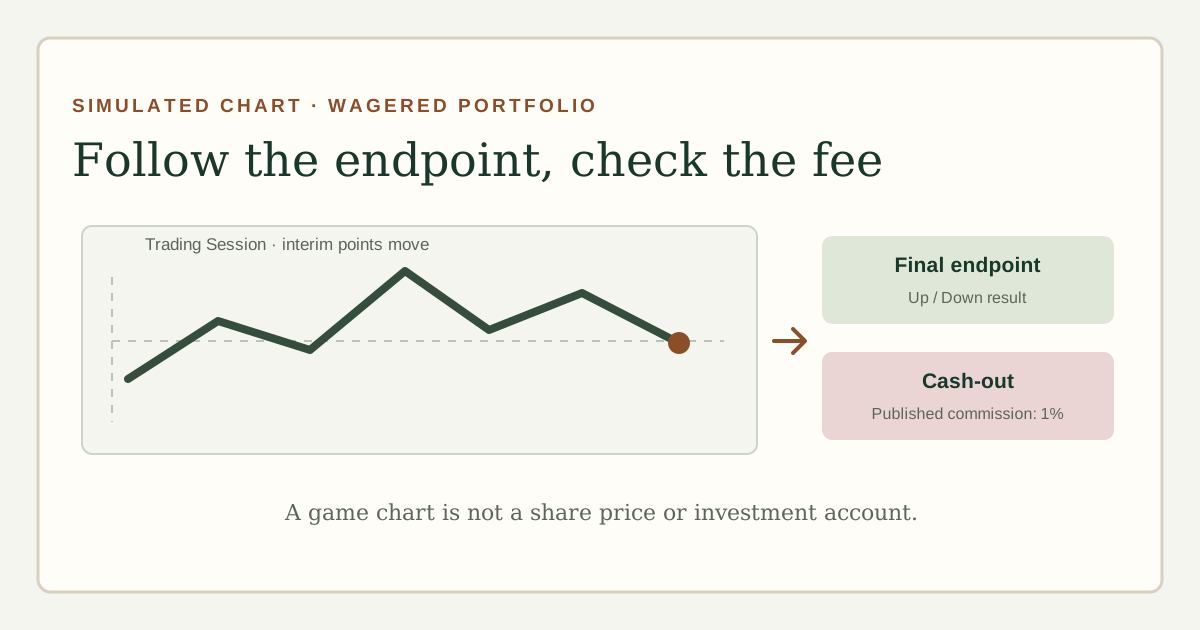
Evolution Stock Market is a live-presented gambling game in which a player predicts whether a simulated price chart will finish above or below its opening point. The game moves through a betting phase and a Trading Session. The published rules describe a result between −100% and +100%, excluding exactly 0%, and say that the value shown during the session does not itself settle the wager; the endpoint does. If the selected direction is correct, the percentage change is applied to the portfolio associated with the bet. A cash-out ends that exposure and carries a published 1% commission.
The financial-market theme is presentation. A wager is not a purchase of shares, an investment account, or advice about actual markets. The game’s chart uses simulated values generated under the game rules. It should be understood as a chance-based casino product, not as a tool for learning to trade or predicting a real index. Exact stake limits, currency, return information, cash-out options and which version an operator has integrated must be checked in the active game’s help panel.
What the name means—and what it does not mean
“Stock Market” can sound like a financial product, but the title here refers to Evolution’s casino game. The interface borrows familiar visual language such as a chart, percentage movement, Up and Down controls, and a portfolio balance. Those labels describe how the game presents its outcome; they do not turn a casino stake into a security or a trade on an exchange. The result is determined under the game’s rules rather than by the real-world price of a named company.
That distinction affects how to read every screen. A chart that rises during a round is not evidence that the player has locked in a profit. The final percentage may move before the Trading Session ends, and the chosen cash-out setting determines whether the game settles at an intermediate point or follows the automatic end-of-round rule in the version being used. A history panel records earlier game outcomes, not an independently audited market feed.
The two phases of a round
Each round has two broad phases. During betting, the interface accepts the stake and the player selects Up or Down. During the Trading Session, the chart moves and the game reaches an endpoint. The central question is whether the final percentage is on the predicted side of the opening value. The visual motion between those points supplies suspense but is not a separate set of intermediate winning checkpoints.
Before the betting window closes, verify that the selected side and amount are both shown as accepted. A highlighted button or a chip dragged over a control may not be enough if the timer has ended or the operator client has not confirmed the wager. The round summary should identify the selected direction, amount and any portfolio amount that remains active. When the next phase begins, do not assume that a late click changed the bet unless the accepted-bet panel confirms it.
During the Trading Session, the chart may cross above and below its opening level several times. Those movements can be useful for understanding what is happening on screen, but Evolution’s rule description says that the interim chart values do not determine the outcome. The endpoint percentage settles the direction prediction. If an operator displays a cash-out control, that creates a separate decision under the applicable version: the amount available at that moment can differ from the final result, and a fee can be deducted.
Choosing Up or Down
An Up selection predicts a positive final movement from the opening value; a Down selection predicts a negative one. The labels are directional choices, not instructions to buy or sell anything in a securities market. They apply to the game’s final result for that particular round. A correct direction does not necessarily mean the player receives the full value suggested by a moving chart, because the final percentage, stake basis, cash-out timing and commission all matter.
The game page describes a result range from −100% to +100%, with the exact zero result excluded. That range helps explain the possible sign and outer limits of the simulated endpoint. It is not a statement of the probability of any point in that range. Do not divide the interval into equal buckets and treat those as odds; the supplier page does not say that every value is equally likely. Likewise, a chart whose line appears to be approaching an extreme does not establish that the endpoint will continue in the same direction.
Read the percentage chart without mistaking it for market data
The chart is an animated representation of the game’s simulated outcome. Evolution’s public description says the values are simulated using a random-number generator. That statement is relevant to how the supplier characterises its product. It does not disclose the distribution of all possible endpoints or prove that any specific chart path is more likely than another. The game page’s top-level explanation is not a statistical audit, and this guide does not make one.
The percentage labels describe movement relative to the game’s opening reference point. Under a common percentage convention, a positive value is above the reference and a negative value is below it. The operator’s help should define precisely what the game’s displayed “portfolio” value represents and how a percentage result changes it. If the screen shows a number such as +12%, that is not the same thing as twelve currency units; the stake basis must be applied before interpreting a balance amount.
For example, a chart can show a positive intermediate reading and later finish below its opening point. An Up bet is judged at the stated endpoint, not at the earlier high. Conversely, a temporary fall does not make a Down bet a winner if the chart finishes above the start. This is why a screenshot captured mid-session is not enough to establish the settled result. When checking a completed round, use the final outcome panel and the accepted wager record together.
What a portfolio means inside this game
Evolution’s rules use a portfolio as the value connected with the player’s accepted bet. It is a game balance concept, not a collection of shares, an account held with a broker, or an asset that can be transferred to an exchange. The word may make the animation easier to understand, but it should not be taken literally as ownership of company stock. The player has exposure to a wager, and the casino rules define how that wager settles.
The supplier page says that every one-percent change in the correctly predicted direction increases the portfolio by one percent. In a hypothetical example, if an accepted game portfolio were 100 units and the final result were a positive 5%, a matching Up selection would use that percentage relationship before the operator’s settlement details are applied. This arithmetic illustrates a rule, not a promised outcome; the game can finish in either direction, and the active table may show how it handles the initial stake, a commission and currency rounding.
Evolution also says the game balance is rounded to the smallest currency unit. That can produce a visible difference between an unrounded calculation and a displayed balance. A fraction of a cent or cent cannot necessarily be credited as a fractional currency unit, so the help panel’s rounding rule matters when reconciling a small stake. Do not use an online calculator that assumes different rounding or currency precision to dispute a result without comparing it to the active rule.
If the game permits the player to keep a portfolio active between rounds, read the auto-re-wager wording carefully. Carrying an amount forward is different from placing a fresh selection, cashing out, or returning to the betting lobby. The public product information describes variants with automatic re-wagering and variants without it. The operator’s client determines which behaviour applies to the game currently open.
Cashing out and the 1% commission
The published Stock Market rules describe a 1% commission when a player cashes out. The commission is a deduction associated with the cash-out action; it is not the same as the chart’s percentage movement and should not be confused with a casino deposit or withdrawal fee. The precise screen should show how the fee is calculated and what balance remains after the cash-out is processed.
A manual cash-out changes the point at which the player stops being exposed to later movements in that Trading Session. The displayed offer at the time of the action can differ from the final result. Pressing cash out also does not erase an already incurred loss or guarantee that the returned balance exceeds the original stake. A person deciding whether to cash out should understand the current amount, the 1% charge, any rule on unfinished rounds and the effect of confirming the action.
Some supplier-described variants automatically cash out at the end of the round; others allow the player to cash out manually. The public information also distinguishes game versions with an auto-re-wager feature from those without one. Those are separate settings: one controls when a round’s portfolio is cashed out, while the other controls whether an amount is automatically entered again. A version can present one without the other. The interface and table-specific help should make both choices explicit.
Four variants described by the supplier
Evolution describes four possible product configurations that differ along two axes: whether the game has a live stream, and whether the portfolio is automatically re-wagered. The public page says a version without a stream can exist and that versions may either cash out automatically after each round or leave cash-out to the player. These statements identify the kinds of configurations a reader may encounter. They do not mean that all four are offered at every casino.
| Version detail | What to look for | Why it changes the round |
|---|---|---|
| Live stream | A presenter/video feed alongside the chart | Presentation changes, but the endpoint rule remains the key settlement check. |
| No stream | A chart-and-controls interface without live video | Lack of a stream does not make the outcome a financial-market feed. |
| Automatic cash-out | A stated end-of-round settlement without a manual action | Clarifies when exposure ends and the account value is realised. |
| Manual cash-out | A control that lets the player end exposure during a session | Makes timing relevant and should display the commission and provisional amount. |
| Automatic re-wager | A setting that re-enters a portfolio into the next round | Can expose a balance again; confirm whether it can be switched off. |
| No automatic re-wager | A fresh betting decision is required for the next round | Prevents assuming that a settled amount is automatically active. |
The table is a checklist, not an inventory of a specific New Zealand operator. If the title opens without video, that alone does not establish which variant is active. Look for an explicit rules page or in-game label describing the re-wager and cash-out behaviour. A casino lobby may use the same title for multiple table configurations, so record the table name and rules version if they are displayed.
Bets, returns and figures that are not confirmed universally
The official game page explains the directional outcome, percentage range, simulated chart, cash-out fee and variant options. It does not establish a universal New Zealand minimum stake, maximum stake, one RTP for all operators, or an always-available demo. Those details can depend on the casino integration, table, currency, jurisdiction and version. A number quoted by a third-party guide may accurately describe one operator but still be wrong for a different account.
To check a payout, look for the game’s actual help control and identify its exact scope. Does the figure apply to the active product version, a particular bet, a certain currency or one jurisdiction? Does the displayed result include the original stake, or is it a net gain/loss? Is a cash-out amount before or after the 1% commission? Does the table show a theoretical return or only examples of how the portfolio changes? Keep those categories separate. A commission is not an RTP; a maximum endpoint is not a payout schedule; a supplier explanation is not a local account limit.
If a third-party review gives a percentage, open the linked source and ask whether the exact active operator rule can be confirmed. If the number appears only in a casino lobby tile or affiliate review, it may not explain how the game settles. Where the operator does not publish a figure, this page leaves it unreported. That is more accurate than copying a return value from a PDF issued for a South African, European or other market and presenting it as New Zealand configuration.
If a rule and a live result appear to disagree, keep the round ID, time, accepted bet and rules text. The supplier’s generic page can help explain the product, but only the operator has the account record needed to investigate a specific wager. Contact support through the operator’s own process and ask which version and cash-out rule applied. Do not publish an account balance or personal data in a public post while seeking clarification.
Mobile interface and accessibility checks
On a phone, inspect the chart and bet controls before using the game. The Up and Down labels should remain readable when the interface is in portrait orientation; the selected direction and total stake should not be covered by a pop-up or an on-screen keyboard. A video can use screen space that a no-stream version does not, so do not assume the layout is identical on every table.
Open the help panel and check that the percentage range, endpoint rule, cash-out fee, auto-re-wager setting and variant information are accessible without relying on colour alone. If a red/green chart is difficult to read, look for the signed number or text label. If the screen clips the cash-out value or hides its confirmation state, stop rather than tapping based on an estimate. The decision is monetary; an unclear button is a reason to wait.
Mobile behaviour belongs to the operator as well as the supplier. Evolution’s public game page does not certify a specific casino’s app, browser compatibility, deposit route, responsible-gambling tools or NZ account access. A video loading successfully demonstrates only that a media element loaded. It does not prove the local game is enabled or that a particular stake range is available.
The supplier catalogue describes a free-play demo environment generally, while stating that features and availability can depend on jurisdiction. That does not confirm Stock Market demo availability for every New Zealand visitor. Distinguish a product video, an instruction page and a playable demo. Only call something a demo when the source actually allows a visitor to interact with the game without an account stake; verify that the demo is available in the relevant market.
Responsible-use boundaries for a market-themed game
The stock-chart design can make the round feel like a prediction exercise. That feeling is not evidence of skill or of a link to current financial news. The chart uses the game’s simulated outcome rules, and a sequence of prior results cannot reliably tell you the next endpoint. A strategy based on real company reports, exchange prices or economic announcements is not supported by the supplier’s public description.
Set a fixed entertainment budget before opening the game and stop when it is reached. Do not increase the amount to recover a loss or keep a portfolio active simply because the chart is close to a target. The game’s movement, live presentation and rapid next-round controls can encourage decisions without a pause. If the automatic re-wager option is present, check its status before play and disable it if it does not fit the limit you set.
New Zealand’s Department of Internal Affairs says that online casino providers may continue to operate during the transition up to 1 December 2026, while they must not advertise to people in New Zealand. This is an evolving national framework; access to the game at a named operator and any operator’s status cannot be inferred from Evolution’s catalogue. Use the regulator’s current customer information for the transition and seek support if gambling is causing harm. The available New Zealand Gambling Helpline can be reached by calling 0800 654 655 or texting 8006, as listed by DIA.
Questions readers commonly ask
Is Evolution Stock Market a real investing product?
No. It is presented as a casino game with a simulated chart and a wager on an Up or Down outcome. The game’s portfolio terminology does not mean that the player owns company shares or uses a brokerage account. It is not financial advice or a substitute for investing information.
Do the chart’s interim points settle my bet?
Evolution’s rules say the endpoint percentage determines the round’s result. An intermediate high or low may be visible while the Trading Session is running, but it is not the final directional result. A manual cash-out, where available, is a separate action governed by the active version’s rules.
What does the published 1% commission apply to?
The supplier describes a 1% commission on cash-out. The local help should show how it is calculated and whether the displayed amount is before or after the fee. It is not the same as a casino withdrawal fee or a percentage movement on the chart.
Are all four game variants available in every casino?
No such universal availability is established by the public product page. Evolution describes variations involving stream/no-stream and automatic/manual cash-out or re-wager settings. Check the exact table and client help offered by the operator you are inspecting.
Does an Up bet use real stock prices?
The official page says the values are simulated using a random-number generator. It does not describe the endpoint as a real listed-company price. Do not read the chart as an exchange feed or use it to make a financial decision.
What are the minimum and maximum bets in New Zealand?
No universal New Zealand limits were verified from the supplier page. Stake limits can depend on the table, casino, currency and account. Check the active game’s table information before confirming a wager; do not use a figure from another market as a local limit.
Sources and verification boundary
Official product source checked 6 October 2026: Evolution Stock Market game page. It describes the simulated percentage chart, Trading Session, endpoint rule, Up/Down selection, portfolio relationship, 1% cash-out commission and version options. New Zealand operator limits, local RTP, account access and a specific operator integration were not verified. New Zealand transition and support information checked 6 October 2026: DIA information for online casino customers. This article is an informational game guide, not investment or financial advice.
