Wazdan game guides · South Island guide
Black Horse™ by Wazdan: game rules, features and RTP evidence
 Best casinos available in New ZealandUpdated 7 November 2026

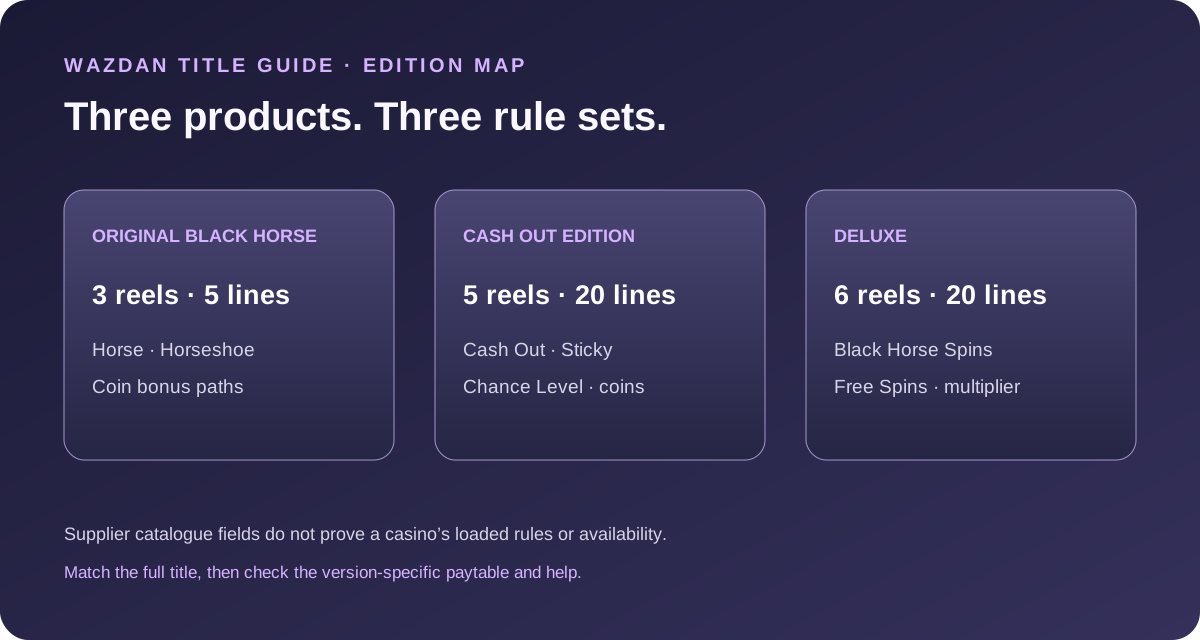
Wazdan lists Black Horse, Black Horse Cash Out Edition and Black Horse Deluxe as separate products. The base title is catalogued as a three-reel, five-payline slot with Black Horse, Horseshoe and Coin bonus labels; Cash Out Edition and Deluxe have different reel formats and feature names. This guide compares the supplier descriptions and shows how to confirm the exact build, paytable, stake, RTP and feature sequence in the game help.
The short answer
A Black Horse™ Wazdan game review needs to identify which edition is on screen before it says anything about reels, lines, bonus rounds or return. The supplier’s current catalogue separates the original Black Horse™ from Black Horse™ Cash Out Edition and Black Horse™ Deluxe. Their listed formats and headline mechanics differ, so the title alone is not enough to decide which rules apply.
For the original, Wazdan’s product page lists three reels and five paylines. It describes Black Horse Bonus, Horseshoe Bonus and Coin Bonus, and its supplier summary says the respective routes can award 45, 30 and 15 free spins with a three-times multiplier. The same page lists a 96.07% RTP, a 3,100-times maximum win and Standard volatility. Those are catalogue statements checked on 8 October 2026, not a promise that any casino build uses the same configuration.
Cash Out Edition is presented separately with five reels and twenty lines, Cash Out and Sticky Cash Out labels, Chance Level and Jackpot Coins. Wazdan’s page lists 96.12% RTP, a 2,500-times maximum and High volatility. Black Horse Deluxe is another product: six reels, twenty lines, Black Horse Spins, Free Spins and multiplier features, with a different supplier-listed RTP and cap. Read the exact game’s built-in help before relying on any setting or trigger.
Identify the edition before reading a review
Start with the complete title in the lobby card, loading screen and help menu. “Black Horse” in a search result may refer to the original product, Cash Out Edition, Deluxe, or a third-party shorthand that omits the suffix. Record the exact name, any build or version identifier, the date viewed and the operator’s own product label. If the lobby and help screen name different editions, pause the comparison and use the help for the client that actually opened.
A supplier catalogue answers a limited set of questions: which product names Wazdan currently lists, which features it associates with them, and which headline values appear on those catalogue pages. The in-game help is the better evidence for the rules of a particular loaded version. The casino lobby can show whether that operator lists a title, but it does not always expose every game rule. A review written by another publisher may describe a demo, jurisdiction or version you cannot see.
Keep these evidence layers separate in your notes:
| Evidence layer | Useful for | Not enough to establish by itself |
|---|---|---|
| Wazdan product page | Product identity and supplier-described mechanics | A casino’s selected RTP or local access |
| Loaded game help | Active version’s rules, paytable and settings if shown | Availability at another operator |
| Operator lobby or terms | Whether that site lists the title and account conditions | The complete feature sequence |
| Third-party review | Questions worth checking in the help | Current rules for your exact build |
This distinction prevents an edition comparison from silently importing a number or bonus rule from the wrong game.
Original Black Horse: a compact reel format
Wazdan’s original Black Horse page describes a classic three-reel, five-payline slot. That format is materially different from the five-reel Cash Out Edition and six-reel Deluxe. A short reel set can make the screen visually simpler, but it does not make the game’s actual paytable self-evident. The paytable still determines which symbols form a win, whether positions matter, how wild or scatter symbols work, and whether a bonus symbol has a separate award.
The product page’s feature list includes Black Horse Bonus, Coin Bonus, Horseshoe Bonus and Scatter. Its narrative says the Black Horse route may award 45 free spins with an x3 multiplier, the Horseshoe route may award 30 free spins with an x3 multiplier, and landing nine virtual coins activates a 15-free-spin route. These statements identify the questions to verify; they do not supply every trigger condition. The current help should show the required symbol count, eligible reels or positions, multiplier scope, whether a retrigger is possible and how the free-spin result is settled.
Do not infer a symbol’s function from its artwork. A horseshoe might be a scatter, a bonus trigger, or part of a named feature, but only the exact paytable and help define its role. The supplier’s page labels Scatter among the features; it does not give a complete symbol table in the brief product summary. Check whether the loaded help lists a separate scatter payout, a trigger-only role or both. If an operator has abridged help, note that the missing detail remains unconfirmed rather than filling the gap from a different edition.
The original title’s supplier page also lists a maximum win of 3,100 times the bet and a 96.07% RTP. Preserve the unit exactly as written. A maximum is a ceiling in the catalogue description, not an expected payout or a likely session result. RTP is a long-run theoretical parameter when the game is configured to that value; it does not predict the next spin, sequence or personal result. If the help screen shows a different version or return, report the operator’s evidence separately.
Black Horse Bonus: what the headline label does and does not say
The Black Horse Bonus is the most obvious name-to-feature connection in the original title. Wazdan’s summary associates a magnificent black-stallion symbol with 45 free spins and an x3 multiplier. The useful editorial question is not simply “Is there a horse bonus?” It is whether the loaded build says how many symbols are needed, where they must land, whether one symbol acts as a substitute, and when the multiplier applies.
A multiplier can be applied to a free-spin win, to a symbol value, to a feature award, or to a subtotal before the game applies a maximum. The supplier’s marketing summary does not specify every calculation stage. Check the help’s wording and examples. If the game includes a sample payout, record its bet denomination and whether the displayed amount is a total win or a multiplier only. Avoid describing x3 as a guaranteed three-times return: the multiplier is a calculation condition, not a statement that a bonus will trigger or pay a profit.
The count of 45 spins also needs scope. Ask whether the count is fixed when the feature begins, can increase through retriggers, can be extended by another symbol, or depends on the version. If no retrigger information is published, do not imply one. Check whether the game can pause or resume a feature after a browser interruption and whether the account history records the bonus as one round or multiple events. These are operational details, not assumptions that follow from the feature name.
Horseshoe and Coin bonus paths
The supplier summary links a Horseshoe Bonus to 30 free spins with an x3 multiplier. It describes the Coin Bonus differently: nine virtual coins activate 15 free spins. Treat those as separate routes unless the loaded help explicitly combines them. A title may share a visual theme and bonus screen while using different symbols, triggers or award calculations. A comparison table in an outside review cannot substitute for the rule text shown by the current client.
For the Horseshoe path, check whether the trigger uses a scatter-style count, a fixed number of symbol positions or a combination with the black horse symbol. Record whether the x3 multiplier begins immediately, applies only during a specific feature state, or changes after each spin. For Coins, check whether the nine coins must appear together in one paid round, whether collected coin values matter, and whether the named bonus has additional stages. The short catalogue summary does not answer these points, so an article should not invent a “collect nine over multiple spins” mechanic.
A practical way to document a trigger is to write down four fields: the exact symbol name, the exact condition copied from help, the state entered after triggering, and the settlement rule for the award. Add a fifth field if the feature has a cap or multiplier. If the help describes only a promotional headline, mark the trigger as “not fully specified in the accessible source.” That is more accurate than turning a vague phrase into a complete rule.
Cash Out Edition: a separate product, not a patch to the base title
Black Horse™ Cash Out Edition is a separately listed game. Wazdan’s page shows five reels and twenty lines and names Cash Out, Sticky Cash Out, Chance Level and Jackpot Coins. It also includes a Grand Jackpot label and lists a 96.12% RTP, a 2,500-times maximum win and High volatility. The catalogue release date shown is 30 November 2023. These figures and labels belong to that supplier page, not automatically to the original or Deluxe.
The Cash Out description says the feature appears as standard Cash Out or Sticky Cash Out. It describes Chance Level as a way to increase the chance of landing jackpot symbols and calls out Jackpot Coins and a Grand Jackpot. Those names are not a full payout table. In the game help, inspect what counts as a Cash symbol, whether its displayed value is fixed or bet-linked, how the Cash Out symbol collects values, and whether the total is paid immediately or contributes to another feature state.
“Sticky” also needs a defined scope. Does a value remain in place through one respin, a feature sequence or a different period? Which event clears it? Does the help define whether a sticky object is a symbol, a collected amount or a state? The official product page gives a high-level description but not the complete round logic. Do not write a sequence diagram as a fact unless the actual rules source describes the sequence.
Chance Level should be checked against both its cost and its effect. Wazdan’s supplier wording refers to a higher chance of landing a jackpot; it does not promise that the jackpot will occur. Find out whether an increased stake, a separate setting or a purchase feature is required, and whether the selection changes the total wager. A player comparing editions should treat this as a separate feature control, not as a universal Black Horse option.
Black Horse Deluxe: another format and another set of settings
Black Horse™ Deluxe is not simply a larger-screen presentation of Cash Out Edition. Wazdan lists six reels and twenty lines, a 96.23% RTP, a 950-times maximum win and Medium volatility on its product page. The page’s release date is 1 July 2020. Its feature list includes Black Horse Spins, Free Spins, multi-level wins with a win multiplier, Scatter, Wild, Buy Feature and Ultra Lite Mode. The title therefore needs its own paytable and help evidence.
The supplier copy says Black Horse Spins can award the highest win, and that Free Spins pair with a multiplier. It does not provide every trigger threshold or all the multiplier steps in the summary. The in-game help should state whether the feature is triggered by particular symbols, whether a spin count is set, which symbol becomes wild, how multipliers interact with line wins, and whether buying a feature is available in the loaded market. Do not assume the same Black Horse Bonus or Horseshoe Bonus routes from the original are present simply because the names overlap.
The six-reel format deserves a line-by-line check. Confirm whether the paytable uses fixed paylines, ways, symbol combinations, or a different evaluation rule. Wazdan’s catalogue uses a “reels / lines” field, but the actual help is the source for how wins are formed. If the screen shows six reels and twenty lines, note whether all lines are active at every stake and whether the user can change the bet level without changing the line count.
The Deluxe page includes both Buy Feature and Ultra Lite Mode. These are separate kinds of product information: one may affect how a bonus is entered, while the other is a technical display mode. Verify availability and cost in the actual client before describing either as an option. Do not treat the existence of a supplier catalogue toggle as proof that the casino exposes the same toggle.
Side-by-side edition check
| Edition listed by Wazdan | Catalogue format | Supplier-listed headline details | What to confirm in the casino help |
|---|---|---|---|
| Black Horse™ | 3 reels / 5 paylines | 96.07% RTP; Standard; 3,100x max; three named bonus paths | Symbol triggers, free-spin count, x3 scope and active return |
| Black Horse™ Cash Out Edition | 5 reels / 20 lines | 96.12% RTP; High; 2,500x max; Cash Out and Sticky Cash Out | Cash-symbol values, sticky state, Chance Level cost and jackpot settlement |
| Black Horse™ Deluxe | 6 reels / 20 lines | 96.23% RTP; Medium; 950x max; Black Horse Spins and multipliers | Line evaluation, spins trigger, multiplier order and Buy Feature availability |
The table is a dated supplier catalogue comparison, checked 8 October 2026. It is not a recommendation or a report that these products are available at a particular casino. A title may have different settings in a game client or be absent from an operator’s current lobby.
How to check the paytable without mixing versions
Open the help icon from the actual game screen rather than a search result. Record the exact title at the same time; it is easy to leave one edition’s page open while reading another. If a separate “i” panel, paytable and settings page exist, read all of them. Look for the minimum and maximum stake, the denomination, the active currency, whether the displayed values are per line or total bet, and any optional mode that can affect play.
Paytable examples often use a nominal coin value. Convert carefully: if the example uses one unit per line and twenty lines, the round stake may be twenty units rather than one. If the game has five paylines, do not transfer the twenty-line arithmetic from another edition. The paytable may describe a win as “times total bet,” “times line bet,” or a fixed coin value. These are different bases. Copy the label alongside the number.
Record the return-to-player display only if the exact help identifies the loaded build or operator’s selected value. A catalogue may show one percentage while the casino’s client supports several configurations. If no version or market label is shown, say “supplier catalogue lists” and “operator setting not verified.” An outdated review can help identify a discrepancy, but it should never silently override the game’s current help.
Understanding volatility and maximum win
Wazdan labels the original Black Horse as Standard, Cash Out Edition as High, and Deluxe as Medium in the supplier catalogue snapshot. The labels are not a clock or forecast. They do not state how many spins will occur between wins, that one version pays more often today, or that a higher-volatility game will deliver a larger result in a session. They are broad product-level descriptions whose meaning depends on the provider’s model and configured version.
The maximum-win field also needs a unit and source. The original is listed as 3,100 times bet; Cash Out Edition as 2,500 times; Deluxe as 950 times. A cap says what the supplier page identifies as the top award under its stated configuration. It does not supply the probability of reaching the cap, the number of qualifying symbols, or whether a particular operator build uses the same cap. Do not divide the maximum by the RTP or use it to estimate a likely outcome.
RTP is a theoretical long-run percentage, not a refund schedule for a person. A figure such as 96.07% is not a promise that a particular account will receive 96.07% back from a short session. It cannot be used to infer a bonus trigger probability. If two editions have different published RTPs, that only establishes that the catalogue numbers differ; it does not rank them for a particular player or session.
A repeatable game-help worksheet
Before describing a Black Horse edition, fill out a one-page record. Write the lobby title, the loading title, any version number, operator, date, country or currency context if visible, and the help-menu location. Capture the game’s own text where permitted by the operator’s rules. Do not store passwords, payment credentials or identity documents in editorial research notes.
Next, make a feature table with one row per named mechanic. For the original, include Black Horse Bonus, Horseshoe Bonus and Coin Bonus. For Cash Out Edition, include Cash Out, Sticky Cash Out, Chance Level, Jackpot Coins and Grand Jackpot. For Deluxe, include Black Horse Spins, Free Spins, multiplier wins and any visible Buy Feature option. Use columns for “supplier description,” “help wording,” “trigger,” “what persists,” “settlement” and “unanswered question.” This structure makes missing evidence visible.
Then record numeric settings separately: reel and line format, pay basis, bet minimum and maximum, coin denomination, currency, RTP statement, volatility label and maximum-win unit. Do not put catalogue and operator values in the same cell. Use two columns and mark each source. If the game help is unavailable, use “not verified” rather than copying a secondary review’s value.
Finish with a limitation statement. A complete review may still be useful while some values are unavailable if it clearly separates what the supplier publishes from what the operator confirms. It should not claim personal play, testing, local eligibility or results when those checks were not performed. An editor can identify the precise evidence gap without making the article less useful.
Practical edition-selection checklist
A reader comparing the three listings should first decide what kind of information they need. If they are trying to understand a particular screen, use that screen’s edition name. If they are comparing supplier descriptions, compare the same fields side by side and keep the publication date attached. If they are checking a casino lobby, search the casino’s own catalogue for the full edition name and then open the rules before assuming the product matches the supplier page.
Check whether the product is actually offered by the operator and whether the account can access it; a supplier page does not establish either fact. Inspect terms for market or account restrictions and do not infer New Zealand availability from Wazdan’s list of markets or broad claims such as “all currencies.” Those labels describe supplier-side cataloguing, not a legal access determination for every operator or player.
For a low-friction comparison, write down four questions: “Which edition is this?”, “What rules does this build show?”, “Which numerical settings are displayed?” and “What is missing?” If an answer comes from a different edition, tag it clearly. If the help is ambiguous about a feature, quote the ambiguity rather than interpreting a promotional adjective as a rule.
Mobile, browser and demo considerations
The supplier catalogue says its products are available across platforms, but that does not prove a particular casino has deployed the mobile build or that all functions behave identically on every phone. The Deluxe catalogue also lists Ultra Lite Mode, while the other editions use their own technical descriptions. A lightweight or responsive label should not be converted into a claim about tested performance, accessibility or compatibility on a named device.
If a demo is offered by an operator or a permitted source, use it only to inspect navigation and the displayed help, not to estimate the chance of a bonus or typical return. A short sample cannot validate RTP. Check whether the demo is the same edition as the cash game, whether a mode or stake is missing, and whether the help panel includes a version indicator. If no demo was available, say so; never invent hands-on testing.
When reviewing on a phone, check whether the help button, paytable, balance display and bet adjustment remain visible without covering one another. This is a usability observation, not a rules conclusion. Do not claim WCAG compliance from a brief visual glance or describe an untested casino page as mobile-optimised.
Questions readers commonly ask
Does Black Horse have only one game version?
No. Wazdan’s catalogue separates Black Horse, Cash Out Edition and Deluxe. They have different formats and features, so an article should name the edition it is discussing. Use the full title in the loaded help.
Is the original’s 96.07% RTP the RTP in every casino?
That cannot be concluded from the supplier page alone. The page lists that value for the product catalogue as checked on the date stated here. Confirm the actual value and version in the operator’s game help.
Does a 3,100x catalogue cap mean Black Horse is likely to pay that much?
No. A maximum is an upper limit in a catalogue description, not a probability or forecast. It says nothing about whether a specific round or session will reach the cap.
Are the original free-spin bonuses identical to Black Horse Deluxe?
The supplier pages use separate product names and feature lists. Do not transfer the original’s Black Horse, Horseshoe or Coin trigger descriptions to Deluxe unless that edition’s own help confirms them.
What does Sticky Cash Out mean?
The Cash Out Edition supplier page uses both Cash Out and Sticky Cash Out labels, but its short catalogue summary is not a full rulebook. Check the active help for what sticks, for how long and which event resets the feature.
Editorial limits and responsible use
This page is a product-information guide, not a prediction, a personal-play review or a recommendation to gamble. No casino version, game demo, operator help screen or New Zealand account access was tested for this article. The supplier catalogue was checked on 8 October 2026. Values may change, and an operator’s loaded game may use settings that differ from the catalogue snapshot.
Online casino advertising and affiliate arrangements in New Zealand are subject to current restrictions. Check the Department of Internal Affairs advertiser guidance before any future commercial placement. For independent help, visit the site’s New Zealand safer gambling support page.
Primary sources and review limits
- Wazdan: Black Horse™ — checked 8 October 2026; supplier descriptions, feature names and catalogue fields for the original product.
- Wazdan: Black Horse™ Cash Out Edition — checked 8 October 2026; separate supplier-listed edition and its catalogue fields.
- Wazdan: Black Horse™ Deluxe — checked 8 October 2026; separate supplier-listed edition and its catalogue fields.
- DIA: Online gambling for advertisers — checked 8 October 2026; New Zealand advertising guidance.
- No operator lobby, game client, version-specific help, demo, RTP configuration or New Zealand availability was checked.
Related guides
- Wazdan games guide — navigate the supplier catalogue and distinguish its descriptions from operator rules.
- Hot Slot™: 777 Coins — a separate retro title with Cash Out and 9 Coins Jackpot labels.
- Mighty Symbols™: Diamonds — a different format and a separate feature map.
- All selected game guides — browse the site’s published game-reference pages.
Sponsored offers shown by the shared site components are separate from the editorial game or account evidence above. They do not establish local eligibility or verify an operator configuration. Read the current operator terms and local requirements independently.
