Live table game rules · South Island guide
Dragon Tiger rules: card comparison, ties and side bets
 Best casinos available in New ZealandUpdated 7 November 2026

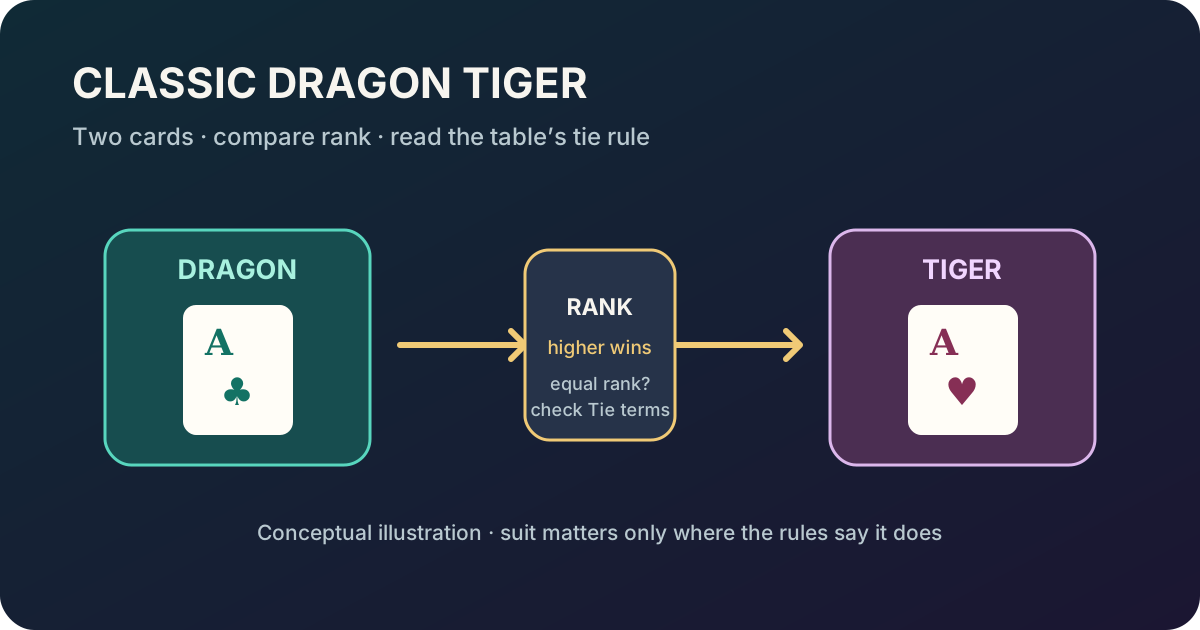
Classic Dragon Tiger compares one card for Dragon with one for Tiger. A higher-ranked card wins the corresponding main wager; equal ranks create a Tie result, while a Suited Tie requires the table’s stated match of rank and suit. The product’s published tie payout is not a universal rule for every operator, so this guide explains what the labels mean and how to read the specific help panel before relying on a settlement figure.
The short answer
Classic Dragon Tiger is a head-to-head comparison: one card is assigned to Dragon, one to Tiger, and the higher card determines the main result. A player can usually select Dragon, Tiger or Tie before the deal. Evolution’s current public overview describes those three outcomes and lists a Tie side bet at 11:1 and a Suited Tie side bet at 50:1. Those figures describe the supplier’s published overview; the table’s own help remains the controlling place to confirm the exact rules and display convention in a particular game.
The main Dragon or Tiger wager and the Tie side bet are different contracts. If the cards have equal ranks, a main-side selection may be partly returned or settled another way under that version’s rule. A Tie wager is judged against the tie market’s stated payout. A Suited Tie is narrower: the table must define whether the two cards need both the same rank and suit, then show its return. Do not infer a refund or a payout from the animation alone.
This page covers the classic two-card game. Evolution’s Dragon Tiger Phoenix adds a third hand, while Super Speed Dragon Tiger is a distinct faster product. Their product help can differ, so use the separate Dragon Tiger Phoenix guide or Super Speed Dragon Tiger guide only for those named games. Neither substitutes for the rule panel attached to a classic table.
What is being compared
The table assigns one dealt card to Dragon and another to Tiger. The game then compares their ranks under its published card order. The winning side is not chosen by the card’s colour, by a pattern in the history road, or by the label’s visual prominence. Suit may matter for an optional side bet, but it is separate from the rank comparison used to decide the ordinary Dragon or Tiger result.
Before treating a familiar deck convention as a rule, find the game’s ranking list. Card interfaces often display a small help icon or rules button beside the game screen. It should define how Ace is ordered, whether all face cards share a rank or use separate ranks, and whether suit has any role outside Suited Tie. If the public supplier page does not answer a detail, the missing information should remain an open question rather than being filled with a rule borrowed from baccarat, poker or another casino’s version.
The simplicity of two cards makes the result easy to read, but not every part of the wager is simple. A display may show three main areas and an extra side bet, while a separate panel explains the tie refund, payout basis and accepted stake range. Those details are not all contained in the words “Dragon wins” or “Tiger wins.” The outcome, the selection and the settlement are three related but distinct pieces of information.
An easy way to describe a round is: betting opens, selections are accepted, betting closes, cards are dealt, ranks are compared, and the game settles each eligible selection. A live presentation may include a dealer, camera feed, countdown and a results road. These features help follow the round; none changes the mathematical definition of the market. Always distinguish the game result from the wager result: a tied hand is a game outcome, while what happens to each stake depends on the relevant rule.
Read the card order before calculating a winner
The card order is the first item to verify because it determines every Dragon or Tiger comparison. Many card games use familiar high-card ordering, but variations exist and “highest card” does not by itself define the complete order. A clear help panel should state the values from low to high or provide an equivalent list. If it uses symbols, tap the help control and make sure the order is readable on the device being used.
Compare rank first. If one card ranks above the other, the higher-ranked side wins the corresponding main selection under the standard comparison. The suit symbols can be identical or different without changing that ordinary high-card comparison. If the ranks match, the result is a tie. Only after identifying a tie should a player consider whether an optional Tie or Suited Tie selection applies.
The Ace deserves special attention. It may be the lowest card in a particular card game or the highest in another, and a familiar poker assumption can be wrong at a new table. Face-card ordering should also be verified rather than guessed from artwork. The help should make the order explicit; if it does not, the safest conclusion is that the available public description is incomplete.
It can help to read the cards out loud in two stages: “rank, then suit.” For the main markets, decide the higher rank or identify equal ranks. For Suited Tie, compare both attributes only if the rule requires both. This prevents a common interpretation error: two equal ranks in different suits are a Tie, but not necessarily a Suited Tie. Conversely, two cards of the same suit but different ranks are not a Tie because the ranks are not equal.
Do not let suit colour stand in for suit identity. Red versus black is a colour grouping; hearts, diamonds, clubs and spades are individual suits. A Suited Tie label normally refers to a precise identity test, not merely two red cards. The active rule sheet should say whether the pair must match rank and suit and whether a special case changes the settlement. If that definition is absent, do not assume which visual pattern qualifies.
Dragon, Tiger and Tie are separate selections
Dragon and Tiger are the two main comparison markets. A selection wins when its card has the higher rank according to that table’s order. A Tie selection asks for equal ranks. The screen may put these markets next to each other, but their settlement and likelihood are not interchangeable. A quoted payout for Tie does not tell you what happens to the main wagers when a tie occurs.
Evolution’s public overview says that its Tie bet pays 11:1 and its Suited Tie bet pays 50:1. A ratio like “11:1” is commonly shown as profit relative to the stake, with the original stake also returned on a winning wager, but interfaces can present return wording differently. Read whether a displayed figure is profit-only or total return. The help, rather than a third-party article or an informal table, should define the convention.
For a simple hypothetical example, suppose a player selects Dragon and Dragon’s card ranks above Tiger’s card. The selection wins under the main comparison. If Tiger is higher, a Dragon selection loses. If ranks are equal, the round is tied and the main selection follows the product’s tie rule. The example identifies the comparison; it does not assert a particular refund where that refund has not been checked against the live table.
A player who has placed more than one selection must read each separately. A Dragon selection, a Tie selection and a Suited Tie selection can have different outcomes from the same pair of cards. The settlement screen should show which market won, which lost, and which may have been partly returned. Check the detailed help before treating a wallet change as a complete explanation; history panels can compress or abbreviate settlement details.
What a tie means and why the refund rule matters
A tie begins with equal card ranks. It is not a claim that the cards are identical in suit, and it does not automatically mean every selection is refunded. There are at least three separate questions: does the tie side bet win; what happens to a Dragon/Tiger stake; and does a Suited Tie condition also apply? Each answer comes from the relevant game rule.
Some published Dragon Tiger rules return part of a main Dragon or Tiger wager when the cards tie. Evolution’s game-rules material published by an operator describes a half-stake return for a Tie and a separate half return for a Suited Tie. Because the game help can be table-specific, treat that as an example of a published version rather than a promise that every table or operator will settle the same way. The live help should confirm any return before play.
A refund is not a win. If part of a wager is returned, the player has not necessarily earned a positive net result; the unrecovered part may be lost. Settlement wording such as “push,” “half back,” “half returned,” or “stake returned” matters. A “push” often means the entire relevant stake is returned, while a partial return leaves a loss on that wager. Never transfer a term from another casino without checking its own definition.
There is also a difference between a tied result and a winning tie wager. A player can have no Tie selection and still see a tied deal. The Tie side bet only applies if that market was selected and its conditions are met. Similarly, a Suited Tie result does not necessarily make a main Dragon or Tiger selection a full refund. The game may settle the ordinary bet and the suited market independently.
For a disputed or unclear settlement, capture the round identifier and the rules panel available at the time, then contact the operator through its official support channel. A screenshot of the card display alone may not show the accepted selection, table version or stake terms. Keep the round’s rules, transaction record and result together. Avoid relying on a road chart or a community post to resolve an account-specific settlement question.
Suited Tie and side bets
Suited Tie narrows the event by adding a suit condition to the equal-rank condition. The exact wording matters: the table should explain whether the two cards must share both rank and suit. Evolution’s product overview lists the Suited Tie alongside Tie and gives a published 50:1 figure. The page does not mean the market is available on every table, in every operator interface, or to every New Zealand user.
Before reading any side bet, locate its complete event definition, the payoff convention, and its relationship to the ordinary selection. A market called “Suited Tie” is not automatically equivalent to a colour match or any two cards of the same suit. If extra bets such as high/low, red/black, odd/even or a named pair appear on a provider’s table, confirm whether they belong to that exact version. Their presence on one provider’s version does not establish that Evolution or an operator offers them here.
The trade-off of a narrow side bet is that it describes a more specific event. A larger displayed payout, by itself, does not show that it is a favourable choice. To evaluate the market mathematically, one needs the deck composition, whether cards are dealt with or without replacement, the rank order, the exact qualifying event and the payout convention. If any input differs, the probability and expected return can change.
For a standard multi-deck theoretical illustration, a probability table can be calculated by enumerating all possible pairs of cards from the stated deck model. But a result for an assumed shoe is not an operator RTP, and it should not be relabelled as one. A table may use a different shoe, shuffle procedure, number of decks or side-market availability. A useful guide separates “calculated under these assumptions” from “published by the game” and “confirmed in this operator’s help.”
The Tie and Suited Tie markets can be visually adjacent or grouped in an expandable side-bet panel. Check whether each requires a separate stake and whether one wager can be placed alongside the other. Then read the settlement examples. If the interface hides a rule behind a scrollable help panel, use the panel rather than assuming the displayed headline ratio tells the whole story.
A practical settlement table
The table below describes the decision sequence, not a universal operator payout table. It avoids turning supplier overview figures into a guarantee about an unseen client version.
| Card comparison | Main result | Tie selection | Suited Tie selection |
|---|---|---|---|
| Dragon rank is higher | Dragon outcome | Does not qualify | Does not qualify |
| Tiger rank is higher | Tiger outcome | Does not qualify | Does not qualify |
| Ranks are equal, suits differ | Tie outcome | Check the shown Tie payout | Check the rule’s rank-and-suit definition |
| Ranks and suits match | Tie outcome plus possible suited event | Check the shown Tie payout | Check whether this is the defined Suited Tie |
For every row, the ordinary Dragon or Tiger stake needs its own settlement rule. A Tie in the game state is not enough to infer a full refund. Use the active help table for partial returns, any exceptions and how the stated ratio is displayed. If there is a choice of tables, compare their rule panels rather than relying on a lobby label.
Reading a payout table is a small but repeatable process. First find the selection name and qualifying event. Next find what the line means: net win, gross return, or a multiplier of the total stake. Then check what happens when the event is not met and whether the main wager has a separate tie rule. Finally, match the example to the exact game title shown in the lobby. This prevents a payout attached to a side market from being applied to the wrong card outcome.
Probability, payout and house edge
Probability answers how often an event is expected under a stated deck model. A payout table states the settlement for a winning selection. House edge or theoretical return combines those assumptions with the payout and losing outcomes. The three concepts belong together, but they are not interchangeable. A large payout may compensate for a rare event, and it does not alone establish the market’s expected value.
The relevant card model has to be known before calculating odds. Is the shoe assembled from a standard set of cards, multiple decks, or a virtual process? Are dealt cards removed until a reshuffle? How are suits ranked, if at all? Does a Tie return a portion of the main bet? The same label can produce different calculations when any of those assumptions changes.
For a purely theoretical calculation, count the eligible pairs and divide by all possible pairs in the model. Then multiply each outcome probability by its net win or loss and combine the results. If the payout is described as “to one,” establish whether the stake comes back on a win, because mixing a gross return with a net-profit figure will produce the wrong expectation. The operator’s help is the source for the real product; an independent calculation is an audit under declared assumptions, not proof of the operator’s internal math.
Historical roads are not a probability calculator. They show previous outcomes, sometimes grouped by streaks or patterns. In a properly random game, seeing Dragon repeatedly does not force a future Tiger or Tie. A road can help a viewer follow what has happened, but it cannot make a prediction reliable. Avoid systems that claim a guaranteed result by increasing stakes after losses: a finite bankroll, table limits and uncertain outcomes make those promises unsafe.
How to inspect a live table before a round
Start by confirming the product name. “Dragon Tiger” in a lobby may sit beside branded variants with extra hands or a faster deal cycle. Then open the help panel and find the rank order, the three primary markets, the Suited Tie definition, the tie settlement for a main bet, and the payout display convention. If a rule is not available, do not infer it from an adjacent product.
Next, identify the current betting state and the selected chip or stake. A live screen may have a timer; only selections accepted before betting closes should count. Check whether your chosen area visibly highlights after selection, then verify the amount before the deal. If the interface permits multiple selections, confirm that each amount is independently displayed. A touch screen can register a nearby area differently than intended, especially if markets are close together.
After the deal, compare ranks first and suits second. Look for a result label, then a separate settlement label or balance change. If the game includes a history road, make sure the new result appears there only after settlement. Do not confuse the card-reveal order with the ranking rule: a card turned over first is not thereby the winning card.
Use the help panel to resolve terminology before a wager, rather than during an unexpected tie. If the table supports a practice mode, its access and rules are jurisdiction-dependent and may be unavailable. A no-stake animation can illustrate the interface, but it cannot establish real-money eligibility, the availability of a specific table in New Zealand, or a cash-play settlement policy.
Separate variants and product boundaries
The word “Dragon Tiger” appears in product names beyond the classic two-card comparison. Dragon Tiger Phoenix adds another hand and has its own tie language. Super Speed Dragon Tiger changes the presentation pace, but its exact betting window and settlement terms still belong to that table’s rules. These pages are linked for navigation, not merged into this guide.
Other providers can add side bets or publish different payout ratios. A third-party rule comparison may be useful for understanding why versions differ, but it cannot prove that a given operator has loaded that exact version. Always match the visible provider, product title and help panel. If the casino’s version is a branded game, use the branded rule sheet and do not silently borrow the classic table’s payout grid.
This separation is especially important in search results, where a generic article may present one common rule as universal. A reader searching for card-game rules needs an explanation of the common outcome structure and a clear method for checking local settlement. They do not need a claim that a product variant is available in the country or that every site uses the same Tie refund.
For the provider’s other selected guides, use the Evolution catalogue. To compare another product’s rules, return to the existing game guide index. These are navigation routes only; neither catalogue establishes the operator’s current local offering.
Mobile display and accessible reading
On a phone, the table may fit by shrinking bet areas, hiding secondary markets behind a tab, or placing the history road below the live feed. Before reading a card result, identify where the game keeps the rules control and whether the entire payout table scrolls. Do not assume that a partially visible row is the complete paytable.
Small suit icons can be hard to distinguish at a glance. Zooming may help with static help text, but avoid changing browser zoom if it obscures the stake amount or the selected bet. If colour is the only cue for a market, look for its text label too. A well-designed interface should give the result in words or other distinguishable symbols, not colour alone.
For keyboard or assistive-technology users, game interfaces vary widely. The provider or operator may document keyboard focus, screen-reader output and accessible controls separately from the card rules. A live video feed may not be sufficient to communicate a result without labels. Check the accessible help documentation and the operator’s support information rather than treating a visual card reveal as fully accessible.
This guide does not confirm mobile compatibility, device performance or availability for an operator in New Zealand. Those facts depend on the client and the current service. When the official product page links to a demo, that still does not establish that a local operator offers the same game or that the demo is available in every territory.
What this guide can and cannot confirm
The current Evolution product overview describes a two-card Dragon/Tiger comparison, a Tie selection, a Suited Tie selection, and published side-bet figures. Public rules hosted by an operator also illustrate a half-stake main-bet return on a Tie and a separate Suited Tie settlement. Those are evidence about published versions, not a live inspection of any casino’s current New Zealand game client.
The game-specific operator help was not available for this review. For that reason, this page does not claim a New Zealand operator offers the title, does not call a practice mode locally accessible, and does not treat every published payout or refund as universal. The current table should provide the active rule text, actual market list, deck/shoe assumptions, settlement and any local restrictions. If those are not shown, the reader should treat the specific value as unverified.
The Department of Internal Affairs’ advertising guidance is relevant to the distribution of online-casino material in New Zealand. This page has no operator offer or affiliate link. The information explains rules and verification, rather than recommending a place to play. Public release remains subject to appropriate review of the current rules and applicable advertising requirements.
Frequently asked questions
What is the basic Dragon Tiger rule?
One card is dealt to Dragon and another to Tiger. The card with the higher rank wins the corresponding main selection; equal ranks create a Tie result. The card order and settlement details should be confirmed in that table’s own help.
Does a Tie refund the Dragon or Tiger stake?
Not universally. Published versions can return part of a main stake, while other terms may differ. Read the active help for the exact tie rule and distinguish a partial return from a full push.
What does Suited Tie mean?
It is a separate market for a tie that also meets a suit condition. Confirm whether the table requires both cards to share rank and suit and check the payout shown in the relevant rules panel.
Are Evolution’s displayed Tie payouts guaranteed at every operator?
No. Evolution publishes figures on its product overview, but an operator’s active game help is the relevant source for its loaded version and settlement wording. Availability in New Zealand also requires separate verification.
Is Dragon Tiger Phoenix the same game?
No. Phoenix adds a third hand and has distinct outcome rules. Use its own product guide and help rather than transferring the two-hand rules to it.
Does Super Speed only make the same game faster?
It is a separate named product. Its table rules, display and local availability should be checked independently. A product name or faster-looking presentation does not prove every other rule is identical.
Can a history road predict the next card?
No. It records prior outcomes; it does not make a future card more likely to match a visible pattern. Treat streaks as historical display, not a forecast.
Sources and scope
- Official Evolution overview, checked 7 October 2026: Live Baccarat and Sic Bo — Dragon Tiger. The page describes the two-card comparison and lists Tie and Suited Tie headline payouts.
- Official Evolution product page, checked 7 October 2026: Dragon Tiger. The accessible page did not expose a complete operator-specific help panel during this review.
- Published Evolution rules copy hosted by an operator, checked 7 October 2026: Evolution game rules PDF. Used as a version-specific example, not a current New Zealand operator rule.
- Probability comparison: Wizard of Odds — Dragon/Tiger, checked 7 October 2026. Assumptions and provider differences are explicitly distinguished from a local table’s rules.
- Related product boundaries: Dragon Tiger Phoenix and Super Speed Dragon Tiger.
- New Zealand advertising context: Department of Internal Affairs guidance, checked 7 October 2026.
