Live table game rules · South Island guide
Sic Bo betting table explained: bets, odds and payouts
 Best casinos available in New ZealandUpdated 7 November 2026

Sic Bo uses three six-sided dice, and its betting layout lets a player select a sum, parity group, face appearance or exact combination. This guide explains the common areas, the mathematics behind the outcomes, and how to read a real payout table without assuming that every operator uses the same settlement.
The short answer
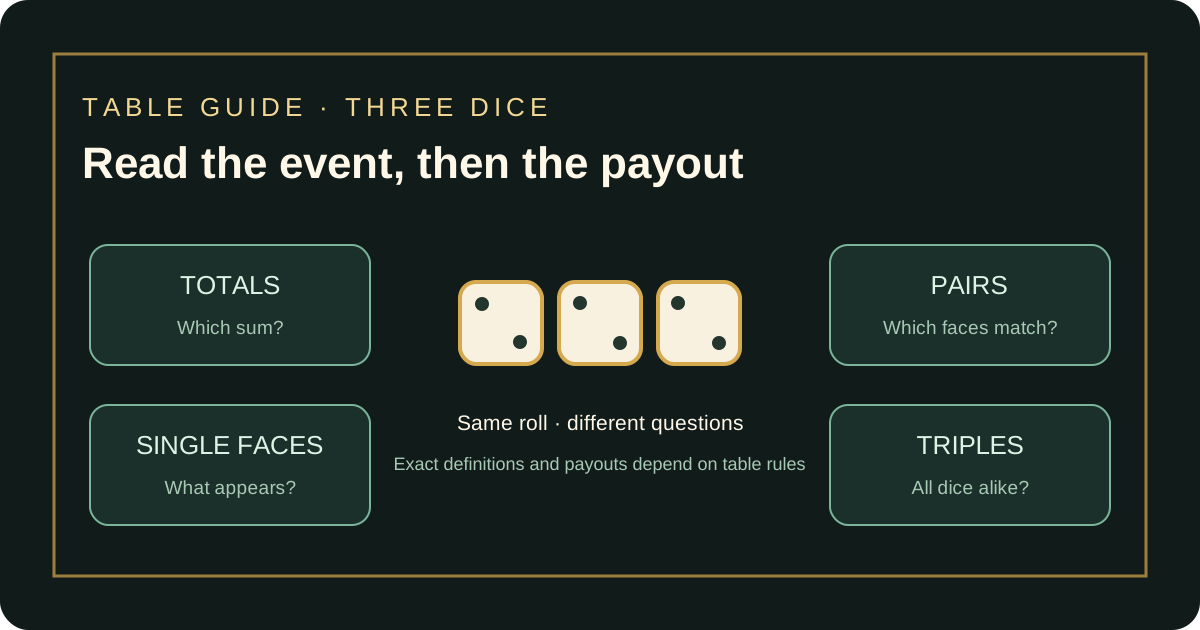
A Sic Bo betting table is a map of predictions about three dice. A wager may name the total, ask whether the total is small or big, predict odd or even, identify a face that appears, or specify a pair or triple. Those choices are different events, so they do not share one probability or one payout. With three fair six-sided dice there are 216 equally likely ordered results, but the table’s displayed return is set by the rules of the particular game. Read the bet definition, the payout convention and exceptions such as triples before placing anything. The arithmetic below explains the classic layout; it does not certify an operator’s current game version or New Zealand availability.
What the layout represents
The table surface is divided into labelled betting boxes. Each box describes an event that can be checked after the dice stop: a total, a range of totals, a parity, the appearance of a face, or a particular combination. A digital table may arrange those boxes in a compact grid, while a physical layout may group them in bands. Colour, position and decoration help a player find a market, but the printed label and game rules determine what the selection means.
Think of the grid as a set of questions asked about the same three dice. “Will the total be nine?” asks about the sum. “Will a four appear?” asks whether at least one die shows that face. “Will there be a four-four pair?” is more specific: two dice must show four while the third differs if the paytable defines a double as exactly two. The selected areas can overlap. A roll might satisfy a total bet and a single-face bet at the same time, but each wager is settled independently according to its own rules.
Before a round, the interface normally accepts chips or digital stake selections while the betting window is open. When betting closes, the result is produced and winning areas are evaluated. A live table may also show recent results or a history panel. That history describes past outcomes; it does not change the probability of the next independent roll. A screen showing a long run of small totals is not evidence that a big result is due.
Three dice create 216 equally likely ordered results
Each fair die has six faces. A roll of three distinguishable dice therefore has six possibilities for the first die, six for the second and six for the third. Multiplication gives 6 × 6 × 6 = 216 ordered outcomes. The order matters for counting even when a bet does not care which die showed a value. For example, one two and two fives can occur in three orders: 2-5-5, 5-2-5 and 5-5-2.
Every one of the 216 ordered results has the same theoretical probability if the dice are fair and independent. A particular ordered result, such as 1-3-6, is one outcome in 216. A market that wins on several ordered results has the sum of their counts as its numerator. Its chance is then winning outcomes divided by 216. This is the cleanest way to understand why a common-looking event and a rare exact combination need different payouts.
The total is the arithmetic sum of the faces. The lowest possible total is three and the highest is eighteen. Middle totals can be made in more ways than edge totals: a seven can be formed by several combinations, while a three can only be made by three ones. That difference is the reason exact-total boxes do not have one common fair return.
Common betting areas and what they ask
| Bet family | What must happen | Important detail to verify |
|---|---|---|
| Small or Big | The sum falls in the selected range | Many classic rules exclude every triple from both ranges |
| Odd or Even | The sum has the selected parity | Some tables also exclude triples |
| Exact total | The three faces add to the named total | The number of combinations differs by total |
| Single face | A chosen face appears on one or more dice | Some tables pay differently for one, two or three appearances |
| Specific double | Two dice show the chosen face | Check whether a triple loses, pushes or is treated as a double |
| Specific triple | All three dice show the same chosen face | This is much rarer than a single appearance |
| Any triple | All three dice match, whatever the face | It covers several specific-triple outcomes |
| Two-face combination | The named two faces both appear | Rules differ on whether a third matching face also qualifies |
The table labels are not a strategy ranking. A single-face bet covers more outcomes than a specific triple, but its payout is lower because the event occurs more often. A high advertised multiplier may simply correspond to a rare event. It does not make the wager more valuable or increase the chance that the outcome will occur.
Small and Big
In a common layout, Small covers sums from four through ten and Big covers eleven through seventeen. Three and eighteen are left out because they are triples. The triple exception matters: a total of six might ordinarily sit in Small, but a roll of 2-2-2 may lose rather than win under the table’s definition. A range label alone is not enough; check its exception text.
For the common rule, the counts are symmetric. The 107 ordered outcomes that sum to four through ten mirror the 107 outcomes from eleven through seventeen. The remaining two outcomes are the extreme triples, 1-1-1 and 6-6-6, while the other four triples sit within the ranges but are excluded from both bets. Thus Small and Big do not cover every non-edge total result in the same way that a plain sum range might suggest.
Odd and Even
Odd and Even classify the sum, not the individual dice. A roll with two odd faces and one even face has an odd sum; a roll with one odd face and two even faces has an even sum. In the classic table described by Evolution, both parity bets lose on any triple. Since there are three odd triples and three even triples, removing those from the otherwise even split leaves the same number of winning ordered results for each side under that convention.
Do not carry this exception to a different operator’s table without checking. If the interface uses different wording, a side market or a special rule, follow the displayed help. The phrase “odd wins” could be shorthand for a market whose settlement also contains a triple clause.
Exact totals
An exact-total bet predicts the sum of all three dice, regardless of their order. Totals at the edges are rare; totals near the centre have more combinations. A player selecting a total should therefore compare its payout with the number of ways to make it, rather than treating every total box as equally likely.
The middle total does not become “due” after a run of edge totals. Each roll starts a fresh sample. What the distribution does say is that if the same fair three-dice process is repeated many times, central totals will occur more often on average than extreme totals. It cannot tell you what will happen in a short session or on the next roll.
Single-face bets
A Single bet usually asks whether a selected face appears on at least one die. Some tables distinguish the number of appearances because one occurrence, two occurrences and a triple have different outcome counts. Others use separate boxes for a single or a combination. Read the rules next to the chosen box to determine whether it is an “at least once” market or a count-specific market.
For a named face, the number of dice showing it can be counted by cases. Exactly one appearance has 3 × 5 × 5 = 75 ordered outcomes: choose which die has the face, then choose any of five other values for each remaining die. Exactly two appearances have three possible locations for the different die and five choices for that other face, giving 15 outcomes. All three appearances is one outcome. Together, at least one appearance has 91 results out of 216. These are mathematical counts, not a promise of any particular payout.
Doubles, triples and combinations
A specific double names a face and asks for two dice to show it. If the third die must differ, there are 15 ordered outcomes: three choices for which die differs and five possible values for that die. The specific triple has only one ordered outcome for that face. An Any Triple market covers all six specific triples, so it has six possible ordered outcomes.
A two-face combination names two different values, such as two and five. If the rule requires both named values to appear at least once, the third die may affect the count and may itself repeat one of the named faces. If it instead describes exactly one of each among two selected dice, the event is different. A label such as “combination” should be read alongside its definition; do not infer whether repeats count from the table graphic alone.
Distribution of three-dice totals
The following table counts all ordered outcomes for each possible total. Each probability is the count divided by 216. It describes three fair six-sided dice before any special market exception is applied.
| Total | Ordered outcomes | Theoretical chance |
|---|---|---|
| 3 | 1 | 1/216 |
| 4 | 3 | 3/216 |
| 5 | 6 | 6/216 |
| 6 | 10 | 10/216 |
| 7 | 15 | 15/216 |
| 8 | 21 | 21/216 |
| 9 | 25 | 25/216 |
| 10 | 27 | 27/216 |
| 11 | 27 | 27/216 |
| 12 | 25 | 25/216 |
| 13 | 21 | 21/216 |
| 14 | 15 | 15/216 |
| 15 | 10 | 10/216 |
| 16 | 6 | 6/216 |
| 17 | 3 | 3/216 |
| 18 | 1 | 1/216 |
The counts add to 216, which is a useful check on the table. They also mirror around the midpoint: the combinations for four match seventeen, five match sixteen, and so on. If a source presents a different theoretical count for standard three-dice totals, inspect whether it counts unordered combinations, applies a special die, or describes a different game.
The table gives the chance of a total, not the return of an exact-total bet. To evaluate the payout, read the table’s convention. It may say “wins X to one,” “pays X times stake,” or display a total return that includes the original stake. Those wordings are not interchangeable. A payout of “five to one” often means five units of profit plus return of the stake, while a gross-return display may include the stake in its figure. Confirm the convention before doing expected-value arithmetic.
How to read a payout table without mixing up odds
Start with the exact market name. Then locate its winning condition, exclusions, payout and whether the displayed amount is profit or total credit. Finally, check if a commission, fee, cap or multiplier changes the settlement. A payout table answers “what is credited if this bet wins?” It does not answer “how likely is this outcome?” The probability comes from the dice model and the precise bet definition.
For a simple single market with no push or commission, let p be the probability of winning and x be the net profit paid per unit stake when it wins. The expected net result per unit stake is p × x − (1 − p). If the table lists gross return including the original stake, subtract one unit from that gross amount before using it as x. This calculation describes the long-run average under the stated assumptions; it does not predict the result of a session.
If there can be a push, split the result into three cases: win, loss and returned stake. The push contributes zero net profit, so the formula becomes the winning probability multiplied by net profit minus the losing probability multiplied by the stake. If a commission is deducted from winnings, use the after-commission amount. A table with multipliers or bonus spots needs an even more specific model because the payout depends on an additional event.
Compare a game’s posted return with the theoretical fair price only after definitions match. A rare event may look generous in isolation but still include a house margin. Conversely, a low payout on a common event may be more favourable than a larger-looking number on a much rarer event. Comparing headline multipliers without probability and stake-return conventions is not meaningful.
Worked ways to check a selection
Suppose a player chooses a named face in a market that pays based on appearances. First ask whether “one” means exactly one, at least one, or one of several separate result bands. If the chosen face appears on two dice, does the one-face market still win, move into another band, or lose? The rule text settles that question. Then use the relevant count from the dice model and compare it with the net payout.
For a Small bet, do not stop after summing the faces. Check the triple clause first. A result of 1-1-4 sums to six and fits a conventional Small range. A result of 2-2-2 has the same total, yet may be excluded because it is a triple. The payout area is therefore a union of outcomes with a specific exception, not simply all rolls whose sum falls in a range.
For a specific triple, count the one exact combination. For an Any Triple, count each matching face. The second market covers more outcomes, so its theoretical chance is greater, but the payout usually reflects that broader coverage. The actual payment still comes from the displayed table. Never substitute a payout copied from a different casino or land-based rule sheet.
For an exact total, use the distribution table. If the total has 15 possible ordered outcomes, its chance is 15/216. A total with three combinations occurs less often. The table may reflect that difference in the quoted payout. If it does not, calculate the implied expected value and check whether the display includes the returned stake, a fee, or a special rule.
Round procedure and settlement
The betting window is the time to choose a market and stake. The countdown or “bets closing” signal is operational, not a reason to rush. If the interface is unfamiliar, observe a round without staking and locate the rules and paytable first. A wager accepted after the window closes may be rejected or rolled into the next round depending on the operator’s implementation; use the on-screen confirmation rather than assuming.
Once bets close, the dice are rolled or shaken. The outcome is recorded, each active market is checked against its winning condition, and the table credits or removes stakes. If a roll appears to match a box but the result history shows no win, inspect the precise condition. It may be an excluded triple, a pair market that requires a different number of matching faces, or a bet that did not register before closure.
Keep a record of the round identifier and market if you need to question a result. A screenshot of the full table state can help, but it should not include private account information. The operator’s transaction history and game-round reference are better evidence than memory of a short animation. If the written rules and settlement appear inconsistent, stop wagering while the operator explains the specific result.
The table’s own paytable is authoritative
Sic Bo is a family of table layouts, not one universal schedule of returns. Casino rules can use different payouts for totals, doubles, triples, single appearances and combinations. The words “standard Sic Bo” establish a familiar structure but do not certify a particular operator’s version. Even an official supplier page that lists market types may not display the complete payout schedule of the casino client a player sees.
Before comparing two tables, make a side-by-side record of the same fields: market definition, winning condition, triple treatment, stake-return wording, net payout, commission or fee, bet limits and game version. A market missing from one table should be marked “not offered,” not treated as a zero-payout version of another market. If terms use a different name, compare the settlement condition rather than the label.
If game help is not available until a table opens, do not use a third-party review’s values as a substitute. Such pages may describe a land-based property, a specific country, an older edition or a different supplier. The same game family can have a similar layout while settling a named wager differently. A careful guide can explain how to check the table; only the actual rules can confirm the current terms.
Standard Sic Bo versus Lightning Sic Bo
Standard Sic Bo resolves a selection against the three-dice result and the table’s paytable. Lightning Sic Bo is a separate Evolution product with an additional multiplier layer and its own market rules. The presence of dice and familiar labels does not make its fee, multiplier selection or payouts transferable to a classic Sic Bo table.
Use the separate Lightning Sic Bo guide when the table title explicitly names that multiplier version. That guide covers its own marked spots and settlement. This page stays focused on the general three-dice betting layout. Do not use a Lightning multiplier as a shortcut to estimate an ordinary Sic Bo payout.
A careful checklist before placing a bet
- Confirm the exact game title and table version.
- Read the selected box’s winning condition, not just its label.
- Check whether triples are excluded from range or parity bets.
- Confirm how the table handles a repeated face for a Single or Double.
- Find the payout and determine whether it is net profit or gross return.
- Check whether commission, a multiplier, a minimum or a maximum changes settlement.
- Confirm the wager was accepted before bets closed.
- Keep the round history available if a result needs review.
This sequence separates probability from operator terms. The dice model tells you how often an event can occur under fair independent dice. The rule sheet tells you which outcomes count as wins. The paytable tells you what the winning selection returns. You need all three to compare a wager; none can replace the others.
Common mistakes
Treating the range as the entire rule. Small and Big often look like uninterrupted sum intervals, but triples may lose in both. The exception changes the number of winning results.
Confusing probability with payout. A larger quoted return usually corresponds to a less common event. The number alone cannot show whether a wager is favourable.
Reading a multiplier as total credit. Some displays show net winnings and some show the amount credited including stake. Check the rules legend before calculating.
Assuming every pair bet is alike. A Double, a Pair and a two-face Combination can name different events. Their boxes can look similar while the definitions differ.
Using recent results as a forecast. A history panel does not make a face more or less likely on a fair independent roll. It is a record, not a prediction model.
Borrowing a table from another casino. Payout values are not guaranteed across operators, studios, jurisdictions or physical and online variants. Verify the specific screen and its version.
Questions readers often ask
How many possible three-dice results are there?
There are 216 equally likely ordered results when each of three fair six-sided dice is distinguished by its position. Some betting markets ignore the order, but the ordered count is the correct denominator for probability.
Is a triple included in Small or Big?
That depends on the table. A common rule excludes every triple from both bets, even when its sum lies in the labelled interval. Read the help next to the actual market.
Does a Double bet win on a triple?
Do not assume so. Some rule sets define a Double as exactly two matching faces and exclude triples. The payout and exception should be visible in that table’s instructions.
Why do exact totals pay different amounts?
The sums have different numbers of possible combinations. Central totals can be formed in more ways than edge totals, so their theoretical chances differ.
Is Evolution Super Sic Bo the same as ordinary Sic Bo?
It uses the classic three-dice idea, but Super Sic Bo is a named product with its own feature and rules description. Lightning Sic Bo is another distinct title with multipliers. Follow the rules for the product actually open.
Can a previous result make the next total due?
No. A prior roll does not change the chance of the next independent fair roll. The distribution describes the process over many trials, not a schedule for a short sequence.
Sources and verification boundary
Checked 6 October 2026. The official Evolution Sic Bo and Super Sic Bo pages describe three-dice play and common market families; Super Sic Bo is not treated as the same product as ordinary Sic Bo. The exact theoretical counts in this article are derived from 216 ordered results for three fair six-sided dice. For rule variation, reviewed the Metropolitan Sic Bo rules, Crown Melbourne rules and Sicbo.be guide. These examples establish that rules and return schedules differ; they are not the terms of a New Zealand operator. No operator help, live table version or NZ-specific payout table was supplied.
For the live game-show side, our Crazy Time bonus round comparison explains how its four features differ from a table-bet layout.
