ELK Studios game guide · South Island guide
Arcanum: rules, features and settings to verify
 Best casinos available in New ZealandUpdated 7 November 2026

Arcanum layers persistent Wizard Wilds, hidden spells, a global multiplier and different bonus routes. ELK’s public description explains the system; the current operator help is needed for its exact values and settings.
The short answer
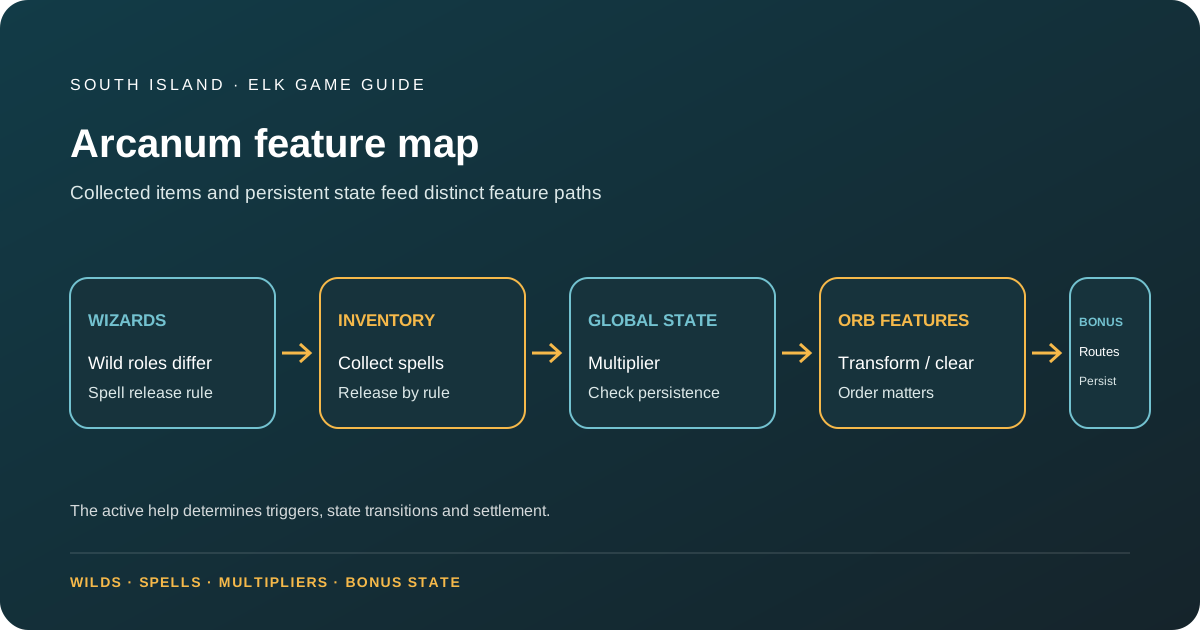
Arcanum is an ELK Studios slot built around a Wizard Wild, a Mirror Wizard, a spell inventory and a global multiplier. ELK’s product summary says the Wizard is a jumping persistent Wild that appears in each game round; collected spells are released after qualifying Wizard-linked cluster wins. The Mirror Wizard shares the Wizard’s attributes but does not release spells. Multiplier symbols and spells can be hidden behind payout symbols and collected when a winning cluster reveals them. The feature page also describes separate bonus routes and persistent state during the bonus. See also: GTA 6 free casino bonus: who actually gives it.
That structure is more helpful than a bare list of symbols: a reader needs to follow the Wizard, the spell inventory, the multiplier state and the bonus path as related but distinct systems. The product page does not constitute a current operator paytable. No active game-help panel was supplied, so this guide does not state RTP, volatility, stake range, feature price, trigger count or maximum payout.
The supplier catalogue confirms that ELK lists Arcanum; it does not prove that a particular New Zealand operator offers it or that a reader’s account can load it. This page explains the public mechanics, identifies what the current help needs to confirm, and does not contain a casino offer or affiliate link.
Confirm the exact Arcanum build
Start with the title and supplier credit inside the game, then compare them with ELK’s official Arcanum page and catalogue. The supplier’s title page is the primary reference for published feature names. It does not show every operator that carries the game, the exact version enabled for an account or the current configuration in a New Zealand-facing client.
Open the help panel before a paid round. Record the operator, date, title, any version marker and mode. Look for separate explanations of the base game, symbols, clusters, Wizard movement, spells, multiplier, bonus entry and any optional modes. If the rules page has a change date, keep it with the values; a number without a date or mode is hard to compare.
Arcanum shares visual and vocabulary cues with other magical games. That is not evidence of identical rules. The exact meaning of a spell, Wild, multiplier or bonus trigger belongs to this title’s help. Do not infer behaviour from a different ELK game or from a third-party feature list.
The source boundary matters here because Arcanum’s published mechanics include multiple persistent counters. A supplier-level overview can tell a reader what the intended system is called. Only the active client can tell them which version and setting is loaded. Where that client does not expose a detail, report the uncertainty instead of completing the rule by analogy.
Cluster wins and cascades
ELK describes Arcanum as a cluster slot. The paytable should define which symbols form a qualifying group, whether adjacent positions must touch horizontally or vertically, how Wilds substitute, and what happens after a win. A cluster layout is different from fixed pay lines, but the phrase alone does not supply every rule.
When a cluster qualifies, check whether its symbols are removed and new symbols fall into the open positions. If another group appears, the round may continue through another evaluation. The help should state whether this is a cascade sequence inside one paid round, how any counters persist between drops and when the final amount is settled.
Keep three things separate while following the board: payout symbols that form the cluster, special symbols revealed behind them, and state counters that update as a result. A spell or multiplier hidden behind a payout symbol can become visible after a win, but it is not the same thing as the winning cluster itself. The paytable and feature rules may apply different conditions to these elements.
The screen can change several properties at once. If a spell is collected, a multiplier increases and a Wizard moves during one sequence, use the help and history to identify the order. Do not state that a given order is universal unless the active rules explain it. A fast animation is not a substitute for a written trigger condition.
Wizard: a persistent roaming Wild
ELK describes the Wizard as a jumping persistent Wild that appears in every game round. Its movement and persistence are central to reading Arcanum. Check how the active help defines the initial position, when the Wizard jumps, whether it moves between cascades, and which symbols it can replace.
The term persistent can refer to a state that stays active over part of a round or feature. Do not assume it carries from one paid round into the next. The product summary says the Wizard appears in each round, but the exact position and timing are rules questions. The client may also distinguish persistence in the base game from persistence within the bonus.
ELK says that a specified number of cluster wins involving the Wizard releases collected spells. The precise count is a game value and should be taken from the live help rather than repeated from a secondary page. The help should clarify whether each qualifying cluster is counted once, whether a multi-cluster evaluation counts separately and what happens to the inventory after release.
A Wizard-linked cluster does not itself guarantee that a spell will create a winning result. Spell release describes a feature event, not a profit statement. Track the qualifying cluster, the release, the effect on the board and the final settlement independently.
If the client shows a Wizard Win Tracker, read how its counter advances and resets. The supplier page says a tracker persists in the bonus and between drops, but its local display and exact thresholds need the current help. A counter’s progress should never be described as a prediction that a bonus or payout is due.
Mirror Wizard: similar role, different spell behaviour
The Mirror Wizard is described as having the Wizard’s attributes but not releasing spells. That exception is important. A short guide that calls both symbols simply “roaming Wilds” could lead a reader to expect the same inventory effect from each.
Check whether the Mirror Wizard moves on the same timing as the primary Wizard, which positions it can occupy, whether it substitutes for payout symbols and how it interacts with multiplier or spell symbols. The supplier overview provides the broad comparison but may not answer every edge case in a particular client.
The distinction between presence and activation also matters. A Mirror Wizard can be visible and participate as a Wild without releasing spells. If a feature tracker changes during a round that contains both Wizards, the help should say which symbol or event caused the change. Do not infer causality from the sequence alone.
In a bonus state, the public supplier description refers to additional Mirror Wizards in some paths. A reader should check the exact entry condition and starting layout in the active help. More visible symbols do not by themselves imply a greater cash return; the cluster rules and later events still determine the settlement.
When writing a round example, label the two symbols clearly. A small screen may show them as visually related. Use the help’s names and colours where available, but do not rely only on colour if an accessible text label exists.
Hidden multiplier symbols and the global value
ELK says multiplier symbols can be hidden behind payout symbols and collected if revealed behind a win. The collected multiplier symbol adds to a global multiplier. This creates a sequence: a win reveals a hidden item, the item is collected and the global state changes. The active rules need to say when that value is applied to a later or current result.
The term global indicates that the multiplier may affect more than one symbol or position, but a guide should not overinterpret it. Check the help for the scope of a global multiplier, when it resets, whether it changes between cascades and whether bonus play carries it forward. The supplier summary indicates persistence in the bonus; it does not replace the detailed settlement terms.
A hidden multiplier is not a value that a reader can count before it is revealed. Nor does every revealed item necessarily add to a settled win. The rule condition is tied to a qualifying win in the supplier description. If the game displays a new global value, determine whether it applies immediately, from the next evaluation, or at another point specified by the help.
To explain a round, record the original cluster, the revealed multiplier symbol, the new global value and the payout evaluation. If the history does not expose each step, make that limitation clear. Avoid using a multiplier total as a synonym for the account balance or for guaranteed future value.
Spell inventory and spell release
The spell inventory stores feature items collected when a winning cluster reveals them, according to ELK’s overview. A useful explanation distinguishes discovery from collection and collection from release. A hidden icon may become visible, be added to the inventory and only later produce a spell effect when the Wizard condition is met.
The product page names several spell types, including Wild effects and an expanding-symbol spell, plus feature symbols described as an Explosive Orb and Transform Orb. The current help should establish which items are spells, which are separate feature symbols, what order they resolve in and whether the order changes by mode. Do not assume that every inventory item fires at once.
The inventory can persist across drops in a bonus state, according to the supplier description. Verify what “between drops” means in the actual rules: it can be different from persistence between paid rounds or from carrying through the entire bonus. The game should describe whether a spell remains stored if another feature ends the sequence.
For each spell, document the name, trigger, board change and next evaluation. If a Wild spell creates or expands a Wild, identify whether it participates in the same evaluation or only afterward. If an orb removes or transforms symbols, distinguish that action from the resulting cluster. A named effect is not a payout formula.
Do not fill out an exhaustive numeric spell table from third-party screenshots. If the operator help does not provide an exact value or sequence, describe only the published high-level feature and label the missing detail. Readers benefit from knowing what remains unverified.
Explosive Orb and Transform Orb
ELK identifies an Explosive Orb and a Transform Orb as two feature symbols. Their labels suggest different board changes, and the public page groups them among Arcanum’s feature system. The active help should define what each symbol removes or transforms, which positions it can affect and the order in which the board is evaluated afterward.
For the Explosive Orb, check whether removal is limited to a selected area or a specific symbol group. Determine whether hidden spells and multipliers behind removed symbols are collected, preserved or discarded. The result can affect the inventory as well as the next cluster, so a reader should not assume that removal only clears space.
For the Transform Orb, read what can be transformed and how the target is selected. Does the effect choose one payout symbol type, change every eligible symbol or apply to an area? The supplier summary names the feature but does not supply every detail. Do not copy the mechanic from a different title that also uses a Transform Orb.
If both feature symbols appear in the same state, the help should define their priority. A screenshot that shows one event after another is useful only if the source identifies the exact game build and the sequence is not a one-off visual. If the order is unclear, say so and avoid explaining a payout as if the order were certain.
Bonus paths and persistent state
ELK describes distinct bonus paths associated with different scatter counts and additional Mirror Wizard symbols. Because the exact thresholds and awards are numerical settings, this article does not repeat them without current game help. The important reader task is to inspect how the base bonus, Mirage route and Arcanum route differ in the loaded version.
The supplier overview says that the global multiplier, spell inventory and Wizard win tracker persist when entering the bonus and between drops. That is a useful structural detail: the bonus can begin with state carried from the base round, and later drops can continue to build on it. The exact state transition should still be confirmed in the client.
Check whether the bonus starts immediately, whether it uses a fixed number of drops or another sequence, whether additional symbols can extend it and whether the tracker resets when the feature ends. Look for a separate explanation of any route that adds Mirror Wizards. A different starting state should not be casually summarized as “more free spins” if the rules describe something else.
Persistent state is not a promise of an increasing payout. A multiplier, spell inventory or tracker can remain visible while a round produces no qualifying result. Describe the mechanic as state persistence, then explain that only the paytable and final settlement determine the outcome.
If the client has a bonus history panel, compare what persisted on entry with what remained at the end. A well-sourced review should state the exact mode and rules date. If an accessible history is missing, do not claim independent verification of the state sequence.
X-iter and feature entry modes
The Arcanum product page links to X-iter modes. These optional paths may start a round closer to a feature or enter a named bonus state, depending on what a specific client offers. Their availability is not established by the supplier page alone.
If the menu is shown, the reader should inspect its price, entry state, stake basis, RTP configuration and rules before selecting it. Those terms may differ from the standard round. The same game can therefore have more than one relevant help section, and a summary that merges them can misstate the applicable settings.
This guide does not recommend an X-iter option. A feature-entry purchase changes the cost and state of a round; it does not guarantee a positive result. The supplier’s mode labels and example prices are not repeated here because no current operator help was supplied for this package.
The menu may also be unavailable or restricted in a particular market. If it does not appear in the client, do not imply that it can be accessed. If a third-party review mentions it, check whether the review’s mode and configuration match the actual game being considered.
RTP, volatility and payout settings
No current operator help was provided for Arcanum. This page therefore does not state a local RTP percentage, volatility label, hit frequency, stake range, bonus-mode cost or maximum payout. A figure on a third-party review may belong to another operator, a different mode or a previous configuration.
Where the active help displays an RTP value, record its label and mode. RTP is a theoretical long-run measure for a defined configuration, not a forecast for one session. It does not describe when a spell will release, how often the Wizard will connect or what a reader should expect to win in a short sample.
The paytable should state qualifying cluster rules and values. A separate game-data panel may show settings such as stake limits, volatility or maximum exposure. Keep those items distinct. A maximum win is a ceiling, not the amount most sessions return, and a volatility label does not tell anyone how to bet.
When values differ across sources, do not select the highest value, average the values or assume a number printed in a promotion applies to every mode. Record the source, date, title, operator, mode and help wording. Mark missing details as unavailable. That makes the article updateable and protects the reader from false precision.
Mobile use and information access
ELK’s product page gives a recommended desktop display ratio, but that does not prove that every casino’s Arcanum client behaves identically on a phone. A mobile interface can resize the grid, move the information button and present the spell inventory in a compressed area. Inspect the actual client if a local usability claim is needed.
On a phone, make sure the title and supplier are identifiable and that the spell inventory, multiplier state and round result can be read without overlapping controls. Check whether the help panel scrolls independently, whether the history can be reached and whether the paytable values remain visible at a readable size.
Because the feature relies on counters and symbol state, a reader may need more than animation to understand it. Look for text labels, a mute control, contrast and keyboard focus. A screen-reader user may receive less information from a canvas than from the surrounding page. This article has not tested the game client, so it does not claim accessibility compliance.
If a key rule cannot be located on a mobile screen, use an accessible desktop interface or ask the operator for the current rules rather than relying on a third-party summary. A game that opens on a device is not automatically clear, usable or accessible.
Demo and New Zealand availability
ELK’s catalogue entry does not confirm that a particular operator provides Arcanum in New Zealand, and a product-page “Play” control does not establish an account’s eligibility. Access may depend on the operator, territory, product configuration and applicable rules. This guide does not link to an operator or open a game.
A demo, if a lawful and clearly labelled version is offered, may help a reader find controls and observe the named symbols. It cannot verify a production account’s RTP, stake settings or bonus configuration, and it cannot predict real-money results. Demo availability should be confirmed separately from the supplier’s catalogue listing.
New Zealand’s DIA says online casino advertising is prohibited under the framework in force and notes that the rules can apply to third parties who publish or arrange advertisements. Its current advertiser guidance identifies affiliate marketing as an initial prohibited advertising decision. Accordingly, this article has no CPA button or casino offer link.
The advertising question is separate from the technical question of whether the supplier’s game can load in some environment. This page is not legal advice and does not declare any operator licensed or authorised. Recheck official New Zealand information before a future public update because the staged regime can change.
A method for checking a complicated Arcanum round
Take a single round and create a sequence of observations rather than a narrative of presumed cause and effect. Start with the paid round and its mode. Record the cluster that qualified, then note whether the Wizard or Mirror Wizard participated. Mark any hidden item revealed by that win, whether it was a multiplier or a spell, and the state change shown in the inventory or global value.
Next record any spell release and the board effect. A spell can change symbols, create a Wild effect or interact with an Orb feature. The order matters because the altered board may be evaluated afterward. If the client history provides no breakdown, distinguish what is visible from what is not.
If a bonus is triggered, compare the state at entry with the state between drops and the final result. Did the multiplier persist? Did the inventory remain? What happened to the Wizard Win Tracker? Did a Mirror Wizard appear? These questions use the provider’s feature map while still requiring the active help for exact rules.
The record should not include private account details. Do not publish a balance, username or transaction identifier to prove a rule. A short, dated note of the help text and mode is often enough. If the result needs a dispute with an operator, use the operator’s official history and complaint process rather than a public screenshot.
Questions readers commonly ask
What is the Wizard in Arcanum?
ELK describes it as a jumping persistent Wild that appears in each game round. The help panel should define its movement and which wins count toward spell release.
How is the Mirror Wizard different?
ELK says it has the Wizard’s attributes but does not release spells. Check the active rules for movement and interactions in the specific game state.
What is the spell inventory?
It is the game state where spells collected behind payout symbols are stored. The active help should define collection, release order and persistence.
Do multiplier symbols always increase a paid win?
The supplier says a revealed multiplier symbol adds to the global multiplier. Whether and when that value affects a settled result depends on the game’s rules and the qualifying outcome.
What is the RTP for Arcanum?
No current operator game-help panel was supplied. This guide does not assign an RTP to a New Zealand configuration.
Are the Mirage and Arcanum bonus paths separate games?
ELK describes them as distinct feature routes within Arcanum. The exact trigger and starting state should be checked in the active help; this page does not create separate URLs for them.
Can X-iter guarantee a win?
No. An optional mode may alter the entry state and cost, but it does not guarantee a positive financial result.
Does a supplier listing prove local availability?
No. It confirms the title is listed by the supplier, not that a specific operator offers it to a New Zealand account.
Sources and verification boundary
- ELK Studios: Arcanum — official feature and bonus overview, checked 6 October 2026.
- ELK Studios games catalogue — title listing, checked 6 October 2026.
- ELK Studios game assets catalogue — supplier catalogue materials, checked 6 October 2026.
- DIA: Online gambling for advertisers — New Zealand advertiser guidance, checked 6 October 2026.
- Online Casino Gambling Regulations 2026 — regulation 40(c), checked 6 October 2026.
- Competitor context checked 6 October 2026: HideousSlots, AboutSlots, FruitySlots, and CasinoWizard.
Competitor pages are not treated as New Zealand configuration evidence. No active operator help or in-game test was available. RTP, volatility, stake range, mode cost, exact trigger thresholds, maximum payout, demo access and local operator availability remain unverified.
