ELK Studios game rules · South Island guide
Pirots3 ELK Studios slot review: rules and features
 Best casinos available in New ZealandUpdated 7 November 2026

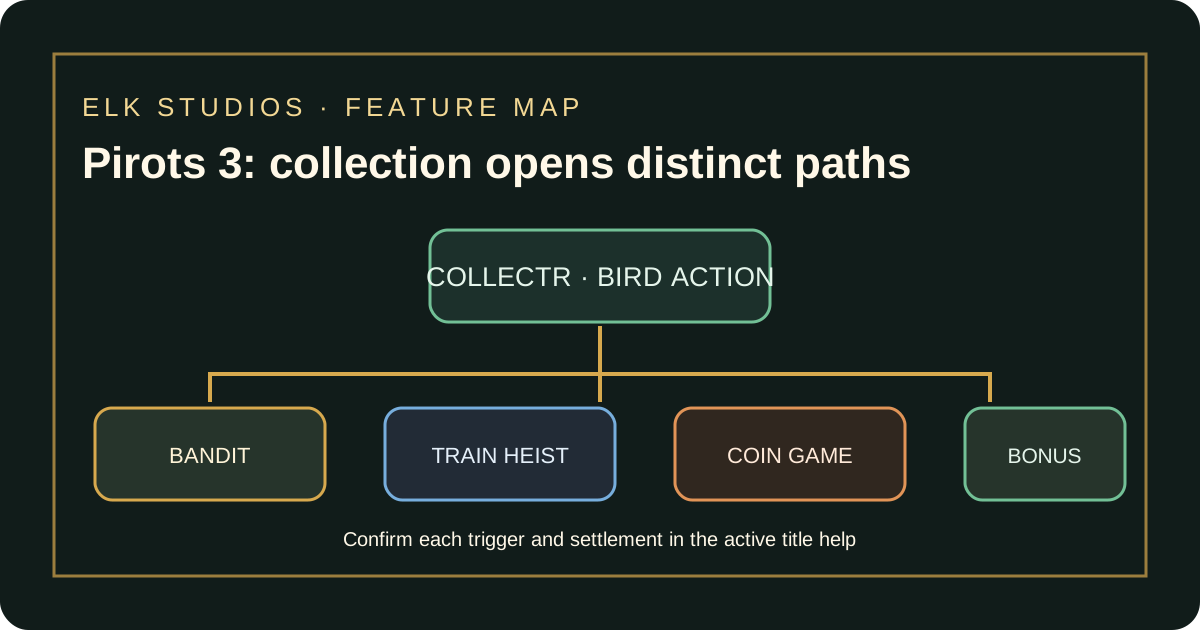
The title ELK presents as Pirots 3 combines CollectR, an expanding grid, symbol upgrades and transformations, bird duels, a Bandit escape, a Train Heist and a Coin Game. The bonus carries selected board and meter state according to the supplier description. This guide explains how those feature paths relate and where a current operator’s rules are still needed.
The short answer
Pirots 3 is ELK Studios’ bird-and-collecting slot that its product page writes as “Pirots 3.” The assigned topic and URL use “Pirots3,” so this guide preserves that route while using the supplier’s display name in the explanation. ELK describes CollectR, a changing grid, symbol upgrades and transformations, Wilds and coin wins, plus a Bandit escape, Train Heist, Coin Game, Bonus and Super Bonus.
The main review challenge is to understand how the collection state feeds into feature events. A bird can collect a symbol or participate in a duel; the Bandit can enter the grid and collect while interacting with birds; the train backdrop creates its own trigger condition; and a cleared grid can lead to a distinct Coin Game. These are connected systems, not interchangeable names for one bonus.
The official Pirots 3 page is the primary source for the feature labels and broad rules described here. No current New Zealand operator help or paytable was supplied. This guide does not state RTP variants, volatility, a maximum payout, stake limits, feature costs or local availability. Exact numeric triggers and configuration values should come from the title’s current game help.
Title identity and Pirots family boundaries
The exact supplier title is important because ELK has multiple Pirots games and editions. Pirots 3 is not Pirots 4, Pirots 5 or Pirots X. Those other pages on this site have separate feature systems and their own product references. A shared bird motif or the word CollectR is not enough to transfer a grid rule, symbol role, upgrade path, bonus state or payout formula from one title to another.
When opening a game client, confirm the name shown in the rules panel, the provider and any version identifier. Some search results omit spaces, hyphenate names or display only a logo. Record “Pirots 3” if that is the supplier’s actual product display and map it to the assigned Pirots3 URL. This preserves the topic owner’s route while preventing the punctuation difference from being treated as a separate game.
Use three separate evidence questions. Does ELK list the product? Does the current operator client show the feature rules and settings? Is the title offered to a person in New Zealand by an operator that may serve them? The supplier catalogue answers only the first. The current help answers the second. The operator and official local information are needed for the third. This article does not claim that a casino in New Zealand offers the game.
CollectR as a collection system
The product page identifies CollectR as a central mechanic. A collection system needs more than a symbol labelled “collector”: a reader should find what can be collected, which symbols are eligible, how the collector moves or acts, what ends the collection and when the accumulated result is settled. The supplier’s summary says birds can shoot and collect symbols they hit, but the exact active-client rules should specify the path and sequence.
Keep collection and payout separate. A bird reaching or striking a symbol can change a feature state; that does not automatically say whether the symbol’s value is paid immediately, held for a later event or used to form a feature. The current help should show whether a collected object disappears, moves into a meter or changes a payout level. If the rules do not state the treatment, describe only the visible action and leave the calculation unverified.
Use a state note when following the board. Record the bird involved, its initial position, target symbol, direction of travel, whether an upgrade or transformation occurred, and the final status of the collected object. Avoid treating an animated path as proof that every symbol on it was collected. ELK’s outline says what kinds of interactions exist; a frame-by-frame display and help text establish which targets count.
Collection values can also persist. The official summary says some grid and feature progress carries through the Bonus. That makes it especially important to record the starting state at entry and the state at the end. A symbol that remains available during a free-drop sequence is different from an amount that has already been settled. Check the bonus help for what is retained and whether the same item can be collected again.
Grid expansion, upgrades and transformations
The product page describes an expanding game grid alongside symbol upgrades and transformations. These operations should be explained separately. Expansion changes the space available for symbols; an upgrade changes a symbol’s level or value category under the game’s rules; a transformation replaces one symbol with another. They can occur in a single feature chain, but each requires its own trigger and evaluation step.
The active help should say when the grid expands, which area changes, and whether the new positions remain available. It should define what causes an upgrade, which symbols may advance, and whether the level resets after a win or feature. For a transformation, identify which symbol is replaced, the possible result categories and whether the new symbol can immediately take part in the next evaluation.
Do not infer that “upgrade” always means a larger payout. It might change a symbol class, unlock a feature, or make a later collection possible. The game’s paytable determines whether a symbol pays on its own or only participates in a feature. A transformation can produce a Wild or a coin, but the exact effects and settlement remain title-specific.
Write down the event order rather than compressing it into “the grid got better.” A concise sequence might read: a collection action changes the grid; the game upgrades an eligible symbol; the new arrangement is evaluated; then a feature starts. The sequence tells a future reader what happened without assigning unverified probability or value to any step.
Gunslingers and bird duels
ELK describes adjacent birds that may duel. During the duel, they move apart and shoot in any direction, collecting symbols they hit. The supplier also says a larger adjacent group guarantees the duel feature. The current operator help must confirm the exact eligible arrangement and numeric trigger condition before those details are used as a local game rule; this guide does not transfer a supplier summary into an assumed operator setting.
The important mechanic is that a duel changes positions and creates a collection path. It is not simply a decorative animation between spins. To understand the result, note where the birds begin, how they separate, which directions the shots take, which symbols are hit and what the game does with those symbols. A symbol’s visual impact may be hidden behind an effect animation, so rely on the result history or feature log where available.
Check whether the duel is available only to birds next to each other, whether the game chooses a direction, and whether all hits are treated identically. The supplier’s phrase “shoot in any direction” does not establish that a player chooses the aim. Nor does it state the chance of a duel or the value of each collected object. The live help should answer these questions if the operator publishes them.
When the game has more than one bird colour or type, do not presume each plays the same role. A collector may interact with a particular symbol family or meter. The exact client help should identify those mappings. If a recorded round shows a bird passing over a symbol without a visible collection, check whether the trajectory crossed it, whether the feature only targets selected positions, or whether the interface uses an additional condition.
Bandit escape
The supplier says a collected key triggers the Bandit escape feature. The Bandit enters the grid, collects symbols and duels birds until defeated. This is a feature sequence with an entry object, a moving character and an endpoint. It should not be reduced to “the Bandit collects everything” because the target path, bird interaction and ending condition define the actual mechanic.
First verify what makes a key “collected.” The rules may tie it to a bird, a collection route or another feature. Then check whether Bandit entry is immediate, what symbols it can collect, and how the duel with birds changes the state. The supplier’s concise page outlines the relationship but does not publish every selection rule. If the help does not say which objects are eligible, do not extend the description beyond what the page establishes.
The phrase “until defeated” identifies an endpoint but does not tell you how many actions occur or what determines the outcome. Do not state a duration, frequency or guaranteed award. Follow the on-screen sequence and read the final settlement separately. If the feature changes the grid and then allows another evaluation, note whether that later result is part of the same feature or a fresh spin.
The Bandit and the bird-duel feature can both include movement and collection. That does not mean their conditions are identical. Keep separate headings in a review and use the game’s own labels. This makes the guide easier to verify and prevents another Pirots title’s collector or character rules from leaking into Pirots 3.
Train Heist and the backdrop condition
The Train Heist is a distinct feature that ELK says is triggered when the same bird can collect a symbol in both positions of the train backdrop. The condition is spatial: the relevant bird needs to reach the backdrop’s eligible symbol positions. The game then awards feature symbols according to its published sequence. The active help should show how the backdrop is drawn, what counts as both positions and what the feature symbols do.
When reviewing an attempted Train Heist, trace the same bird from start to finish. Do not combine one bird’s collection in the first position with another bird’s collection in the second unless the rules explicitly allow that. Confirm whether the target symbols must be collected in a single action, feature event or round. The supplier summary describes the “same bird” condition but not every timing case.
The supplier says the event can award additional feature symbols. That is not the same as saying those symbols always create a payout. Check whether they progress a meter, trigger a separate state or alter the next round. The help should distinguish an awarded symbol from a settled win. If the interface displays a counter, note whether it records symbols, progress or money.
To avoid overclaiming, describe the trigger and then describe what the symbols do only if the current help provides that next step. A good review can say “the official page links the Train Heist to same-bird collection across the marked backdrop positions; the available source did not specify the operator’s symbol settlement.” That is more useful than assigning a guessed prize to the feature.
Coin Game and full-grid clear
ELK describes a Coin Game when the entire grid is cleared during the Peanut feature or Bandit escape. It identifies coin wins and a “Scorpio death” outcome as possible feature results. Because this is a separate event, explain its trigger independently from the ordinary coin symbols and the Bandit’s collection path.
The phrase “entire grid is cleared” should be verified against the current help. Does every position need to be empty, or can a feature symbol remain? Does the clear need to happen within one action or across a sequence? The public summary establishes the broad condition, but the active game rules determine edge cases. Avoid saying the Coin Game triggers after any near-clear or a partial board change.
The Coin Game’s named outcomes also need exact definitions. Check how coin values are shown, whether a coin win settles immediately, and what the Scorpio event changes. The supplier’s playful “coin wins or Scorpio death” wording is not a paytable. It does not establish odds, result ranges, a maximum prize or an operator’s configured payout. Use the help’s outcome panel and keep any observed result distinct from an expected result.
If the Coin Game is entered while another feature is active, map the order: original feature; full-grid clear; Coin Game entry; outcome; final settlement; next game state. This helps a reviewer avoid counting the original collection and the Coin Game as two separate cash awards if one is only a feature transition. Follow the balance history and the rules rather than adding animation values from memory.
Bonus and Super Bonus persistence
The supplier describes a Bonus and a Super Bonus. It says the Bonus begins after its stated collected Bonus-symbol condition and that grid size, Feature Meter progress, Amber-symbol payout level and additional bonus-symbol collection persist within the Bonus. Numeric entry thresholds are not repeated here because the task requires current game help for game numbers, and no operator help was supplied.
The persistence list matters because it identifies four state categories that a reviewer should inspect. Grid size is the board’s available area. Meter progress is feature readiness. Amber-symbol payout level is a symbol-specific value category. Additional Bonus-symbol collection relates to feature continuation or another state under the rules. Do not assume these fields persist beyond the bonus itself; the public description limits the claim to the Bonus state.
At entry, note the grid and meter as shown, then check the amber symbols and bonus progress before the first drop. During the feature, record which values change and which remain. At the end, inspect what is reset and what is removed. This process answers what “persistent” means in the client and helps separate temporary bonus state from any permanent account or game state. No such long-term persistence is claimed here.
ELK says the Super Bonus has a different feature configuration, including a maximum grid and an upgrade effect. The exact starting state and the way the symbols interact should be read from the current help. A larger or more developed starting board is a design characteristic; it does not prove a greater expected return or guarantee that a winning symbol combination will form.
As with all special modes, compare their entry trigger, starting symbols, retained state, progression and end condition. If an optional mode selects a feature at a cost, confirm the total charge and any different mathematical configuration before choosing it. The official catalogue does not confirm that a particular operator exposes every mode or that it is available in New Zealand.
RTP and version-specific settings
No current Pirots 3 operator help was available for this review. As a result, it does not list RTP values, RTP variants, volatility, maximum payout, stake limits or an optional-mode price. These figures are not safely inferred from the slot’s feature names or from another Pirots title.
If a game client displays an RTP, confirm the figure is attached to the title and version visible on the start screen. Preserve the exact label and date. If several configurations are shown, do not collapse them into one range without explaining which one applies. An RTP is a theoretical long-run measure for the specified configuration; it is not an amount a player should expect to receive from a particular session.
Volatility also needs a defined source. A third-party site’s high, medium or low label may be an editorial opinion. The presence of a Coin Game, bonus or collection system does not provide enough information to derive a volatility category. If the active client does not publish one and the supplier’s technical documentation is not available, leave the field unverified.
For a maximum payout, check whether the figure refers to one spin, the feature, a mode or the whole title. A marketing headline can use different units or scope from a game help screen. For stake range, use the currency and limits shown by the operator, not a value copied from a casino in another market. For optional modes, check the charge and how the entry state differs from regular play.
Mobile usability and demonstration limits
Pirots 3’s collection paths, expanding grid and train backdrop make the visible board central to understanding the game. On a small screen, confirm that the whole game area remains visible and that the feature labels do not disappear beneath an animation. Locate the help, paytable, history and round-result controls before playing. If the screen crops backdrop positions, use an orientation or zoom option that keeps the rules legible.
For accessibility, look for text labels in addition to colour, bird shape or motion. A distinctive animation can be easy to recognise in a video but hard to interpret when it overlaps a small symbol. The history panel should identify the settled result and feature outcome; if it does not, take care not to infer the event solely from an animation.
A demo may show how the board, collection and features are presented. It cannot prove the operator’s RTP, stake limits, account eligibility, local access or whether the real-money client has the same configuration. ELK’s catalogue presence and an online play button do not establish that the game is available to an individual in New Zealand.
This guide did not run a live session or device test. A screen-size recommendation is not a guarantee of support by every casino wrapper or app. Any claim about mobile compatibility, speed, stability or the ability to launch should be tied to a named device, client, test date and access permission. That evidence is not part of this assignment.
A methodical review checklist
Start by confirming the full title, provider and rules version. Read the base win condition and then the CollectR definitions. Identify eligible collection symbols, bird roles, the upgrade and transformation rules, grid changes and Wild treatment. If the help has an illustrated example, check that the example belongs to the exact title and configuration.
Next, document each feature path separately: bird duel, Bandit escape, Train Heist, Coin Game, Bonus and Super Bonus. For each, record the entry condition, board change, eligible symbols, persistence, payout or feature result, and end condition. Mark whether the value is paid immediately or carried to another step. Use the same wording as the client where possible.
For any numerical field, capture the information panel as shown and preserve its units. Record RTP variants, volatility only if explicitly sourced, payout cap, stake range and optional mode cost. If the help has no value, write “not shown” instead of borrowing a figure from a competing page. Do not claim that an observed sample demonstrates a feature’s frequency.
Finally, establish local access independently. The official catalogue confirms that ELK has a Pirots 3 product entry. It does not confirm a New Zealand casino listing, operator authorisation, account eligibility or currency. The ELK Studios catalogue guide explains this supplier-versus-operator distinction, and the game-guide index lists other titles without treating their shared mechanics as interchangeable.
Common review mistakes
Confusing Pirots 3 with Pirots X or another edition. Shared branding does not mean the same grid, collector rules or feature order. Use the exact title page and help.
Calling every collection a payout. A symbol can be collected, held, upgraded or transformed before a later settlement. Identify the accounting event.
Combining bird actions. The Train Heist condition is described around the same bird collecting at the backdrop positions. Do not combine separate birds unless the game help permits it.
Treating the Bandit and Coin Game as one feature. The Bandit has its own entry and interaction, while a full-grid clear can lead to the Coin Game. Follow the event chain.
Assuming “persistent” means forever. The supplier’s persistence statement applies within the Bonus. Confirm what resets at its end.
Importing figures from a foreign operator. RTP, currency, stake limits and availability require the current local client. A competitor review is not proof of the configuration a reader can access.
Frequently asked questions
Is this page about Pirots3 or Pirots 3?
The assigned Topic ID and URL use “Pirots3.” ELK’s product page displays the title as “Pirots 3.” This page keeps the requested route while treating both spellings as the same assigned product entity, not as two titles.
What does CollectR do in this game?
ELK describes birds that can move and collect symbols they hit, with separate feature paths such as duels and the Bandit escape. The active help should define eligible targets, sequence and settlement.
What starts the Train Heist?
The supplier says the same bird must collect a symbol at both train-backdrop positions. Verify the exact timing and trigger wording in the client before applying it to a specific operator version.
What persists in the Bonus?
ELK’s public summary names grid size, Feature Meter progress, Amber-symbol payout level and bonus-symbol collection as persistent within the Bonus. The current help should confirm how each field behaves and what resets at the feature’s end.
What is Pirots 3’s current RTP?
No current operator help was supplied, so this review does not state an RTP, volatility, maximum payout or stake limit. Use the exact game client’s dated information panel if available.
Is Pirots 3 available to New Zealand players?
The ELK product page does not establish that a particular casino offers the game to a New Zealand customer. No local operator access has been verified here.
Sources and date checked
- ELK Studios: Pirots 3 — supplier display name and feature summary.
- ELK Studios games catalogue — product identity and catalogue context.
- Online-Slot.co.uk Pirots 3 review — competitor coverage checked for questions; no numerical claims are reused.
- SpinHunter Pirots 3 page — competitor coverage checked for feature framing, not operator settings.
- Judge Casino Pirots 3 overview — competitor coverage checked; foreign-market settings are not used as local facts.
- New Zealand Department of Internal Affairs: online gambling for advertisers — current advertising context.
Sources checked 6 October 2026. No current New Zealand operator help, RTP disclosure, live client, demo access or device test was supplied. Recheck current help before a public numerical update.
