ELK Studios game rules · South Island guide
Man vs Gator ELK Studios slot review: rules and features
 Best casinos available in New ZealandUpdated 7 November 2026

Man vs Gator is an ELK Studios slot built around opposing character Wilds. The public supplier outline describes nudging Wilds that can award respins, a Combo Nudge that upgrades the matching character’s multiplier values, a Multiplier Fight and sticky Wilds in the Bonus. This guide explains the relationship between those events and what the current operator help still needs to confirm.
The short answer
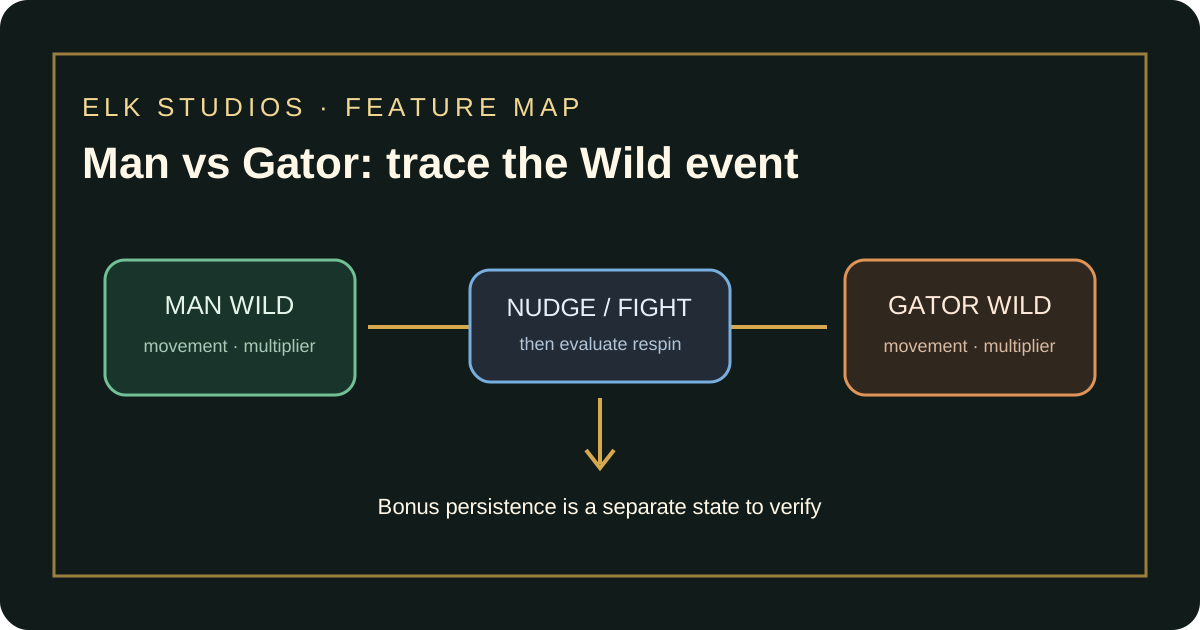
Man vs Gator is an ELK Studios slot whose two character Wild families, the Man and the Gator, can nudge across the grid, interact with multipliers and start respins. The supplier’s public description also names a Multiplier Fight, Combo Nudge, sticky Wilds in the Bonus, and separate Bonus and Super Bonus states. The central task when reading a round is to track which character’s feature is active, what the nudge changes, and whether the event is a new payout or only a new board state.
This review uses ELK’s Man vs Gator product page to explain named mechanics. It does not have a current operator help screen or paytable. Under the topic brief, current numerical game settings must come from the live game help. This page therefore does not publish an RTP, volatility label, maximum payout, stake range, feature price or New Zealand access claim. A supplier feature summary is not proof that a specific casino offers the game or that its configuration matches another market.
Start with the right product and rule source
Before assessing any feature, confirm that the title shown in the client is Man vs Gator and that the provider is ELK Studios. Similar alligator artwork or a “versus” theme does not make another game the same product. A feature name can also be reused by a studio in a different title without carrying the identical trigger or payout. The official catalogue establishes product identity; the active game information panel establishes the rules in the version being examined.
Keep the supplier outline, live help and operator terms in separate notes. The supplier page explains the broad design. The live help defines the game’s symbols, winning condition, feature trigger and settlement. The operator’s account or site establishes access, currency and any local restrictions. If a review page does not show which source supports a claim, treat it as a lead for further checking, not as a verified setting.
When there is an uncertainty, write down exactly what the screen shows and the date. For example, distinguish “the supplier describes a nudge feature” from “this client’s rules say the Wild moves after a qualifying result.” That distinction is not pedantic: a product page can remain online after the operator changes its configuration, and a remembered animation may come from a demo or an earlier version.
The two Wild identities
ELK’s description distinguishes Man and Gator Wilds. Their relationship is thematic, but the mechanics are not merely colour variants. The public rules summary says they can participate in nudges and multiplier behaviour. A reader should follow the identity of each Wild rather than recording only “a Wild appeared.” If the characters have separate multiplier tracks or directional effects, the applicable result depends on which one is visible and which event triggered it.
First identify ordinary symbols, Man Wilds, Gator Wilds, any multiplier markers and the bonus symbols. Then inspect the help for substitution: which symbols can a character Wild replace, whether it replaces special symbols, and what happens when both characters are involved in one winning arrangement. These are foundational rules. A Wild’s visual presence does not prove that it counts for every result or that its multiplier applies to all wins.
Use a basic notation when observing the board: character, position, direction of movement, multiplier shown, and whether a respin begins. Avoid inventing a direction from the screen’s theme. The supplier says nudges can move up or down, but the active help should identify which character moves which way, how a movement is selected, and what ends the sequence. Do not assume a move is controlled by the player unless the game offers an explicit control.
The title’s central contrast can make the screen feel like a contest. That theme is not a separate probability rule. A “fight” animation or a character facing the other does not reveal which multiplier will be selected until the rules and result panel show the actual event. The review should describe the specified conditions, not infer an advantage from the game’s narrative.
Nudging Wilds and respins
ELK describes stacked Wild symbols that nudge vertically and award respins until they leave the screen. The practical distinction is between a position change and a winning evaluation. A Wild can move, remain visible and cause another reel state without independently paying. A respin can create a new possible arrangement, but the outcome still must meet the game’s winning condition.
The live help needs to define the initial nudge condition, whether movement is guaranteed in a particular situation, which direction each Wild can take, and how a Wild leaves the board. It should also explain whether a nudge occurs before or after the win is valued. The supplier summary provides the concept but not every edge case. Where the actual sequence is unclear, keep it as unknown rather than importing a rule from another ELK game.
Watch the transition between a qualifying result and the next respin. Does the current win settle first? Does the Wild hold in place while other positions change? Does a new result reset the feature, continue it or start a different event? These questions determine whether the sequence is one expanding event or several separate game evaluations. Round history can clarify the accounting if it lists each settlement separately.
The phrase “until they leave the screen” describes an endpoint for the supplier’s nudging feature, not a duration estimate. A feature may resolve quickly or involve multiple animations. Do not use the number of movements in one sample to claim how many respins normally occur. A single round is an illustration, not a statistical study.
How to read the Combo Nudge
The supplier says that each nudge by the character Wilds upgrades multiplier values on the corresponding Man or Gator Wilds in view and awards a respin. That means the movement and the upgrade are linked events. It does not establish that both characters upgrade together or that every multiplier on the board participates. The words “respective” and “in view” make the exact character and visibility conditions important.
To make sense of a Combo Nudge, keep the pre-event and post-event state separate. Record the Wilds visible before the movement, which Wild moved, and which values changed afterward. Then identify the next evaluation and whether any multiplier applied to a qualifying result. A number increasing on the display is not itself an amount won. It is a feature-state change whose payout effect depends on a later eligible event and the client’s multiplier formula.
Ask the rules whether multipliers add, multiply or follow another calculation; which character’s value applies to a win containing both Wild families; and whether a value can carry through more than one respin. The public summary does not provide the full formula. Do not deduce it from one board image, since the same display can look plausible under several different calculation orders.
If an upgrade animation is accompanied by a new number, write down its exact label and source. A feature may show a multiplier value that is local to one symbol, local to the current event or global to the whole win. The word “multiplier” alone does not establish scope. This is one of the most important points to resolve in the in-game help before comparing two screenshots or review claims.
Multiplier Fight: selection and settlement
ELK describes a Multiplier Fight in which full-reel stacked Wilds contest the Man’s or Gator’s multiplier and award a respin. The public phrase is enough to identify a conflict between two multiplier tracks; it does not define the selection mechanism or payout. The active rules should say what initiates the fight, how the winning multiplier is chosen, whether the choice is random or symbol-driven, and what the respin changes.
Do not treat a “fight” as a side bet or as a guaranteed multiplier increase. It is a named feature within the slot. The visible animation can be dramatic while the actual selection follows a fixed rule or a random process. Only the information panel can establish that. If the help shows a random choice, that still does not disclose the chance of each result unless it provides a mathematical statement.
The most useful way to compare the fight’s result is to identify the before-and-after multiplier state, then trace a later winning outcome that uses it. Avoid counting a multiplier value as a win before it is applied. If the event awards a respin, determine whether that next evaluation is the point at which the chosen multiplier can matter. If the game instead settles immediately, use its displayed payout breakdown.
Where both Man and Gator multipliers are on screen, check whether the result chooses one, combines them or assigns each to separate parts of a win. Do not assume the largest visible value is always used. A product summary names the contest but does not describe every tie case or overlap. If those cases are not in the help, describe the omission rather than pretending the calculation is known.
Bonus, Super Bonus and sticky Wilds
The supplier describes Man vs Gator Wilds as sticky through the Bonus. It also distinguishes a Bonus from a Super Bonus, with different entry symbol conditions and starting feature states. The assignment requires current game help for numeric trigger counts, so this article does not restate unverified thresholds from a marketing summary. Check the exact entry rules in the client before explaining a real operator’s bonus.
“Sticky” means a symbol remains in place for a specified sequence, but the boundaries matter. Does it remain for the entire free-spin state, only until it is part of a win, or until another event changes it? Can it nudge while sticky? Does its multiplier continue to grow? Does it preserve its character identity? The supplier page identifies persistence as a feature; the live help should answer how long the persistence lasts and which events can change it.
Compare the two bonus states using their entry requirements, starting Wilds, multiplier rules, free-spin progression and retrigger conditions. A Super Bonus is not simply a promise of more value. It may begin with a different starting arrangement or special feature. Its title communicates a mode, not a result. The rules and mathematical configuration are needed before making any comparative claim about expected return.
At bonus entry, note the board state and any multiplier values before the first free spin. During the bonus, observe whether Wilds stay fixed, move or upgrade. At the end, check what is removed and whether the next paid round begins with a reset. The supplier summary may say sticky Wilds are a feature, but it does not establish whether any value persists after the bonus closes.
If a special mode or X-iter option is offered, verify its entry price, starting configuration and active paytable. Do not assume it is available at every casino or in New Zealand. A purchase or mode selection changes the amount at risk and should be evaluated independently of the regular feature. The supplier’s catalogue link is not an operator menu.
Interactions: avoid counting the same event twice
The main review challenge is to understand whether several animations are separate outcomes or linked steps within one resolution. A winning arrangement may lead to a Wild movement, then a multiplier upgrade and a respin. If each animation is described as a payout, the review can overstate what happened. Use the round history and the balance change to identify actual settlements.
Create a small event map for a sample round: initial arrangement; qualifying win; Wild movement; multiplier change; respin; next result; final payout. Mark each step as a board change, a feature trigger, a separate paid win or an unverified state. This simple method prevents a later respin from being mistaken for an additional award before its result is known.
A feature can also change the conditions of a later feature. For example, a nudge may create a layout in which a character Wild can participate in a multiplier event. The existence of that interaction should be confirmed by help or a clearly documented rule. Do not assume that every combination of named features can occur together just because each appears on the supplier page.
When two multiplier values change during the same event, check whether they belong to the same character. The “Man” and “Gator” labels may identify separate states. If values combine in a particular manner, record the formula from the live rule text. If it is not published, keep the observation qualitative and do not estimate a return from the visible numbers.
RTP, volatility and payout settings
No current Man vs Gator game help was supplied, so this review does not state an RTP, RTP variants, volatility, maximum payout, stake range or mode price. These are configuration fields, not details that can be inferred from the theme or from an older review. The assignment specifies that numerical values must be verified in current game help.
If a casino client displays an RTP, verify that it names Man vs Gator, matches the version shown on the start screen and is dated or otherwise current. If multiple configurations are listed, keep their labels separate. Do not report a foreign-market number as the New Zealand setting. A theoretical RTP is a long-run modelled percentage, not a predicted return for one person or any short sequence of rounds.
Volatility labels need a source and method. “High volatility” can be an editorial rating rather than a field published by the supplier. The game’s nudge-and-respin structure may create visible swings, but visual pacing is not enough to classify its mathematical distribution. If the current help does not state a rating and there is no official technical sheet, mark the field as unknown.
Check any advertised maximum payout against the exact client and note whether it applies to all wins, the base game or one feature. A headline maximum is not a typical result. Likewise, an optional feature mode’s cost should be copied with its unit and the currency shown. Do not convert to NZD unless the operator gives the actual currency and conversion basis.
Mobile display and demo boundaries
Man vs Gator has several character and multiplier states that may be difficult to inspect on a narrow screen. Locate the rules, paytable, history and round record before beginning. Check that the Wild labels and multiplier values are legible and that the screen does not crop the reel area. If orientation changes the layout, confirm that the help remains available and readable.
An image of a Wild moving upward or downward may not show which event caused the move. Read the adjacent text, animation label or history entry. If the interface relies only on colour, look for an accessible text label that distinguishes Man from Gator. Do not assume that a colour or outline has the same meaning in every mode.
A demo can help a reader locate controls and recognise the names of features. It does not verify a real-money client, stake limits, account rules, RTP variant or local availability. The same caution applies to playthrough videos: an edited clip may focus on unusual features and is not evidence of event frequency. This guide has not tested the title in a casino, demo, mobile app or desktop browser.
Supplier guidance about display ratio is not a device compatibility guarantee. A particular operator can use a different wrapper or game integration. To report mobile performance, one would need the exact client, device, version, test conditions and date; none is available here. This page therefore sticks to what the supplier documents and what a reader should verify.
A title-specific checklist
Open the client’s own rules and note the title, provider, version and date. Verify the base symbol and Wild rules first. Then find the exact conditions for the nudging feature, directions, respins, Combo Nudge upgrades and Multiplier Fight. Confirm which multipliers belong to each character and how they apply to wins. If the help offers a worked example, use that rather than inferring a formula from animation.
For the Bonus, record its entry condition, what remains sticky, whether Wilds can still move, how the multiplier changes and what ends the state. Repeat the same fields for the Super Bonus. If the feature offers retriggers or an optional mode, include only rules visible in the exact version. Keep all costs separate from the base stake and do not include a mode in a default play description unless it is actually enabled.
For numerical settings, preserve the wording and units. Capture RTP variants, volatility if explicitly stated, maximum payout, stake limits and any mode costs only from current game help. If a field is absent, write “not shown in the help checked.” Do not hide missing data behind a generic phrase such as “standard settings.”
Finally, verify operator access separately. ELK’s page confirms the supplier’s product description; it does not show which customer can launch the game. No New Zealand availability or operator eligibility is claimed here. The site’s ELK Studios catalogue guide covers supplier-source boundaries, while the game guide index lists the other selected titles without combining their mechanics.
Common review mistakes
Calling every Wild movement a win. A nudge is a board change. A new win still depends on the next evaluation and game rules.
Combining character multipliers automatically. The supplier distinguishes Man and Gator. Check the exact scope and combination formula before adding or multiplying values.
Counting a respin as a payout. A respin is another opportunity for the board to resolve; the resulting outcome needs its own settlement.
Assuming sticky Wilds cannot move. Persistence and movement can be separate attributes. The current help must say whether a Wild can nudge during the bonus.
Treating a Super Bonus as guaranteed value. A distinct feature state can have different rules without guaranteeing a positive outcome or a particular multiplier.
Copying another casino’s settings. RTP, stake range, access and mode prices may differ. A third-party page from another market does not verify the active client.
Frequently asked questions
How do the Man and Gator Wilds differ?
ELK describes separate character Wilds whose movement and multiplier values participate in the game’s feature system. The exact direction, substitution, multiplier scope and interaction should be checked in the current title help.
What does Combo Nudge do?
The supplier says a qualifying nudge upgrades multiplier values on the corresponding character Wilds in view and awards a respin. The current client should confirm which values change and when they affect a payout.
Does a Multiplier Fight guarantee the larger value?
No such conclusion follows from the supplier’s short description. It describes a feature in which the characters’ multiplier values contest an outcome. The active rules determine how selection and settlement work.
Are Wilds sticky in the Bonus?
ELK’s public summary says the Man vs Gator Wilds remain sticky through the Bonus. Confirm in the exact operator help which Wilds persist, whether they can move or upgrade, and when the state ends.
What is Man vs Gator’s RTP or volatility?
No current game help was supplied. This guide does not state a figure or rating. Check the version-specific rules and disclose its date if the client publishes those settings.
Is Man vs Gator available in New Zealand?
The ELK catalogue confirms a supplier product page, not availability through a New Zealand operator. This guide has not verified a local casino or accessed an operator client.
Sources and date checked
- ELK Studios: Man vs Gator — supplier-described Wild, nudge, multiplier and bonus mechanics.
- ELK Studios games catalogue — product identity and catalogue context.
- FruitySlots Man vs Gator review — competitor coverage checked for reader questions; its numerical claims are not reused.
- AllSlotSites Man vs Gator overview — competitor coverage checked for topic boundaries; it does not establish current New Zealand settings.
- HideousSlots Man vs Gator review — competitor coverage checked; its review details are not treated as operator help.
- New Zealand Department of Internal Affairs: online gambling for advertisers — current advertising context.
Sources checked 6 October 2026. No current New Zealand operator help, RTP disclosure, live client, demo access or device test was supplied. Recheck the game help before a public numerical update.
