ELK Studios game rules · South Island guide
Squeeze ELK Studios slot review: rules and features
 Best casinos available in New ZealandUpdated 7 November 2026

Squeeze is an ELK Studios cluster slot whose supplier page describes coloured Feature Meters, Bounce Back wins, symbol changes and separate Bonus and Super Bonus states. This guide explains how to follow those systems without turning a feature animation into a promise about a result. Operator-specific RTP, volatility, payout limits, feature costs, mobile access and New Zealand availability have not been verified.
The short answer
Squeeze is a cluster-based slot by ELK Studios. The supplier describes coloured Feature Meters that fill when matching clusters win, a Bounce Back event that can preserve a cluster for another valuation while increasing a multiplier, and transformations such as swaps, upgrades, big symbols and random Wilds. Its Bonus and Super Bonus are different feature states with different persistence rules. To review a real client, first identify the base cluster condition, then follow what each meter changes, and finally read the bonus rules and paytable in that exact version. The assignment did not include an operator help screen, so this guide does not publish an RTP setting, volatility, maximum payout, price, or New Zealand access claim.
The official Squeeze product page is the primary source for the named features in this article. It describes the title’s product mechanics, but a supplier overview is not the live rules panel used by a particular casino. That distinction matters if you are comparing screenshots, a video, an old review or a version opened under a different account region. Use the operator’s own Help and Paytable controls for the active rules and record the date you checked them.
What the board and a cluster mean
ELK describes Squeeze as a large-symbol game with a cluster-win system. “Cluster” means a group evaluated under a rule about symbol identity and connection, rather than a conventional payline running across a fixed row. The public summary does not state every adjacency, minimum-size or Wild-substitution rule. Those details must come from the active game help. A visually connected group is not automatically a win unless it meets the stated condition.
Separate the board’s appearance from its settlement. A cluster may be highlighted, removed, retained or changed by an animation. The highlight indicates that the game is processing a result; it does not tell you whether the group will be valued once or again. The help should clarify the order: identify a qualifying group, calculate its payout, remove or preserve symbols, apply any feature, and test the resulting board again. If the sequence is not explained by a brief animation, use the rules panel or round history instead of guessing.
An efficient first read follows one symbol through a complete round. Note which symbols are ordinary payout symbols, which are Wilds, and whether a special symbol activates a meter or a different feature. Then observe the transition after a win. This avoids treating every moving piece as an independent prize. A symbol can be involved in a cluster without being the symbol that caused the next state, and a feature can alter a later board without paying anything on its own.
Why the coloured meters matter
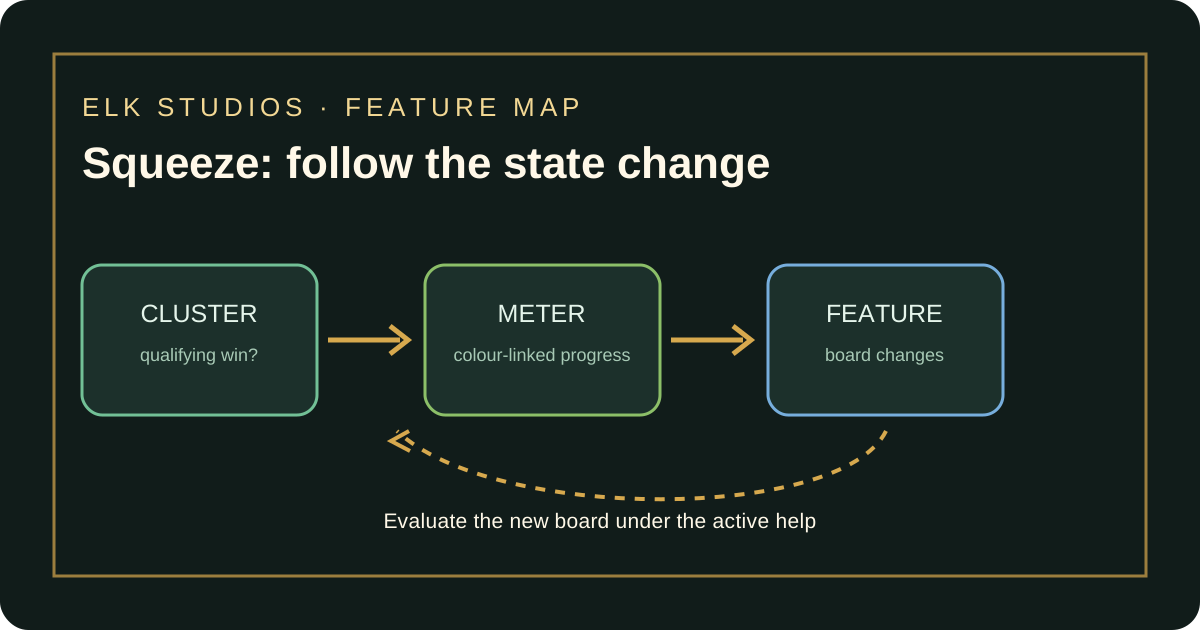
Squeeze’s supplier page says a cluster win fills the Feature Meter associated with that colour. When a meter is full, its feature is triggered once there are no more wins to resolve. A “super charged” symbol that participates in a win is described as filling its corresponding meter completely. This creates a link between the winning colour and a later board effect. It is not just a decorative progress bar.
To interpret a meter correctly, look for its label, colour, starting state and the event that fills it. Confirm whether the meter changes once per cluster, once per symbol, or by another measure; the short public overview does not provide that formula. Check whether the meter persists for one base-game sequence, carries into a bonus, or resets at a defined point. A near-full bar is not proof that the next win will trigger a feature unless the help says exactly how its remaining progress is calculated.
The supplier names several meter features: symbol swaps, symbol upgrades, big symbols and random Wilds. Each category changes the board in a different way. A swap changes the identity or positions of selected symbols; an upgrade changes a selected symbol to a higher-paying or otherwise enhanced type according to the help; a big symbol occupies more visible space; and random Wilds introduce substitution symbols. Those are useful labels, but the exact selection range and effect are not supplied in the product summary. Do not assume every meter always changes the same number or type of positions.
A feature trigger is not a feature win
The order of resolution is important. ELK says a full meter’s feature activates when there are no further wins. This suggests the game first completes the current win sequence, checks whether the meter is full, and then performs the feature. The next board may create another cluster, but that follow-up still depends on the resulting symbols and the game’s win condition. A feature animation is a state change, not evidence of a guaranteed additional payout.
When reviewing a round, write down the sequence in neutral language: “the green meter filled,” “the symbol swap occurred,” “the next evaluation found a cluster,” and “the game displayed a settlement.” That description is more precise than saying “the meter paid.” The meter changes the board; the winning combination determines whether the changed board produces a payable event. If a feature appears not to activate, check whether the meter was actually full and whether another win still needed to resolve.
Bounce Back: retained cluster and multiplier change
The supplier describes a chance that a winning cluster will bounce back. When it does, the Win Multiplier increases and the cluster remains for another win valuation. This combines two concepts: a repeated evaluation of a cluster and a changed multiplier. Do not collapse them into a single “double win” rule. The cluster must still be evaluated under the game’s rules, and the active client help must explain how a qualifying result is calculated.
There are several questions worth checking in the live rules. What exactly qualifies for a Bounce Back? Is the same cluster revalued as it stands, or can another symbol change its membership? Does the multiplier affect only the retained cluster or the whole board? When does it reset? Can a meter feature happen before or after that event? The supplier’s short description identifies the mechanic but does not give all of these boundaries. If the help is silent, report that limit rather than infer a formula from a winning clip.
On the screen, watch for the distinction between “the cluster stayed” and “the cluster won again.” A retained group might be eligible for another check but fail the payout condition after a symbol change, depending on the resolution rules. Conversely, a successful second valuation may contribute to another multiplier increase. Round history, if it lists events separately, is more useful than total balance movement alone because several features can resolve in one round.
The word “chance” also needs careful treatment. It means the event is not described as automatic for every cluster win. It does not tell us how frequent it is, whether different colours have the same chance, or how it interacts with a particular stake configuration. No probability is stated here. A single observed Bounce Back cannot establish its frequency, and a series of rounds cannot replace a verified help file or mathematical disclosure.
Reading the Bonus and Super Bonus states
ELK’s product page describes a Bonus-symbol condition for entry to the free-drop Bonus. It also says Feature Meter progress and the Win Multiplier carry into the Bonus and persist between free drops. A Super Bonus uses a Super Bonus symbol; the supplier says a Feature Meter begins full at the start of each free drop in that state. These are supplier-described conditions. The assignment requires numerical rules from current game help, which was not supplied, so the precise entry threshold and meter count are left to the active client’s own rules.
The key review distinction is between what is carried into the feature and what is retained from one free drop to the next. Meter progress and the current multiplier are named as carry-over state. The Super Bonus has an additional meter condition. Other details—how many free drops, how extra drops are awarded, when a multiplier changes, whether a meter can fill again, or which symbols remain visible—must be taken from the active help. Do not borrow those rules from another cluster game, even if it uses the same terms.
A simple feature log can have four columns: entry condition, starting state, changes during the feature, and end condition. For Squeeze, record the displayed meter progress and Win Multiplier at entry, then note which features occur during each free drop. At the end, check whether the game resets the meters and multiplier, carries anything forward, or starts the next paid round cleanly. This makes the persistence claim testable without pretending that one round reveals the game’s long-run return.
If the screen distinguishes ordinary and Super Bonus symbols, do not infer that the latter is always preferable based on its name. Its opening state is different according to the supplier’s summary, but the value of a game state depends on the full rule set and mathematical configuration. “Super” describes a feature mode, not a guarantee of a positive return. Read any separate entry option and price in the client; a naturally triggered bonus and an optional purchase are different ways of entering a state.
X-iter and optional entry modes
ELK lists X-iter as a way to select among several modes that move a player into a different starting state or change how often a feature may be encountered. A product page may describe mode types, but that does not prove that every operator makes them available. The exact menu, stake relationship, price, included state and applicable paytable are version- and jurisdiction-dependent.
If an X-iter control appears in a client, open its information panel before choosing anything. Record the menu label, what changes from the base game, whether the cost is additional to the normal stake, and how cancellation works before confirmation. Use the operator’s displayed currency, not an assumed NZD conversion or a value from another review. A feature-entry mode can spend more per round even when the underlying game board looks familiar, so decide using the total amount at risk rather than the feature name.
Do not describe a mode as a “bonus buy” unless the client itself uses that description or the rules make the equivalence clear. A mode can alter the starting meter, the chance of a trigger or the feature state in a way that is not equivalent to a direct purchase. It can also be unavailable or disabled. The public Squeeze summary is insufficient to make a New Zealand availability or price claim, and this review did not open a casino client.
RTP, volatility, payout cap and other settings
The assignment asks for verified RTP settings, but no current Squeeze game help or operator paytable was supplied. An honest review therefore cannot list an RTP figure or claim that the title has one universal setting. RTP is a long-run theoretical measure attached to a defined mathematical configuration. It is not a promise that any individual stake, short session or bonus round will return a particular amount.
When a live client does show an RTP, check that the number belongs to the exact title and current version. Distinguish the operator’s configurable game version from the supplier’s marketing copy. If more than one figure is listed, record each exactly as labelled and include the source date; do not merge variants into one range. If the client does not expose the information, state “not shown in the help checked” rather than taking a value from an unrelated casino review.
Volatility is likewise a descriptor of the distribution of results, not a forecast of an upcoming round. A third-party site may assign a low, medium or high label using its own methodology. Without an official current game-help description or transparent source for that label, it should not be presented as a verified property. The Feature Meter and Bounce Back can make individual rounds visually complex; visual activity alone does not determine volatility.
The same restraint applies to a maximum payout, stake range, feature cost, bonus frequency and any quoted return-to-player figure. These values can depend on the operator’s configuration. A supplier page may publish a potential win headline, but the assignment’s requirement is to use current game help for numerical settings. None was provided for this review. Keep the field empty until the active game’s own information panel supports it.
Mobile play and what a demo can establish
The supplier recommends a widescreen desktop ratio for its game presentation. That is a display recommendation, not proof of mobile support by every operator. A responsive client can rearrange the board, shrink the meters or move the paytable into a separate panel. If using a phone, locate the information and history controls before a round and make sure the labels remain readable at the actual screen size.
Check whether the meter colours are accompanied by text or icons, so meaning is not communicated by colour alone. See whether a large symbol or feature animation obscures the meter state, whether the screen can rotate, and whether the round result remains accessible after the animation. These are practical accessibility and usability questions. They do not tell you about the game’s probability, and this guide has not tested any device or casino app.
A demo, if a supplier or operator offers one, can help someone recognise a feature animation and find the rules menu. It cannot establish the operator’s real-money stake limits, RTP configuration, cashier terms, identity checks or New Zealand eligibility. A demo can also be regionally restricted or present a configuration different from the live game. The Evolution pages explicitly say freeplay and individual features may depend on jurisdiction; the same general caution is appropriate when interpreting a demo elsewhere.
Do not treat a supplier video as a complete replay of a game. It may select a particular feature state, omit an ordinary round or use editing. The useful questions are “what does this feature look like?” and “where is the help panel?” rather than “how often will it happen?” For the latter, use verified mathematical information, not a promotional clip or a short sample.
A repeatable review checklist
Before describing a specific version of Squeeze, capture the full title and provider name shown in the client. Open Help and Paytable and record the date, language, version identifier if present, base cluster definition, Wild rule, meter triggers, Bounce Back sequence, Bonus and Super Bonus entry conditions, payout basis and any mode menu. If a field is missing, record it as unverified.
Next, map the feature order without recording a stake. Follow one ordinary cluster and note what happens after settlement. If a meter fills, observe when the feature activates and whether the new symbols are evaluated. If a Bounce Back occurs, identify which cluster remains and what multiplier change is shown. If a bonus opens, note the starting meter and multiplier state and which pieces persist. A controlled observation can clarify interface behaviour, but it cannot establish a game probability or RTP.
For the numerical fields, copy the game help’s own words. Keep net payout and stake-return wording distinct. Check whether a displayed amount includes the original stake, whether the mode has a separate cost, and whether any cap applies to the title or a particular feature. If a figure appears only in a third-party review, mark it as unverified instead of repeating it as a current fact.
Finally, separate three statements in your notes: the supplier documents the product; the operator client displays a particular configuration; and the operator is available to a person in a given jurisdiction. Evidence for one does not prove the other two. ELK’s catalogue confirms a product page exists. It does not show that a named casino currently offers Squeeze to a New Zealand customer. No such operator access has been checked for this page.
Common review mistakes
Treating every cluster as an automatic win. The paytable defines the cluster condition, Wild substitution and evaluation. A connected-looking group may not qualify, and a feature may alter symbols before the next check.
Calling a meter a payout. The meter progresses and triggers a board effect. Any resulting payout still depends on a qualifying outcome and the settlement rules.
Assuming Bounce Back is guaranteed. The supplier describes a chance of a cluster returning. That does not make it automatic, frequent or equally likely in each configuration.
Confusing carry-over with a permanent feature. A meter or multiplier can persist through the Bonus state as the supplier says, but that does not mean it remains after the feature or between sessions.
Using an old number as current. RTP, volatility, maximum payout and feature mode costs require a dated source tied to the active client. A search snippet or foreign operator review does not supply that evidence.
Equating a demo with New Zealand access. A demo helps explain mechanics; it does not confirm that a particular operator may serve a local customer or that real-money settings are identical.
Frequently asked questions
Is Squeeze a ways-to-win or cluster slot?
ELK describes it as a cluster slot. The exact rule for adjacency and the minimum qualifying group should be checked in the active game help. Do not use a generic cluster definition from another game.
What do the Feature Meters do?
The supplier says each cluster win fills a meter for its colour and that a full meter triggers a corresponding feature after wins have resolved. It names swaps, upgrades, big symbols and random Wilds. The live help should define exact progress and selection behaviour.
Does Bounce Back pay the same cluster twice?
The supplier describes a chance that a winning cluster bounces back, increases the Win Multiplier and is retained for another valuation. The exact qualifying condition and settlement order need confirmation from the current client. “Another valuation” should not be rewritten as a guaranteed second win.
Are the Bonus and Super Bonus identical?
No. ELK’s summary describes different entry conditions and a full Feature Meter at the start of the Super Bonus drops. It also identifies carry-over of meter progress and the Win Multiplier into the Bonus. Verify the current help for the exact state and all other feature rules.
What is Squeeze’s RTP in New Zealand?
No New Zealand operator version or current Squeeze game help was supplied. This guide therefore does not state a local RTP, a list of variants or that the game is available in New Zealand. Use the exact client’s published information if access is lawful and permitted.
Can I play Squeeze on a phone or in demo mode?
That depends on the operator, device and jurisdiction. The supplier’s display recommendation does not confirm a local casino’s mobile support, while a demo does not prove access to an operator’s real-money client or settings.
Sources and date checked
- ELK Studios: Squeeze — named features and supplier description.
- ELK Studios games catalogue — supplier catalogue context.
- Online-Slot.co.uk Squeeze review — competitor coverage checked for reader questions; its operator figures are not used as New Zealand settings.
- FruitySlots Squeeze review — competitor coverage checked for feature coverage; its claims are not used to establish local access or RTP.
- SlotGods Squeeze overview — competitor coverage checked; no third-party setting is treated as current game help.
- New Zealand Department of Internal Affairs: online gambling for advertisers — current advertising context.
Sources checked 6 October 2026. No current New Zealand operator help, RTP sheet, live client, demo access or device test was supplied. Recheck the supplier page and the exact game help before a public factual update.
