ELK Studios game rules · South Island guide
Ashoka Eternal slot review: rules, wilds and bonus flow
 Best casinos available in New ZealandUpdated 7 November 2026

Ashoka Eternal is a cluster-paying ELK Studios slot built around expanding game space, charged and oversized Wilds, a global multiplier wheel, and free-drop bonus states. This guide explains how to read those systems separately and what the current game help must confirm before you rely on an RTP, volatility label, maximum win or local availability claim.
The short answer
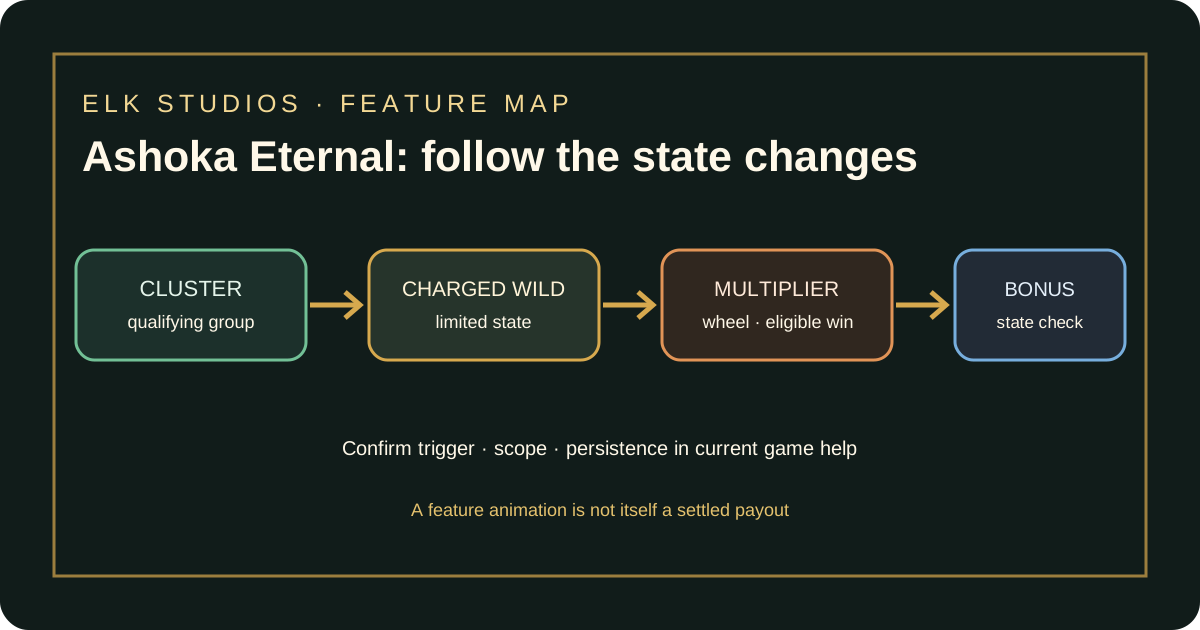
Ashoka Eternal is ELK Studios’ cluster-paying slot in which the visible grid, large symbols, charged Wilds and a global multiplier can alter how a spin develops. The ordinary question is whether matching symbols form a qualifying group under the paytable. The feature question is what changes after that result: a charged Wild may remain active for a limited sequence of wins, the multiplier wheel may add a global value, and bonus drops use their own trigger and persistence rules. Those are separate layers, even when one animated sequence shows them happening together.
The quickest useful review is therefore not a promise about how often a feature appears. It is a map of the decision points: confirm the game identity, read how clusters connect, distinguish a symbol’s size from its paying value, watch when the wheel multiplier is applied, and then check which state carries between bonus drops. ELK’s public product page confirms the broad feature names and identifies the game as live, but it does not replace the help panel in the operator’s version. No current New Zealand operator build was supplied for this review, so exact RTP, volatility, stake range and maximum-win settings are left unconfirmed.
A practical session plan can be short. Open the information button before staking, find the paytable and bonus descriptions, record the displayed configuration, and decide on a stop point that does not depend on triggering a feature. If any of those details are missing, the responsible conclusion is “not verified here,” rather than filling a gap with a number from an old review or a different casino.
Check the title before comparing it
The supplier’s exact product title is Ashoka Eternal. It is distinct from ELK’s earlier Ashoka title, even though the names, characters and general setting are related. Similar artwork is not evidence that the two games share the same grid, symbol values, multiplier behaviour or bonus triggers. A review that removes the word “Eternal” may be describing the other game or merging information from both; check the name shown in the game’s help menu and on the operator’s game details screen.
A reliable identity check uses several details together. Read the provider name, title, rules heading, and any displayed game version or jurisdiction note. If a casino directory names another studio, describes a conventional fixed-payline layout, or lists a feature not present in the supplier’s current product summary, treat that page as a lead to investigate rather than as the rulebook. Search snippets can combine unrelated titles, outdated entries and generic copy. The game’s own help and paytable are the authority for the build that is actually open.
The theme uses temple and royal imagery. That visual framing is part of a fictional slot presentation; it is not an educational account of South Asian history or a basis for a claim about cultural authenticity. For a rules review, separate scenery and character animation from the mechanics that determine a wager: the paytable, cluster definition, Wild behaviour, multiplier timing and feature trigger.
How to read the cluster grid
A cluster game evaluates matching symbols as a connected group rather than asking whether a symbol appears along one of a fixed set of drawn lines. The exact connection rule belongs to the paytable. Some games connect horizontally and vertically, while others define additional adjacency; do not assume that a diagonal touch counts merely because the symbols appear close on the screen. The help should show the qualifying shape or state the connection rule directly.
Start with one ordinary symbol and follow the board in a deliberate order. Find all matching positions, identify which positions are connected under the game’s rule, and then compare the group with the symbol table. Only after the game has confirmed a paying cluster should you interpret an animation as a win. A screen that flashes, expands or highlights a symbol may signal a feature action without changing the settled award by itself.
Large symbols affect the space they occupy, but their footprint is not the same thing as a multiplier. A symbol displayed across several cells may count according to the paytable’s definition of that large symbol; it does not automatically equal several separate symbols, several separate wins or a larger prize. Check whether it substitutes, pays as its own symbol, occupies multiple evaluation positions or interacts with the expanding grid. If the rules do not say how the larger image is counted, do not reverse-engineer a payout from a screenshot.
The expanding game grid is another distinct mechanic. Expansion changes the available play area, and therefore may create additional positions that can participate in later evaluations. It does not mean every new position is immediately a win, nor does it guarantee a cluster. Read whether expansion is triggered by a specific feature, whether the expanded space persists through the rest of the round, and whether it resets when the next base spin begins. Those questions affect the state you should track, not just the appearance of the board.
Separate the symbol roles
A standard paying symbol contributes to cluster evaluation. A Wild substitutes for eligible symbols, if the paytable says so. A Big Symbol changes the displayed footprint. A Big Wild combines a large footprint with Wild behaviour, but the exact interaction still needs its own description. A Charged Wild adds a state that may remain relevant over multiple wins. Treating all of these as “a bigger Wild” loses the rules that tell you when the effect starts and when it stops.
The best way to check a Wild is to ask four questions. Which symbols may it replace? Can it itself form or pay as a cluster? Does it occupy one evaluation position or a larger area? Does a special version behave differently from an ordinary Wild? An answer to one question does not answer the others. For example, the supplier says that a Big Wild substitutes for paying symbols, but the live paytable remains the place to confirm exact coverage and award evaluation.
A charged state deserves a simple note after each event: which Wild became charged, what triggered that state, whether the charge applies before or after the current win is evaluated, and what ends it. The product description says a Charged Wild can appear in different sizes and last for a limited run of wins. That is a feature summary, not enough to settle every edge case. Check whether the charge survives a no-win drop, a new spin, a grid expansion, or entry into a bonus round. If the help does not specify one of those transitions, mark it as unresolved rather than inventing a reset rule.
The multiplier wheel and settlement order
The wheel adds a global multiplier when it stops in its activating position, according to ELK’s description. “Global” tells you that the value is not simply printed on one symbol; it may apply across a broader qualifying result. It does not, by itself, tell you which wins are eligible, when the multiplier is checked, whether it persists, or whether a displayed wheel movement has reached the activating state.
Read the rule as a sequence. First identify the trigger that causes the wheel to act. Then see how the game marks a successful activation. Next confirm which award is being multiplied: a cluster that triggered the wheel, a later drop, a bonus result, or some defined subset. Finally check whether the resulting total is capped by the game’s payout rules. A multiplier animation can appear between these steps; the animation alone is not a complete settlement explanation.
The supplier says the global multiplier carries between free drops in the bonus. That is a useful persistence clue. It means the bonus is not necessarily a series of completely independent drops: a state created earlier may alter a later evaluation. To verify it, compare the multiplier shown before the first bonus drop, after an activating event and before the next drop. If the display changes, record the value and the rule that caused the change; do not infer a probability or expected return from one observed session.
A clear example of the bookkeeping is a fictional sequence: a qualifying cluster resolves, a wheel event activates, and the game shows a multiplier state for the next eligible result. The next cluster is then evaluated under whatever scope the help defines. The example illustrates the order only; it does not claim that this sequence is guaranteed, common or available in every operator configuration. Keeping triggers, state changes and payouts in separate notes avoids calling every flash a win.
Bonus and Super Bonus states
ELK describes a free-drop bonus triggered by active bonus symbols on the main grid. Additional active bonus symbols can add drops, while a Super Bonus condition depends on the presence of the special Super Bonus symbol among the trigger symbols. The supplier also describes a difference in the Super Bonus’s chance to activate the global multiplier. “More chance” is not a numerical probability, a promise of activation or an estimate of how frequently the feature appears.
When the bonus starts, check the entry state rather than relying on a generic phrase such as “free spins.” The relevant state may include the grid, charged Wilds, global multiplier and remaining drops. The help should state which of those items carries into the bonus and which is reset. It should also explain what happens if additional bonus symbols land during the feature and how the game signals a transition into the Super Bonus.
Free drops and ordinary spins can have different evaluation order. A feature symbol may appear after a winning cluster clears space, and the next drop may form another cluster before the game ends the chain. Track each step: identify the cleared symbols, see what enters the board, apply the cluster rule, and then check whether the wheel or Wild state changed. That method is more accurate than summarising the entire sequence as one “bonus win.”
Do not treat an added drop as an added cash amount. A drop is another opportunity for the game’s rules to evaluate symbols; its result can still be no win. A persistent multiplier also does not make a result payable unless an eligible win occurs. For a fair description, say what state was retained, what event occurred and what amount the paytable settled. Avoid describing the bonus as “due” after a dry sequence: each trigger remains governed by the game’s random model.
What X-iter changes, and what it does not tell you
ELK lists X-iter as a way to enter selected feature scenarios directly. The supplier’s page describes several modes, including options that alter the path to a feature or begin a bonus-style state. The actual menu and available modes can vary by jurisdiction and operator. Review the screen shown in the current client, the cost displayed before confirmation, and the rules shown for that mode. Do not copy a mode cost from a different market or assume a menu item is enabled in New Zealand.
A feature-entry purchase is a different decision from a regular spin. It changes what the next paid action buys, but it does not change uncertainty into a guaranteed profit. Before selecting one, read the stated price, whether the charge is deducted immediately, which state it starts, any RTP information for the mode, and the settlement limit. If the interface does not show a term clearly, cancel and look for a written help screen rather than relying on a review’s recollection.
A useful comparison is to ask what evidence each option provides. A normal spin has the cost shown in the stake controls and begins the ordinary game loop. A direct feature mode names a selected route and presents a price or purchase confirmation. Neither label explains the long-term return by itself. RTP, volatility and payout ceiling are separate properties, so one should not be used as shorthand for another.
The purchased route may also have its own mathematical configuration. A third-party review that says “same RTP” is not proof that the current casino’s version uses the same setting. The operator’s help should identify the applicable value for the current game and mode; if it does not, the value remains unknown for this guide. This distinction is particularly important where older pages compare a standard game with feature-entry options.
RTP, volatility and maximum win: what can be verified
RTP is a theoretical long-run measure of the portion of wagered value returned by a particular game configuration over a very large sample. It is not the expected cash result of an individual session, a forecast for the next spin, or a refund percentage. A published value applies only to the version and ruleset it describes. If a casino offers a different configuration, the relevant value is the one shown in that casino’s current help or game information panel.
Volatility describes the distribution and variability of results, not whether the next spin will win. A label such as “high” is not a specific promise about dry stretches, feature timing or the size of a future award. If ELK or the operator provides a defined scale, quote the scale and its source; if the client only uses a word, report that word without turning it into a forecast. Do not claim to have tested a mathematical model when no game session or approved data set was available.
A maximum-win figure, when disclosed, is a ceiling under stated rules rather than a likely result. The figure may be expressed relative to stake, but the exact value and whether it applies to base play, a bonus or an X-iter mode must be verified in the relevant help. This guide deliberately does not repeat a promotional ceiling as an operator-confirmed setting. The current New Zealand operator help and paytable were not provided for this review.
If you are checking a displayed RTP, save the exact title, operator, jurisdiction, mode, help text and date. A screenshot should show enough context to identify the product, not just a number. If two reputable pages disagree, prefer neither by reputation alone; look for the current operator panel or a current provider data sheet tied to the exact game build. Historical reviews may remain useful for feature vocabulary, while their numerical claims can age or refer to another market.
Mobile, controls and demo access
The supplier recommends a desktop aspect ratio for its product page, but that recommendation is not proof of a particular casino’s mobile support. On a phone, the useful checks are whether the board remains readable, the information screen can be opened without losing the round, stake controls remain distinct from spin controls, and the feature explanation can be read without magnifying an image. A layout that technically fits the screen can still make a symbol count or bonus notice hard to understand.
Rotate the device only if the operator permits it and the interface preserves the displayed game state. Before continuing after an interruption, check whether the client restored the same round, whether the last action settled and whether the balance screen agrees with the game history. A reconnect is not a new feature trigger, and a paused animation should not be interpreted as a separate paid action. Use the operator’s support record for unresolved transactions.
Demo availability is not guaranteed by a supplier’s product page. Some operators display practice play, some limit it by region, and some provide no demo at all. If a play-money mode is offered, verify that the screen clearly labels it and that it uses the same ruleset you want to study. A demo can help you locate the paytable and observe the interface; a short sample cannot establish RTP or feature frequency.
A demo also should not be used as a simulation of likely real-money outcomes. The interface may be identical while the account type, balance display or enabled game settings differ. The right conclusion is narrow: a practice mode may teach where controls are and how the client explains features. It cannot demonstrate that a particular casino offers the game to a New Zealand resident, nor prove the version’s mathematical configuration.
A careful review checklist
Before writing down a rule, capture the exact wording and ask what part of the game it governs. “Charged Wild lasts for wins” describes a persistence condition but may not say which wins consume the charge. “Multiplier activates” identifies an event but not the exact set of prizes that it affects. “Bonus symbols add drops” describes a count change but not whether the added drops begin immediately or after the current evaluation. The missing clause matters.
Use a simple evidence table with separate rows for: title and supplier; cluster definition; symbol substitution; large-symbol footprint; charged-state start and end; grid expansion; wheel trigger and scope; bonus entry; state persistence; RTP and variant; volatility; payout ceiling; mobile support; demo access; New Zealand availability. For each row, write the source and version, then use “not shown” when necessary. Avoid copying one number into several rows because a third-party table groups facts together.
A second reviewer should be able to reproduce your reading without playing a long session. Point them to the information screen, section heading and exact label. If the help uses a term but does not define it, explain the ambiguity in plain language and leave the unresolved part open. This is better editorial practice than offering a confident but unsupported interpretation.
Keep observed outcomes separate from rules. If a demo round displayed a charged Wild, describe the event as an observation and note that one session does not prove probability. If the help says how the state works, cite that as a rule. If a provider page summarises the feature, call it a supplier description. Each source supports a different kind of statement.
New Zealand context and responsible play
This page is written for the site’s New Zealand audience, but that does not establish that Ashoka Eternal is offered by any operator to someone in New Zealand. Confirm the operator, account terms, territorial availability and current game list directly before treating access as available. A supplier’s catalogue can establish that the supplier lists a title; it does not establish a local casino offer or authorise a marketing claim about availability.
The Department of Internal Affairs says online casino gambling advertising is prohibited in New Zealand and that affiliate marketing is among the initial prohibited advertising decisions. The site’s existing advertising notice is therefore retained and this guide does not add a casino sign-up, affiliate or direct-play button. This implementation is not legal advice; publication or any promotional placement needs qualified review of the current rules. An informational article should not encourage a reader to treat gambling as income or a way to recover losses.
If you choose to engage with gambling where it is legally available, decide in advance what you can afford to lose and how long you will spend. Stop when either limit is reached. Do not raise a limit to chase a result, use borrowed money, or continue because a multiplier or bonus animation suggests the game is “warming up.” Random game states do not remember a previous loss. If gambling is causing stress or affecting household costs, take a break and use independent support rather than opening another session.
Questions readers ask
Is Ashoka Eternal a paylines slot?
ELK describes it as a cluster-paying game. That means the qualifying result is based on a connected group under the game’s own rules, rather than a fixed set of line drawings. The current paytable still needs to define which positions count as connected, whether all symbol groups qualify and how any Wild participates. Do not apply rules from the original Ashoka title.
Does a Big Wild automatically pay more?
Not necessarily. Its size describes the area or appearance, while its paying behaviour is defined separately. Check whether the Wild substitutes, whether it has a paytable value, how a large symbol occupies the grid, and how an associated cluster is evaluated. The animation alone does not establish an award.
Does the wheel multiplier apply to every win?
The supplier calls it global and describes its activation, but the current game help must state which outcomes are eligible and at what point the multiplier is applied. The help should also explain whether the multiplier persists into later drops or bonus states. If those details are not shown, the exact scope is unverified.
Is the global multiplier retained in the bonus?
ELK’s public description says the multiplier persists between free drops. Confirm that statement in the operator’s current help and check what happens on bonus entry, on a new base spin and when a feature ends. Persistence between drops does not itself guarantee a win or specify how a payout is calculated.
What is the game’s RTP in New Zealand?
No current New Zealand operator configuration or help panel was supplied. The right answer for this page is that a local RTP value has not been verified. Values in older reviews or another operator’s page may refer to a different version. Use the number shown in the current game information panel for the exact casino and mode.
Can I try a demo before deciding?
Only if the operator or authorised provider actually presents a demo to you. Check that the client labels practice play and that the title and rules match the game you intend to review. A demo can help you understand controls, but a short sample cannot verify RTP, feature frequency or New Zealand availability.
Is the game available to New Zealand players?
This guide does not verify access at a New Zealand operator. Check the operator’s current game list, eligibility terms and applicable local requirements. ELK’s supplier catalogue is not an operator availability directory.
What should I record if the rules are unclear?
Record the exact title, provider, help heading, game version if shown, operator and date. Describe what the screen visibly did without inferring why it happened. If the missing rule affects a wager, pause and contact the operator rather than using a rule from a similar game.
Sources and verification boundary
- ELK Studios, Ashoka Eternal product page and game catalogue, checked 7 October 2026. Used for title identity, feature names and supplier-level rule summary; not for a New Zealand operator configuration.
- Competing pages reviewed on 7 October 2026: SlotsData, Online-Slot, SlotCatalog, AboutSlots, and Casinos.com. Their numerical settings and testing claims were not treated as universal rules.
- Search also surfaced a page that attributes Ashoka Eternal to another provider and describes a conventional line slot. That conflicts with ELK’s official product page; it was excluded as a factual source rather than copied.
- New Zealand advertising context: Department of Internal Affairs advertiser guidance, checked 7 October 2026.
